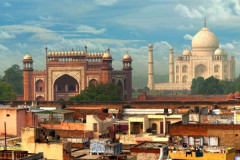
Uttar Pradesh
Description
Uttar Pradesh , abbreviated as UP, is the most populous state in the Republic of India as well as the most populous country subdivision in the world. It was created on 1 April 1937 as the United Provinces during British rule, and was renamed Uttar Pradesh in 1950. Lucknow is the capital city of Uttar Pradesh. Ghaziabad, Bulandshahr, Kanpur, Gorakhpur, Allahabad, Raebareli, Moradabad, Bareilly, Aligarh, Sonbhadra, and Varanasi are known for their industrial importance in the state. On 9 November 2000, a new state, Uttarakhand, was carved out from the Himalayan hill region of Uttar Pradesh. The state in the northern region of the Indian subcontinent has over 200 million inhabitants.
The state is bordered by Rajasthan to the west, Haryana, Himachal Pradesh and Delhi to the northwest, Uttarakhand and Nepal to the north, Bihar to the east, Madhya Pradesh to the south and touches the states of Jharkhand and Chhattisgarh to the southeast. It covers 243,290 square kilometres (93,933 sq mi), equal to 6.88% of the total area of India, and is the fourth largest Indian state by area. Hindi is the official and most widely spoken language in its 75 districts. Uttar Pradesh is the third largest Indian state by economy, with a GDP of ₹9,763 billion (US$150 billion). Agriculture and service industries are the largest parts of the state's economy. The service sector comprises travel and tourism, hotel industry, real estate, insurance and financial consultancies.
Uttar Pradesh was home to powerful empires of ancient and medieval India. The two major rivers of the state, the Ganges and Yamuna, join at Allahabad and then flow as the Ganges further east. The state has several historical, natural, and religious tourist destinations, such as, Agra, Varanasi, Piprahwa, Raebareli, Kaushambi, Ballia, Shravasti, Gorakhpur, Chauri Chaura situated in Gorakhpur, Kushinagar, Lucknow, Jhansi, Allahabad, Budaun, Meerut, Mathura, Jaunpur, Muzaffarnagar and Shahjahanpur.
History
Prehistory
Modern human hunter-gatherers have been in Uttar Pradesh since between around 85,000 and 72,000 years ago. There have also been prehistorical finds in Uttar Pradesh from the Middle and Upper Paleolithic dated to 21,000–31,000 years old and Mesolithic/Microlithic hunter-gatherer's settlement, near Pratapgarh, from around 10550–9550 BC. Villages with domesticated cattle, sheep, and goats and evidence of agriculture began as early as 6000 BC, and gradually developed between c. 4000 and 1500 BC beginning with the Indus Valley Civilisation and Harappa Culture to the Vedic period and extending into the Iron Age.
Ancient and Classical period
The kingdom of Kosala, in the Mahajanapada era, was located within the regional boundaries of modern-day Uttar Pradesh. According to Hindu legend, the divine king Rama of the Ramayana epic reigned in Ayodhya, the capital of Kosala. Krishna, another divine king of Hindu legend, who plays a key role in the Mahabharata epic and is revered as the eighth reincarnation (Avatar) of the Hindu god Vishnu, is said to have been born in the city of Mathura, in Uttar Pradesh. The aftermath of the Mahabharata yuddh is believed to have taken place in the area between the Upper Doab and Delhi, (in what was Kuru Mahajanapada), during the reign of the Pandava king Yudhishthira. The kingdom of the Kurus corresponds to the Black and Red Ware and Painted Gray Ware culture and the beginning of the Iron Age in North-west India, around 1000 BC.
Most of the invaders of south India passed through the Gangetic plains of what is today Uttar Pradesh. Control over this region was of vital importance to the power and stability of all of India's major empires, including the Maurya (320–200 BC), Kushan (AD 100–250), Gupta (350–600), and Gurjara-Pratihara (650–1036) empires. Following the Huns invasions that broke the Gupta empire, the Ganges-Yamuna Doab saw the rise of Kannauj. During the reign of Harshavardhana (590–647), the Kannauj empire reached its zenith. It spanned from Punjab in the north and Gujarat in the west to Bengal in the east and Odisha in the south. It included parts of central India, north of the Narmada River and it encompassed the entire Indo-Gangetic plain. Many communities in various parts of India claim descent from the migrants of Kannauj. Soon after Harshavardhana's death, his empire disintegrated into many kingdoms, which were invaded and ruled by the Gurjara-Pratihara empire, which challenged Bengal's Pala Empire for control of the region. Kannauj was several times invaded by the south Indian Rashtrakuta Dynasty from the 8th century to the 10th century.
Medieval and Early Modern period
In the 16th century, Babur, a Timurid descendant of Timur and Genghis Khan from Fergana Valley (modern-day Uzbekistan), swept across the Khyber Pass and founded the Mughal Empire, covering India, along with modern-day Afghanistan, Pakistan and Bangladesh The Mughals were descended from Persianised Central Asian Turks (with significant Mongol admixture). In the Mughal era, Uttar Pradesh became the heartland of the empire. Mughal emperors Babur and Humayun ruled from Delhi. In 1540 an Afghan, Sher Shah Suri, took over the reins of Uttar Pradesh after defeating the Mughal king Humanyun. Sher Shah and his son Islam Shah ruled Uttar Pradesh from their capital at Gwalior. After the death of Islam Shah Suri, his prime minister Hemu became the de facto ruler of Uttar Pradesh, Bihar, Madhya Pradesh, and the western parts of Bengal. He was bestowed the title of Hemchandra Vikramaditya (title of Vikramāditya adopted from vedic times) at his formal coronation took place at Purana Quila in Delhi on 7 October 1556. Hemu died in the Second Battle of Panipat, and Uttar Pradesh came under Emperor Akbar's rule. Akbar ruled from Agra and Fatehpur Sikri. In the 18th century, after the fall of Mughal authority, the power vacuum was filled by the Maratha Empire, in the mid 18th century, the Maratha army invaded the Uttar Pradesh region, which resulted in Rohillas losing control of Rohillkhand to the Maratha rulers Raghunath Rao and Malharao Holkar. The conflict between Rohillas and Marathas came to an end on 18 December 1788 with the arrest of Ghulam Qadir, the grandson of Najeeb-ud-Daula, who was defeated by the Maratha general Mahadaji Scindia. In 1803, following the Second Anglo-Maratha War, when the British East India Company defeated the Maratha Empire, much of the region came under British suzerainty.
British India-eraStarting from Bengal in the second half of the 18th century, a series of battles for north Indian lands finally gave the British East India Company accession over the state's territories. Ajmer and Jaipur kingdoms were also included in this northern territory, which was named the "North-Western Provinces" (of Agra). Although UP later became the fifth largest state of India, NWPA was one of the smallest states of the British Indian empire. Its capital shifted twice between Agra and Allahabad.
Due to dissatisfaction with British rule, a serious rebellion erupted in various parts of North India; Bengal regiment's sepoy stationed at Meerut cantonment, Mangal Pandey, is widely credited as its starting point. It came to be known as the Indian Rebellion of 1857. After the revolt failed, the British attempted to divide the most rebellious regions by reorganising the administrative boundaries of the region, splitting the Delhi region from 'NWFP of Agra' and merging it with Punjab, while the Ajmer- Marwar region was merged with Rajputana and Oudh was incorporated into the state. The new state was called the 'North Western Provinces of Agra and Oudh', which in 1902 was renamed as the United Provinces of Agra and Oudh. It was commonly referred to as the United Provinces or its acronym UP.
In 1920, the capital of the province was shifted from Allahabad to Lucknow. The high court continued to be at Allahabad, but a bench was established at Lucknow. Allahabad continues to be an important administrative base of today's Uttar Pradesh and has several administrative headquarters. Uttar Pradesh continued to be central to Indian politics and was especially important in modern Indian history as a hotbed of the Indian independence movement. Uttar Pradesh hosted modern educational institutions such as the Benaras Hindu University, Aligarh Muslim University and the Darul Uloom Deoband. Nationally known figures such as Chandra Shekhar Azad were among the leaders of the movement in Uttar Pradesh, and Motilal Nehru, Jawaharlal Nehru, Madan Mohan Malaviya and Gobind Ballabh Pant were important national leaders of the Indian National Congress. The All India Kisan Sabha (AIKS) was formed at the Lucknow session of the Congress on 11 April 1936, with the famous nationalist Swami Sahajanand Saraswati elected as its first President, in order to address the longstanding grievances of the peasantry and mobilise them against the zamindari landlords attacks on their occupancy rights, thus sparking the Farmers movements in India. During the Quit India Movement of 1942, Ballia district overthrew the colonial authority and installed an independent administration under Chittu Pandey. Ballia became known as "Baghi Ballia" (Rebel Ballia) for this significant role in India's independence movement.
Post-independenceAfter India's independence, the United Provinces were renamed "Uttar Pradesh" in 1950, preserving UP as the acronym. The state has provided seven of India's prime ministers and is the source of the largest number of seats in the Lok Sabha. Despite its political influence, its poor record in economic development and administration, organised crime and corruption have kept it amongst India's backward states. The state has been affected by repeated episodes of caste and communal violence. In December, 1992 the Babri Mosque in Ayodhya was demolished by radical activists, leading to widespread violence across India. In 1999, northern districts of the state were separated to form the state of Uttarakhand.
Geography
Uttar Pradesh, with a total area of 243,290 square kilometres (93,935 sq mi), is India’s fourth largest state in terms of land area. It is situated on the northern spout of India and shares an international boundary with Nepal. The Himalayas border the state on the north, but the plains that cover most of the state are distinctly different from those high mountains. The larger Gangetic Plain region is in the north; it includes the Ganges-Yamuna Doab, the Ghaghra plains, the Ganges plains and the Terai. The smaller Vindhya Range and plateau region is in the south. It is characterised by hard rock strata and a varied topography of hills, plains, valleys and plateaus. The Bhabhar tract gives place to the terai area which is covered with tall elephant grass and thick forests interspersed with marshes and swamps. The sluggish rivers of the bhabhar deepen in this area, their course running through a tangled mass of thick undergrowth. The terai runs parallel to the bhabhar in a thin strip. The entire alluvial plain is divided into three sub-regions. The first in the eastern tract consisting of 14 districts which are subject to periodical floods and droughts and have been classified as scarcity areas. These districts have the highest density of population which gives the lowest per capita land. The other two regions, the central and the western are comparatively better with a well-developed irrigation system. They suffer from waterlogging and large-scale user tracts. In addition, the area is fairly arid. The state has more than 32 large and small rivers; of them, the Ganges, Yamuna, Saraswati, Sarayu, Betwa, and Ghaghara are larger and of religious importance in Hinduism.
Cultivation is intensive. The valley areas have fertile and rich soil. There is intensive cultivation on terraced hill slopes, but irrigation facilities are deficient. The Siwalik Range which forms the southern foothills of the Himalayas, slopes down into a boulder bed called 'bhadhar'. The transitional belt running along the entire length of the state is called the terai and bhabhar area. It has rich forests, cutting across it are innumerable streams which swell into raging torrents during the monsoon.
Flora and Fauna
State symbols of Uttar Pradesh State animal Swamp deer State bird Sarus crane State tree Ashoka State flower Palash State dance Kathak State sport Field hockey View of the Terai region Gharial (Gavialis gangeticus) is found in the Ganges riverThe state has an abundance of natural resources. In 2011 the recorded forest area in the state was 16,583 km2 (6,403 sq mi) which is about 6.88% of the state's geographical area. In spite of rapid deforestation and poaching of wildlife, a diverse flora and fauna continue to exist in the state. Several species of trees, large and small mammals, reptiles, and insects are found in the belt of temperate upper mountainous forests. Medicinal plants are found in the wild and are also grown in plantations. The Terai-Duar savanna and grasslands support cattle. Moist deciduous trees grow in the upper Gangetic plain, especially along its riverbanks. This plain supports a wide variety of plants and animals. The Ganges and its tributaries are the habitat of large and small reptiles, amphibians, fresh-water fish, and crabs. Scrubland trees such as the babool and animals such as the chinkara are found in the arid Vindhyas.
Tropical dry deciduous forests are found in all parts of the plains. Since much sunlight reaches the ground, shrubs and grasses are also abundant. Large tracts of these forests have been cleared for cultivation. Tropical thorny forests, consisting of widely scattered thorny trees, mainly babool are mostly found in the southwestern parts of the state. These forests are confined to areas which have low annual rainfall (50–70 cm), a mean annual temperature of 25-27 °C and low humidity.
Uttar Pradesh is known for its extensive avifauna. The most common birds which are found in the state are doves, peafowl, junglefowl, black partridges, house sparrows, songbirds, blue jays, parakeets, quails, bulbuls, comb ducks, kingfishers, woodpeckers, snipes, and parrots. Bird sanctuaries in the state include Bakhira Sanctuary, National Chambal Sanctuary, Chandra Prabha Sanctuary, Hastinapur Sanctuary, Kaimoor Sanctuary, and Okhla Sanctuary.
Other animals in the state include reptiles such as lizards, cobras, kraits, and gharials. Among the wide variety of fishes, the most common ones are mahaseer and trout. Some animal species in Uttar Pradesh have gone extinct in recent years, while others, like the lion from the Gangetic Plain and the rhinoceros from the Terai region, have become endangered. Many species are vulnerable to poaching despite regulation by the government.
Transportation
Further information: List of state highways in Uttar Pradesh, List of airports in Uttar Pradesh, and Uttar Pradesh State Road Transport CorporationThe state has the largest railway network in the country and the sixth highest railway density. As of 2011, there were 8,546 km (5,310 mi) of rail in the state. Allahabad is the headquarters of the North Central Railway and Gorakhpur is the headquarters of the North Eastern Railway. Other than Zonal Headquarters of Allahabad and Gorakhpur, Lucknow and Moradabad serve as divisional Headquarters of the Northern Railway Division. Lucknow Swarna Shatabdi Express, the second fastest shatabdi train, connects the Indian capital of New Delhi to Lucknow. This was the first train in India to get the new German LHB coaches. The railway stations of Lucknow NR, Kanpur Central, Varanasi Junction, Agra Cantt, Gorakhpur and Mathura Junction were included in the Indian Railways list of 50 world-class railway stations.
The state has a large, multimodal transportation system with the largest road network in the country. The state is well connected to its nine neighbouring states and almost all other parts of India through the national highways (NH). It boasts 42 national highways, with a total length of 4,942 km (9.6% of the total NH length in India). The Uttar Pradesh State Road Transport Corporation was established in 1972 to provide economical, reliable, and comfortable transportation in the state with connecting services to adjoining states and boasts as being the only State Transport Corporation that runs in profit in the entire nation. All cities are connected to state highways, and all district headquarters are being connected with four lane roads which carry traffic between major centres within the state. One of them is Agra Lucknow Expressway, which is a 302 km (188 mi) controlled-access highway being constructed by Uttar Pradesh Expressways Industrial Development Authority (UPEIDA) to reduce vehicular traffic in already congested roads. This expressway is country’s largest Greenfield Expressway which would cut the travel time between Lucknow and Agra from 6 hours to 3.30 hours. Other district roads and village roads provide villages accessibility to meet their social needs as also the means to transport agriculture produce from village to nearby markets. Major district roads provide a secondary function of linking between main roads and rural roads. Uttar Pradesh has the highest road density in India, (1,027 km per 1000 km2) and the largest surfaced urban-road network in the country (50,721 km).
The state has excellent civil aviation infrastructure with Chaudhary Charan Singh International Airport in Lucknow and Lal Bahadur Shastri International Airport in Varanasi, providing international service. and four domestic airports located at Agra, Allahabad, Gorakhpur and Kanpur. The Lucknow Airport is the second busiest airport in North India after the Indira Gandhi International Airport, New Delhi. The state has also proposed creating the Taj International Airport at Kurikupa near Hirangaon, Tundla in Firozabad district. An international Airport is also proposed at Kushinagar.
The Lucknow Metro is being constructed in the city of Lucknow as an alternative mode of transport. The capital city is witnessing a swift rise in the number of immigrants and this has called for the transformation of Public modes of transport.
Tourism
Uttar Pradesh ranks first in domestic tourist arrivals with more than 71 million, owing to its rich and varied topography, vibrant culture, festivals, monuments, ancient places of worship, and viharas. Millions gather at Allahabad to take part in the Magh Mela festival on the banks of the Ganges. This festival is organised on a larger scale every 12th year and is called the Kumbha Mela, where over 10 million Hindu pilgrims congregate in one of the largest gatherings of people in the world.
The historically important towns of Sarnath and Kushinagar is near to gorakhpur and are located not far from Varanasi. Gautama Buddha gave his first sermon after his enlightenment at Sarnath and died at Kushinagar; both are important pilgrimage sites for Buddhists. Also at Sarnath are the Pillars of Ashoka and the Lion Capital of Ashoka, both important archaeological artefacts with national significance. At a distance of 80 km from Varanasi, Ghazipur is famous not only for its Ghats on the Ganges but also for the tomb of Lord Cornwallis, the 18th century Governor of East India Company ruled Bengal Presidency. The tomb is maintained by the Archaeological Survey of India. The state also has a bird sanctuary in Etah district called Patna Bird Sanctuary.
Lucknow, the capital of the state, has several beautiful historical monuments. It has also preserved the damaged complex of the Oudh-period British Resident's quarters, which are being restored. Uttar Pradesh gives access to three World Heritage Sites: the Taj Mahal, Agra Fort, and the nearby Fatehpur Sikri. Varanasi is an ancient city famous for its ghats. To promote tourism, the Directorate of Tourism was established in the 1972 with a Director General who is an I.A.S. officer. In 1974 the Uttar Pradesh State Tourism Development Corporation was established to look after the commercial tourist activities.
Culture
Language and literature
Several texts and hymns of the Vedic literature were composed in Uttar Pradesh. The festival of Guru Purnima is dedicated to Sage Vyasa, and also known as Vyasa Purnima as it is the day which is believed to be his birthday and also the day he divided the Vedas. There is a long literary and folk Hindi language tradition in the state. In the 19th and 20th century, Hindi literature was modernised by authors such as Jaishankar Prasad, Maithili Sharan Gupt, Munshi Premchand, Suryakant Tripathi Nirala, Babu Gulabrai, Sachchidananda Hirananda Vatsyayan 'Agyeya', Rahul Sankrityayan, Harivansh Rai Bachchan, Dharamvir Bharati, Subhadra Kumari Chauhan, Mahavir Prasad Dwivedi, Swami Sahajanand Saraswati, Dushyant Kumar, Hazari Prasad Dwivedi, Acharya Kuber Nath Rai, Bharatendu Harishchandra, Kamleshwar Prasad Saxena, Shivmangal Singh Suman, Mahadevi Varma, and Vibhuti Narain Rai.
The state is sometimes called the 'Hindi heartland of India'. Hindi became the language of state administration with the Uttar Pradesh Official Language Act of 1951. A 1989 amendment to the act added Urdu as another native language of the state. Linguistically, the state spreads across the Central, East-Central, and Eastern zones of the Indo-Aryan languages, the major native languages of the state being Awadhi, Bhojpuri, Bundeli, Braj Bhasha, Kannauji and the vernacular form of Khariboli.
Music and dance
Uttar Pradesh has produced musicians, including Anup Jalota, Girija Devi, Gopal Shankar Misra, Hari Prasad Chaurasia, Kishan Maharaj, Vikash Maharaj Naushad Ali, Ravi Shankar, Shubha Mudgal, Siddheshwari Devi, Talat Mehmood, and Ustad Bismillah Khan. The Ghazal singer Begum Akhtar was a native of Uttar Pradesh. The region's folk heritage includes songs called rasiya (especially popular in Braj), which celebrate the divine love of Radha and Krishna. Other forms of music are kajari, sohar, qawwali, rasiya, thumri, birha, chaiti, and sawani. Traditional dance and musical styles are taught at the Bhatkhande Music Institute University in Lucknow, named after the musician Pandit Vishnu Narayan Bhatkhande.
Kathak, a classical dance form, owes its origin to the state of Uttar Pradesh. The dance form is connected to classical Hindustani music where the rhythmic nimbleness of the feet is accompanied by the Tabla or Pakhawaj. Four of the six schools of this dance form, Lucknow gharana, Ajrara gharana, Farukhabad gharana and Benares gharana, are situated in Uttar Pradesh.
Fairs and festivals
Diwali (celebrated between mid-October and mid-December) and Rama Navami are popular festivals in Uttar Pradesh. Kumbh Mela, organised in the month of Maagha (Feb-March), is a major festival held every twelve years in rotation at Allahabad, Haridwar, Ujjain, on the river Ganges and Nasik on the Godavari river. Lath mar Holi is a local celebration of the Hindu festival of Holi. It takes place well before the actual Holi in the town of Barsana near Mathura. Taj Mahotsav, held annually at Agra, is a colourful display of the culture of the Braj area. Buddha Purnima, which marks the birth of Gautama Buddha, is a major Hindu and Buddhist festival, while Christmas is celebrated by the minority Christian population. Other festivals are Eid-ul-Fitr, Eid-ul-Adhaa/Bakreed, Vijayadashami, Makar Sankranti, Vasant Panchami, Ayudha Puja, Ganga Mahotsava, Janmashtami, Sardhana Christian Fair, Maha Shivaratri, Mahavir Jayanti, Bārah Wafāṭ, Chhath puja, Lucknow Mahotsav, Moharram, Kabob and Hanuman Jayanti.
Cuisine
A typical day-to-day traditional vegetarian meal of Uttar Pradesh, like any other North Indian thali, consists of roti (flatbread), chawal, dal, sabji, raita and papad. Many people still drink the traditional drink chaach (traditional Butter milk) with meals. On festive occasions, usually 'tava' (flat pan for roti) is considered inauspicious, and instead fried foods are consumed. A typical festive thali consists of Puri, Kachauri, sabji, pulav, papad, raita, salad and desserts (such as sewai or Kheer).
Many communities have their own particular style of cuisines, such as the Jains, Kayasths and Muslims. There are also certain sub-regional delicacies. Awadhi cuisine is world-famous for dishes such as kebab, biryani, keema and nihari. Sweets occupy an important place in the Hindu diet and are eaten at social ceremonies. People make distinctive sweetmeats from milk products, including khurchan, peda, gulabjamun, petha, makkhan malai, and chamcham. The chaat in Lucknow and Banarasi Paan is known across India for its flavour and ingredients.
Awadhi cuisine is from the city of Lucknow. The cuisine consists of both vegetarian and non-vegetarian dishes. Awadh has been greatly influenced by Mughal cooking techniques, and the cuisine of Lucknow bears similarities to those of Central Asia, Kashmir, Punjab and Hyderabad; and the city is known for Nawabi foods. The bawarchis and rakabdars of Awadh gave birth to the dum style of cooking or the art of cooking over a slow fire, which has become synonymous with Lucknow today. Their spread consisted of elaborate dishes like kebabs, kormas, biryani, kaliya, nahari-kulchas, zarda, sheermal, roomali rotis, and warqi parathas. The richness of Awadh cuisine lies not only in the variety of cuisine but also in the ingredients used like mutton, paneer, and rich spices including cardamom and saffron.
Mughlai cuisine is a style of cooking developed in the Indian subcontinent by the imperial kitchens of the Mughal Empire. It represents the cooking styles used in North India, especially Uttar Pradesh. The cuisine is strongly influenced by the cuisine of Central Asia, and has in turn strongly similarities to the regional cuisines of Kashmir and the Punjab region. The tastes of Mughlai cuisine vary from extremely mild to spicy, and is often associated with a distinctive aroma and the taste of ground and whole spices.
Dress
The people of Uttar Pradesh dress in a variety of traditional and Western styles. Traditional styles of dress include colourful draped garments – such as sari for women and dhoti or lungi for men – and tailored clothes such as salwar kameez for women and kurta-pyjama for men. Men often sport head-gear like topi or pagri. Sherwani is a more formal male dress and is frequently worn along with chooridar on festive occasions. European-style trousers and shirts are also common among the men.