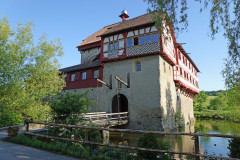
Amriswil
Description
Amriswil is a municipality in Arbon District in the canton of Thurgau in Switzerland.
History
Amriswil is first mentioned in 799 as Amalgeriswilare. During the Middle Ages Amriswil and Brüschwil were part of a Bishop's fief. During the 15th Century, the Helmsdorf family ruled in Eppishausen. In the early 17th Century, the village of Amriswil was sold to Adam Tschudi of Glarus, and in 1665 the hospital was sold to St. Gallen. The court rights over Amriswil, Hölzli, Brüschwil and houses in Ruti and Giezenhaus were acquired by the city of Bürglen, which was under the control of the city of St. Gallen. This situation remained unchanged until 1798.
In the mid-14th Century, chapel dedicated to Mary, was built in Amriswil. This chapel was part of the parish of Sommeri. After the Protestant Reformation of 1529 the majority in Sommeri returned to the old faith. However, the inhabitants of Amriswil remained with the Reformed faith and the chapel was given to Protestants. After 1630 there were weekly sermons, and after 1680 the chapel held regular Sunday services. Since 1710, the Reformed pastor lived in Amriswil, and it was united with Sommeri in a common parish. This remained the situation until migration in the 19th Century changed the religious situation. In 1891, a large Reformed church was constructed in Amriswil. Then, in 1911 the Catholic parish of Amriswil and Sommeri separated and an independent parish was established in Amriswil, followed by the 1939 inauguration of the Catholic Church of St. Stephen.</ref name=HDS/>
Until about 1830 Amriswil was a nondescript village with some farming and viticulture. The introduction of cattle (1833), a monthly market (1840), the establishment of a dairy in Sommeri (1852), the emergence of large scale weaving and the opening of a knitting factory through the German refugee Joseph Sallmann (1849) were the beginning of a structural change. This was followed by the opening of the Northeastern Railway (1855). Between the square and the station a new settlement area grew up. The town center shifted from the previous settlement nuclei around the market and the road intersection in Köpplishaus toward the northeast. The rapid industrialization, however, can not be satisfactorily explained by the modest amounts of hydropower available or through the increased traffic. Rather, entrepreneurial initiative seems to have been an important stimulus. The companies Sallmann, Laib, and Tuchschmid were a center of manufacturing, known as the Trikoterie. While Esco and Löw were important representatives of the clothing and footwear industry. The growth led to structural problems especially in water supply, which were resolved definitively in 1952 with the purchase of water from Lake Constance.
With the migration, espicially from Italy, the number of foreigners increased from 7% in 1870 to 29% in 1910. Several Bürgergemeinden and villages merged into Amriswil, including Hemmerswil in 1925 and Mühlebach in 1932. The construction and services sectors – trade companies, hotels and restaurants, banks, handicapped services (1909), Cantonal Kindergarten training school (1975) – created new jobs. The Trikoterie remained a keystone of the local economy until around 1980, when the various companies had to close down. At this time the economy was more balanced. In 1990 there were about 90 commercial agriculture farms and about 3,300 jobs in the manufacturing and services sectors, of which 47% were in the services sector.
Geography
Amriswil has an area, as of 2009, of 19.02 square km. Of this area, 12.85 km2 (4.96 sq mi) or 67.6% is used for agricultural purposes, while 2.47 km2 (0.95 sq mi) or 13.0% is forested. Of the rest of the land, 3.64 km2 (1.41 sq mi) or 19.1% is settled (buildings or roads), 0.04 km2 (9.9 acres) or 0.2% is either rivers or lakes and 0.01 km2 (2.5 acres) or 0.1% is unproductive land.
Of the built up area, industrial buildings made up 10.8% of the total area while housing and buildings made up 2.1% and transportation infrastructure made up 0.4%. Power and water infrastructure as well as other special developed areas made up 1.1% of the area while parks, green belts and sports fields made up 4.7%. Out of the forested land, 10.5% of the total land area is heavily forested and 2.5% is covered with orchards or small clusters of trees. Of the agricultural land, 54.5% is used for growing crops, while 13.0% is used for orchards or vine crops. All the water in the municipality is flowing water.
The municipality is located in Arbon District, at the crossing of the Winterthur-Arbon and Constance-St. Gallen roads. It consists of the village of Amriswil and the hamlets of Biessenhofen, Oberaach, Schocherswil and Räuchlisberg.
Heritage sites of national significance
The Bohlenständerhaus Schrofen, Sallmann Carriage Collection and Hagenwil Castle are listed as Swiss heritage site of national significance. The village of Hagenwil bei Amriswil is part of the Inventory of Swiss Heritage Sites.
Religion
From the 2000 census, 4,084 or 36.0% were Roman Catholic, while 4,090 or 36.0% belonged to the Swiss Reformed Church. Of the rest of the population, there were 8 Old Catholics (or about 0.07% of the population) who belonged to the Christian Catholic Church of Switzerland there are 398 individuals (or about 3.50% of the population) who belong to the Orthodox Church, and there are 451 individuals (or about 3.97% of the population) who belong to another Christian church. There were 3 individuals (or about 0.03% of the population) who were Jewish, and 1,135 (or about 9.99% of the population) who are Islamic. There are 88 individuals (or about 0.77% of the population) who belong to another church (not listed on the census), 591 (or about 5.20% of the population) belong to no church, are agnostic or atheist, and 509 individuals (or about 4.48% of the population) did not answer the question.