Alabama
Description
Alabama is a state located in the southeastern region of the United States. It is bordered by Tennessee to the north, Georgia to the east, Florida and the Gulf of Mexico to the south, and Mississippi to the west. Alabama is the 30th-most extensive and the 24th-most populous of the 50 United States. At 1,300 miles (2,100 km), Alabama has one of the longest navigable inland waterways in the nation.
From the American Civil War until World War II, Alabama, like many states in the South, suffered economic hardship, in part because of continued dependence on agriculture. Despite the growth of major industries and urban centers, white rural interests dominated the state legislature from 1901 to the 1960s, as it did not regularly reapportion the legislature from 1901 to 1961; urban interests and African Americans were markedly under-represented. African Americans and poor whites were essentially disenfranchised altogether by the state constitution of 1901, a status that continued into the mid-1960s before being alleviated by federal legislation. Exclusion of minorities continued under at-large voting systems in most counties; some changes were made through a series of omnibus court cases in the late 1980s to establish different electoral systems.
Following World War II, Alabama experienced growth as the economy of the state changed from one primarily based on agriculture to one with diversified interests. The power of the Solid South in Congress gained the establishment or expansion of multiple United States Armed Forces installations, which helped to bridge the gap between an agricultural and industrial economy during the mid-20th century. The state economy in the 21st century is based on management, automotive, finance, manufacturing, aerospace, mineral extraction, healthcare, education, retail, and technology.
Alabama is nicknamed the Yellowhammer State, after the state bird. Alabama is also known as the "Heart of Dixie" and the Cotton State. The state tree is the longleaf pine, and the state flower is the camellia. The capital of Alabama is Montgomery. The largest city by population is Birmingham, which has long been the most industrialized city, and largest city by total land area is Huntsville. The oldest city is Mobile, founded by French colonists in 1702 as the capital of French Louisiana.
Etymology
The European-American naming of the Alabama River and state originates from the Alabama people, a Muskogean-speaking tribe whose members lived just below the confluence of the Coosa and Tallapoosa rivers on the upper reaches of the river. In the Alabama language, the word for an Alabama person is Albaamo (or variously Albaama or Albàamo in different dialects; the plural form is Albaamaha).
The word Alabama is believed to have come from the Alabama language and a suggestion that the name was borrowed from the Choctaw language is unlikely. The spelling of the word varies significantly among historical sources. The first usage appears in three accounts of the Hernando de Soto expedition of 1540 with Garcilaso de la Vega using Alibamo, while the Knight of Elvas and Rodrigo Ranjel wrote Alibamu and Limamu, respectively, in efforts to transliterate the term. As early as 1702, the French called the tribe the Alibamon, with French maps identifying the river as Rivière des Alibamons. Other spellings of the appellation have included Alibamu, Alabamo, Albama, Alebamon, Alibama, Alibamou, Alabamu, Allibamou.
Sources disagree on the meaning of the word. Some scholars suggested the word comes from the Choctaw alba (meaning "plants" or "weeds") and amo (meaning "to cut", "to trim", or "to gather"). The meaning may have been "clearers of the thicket" or "herb gatherers", referring to clearing land for cultivation or collecting medicinal plants. The state has numerous place names of Native American origin. However, there are no correspondingly similar words in the Alabama language.
An 1842 article in the Jacksonville Republican proposed that it meant "Here We Rest." This notion was popularized in the 1850s through the writings of Alexander Beaufort Meek. Experts in the Muskogean languages have been unable to find any evidence to support such a translation. And, thus, this is probably erroneous.
History
Pre-European settlement
Indigenous peoples of varying cultures lived in the area for thousands of years before European colonization. Trade with the northeastern tribes via the Ohio River began during the Burial Mound Period (1000 BC–AD 700) and continued until European contact.
The agrarian Mississippian culture covered most of the state from 1000 to 1600 AD, with one of its major centers built at what is now the Moundville Archaeological Site in Moundville, Alabama. This is the second-largest complex of the classic Middle Mississippian era, after Cahokia in present-day Illinois, which was the center of the culture. Analysis of artifacts recovered from archaeological excavations at Moundville were the basis of scholars' formulating the characteristics of the Southeastern Ceremonial Complex (SECC). Contrary to popular belief, the SECC appears to have no direct links to Mesoamerican culture, but developed independently. The Ceremonial Complex represents a major component of the religion of the Mississippian peoples; it is one of the primary means by which their religion is understood.
Among the historical tribes of Native American people living in the area of present-day Alabama at the time of European contact were the Cherokee, an Iroquoian language people; and the Muskogean-speaking Alabama (Alibamu), Chickasaw, Choctaw, Creek, and Koasati. While part of the same large language family, the Muskogee tribes developed distinct cultures and languages.
European settlement
With exploration in the 16th century, the Spanish were the first Europeans to reach Alabama. The expedition of Hernando de Soto passed through Mabila and other parts of the state in 1540. More than 160 years later, the French founded the first European settlement in the region at Old Mobile in 1702. The city was moved to the current site of Mobile in 1711. This area was claimed by the French from 1702 to 1763 as part of La Louisiane.
After the French lost to the British in the Seven Years' War, it became part of British West Florida from 1763 to 1783. After the United States victory in the American Revolutionary War, the territory was divided between the United States and Spain. The latter retained control of this western territory from 1783 until the surrender of the Spanish garrison at Mobile to U.S. forces on April 13, 1813.
Thomas Bassett, a loyalist to the British monarchy during the Revolutionary era, was one of the earliest White settlers in the state outside Mobile. He settled in the Tombigbee District during the early 1770s. The boundaries of the district were roughly limited to the area within a few miles of the Tombigbee River and included portions of what is today southern Clarke County, northernmost Mobile County, and most of Washington County.
What is now the counties of Baldwin and Mobile became part of Spanish West Florida in 1783, part of the independent Republic of West Florida in 1810, and was finally added to the Mississippi Territory in 1812. Most of what is now the northern two-thirds of Alabama was known as the Yazoo lands beginning during the British colonial period. It was claimed by the Province of Georgia from 1767 onwards. Following the Revolutionary War, it remained a part of Georgia, although heavily disputed.
With the exception of the area around Mobile and the Yazoo lands, what is now the lower one-third Alabama was made part of the Mississippi Territory when it was organized in 1798. The Yazoo lands were added to the territory in 1804, following the Yazoo land scandal. Spain kept a claim on its former Spanish West Florida territory in what would become the coastal counties until the Adams–Onís Treaty officially ceded it to the United States in 1819.
19th century
Before the admission of Mississippi as a state on December 10, 1817, the more sparsely settled eastern half of the territory was separated and named the Alabama Territory. The Alabama Territory was created by the United States Congress on March 3, 1817. St. Stephens, now abandoned, served as the territorial capital from 1817 to 1819.
The U.S. Congress selected Huntsville as the site for the first Constitutional Convention of Alabama after it was approved to become the 22nd state. From July 5 to August 2, 1819, delegates met to prepare the new state constitution. Huntsville served as the temporary capital of Alabama from 1819 to 1820, when the seat of state government was moved to Cahaba in Dallas County.
Cahaba, now a ghost town, was the first permanent state capital from 1820 to 1825. Alabama Fever was already underway when the state was admitted to the Union, with settlers and land speculators pouring into the state to take advantage of fertile land suitable for cotton cultivation. Part of the frontier in the 1820s and 1830s, its constitution provided for universal suffrage for white men.
Southeastern planters and traders from the Upper South brought slaves with them as the cotton plantations in Alabama expanded. The economy of the central Black Belt (named for its dark, productive soil) was built around large cotton plantations whose owners' wealth grew largely from slave labor. The area also drew many poor, disfranchised people who became subsistence farmers. Alabama had a population estimated at under 10,000 people in 1810, but it had increased to more than 300,000 people by 1830. Most Native American tribes were completely removed from the state within a few years of the passage of the Indian Removal Act by Congress in 1830.
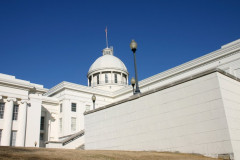
From 1826 to 1846, Tuscaloosa served as the capital of Alabama. On January 30, 1846, the Alabama legislature announced that it had voted to move the capital city from Tuscaloosa to Montgomery. The first legislative session in the new capital met in December 1847. A new capitol building was erected under the direction of Stephen Decatur Button of Philadelphia. The first structure burned down in 1849, but was rebuilt on the same site in 1851. This second capitol building in Montgomery remains to the present day. It was designed by Barachias Holt of Exeter, Maine.
By 1860, the population had increased to a total of 964,201 people, of which nearly half, 435,080 were enslaved African Americans, and 2,690 were free people of color. On January 11, 1861, Alabama declared its secession from the Union. After remaining an independent republic for a few days, it joined the Confederate States of America. The Confederacy's capital was initially located at Montgomery. Alabama was heavily involved in the American Civil War. Although comparatively few battles were fought in the state, Alabama contributed about 120,000 soldiers to the war effort.
A company of cavalry soldiers from Huntsville, Alabama joined Nathan Bedford Forrest's battalion in Hopkinsville, Kentucky. The company wore new uniforms with yellow trim on the sleeves, collar and coat tails. This led to them being greeted with "Yellowhammer", and the name later was applied to all Alabama troops in the Confederate Army.
Alabama's slaves were freed by the 13th Amendment in 1865. Alabama was under military rule from the end of the war in May 1865 until its official restoration to the Union in 1868. From 1867 to 1874, with most White citizens barred temporarily from voting and freedmen enfranchised, many African Americans emerged as political leaders in the state. Alabama was represented in Congress during this period by three African-American congressmen: Jeremiah Haralson, Benjamin S. Turner, and James T. Rapier.
Following the war, the state remained chiefly agricultural, with an economy tied to cotton. During Reconstruction, state legislators ratified a new state constitution in 1868 that created the state's first public school system and expanded women's rights. Legislators funded numerous public road and railroad projects, although these were plagued with allegations of fraud and misappropriation. Organized insurgent, resistance groups tried to suppress the freedmen and Republicans. Besides the short-lived original Ku Klux Klan, these included the Pale Faces, Knights of the White Camellia, Red Shirts, and the White League.
Reconstruction in Alabama ended in 1874, when the Democrats regained control of the legislature and governor's office through an election dominated by fraud and violence. They wrote another constitution in 1875, and the legislature passed the Blaine Amendment, prohibiting public money from being used to finance religious-affiliated schools. The same year, legislation was approved that called for racially segregated schools. Railroad passenger cars were segregated in 1891. After disfranchising most African Americans and many poor whites in the 1901 constitution, the Alabama legislature passed more Jim Crow laws at the beginning of the 20th century to impose segregation in everyday life.
20th century
The new 1901 Constitution of Alabama included provisions for voter registration that effectively disenfranchised large portions of the population, including nearly all African Americans and Native Americans, and tens of thousands of poor whites, through making voter registration difficult, requiring a poll taxes and literacy test. By 1903, only 2,980 African Americans were registered in Alabama, although at least 74,000 were literate. This compared to more than 181,000 African Americans eligible to vote in 1900. The numbers dropped even more in later decades.
While the planter class had persuaded poor whites to vote for this legislative effort to suppress black voting, the new restrictions resulted in their disenfranchisement as well, due mostly to the imposition of a cumulative poll tax. By 1941, whites constituted a slight majority of those disenfranchised by these laws: 600,000 Whites vs. 520,000 African-Americans. Nearly all African Americans had lost the ability to vote. Despite numerous legal challenges that succeeded in overturning certain provisions, the state legislature would create new ones to maintain disenfranchisement. The exclusion of blacks from the political system persisted until after passage of federal civil rights legislation in the 1965 to enforce their constitutional rights as citizens.
The 1901 constitution required racial segregation of public schools. It also restated that interracial marriage was illegal, as it had been prohibited in 1867. Into the 1950s, the state legislature passed additional racial segregation laws related to public facilities: jails were segregated in 1911; hospitals in 1915; toilets, hotels, and restaurants in 1928; and bus stop waiting rooms in 1945.
The rural-dominated Alabama legislature consistently underfunded schools and services for the disenfranchised African Americans, but it did not relieve them of paying taxes. Partially as a response to chronic underfunding of education for African Americans in the South, the Rosenwald Fund began funding the construction of what came to be known as Rosenwald Schools. In Alabama these schools were designed and the construction partially financed with Rosenwald funds, which paid one-third of the construction costs. The fund required the local community and state to raise matching funds to pay the rest. Black residents effectively taxed themselves twice, by raising additional monies to supply matching funds for such schools, which were built in many rural areas. They often donated land and labor as well.
Beginning in 1913, the first 80 Rosenwald Schools were built in Alabama for African-American children. A total of 387 schools, seven teachers' houses, and several vocational buildings were completed by 1937 in the state. Several of the surviving school buildings in the state are now listed on the National Register of Historic Places.
Continued racial discrimination and lynchings, agricultural depression, and the failure of the cotton crops due to boll weevil infestation led tens of thousands of African Americans from rural Alabama and other states to seek opportunities in northern and midwestern cities during the early decades of the 20th century as part of the Great Migration out of the South. Reflecting this emigration, the population growth rate in Alabama (see "Historical Populations" table below) dropped by nearly half from 1910 to 1920.
At the same time, many rural people, both White and African American, migrated to the city of Birmingham to work in new industrial jobs. Birmingham experienced such rapid growth that it was called the "Magic City". By the 1920s, Birmingham was the 19th-largest city in the United States and had more than 30% of the state's population. Heavy industry and mining were the basis of its economy. Its residents were under-represented for decades in the state legislature, which refused to redistrict after each decennial census according to population changes, as it was required by the state constitution. This did not change until the late 1960s following a lawsuit and court order.
Beginning in the 1940s, when the courts started taking the first steps to recognize the voting rights of black voters, the Alabama legislature took several counter -steps designed to disfranchise black voters. The legislature passed, and the voters ratified [as these were mostly white voters], a state constitutional amendment that gave local registrars greater latitude to disqualify voter registration applicants. Black citizens in Mobile successfully challenged this amendment as a violation of the Fifteenth Amendment. The legislature also changed the boundaries of Tuskegee to a 28-sided figure designed to fence out blacks from the city limits. The Supreme Court unanimously held that this racial "gerrymandering" violated the Constitution. In 1961, ... the Alabama legislature also intentionally diluted the effect of the black vote by instituting numbered place requirements for local elections.
Industrial development related to the demands of World War II brought a level of prosperity to the state not seen since before the Civil War. Rural workers poured into the largest cities in the state for better jobs and a higher standard of living. One example of this massive influx of workers occurred in Mobile. Between 1940 and 1943, more than 89,000 people moved into the city to work for war-related industries. Cotton and other cash crops faded in importance as the state developed a manufacturing and service base.
Despite massive population changes in the state from 1901 to 1961, the rural-dominated legislature refused to reapportion House and Senate seats based on population, as required by the state constitution to follow the results of decennial censuses. They held on to old representation to maintain political and economic power in agricultural areas. In addition, the state legislature gerrymandered the few Birmingham legislative seats to ensure election by persons living outside Birmingham.
One result was that Jefferson County, containing Birmingham's industrial and economic powerhouse, contributed more than one-third of all tax revenue to the state, but did not receive a proportional amount in services. Urban interests were consistently underrepresented in the legislature. A 1960 study noted that because of rural domination, "a minority of about 25 per cent of the total state population is in majority control of the Alabama legislature."
A class action suit initiated on behalf of plaintiffs in Lowndes County, Alabama challenged the state legislature's lack of redistricting for congressional seats. In 1962 White v. Crook, Judge Frank M. Johnson ordered the state to redistrict. United States Supreme Court cases of Baker v. Carr (1962) and Reynolds v. Sims (1964) ruled that the principle of "one man, one vote" needed to be the basis of both houses of state legislatures as well, and that their districts had to be based on population, rather than geographic counties, as Alabama had used for its senate.
In 1972, for the first time since 1901, the legislature completed the first congressional redistricting based on the decennial census. This benefited the urban areas that had developed, as well as all in the population who had been underrepresented for more than 60 years. Other changes were made to implement representative state house and senate districts.
African Americans continued to press in the 1950s and 1960s to end disenfranchisement and segregation in the state through the Civil Rights Movement, including legal challenges. In 1954, the US Supreme Court ruled in Brown v. Board of Education that public schools had to be desegregated, but Alabama was slow to comply. During the 1960s, under Governor George Wallace, Alabama resisted compliance with federal demands for desegregation.The civil rights movement had notable events in Alabama, including the Montgomery Bus Boycott (1955–56), Freedom Rides in 1961, and 1965 Selma to Montgomery marches. These contributed to Congressional passage and enactment of the Civil Rights Act of 1964 and Voting Rights Act of 1965 by the U.S. Congress.
Legal segregation ended in the states in 1964, but Jim Crow customs often continued until specifically challenged in court.
Despite recommendations of a 1973 Alabama Constitutional Commission, the state legislature did not approve an amendment to establish home rule for counties. There is very limited home rule, but the legislature is deeply involved in passing legislation that applies to county-level functions and policies. This both deprives local residents of the ability to govern themselves and distracts the legislature from statewide issues.
Alabama has made some changes since the late 20th century and has used new types of voting to increase representation. In the 1980s, an omnibus redistricting case, Dillard v. Crenshaw County, challenged the at-large voting for representative seats of 180 Alabama jurisdictions, including counties and school boards. At-large voting had diluted the votes of any minority in a county, as the majority tended to take all seats. Despite African Americans making up a significant minority in the state, they had been unable to elect any representatives in most of the at-large jurisdictions.
As part of settlement of this case, five Alabama cites and counties, including Chilton County, adopted a system of cumulative voting for election of representatives in multi-seat jurisdictions. This has resulted in more proportional representation for voters. In another form of proportional representation, 23 jurisdictions use limited voting, as in Conecuh County. In 1982, limited voting was first tested in Conecuh County. Together use of these systems has increased the number of African Americans and women being elected to local offices, resulting in governments that are more representative of their citizens.
Geography
Alabama is the thirtieth-largest state in the United States with 52,419 square miles (135,760 km2) of total area: 3.2% of the area is water, making Alabama 23rd in the amount of surface water, also giving it the second-largest inland waterway system in the U.S. About three-fifths of the land area is a gentle plain with a general descent towards the Mississippi River and the Gulf of Mexico. The North Alabama region is mostly mountainous, with the Tennessee River cutting a large valley and creating numerous creeks, streams, rivers, mountains, and lakes.
Alabama is bordered by the states of Tennessee to the north, Georgia to the east, Florida to the south, and Mississippi to the west. Alabama has coastline at the Gulf of Mexico, in the extreme southern edge of the state. The state ranges in elevation from sea level at Mobile Bay to over 1,800 feet (550 m) in the Appalachian Mountains in the northeast.
The highest point is Mount Cheaha, at a height of 2,413 ft (735 m). Alabama's land consists of 22 million acres (89,000 km2) of forest or 67% of total land area. Suburban Baldwin County, along the Gulf Coast, is the largest county in the state in both land area and water area.
Areas in Alabama administered by the National Park Service include Horseshoe Bend National Military Park near Alexander City; Little River Canyon National Preserve near Fort Payne; Russell Cave National Monument in Bridgeport; Tuskegee Airmen National Historic Site in Tuskegee; and Tuskegee Institute National Historic Site near Tuskegee.
Additionally, Alabama has four National Forests: Conecuh, Talladega, Tuskegee, and William B. Bankhead. Alabama also contains the Natchez Trace Parkway, the Selma To Montgomery National Historic Trail, and the Trail Of Tears National Historic Trail. A notable natural wonder in Alabama is "Natural Bridge" rock, the longest natural bridge east of the Rockies, located just south of Haleyville.
A 5-mile (8 km)-wide meteorite impact crater is located in Elmore County, just north of Montgomery. This is the Wetumpka crater, the site of "Alabama's greatest natural disaster." A 1,000-foot (300 m)-wide meteorite hit the area about 80 million years ago. The hills just east of downtown Wetumpka showcase the eroded remains of the impact crater that was blasted into the bedrock, with the area labeled the Wetumpka crater or astrobleme ("star-wound") because of the concentric rings of fractures and zones of shattered rock that can be found beneath the surface. In 2002, Christian Koeberl with the Institute of Geochemistry University of Vienna published evidence and established the site as the 157th recognized impact crater on Earth.
Flora and fauna
Alabama is home to a diverse array of flora and fauna, due largely to a variety of habitats that range from the Tennessee Valley, Appalachian Plateau, and Ridge-and-Valley Appalachians of the north to the Piedmont, Canebrake and Black Belt of the central region to the Gulf Coastal Plain and beaches along the Gulf of Mexico in the south. The state is usually ranked among the top in nation for its range of overall biodiversity.
Alabama is in the subtropical coniferous forest biome and once boasted huge expanses of pine forest, which still form the largest proportion of forests in the state. It currently ranks fifth in the nation for the diversity of its flora. It is home to nearly 4,000 pteridophyte and spermatophyte plant species.
Indigenous animal species in the state include 62 mammal species, 93 reptile species, 73 amphibian species, roughly 307 native freshwater fish species, and 420 bird species that spend at least part of their year within the state. Invertebrates include 83 crayfish species and 383 mollusk species. 113 of these mollusk species have never been collected outside the state.
Transportation
Aviation
Major airports with sustained commercial operations in Alabama include Birmingham-Shuttlesworth International Airport (BHM), Huntsville International Airport (HSV), Dothan Regional Airport (DHN), Mobile Regional Airport (MOB), Montgomery Regional Airport (MGM), and Muscle Shoals – Northwest Alabama Regional Airport (MSL).
Rail
For rail transport, Amtrak schedules the Crescent, a daily passenger train, running from New York to New Orleans with stops at Anniston, Birmingham, and Tuscaloosa.
Roads
Alabama has five major interstate roads that cross the state: Interstate 65 (I-65) travels north–south roughly through the middle of the state; I-20/I-59 travel from the central west Mississippi state line to Birmingham, where I-59 continues to the north-east corner of the state and I-20 continues east towards Atlanta; I-85 originates in Montgomery and travels east-northeast to the Georgia state line, providing a main thoroughfare to Atlanta; and I-10 traverses the southernmost portion of the state, traveling from west to east through Mobile. Another interstate, I-22, is currently under construction. When completed, it will connect Birmingham with Memphis, Tennessee. In addition, there are currently five auxiliary interstate routes in the state: I-165 in Mobile, I-359 in Tuscaloosa, I-459 around Birmingham, I-565 in Decatur and Huntsville, and I-759 in Gadsden. A sixth route, I-685, will be formed when I-85 is rerouted along a new southern bypass of Montgomery. A proposed northern bypass of Birmingham will be designated as I-422. Since a direct connection from I-22 to I-422 will not be possible, I-222 has been proposed, as well.
Several U.S. Highways also pass through the state, such as U.S. Route 11 (US-11), US-29, US-31, US-43, US-45, US-72, US-78, US-80, US-82, US-84, US-90, US-98, US-231, US-278, US-280, US-331, US-411, and US-431.
There are four toll roads in the state: Montgomery Expressway in Montgomery; Tuscaloosa Bypass in Tuscaloosa; Emerald Mountain Expressway in Wetumpka; and Beach Express in Orange Beach.
Ports
The Port of Mobile, Alabama's only saltwater port, is a large seaport on the Gulf of Mexico with inland waterway access to the Midwest by way of the Tennessee-Tombigbee Waterway. The Port of Mobile was ranked 12th by tons of traffic in the United States during 2009. The newly expanded container terminal at the Port of Mobile was ranked as the 25th busiest for container traffic in the nation during 2011. The state's other ports are on rivers with access to the Gulf of Mexico.
Water ports of Alabama, listed from north to south:
Port name Location Connected to Port of Florence Florence/Muscle Shoals, on Pickwick Lake Tennessee River Port of Decatur Decatur, on Wheeler Lake Tennessee River Port of Guntersville Guntersville, on Lake Guntersville Tennessee River Port of Birmingham Birmingham, on Black Warrior River Tenn-Tom Waterway Port of Tuscaloosa Tuscaloosa, on Black Warrior River Tenn-Tom Waterway Port of Montgomery Montgomery, on Woodruff Lake Alabama River Port of Mobile Mobile, on Mobile Bay Gulf of Mexico