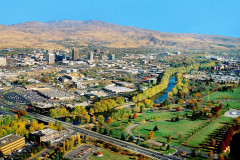
Idaho
Description
Idaho is a state in the northwestern region of the United States. Idaho is the 14th largest, the 39th most populous, and the 7th least densely populated of the 50 United States. The estimated population is 1,654,930 and the state has an area of 83,569 square miles (216,440 km2). The state's largest city and capital is Boise. Residents are called "Idahoans". Idaho was admitted to the Union on July 3, 1890, as the 43rd state.
Idaho is a mountainous state with an area larger than that of all of New England. It borders the US states of Montana to the northeast, Wyoming to the east, Nevada and Utah to the south, and Washington and Oregon to the west. To the north, it shares a 45 mi (72 km) international border with the Canadian province of British Columbia, the shortest such land border of any state. The network of dams and locks on the Columbia River and Snake River make the city of Lewiston the farthest inland seaport on the Pacific coast of the contiguous United States.
Idaho's nickname is the "Gem State", because nearly every known type of gemstone has been found there. In addition, Idaho is one of only two places in the world where star garnets can be found in any significant quantities, the other being India. Idaho is sometimes called the "Potato State" owing to its popular and widely distributed crop. The state motto is Esto Perpetua (Latin for "Let it be forever" or "Let it endure forever").
Etymology
The exact origin of the name remains a mystery. In the early 1860s, when the United States Congress was considering organizing a new territory in the Rocky Mountains, eccentric lobbyist George M. Willing suggested the name "Idaho", which he claimed was derived from a Shoshone language term meaning "the sun comes from the mountains" or "gem of the mountains". Willing later claimed that he had simply invented the name. Congress ultimately decided to name the area Colorado Territory when it was created in February 1861. Thinking they would get a jump on the name, locals named a community in Colorado "Idaho Springs".
However, the name "Idaho" did not fall into obscurity. The same year Congress created Colorado Territory, a county called Idaho County was created in eastern Washington Territory. The county was named after a steamship named Idaho, which was launched on the Columbia River in 1860. It is unclear whether the steamship was named before or after Willing's claim was revealed. Regardless, a portion of Washington Territory, including Idaho County, was used to create Idaho Territory in 1863.
Despite this lack of evidence for the origin of the name, many textbooks well into the 20th century repeated as fact Willing's account that the name "Idaho" derived from the Shoshone term "ee-da-how".
The name "Idaho" may be derived from the Plains Apache word "ídaahę́", which means "enemy." The Comanches used this word to refer to the Idaho Territory.
A 1956 Idaho history textbook says:
"Idaho" is a Shoshoni Indian exclamation. The word consists of three parts. The first is "Ee", which in English conveys the idea of "coming down". The second is "dah" which is the Shoshoni stem or root for both "sun" and "mountain". The third syllable, "how", denotes the exclamation and stands for the same thing in Shoshoni that the exclamation mark (!) does in the English language. The Shoshoni word is "Ee-dah-how", and the Indian thought thus conveyed when translated into English means, "Behold! the sun coming down the mountain.
According to local knowledge, the name Idaho originated from the Nez Perce language and stands for "the Land of many Waters", a kidney-shaped drainage area in north central Idaho in which a multitude of rivers come together. These rivers include the Snake, the Salmon, the Clearwater, North Fork Clearwater River, the Selway, and more. The famed steamboat was probably named 'Idaho' because it voyaged along the Columbia river to "the Land of many Waters".
Geography
Idaho borders six US states and one Canadian province. The states of Washington and Oregon are to the west, Nevada and Utah are to the south, and Montana and Wyoming are to the east. Idaho also shares a short border with the Canadian province of British Columbia to the north. The landscape is rugged with some of the largest unspoiled natural areas in the United States. For example, at 2.3 million acres (930,000 ha), the Frank Church-River of No Return Wilderness Area is the largest contiguous area of protected wilderness in the continental United States. Idaho is a Rocky Mountain state with abundant natural resources and scenic areas. The state has snow-capped mountain ranges, rapids, vast lakes and steep canyons. The waters of the Snake River rush through Hells Canyon, the deepest gorge in the United States. Shoshone Falls plunges down rugged cliffs from a height greater than that of Niagara Falls. The major rivers in Idaho are the Snake River, the Clark Fork/Pend Oreille River, the Clearwater River, and the Salmon River. Other significant rivers include the Coeur d'Alene River, the Spokane River, the Boise River, and the Payette River. The Salmon River empties into the Snake in Hells Canyon and forms the southern boundary of Nez Perce County on its north shore, of which Lewiston is the county seat. The Port of Lewiston, at the confluence of the Clearwater and the Snake Rivers is the farthest inland seaport on the West Coast at 465 river miles from the Pacific at Astoria, Oregon.
Idaho's highest point is Borah Peak, 12,662 ft (3,859 m), in the Lost River Range north of Mackay. Idaho's lowest point, 710 ft (216 m), is in Lewiston, where the Clearwater River joins the Snake River and continues into Washington. The Sawtooth Range is often considered Idaho's most famous mountain range. Other mountain ranges in Idaho include the Bitterroot Range, the White Cloud Mountains, the Lost River Range, the Clearwater Mountains, and the Salmon River Mountains.
Idaho has two time zones, with the dividing line approximately midway between Canada and Nevada. Southern Idaho, including the Boise metropolitan area, Idaho Falls, Pocatello, and Twin Falls, are in the Mountain Time Zone. A legislative error (15 U.S.C. ch. 6 §264) theoretically placed this region in the Central Time Zone, but this was corrected with a 2007 amendment. Areas north of the Salmon River, including Coeur d'Alene, Moscow, Lewiston, and Sandpoint, are in the Pacific Time Zone, which contains less than a quarter of the state's population and land area.
Lakes/rivers
- Alturas Lake
- Brush Lake
- Bear River
- Bear Lake (Idaho-Utah)
- Boise River
- Clearwater River
- Dawson Lake
- Dierkes Lake
- Hayden Lake
- Henry's Lake
- Hidden Lake
- Kootenai River
- Lake Cascade
- Lake Cleveland
- Lake Coeur d'Alene
- Lake Lowell
- Lake Walcott
- Pend Oreille
- Little Redfish Lake
- Lucky Peak Lake
- Moyie River
- North Fork Clearwater River
- Pac River
- Payette Lake, (McCall)
- Pettit Lake
- Priest Lake
- Perkins Lake
- Portneuf River
- Redfish Lake
- River of No Return
- Sawtooth Lake
- Smith Lake
- Snake River
- Stanley Lake
- Warm Lake
- Williams Lake (Salmon)
History
Humans may have been present in the Idaho area as long as 14,500 years ago. Excavations at Wilson Butte Cave near Twin Falls in 1959 revealed evidence of human activity, including arrowheads, that rank among the oldest dated artifacts in North America. American Indian peoples predominant in the area included the Nez Percé in the north and the Northern and Western Shoshone in the south.
An early presence of French-Canadian trappers is visible in names and toponyms that have survived to this day: Nez Percé, Cœur d'Alène, Boisé, Payette, some preexisting the Lewis and Clark and Astorian expeditions which themselves included significant numbers of French and Métis guides recruited for their familiarity with the terrain.
Idaho, as part of the Oregon Country, was claimed by both the United States and Great Britain until the United States gained undisputed jurisdiction in 1846. From 1843 to 1849, present-day Idaho was under the de facto jurisdiction of the Provisional Government of Oregon. When Oregon became a state, what is now Idaho was in what remained of the original Oregon Territory not part of the new state, and designated as the Washington Territory.
Between then and the creation of the Idaho Territory on March 4, 1863, at Lewiston, parts of the present-day state were included in the Oregon, Washington, and Dakota Territories. The new territory included present-day Idaho, Montana, and most of Wyoming. The Lewis and Clark expedition crossed Idaho in 1805 on the way to the Pacific and in 1806 on the return, largely following the Clearwater River both directions. The first non-indigenous settlement was Kullyspell House, established on the shore of Lake Pend Oreille for fur trading in 1809 by David Thompson of the North West Company. In 1812 Donald Mackenzie, working for the Pacific Fur Company at the time, established a post on the lower Clearwater River near present-day Lewiston. This post, known as "MacKenzie's Post" or "Clearwater", operated until the Pacific Fur Company was bought out by the North West Company in 1813, after which it was abandoned. The first attempts at organized communities, within the present borders of Idaho, were established in 1860. The first permanent, substantial incorporated community was Lewiston in 1861.
After some tribulation as a territory, including the chaotic transfer of the territorial capital from Lewiston to Boise, disenfranchisement of Mormon polygamists upheld by the U.S. Supreme Court in 1877, and a federal attempt to split the territory between Washington Territory which gained statehood in 1889, a year before Idaho, and the state of Nevada which had been a state since 1864, Idaho achieved statehood in 1890. The economy of the state, which had been primarily supported by metal mining, shifted towards agriculture, forest products and tourism.
Idaho was one of the hardest hit of the Pacific Northwest states during the Great Depression. Prices plummeted for Idaho's major crops: in 1932 a bushel of potatoes brought only $.10 compared to $1.51 in 1919, while Idaho farmers saw their annual income of $686 in 1929 drop to $250 by 1932.
In recent years, Idaho has expanded its commercial base as a tourism and agricultural state to include science and technology industries. Science and technology have become the largest single economic center (over 25% of the state's total revenue) within the state and are greater than agriculture, forestry and mining combined.
The Idaho State Historical Society and numerous local historical societies and museums preserve and promote Idaho's cultural heritage.
Energy
The energy landscape of Idaho is favorable to the development of renewable energy systems. The state is rich in renewable energy resources but has limited fossil fuel resources. The Snake River Plain and smaller river basins provide Idaho with some of the best hydroelectric power resources in the nation and its geologically active mountain areas have significant geothermal power and wind power potential. These realities have shaped much of the state's current energy landscape.
Most of the energy consumed in Idaho is imported from other states. Imports account for more than 80% of total energy consumption, including all of Idaho's natural gas and petroleum supplies and more than half of its electricity. Of the electricity consumed in Idaho in 2005, 48% came from hydroelectricity, 42% was generated by burning coal and 9% was generated by burning natural gas. The remainder came from other renewable sources such as wind.
The state's numerous river basins allow hydroelectric power plants to provide 556,000 MWh, which amounts to about three-fourths of Idaho's electricity generated in the state. Washington State provides most of the natural gas used in Idaho through one of the two major pipeline systems supplying the state. Although the state relies on out-of-state sources for its entire natural gas supply, it uses natural gas-fired plants to generate 127,000 MWh, or about ten percent of its output. Coal-fired generation and the state's small array of wind turbines supplies the remainder of the state's electricity output. The state produces 739,000 MWh but still needs to import half of its electricity from out-of-state to meet demand.
While Idaho's 515 trillion BTU total energy consumption is low compared with other states and represents just 0.5% of United States consumption, the state also has the nation's 11th smallest population, 1.5 million, so its per capita energy consumption of 352 million Btu is currently just above the national average of 333 million Btu. As the 13th‑largest state in terms of land area (83,570 sq. mi=53,485,000ac), distance creates the additional problem of "line loss". When the length of an electrical transmission line is doubled, the resistance to an electric current passing through it is also doubled.
In addition, Idaho also has the 6th fastest growing population in the United States with the population expected to increase by 31% from 2008 to 2030. This projected increase in population will contribute to a 42% increase in demand by 2030, further straining Idaho's finite hydroelectric resources.
Idaho has an upper-boundary estimate of development potential to generate 44,320 GWh/year from 18,076 MW of wind power, and 7,467,000 GWh/year from solar power using 2,061,000 MW of photovoltaics (PV), including 3,224 MW of rooftop photovoltaics, and 1,267,000 MW of concentrated solar power.
Transportation
The Idaho Transportation Department is the government agency responsible for Idaho's transportation infrastructure, including operations and maintenance as well as planning for future needs. The agency is also responsible for overseeing the disbursement of federal, state, and grant funding for the transportation programs of the state.
Highways
Idaho is among the few states in the nation without a major freeway linking its two largest metropolitan areas, Boise in the south and Coeur d'Alene in the north. U.S. Route 95 (US-95) links the two ends of the state, but like many other highways in Idaho, it is badly in need of repair and upgrade. In 2007, the Idaho Transportation Department stated that the state's highway infrastructure faces a $200 million per year shortfall in maintenance and upgrades. I-84 is the main highway linking the southeast and southwest portions of the state, along with I-86 and I-15.
Airports
Major airports include the Boise Airport serving the southwest region of Idaho, and the Spokane International Airport (located in Spokane, Washington), which serves northern Idaho. Other airports with scheduled service are the Pullman-Moscow Regional Airport serving the Palouse; the Lewiston-Nez Perce County Airport, serving the Lewis-Clark Valley and north central and west central Idaho; The Magic Valley Regional Airport in Twin Falls; the Idaho Falls Regional Airport; and the Pocatello Regional Airport.
Railroads
Idaho is served by three transcontinental railroads. The Burlington Northern Santa Fe (BNSF) connects the Idaho Panhandle with Seattle, Portland, and Spokane to the west, and Minneapolis and Chicago to the east. The BNSF travels through Kootenai, Bonner, and Boundary counties. The Union Pacific Railroad crosses North Idaho entering from Canada through Boundary and Bonner, and proceeding to Spokane. Canadian Pacific Railway uses Union Pacific Railroad tracks in North Idaho carrying products from Alberta to Spokane and Portland, Oregon. Amtrak's Empire Builder crosses northern Idaho, with its only stop being in Sandpoint. Montana Rail Link also operates between Billings, Montana and Sandpoint, Idaho.
The Union Pacific Railroad also crosses southern Idaho traveling between Portland, Oregon, Green River, Wyoming, and Ogden, Utah and serves Boise, Nampa, Twin Falls, and Pocatello. There has been a recent call to return Amtrak service to southern Idaho.
Ports
The Port of Lewiston is the farthest inland Pacific port on the west coast. A series of dams and locks on the Snake River and Columbia River facilitate barge travel from Lewiston to Portland, where goods are loaded on ocean-going vessels.
National parks, reserves, monuments and historic sites
- California National Historic Trail
- City of Rocks National Reserve
- Craters of the Moon National Monument and Preserve
- Hagerman Fossil Beds National Monument
- Lewis and Clark National Historic Trail
- Minidoka National Historic Site
- Nez Perce National Historical Park
- Oregon National Historic Trail
- Yellowstone National Park
- Pacific Northwest National Scenic Trail
National recreation areas
- Hells Canyon National Recreation Area
- Sawtooth National Recreation Area
National wildlife refuges and Wilderness Areas
- Bear Lake National Wildlife Refuge
- Camas National Wildlife Refuge
- Deer Flat National Wildlife Refuge
- Frank Church - River of No Return Wilderness Area
- Grays Lake National Wildlife Refuge
- Kootenai National Wildlife Refuge
- Minidoka National Wildlife Refuge
National conservation areas
- Snake River Birds of Prey National Conservation Area
State parks
- Bear Lake State Park
- Bruneau Dunes State Park
- Castle Rocks State Park
- City of Rocks National Reserve
- Coeur d'Alene Parkway State Park
- Dworshak State Park
- Eagle Island State Park
- Farragut State Park
- Harriman State Park
- Hells Gate State Park
- Henrys Lake State Park
- Heyburn State Park
- Lake Cascade State Park
- Lake Walcott State Park
- Land of the Yankee Fork State Park
- Lucky Peak State Park
- Massacre Rocks State Park
- McCroskey State Park
- Old Mission State Park
- Ponderosa State Park
- Priest Lake State Park
- Round Lake State Park
- Thousand Springs State Park
- Three Island Crossing State Park
- Trail of the Coeur d'Alenes
- Winchester Lake State Park
Idaho in popular culture
The North America localization of the Yo-Kai Watch franchise takes place in a fictionalized version of Springdale, Idaho.
River Phoenix and Keanu Reeves starred in the movie My Own Private Idaho, portions of which take place in Idaho.
Judy Garland performed the elaborate song-and-dance routine "Born in a Trunk in the Princess Theater in Pocatello, Idaho" in the 1954 version of the film A Star is Born.