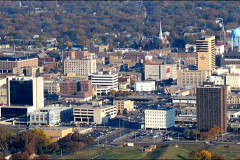
North Dakota
Description
North Dakota is the 39th state of the United States, having been admitted to the union on November 2, 1889.
It is located in the Upper Midwestern region of the United States, bordered by the Canadian provinces of Saskatchewan and Manitoba to the north, Minnesota to the east, South Dakota to the south, and Montana to the west. The state capital is Bismarck, and the largest city is Fargo. North Dakota is the 19th most extensive but the 4th least populous and the 4th least densely populated of the 50 United States.
North Dakota has weathered the Great Recession of the early 21st century with a boom in natural resources, particularly a boom in oil extraction from the Bakken formation, which lies beneath the northwestern part of the state. The development has driven strong job and population growth, and low unemployment.
Geography
North Dakota is located in the U.S. region known as the Great Plains. The state shares the Red River of the North with Minnesota on the east; South Dakota is to the south, Montana is to the west, and the Canadian provinces of Saskatchewan and Manitoba are north. North Dakota is situated near the middle of North America with a stone marker in Rugby, North Dakota marking the "Geographic Center of the North American Continent". With an area of 70,762 square miles (183,273 km2), North Dakota is the 19th largest state.
The western half of the state consists of the hilly Great Plains, and the northern part of the Badlands to the west of the Missouri River. The state's high point, White Butte at 3,506 feet (1,069 m), and Theodore Roosevelt National Park are located in the Badlands. The region is abundant in fossil fuels including natural gas, crude oil and lignite coal. The Missouri River forms Lake Sakakawea, the third largest man-made lake in the United States, behind the Garrison Dam.
The central region of the state is divided into the Drift Prairie and the Missouri Plateau. The eastern part of the state consists of the flat Red River Valley, the bottom of glacial Lake Agassiz. Its fertile soil, drained by the meandering Red River flowing northward into Lake Winnipeg, supports a large agriculture industry. Devils Lake, the largest natural lake in the state, is also found in the east.
Eastern North Dakota is overall flat; however, there are significant hills and buttes in western North Dakota. Most of the state is covered in grassland; crops cover most of eastern North Dakota but become increasingly sparse in the center and farther west. Natural trees in North Dakota are found usually where there is good drainage, such as the ravines and valley near the Pembina Gorge and Killdeer Mountains, the Turtle Mountains, the hills around Devil's Lake, in the dunes area of McHenry County in central North Dakota, and along the Sheyenne Valley slopes and the Sheyenne delta. This diverse terrain supports nearly 2,000 species of plants.The state of North Dakota is home to the geographical center of North America located near Rugby, North Dakota
History
Fort Union Trading Post National Historic SiteAboriginal American peoples lived in what is now North Dakota for thousands of years before the coming of Europeans. Their tribes included the Mandan people, the Dakota people and the Yanktonai: the latter two from the Lakota peoples. The first European to reach the area was the French-Canadian trader La Vérendrye, who led an exploration party to Mandan villages in 1738. In 1762 the region became part of Spanish Louisiana until 1802.
Dakota Territory was settled sparsely by European Americans until the late 19th century, when the railroads were constructed into the region. With the advantage of grants of land, they vigorously marketed their properties, extolling the region as ideal for agriculture. An omnibus bill for statehood for North Dakota, South Dakota, Montana, and Washington, titled the Enabling Act of 1889, was passed on February 22, 1889 during the administration of Grover Cleveland. His successor, Benjamin Harrison, signed the proclamations formally admitting North Dakota and South Dakota to the Union on November 2, 1889.
The rivalry between the two new states presented a dilemma of which was to be admitted first. Harrison directed Secretary of State James G. Blaine to shuffle the papers and obscure from him which he was signing first and the actual order went unrecorded, thus no one knows which of the Dakotas was admitted first. However, since North Dakota alphabetically appears before South Dakota, its proclamation was published first in the Statutes At Large. Since that day, it has become common to list the Dakotas alphabetically and thus North Dakota is usually listed as the 39th state.
Unrest among wheat farmers, especially among Norwegian immigrants, led to a radical political movement after World War I centered in the Non Partisan League ("NPL"). The NPL, which eventually merged into the Democratic Party, tried to insulate North Dakota from the power of out-of-state banks and corporations. In addition to founding the state-owned Bank of North Dakota and North Dakota Mill and Elevator (both still in existence), the NPL established a state-owned railroad line (later sold to the Soo Line Railroad). Anti-corporate laws were passed that virtually prohibited a corporation or bank from owning title to land zoned as farmland. These laws, still in force today, after having been upheld by both state and federal courts, make it almost impossible to foreclose on farmland, as even after foreclosure, the property title cannot be held by a bank or mortgage company.
The original North Dakota State Capitol in Bismarck burned to the ground on December 28, 1930. It was replaced by a limestone-faced art deco skyscraper that still stands today. A round of federal investment and construction projects began in the 1950s, including the Garrison Dam and the Minot and Grand Forks Air Force bases.
There was a boom in oil exploration in western North Dakota in the late 1970s and early 1980s, as rising petroleum prices made development profitable. This boom came to an end after petroleum prices declined.
In recent years the state has had a strong economy, with unemployment lower than the national average and strong job and population growth. Much of the growth has been based on development of the Bakken oil fields in the western part of the state. Estimates as to the remaining amount of oil vary, with some estimating over 100 years worth of oil remaining in the area.
Culture
American Indian presence
North Dakota has a great number of Native Americans, and the word "Dakota" is a corruption of a Sioux (Lakota) word meaning "allies" or "friends". The primary tribal groups originating in or around North Dakota, consist of the Lakota and the Dakotah (often lumped together as "Sioux"), the Blackfoot, the Cheyenne, the Chippewa, and the Mandan (now extinct as a tribe). Social gatherings known as "powwows" (or pow-wows) are an important aspect of Native American culture, and occur regularly throughout the State. Throughout Native American history, powwows were held, usually in the spring, to rejoice at the beginning of new life and the end of the winter cold. These events brought Native American tribes together for singing and dancing and allowed them to meet up with old friends and acquaintances, as well as to make new ones. Many powwows also held religious significance for some tribes. Today, powwows are still a part of the Native American culture, and are attended by Native and non-Natives alike. In North Dakota, the United Tribes International Powwow, held each September in the capital of Bismarck, is one of the largest powwows in the United States.
A pow wow is an occasion for parades and Native American dancers in regalia, with many dancing styles presented. It is traditional for male dancers to wear regalia decorated with beads, quills and eagle feathers; male grass dancers wear colorful fringe regalia; and male fancy dancers wear brightly colored feathers. Female dancers dance much more subtly than the male dancers. Fancy female dancers wear cloth, beaded moccasins and jewelry, while the jingle dress dancer wears a dress made of metal cones. There are intertribal dances throughout the pow wow, where everyone (even spectators) can take part in the dancing.
Norwegian and Icelandic influences
Around 1870 many European immigrants from Norway settled in North Dakota's northeastern corner, especially near the Red River. Icelanders also arrived from Canada. Pembina was a town of many Norwegians when it was founded; they worked on family farms. They started Lutheran churches and schools, greatly outnumbering other denominations in the area. This group has unique foods such as lefse and lutefisk. The continent's largest Scandinavian event, Norsk Høstfest, is celebrated each September in Minot. The Icelandic State Park in Pembina County and an annual Icelandic festival reflect immigrants from that country, who are also descended from Scandinavians.
Old World folk customs have persisted for decades in North Dakota, with revival of techniques in weaving, silver crafting, and wood carving. Traditional turf-roof houses are displayed in parks; this style originated in Iceland. A stave church is a landmark in Minot. Ethnic Norwegians constitute nearly one-third or 32.3% of Minot's total population and 30.8% of North Dakota's total population.
Germans from Russia
Ethnic Germans who had settled in Russia for several generations grew dissatisfied in the nineteenth century because of economic problems and because of the revocation of religious freedoms for Mennonites and Hutterites. About 100,000 immigrated to the U.S. by 1900, settling primarily in North Dakota, South Dakota, Kansas and Nebraska. The south-central part of North Dakota became known as "the German-Russian triangle". By 1910, about 60,000 ethnic Germans from Russia lived in Central North Dakota. They were Lutherans and Roman Catholics who had kept many German customs of the time when their ancestors immigrated to Russia. They were committed to agriculture. Traditional iron cemetery grave markers are a famous art form practiced by ethnic Germans.
Fine and performing arts
North Dakota's major fine art museums and venues include the Chester Fritz Auditorium, Empire Arts Center, the Fargo Theatre, North Dakota Museum of Art, and the Plains Art Museum. The Bismarck-Mandan Symphony Orchestra, Fargo-Moorhead Symphony Orchestra, Greater Grand Forks Symphony Orchestra, Minot Symphony Orchestra and Great Plains Harmony Chorus are full-time professional and semi-professional musical ensembles that perform concerts and offer educational programs to the community.
Entertainment
North Dakotan musicians of many genres include blues guitarist Jonny Lang, country music singer Lynn Anderson, jazz and traditional pop singer and songwriter Peggy Lee, big band leader Lawrence Welk, and pop singer Bobby Vee. The state is also home to Indie rock June Panic (of Fargo, signed to Secretly Canadian).
Ed Schultz is known around the country as the host of progressive talk radio show, The Ed Schultz Show, and The Ed Show on MSNBC. Shadoe Stevens hosted American Top 40 from 1988 to 1995. Josh Duhamel is an Emmy Award-winning actor known for his roles in All My Children and Las Vegas. Nicole Linkletter and CariDee English were winning contestants of Cycles 5 and 7, respectively, of America's Next Top Model. Kellan Lutz has appeared in movies such as Stick It, Accepted, Prom Night, and Twilight.
Popular culture
Along with having the most churches per capita of any state, North Dakota has the highest percentage of church-going population of any state.
Outdoor activities such as hunting and fishing are hobbies for many North Dakotans. Ice fishing, skiing, and snowmobiling are also popular during the winter months. Residents of North Dakota may own or visit a cabin along a lake. Popular sport fish include walleye, perch, and northern pike.
The western terminus of the North Country National Scenic Trail is located on Lake Sakakawea, where it abuts the Lewis and Clark Trail.
Emergency services
The North Dakota Department of Emergency Services provides 24/7 communication and coordination for more than 50 agencies. In addition, "it administers federal disaster recovery programs and the Homeland Security Grant Program". In 2011, the Department selected Geo-Comm, Inc. "for the Statewide Seamless Base Map Project," which will facilitate "identifying locations 9–1–1 callers" and route emergency calls based on locations.
Transportation
Transportation in North Dakota is overseen by the North Dakota Department of Transportation. The major Interstate highways are Interstate 29 and Interstate 94, with I-29 and I-94 meeting at Fargo, with I-29 oriented north to south along the eastern edge of the state, and I-94 bisecting the state from east to west between Minnesota and Montana. A unique feature of the North Dakota Interstate Highway system, is that virtually all of it is paved in concrete, rather than blacktop, because of the extreme weather conditions it must endure. The largest rail systems in the state are operated by BNSF and the Canadian Pacific Railway. Many branch lines formerly used by BNSF and Canadian Pacific Railway are now operated by the Dakota, Missouri Valley and Western Railroad and the Red River Valley and Western Railroad.
North Dakota's principal airports are the Hector International Airport (FAR) in Fargo, Grand Forks International Airport (GFK), Bismarck Municipal Airport (BIS), Minot International Airport (MOT) and Sloulin Field International Airport (ISN) in Williston.
Amtrak's Empire Builder runs through North Dakota, making stops at Fargo (2:13 am westbound, 3:35 am eastbound), Grand Forks (4:52 am westbound, 12:57 am eastbound), Minot (around 9 am westbound and around 9:30 pm eastbound), and four other stations. It is the descendant of the famous line of the same name run by the Great Northern Railway, which was built by the tycoon James J. Hill and ran from St. Paul to Seattle.
Intercity bus service is provided by Greyhound and Jefferson Lines. Public transit in North Dakota includes daily fixed-route bus systems in Fargo, Bismarck-Mandan, Grand Forks, and Minot, paratransit service in 57 communities, along with multi-county rural transit systems.
Major cities
Fargo is the largest city in North Dakota and is the economic hub for the region. Bismarck, located in south-central North Dakota along the banks of the Missouri River, has been North Dakota's capital city since 1883, first as capital of the Dakota Territory, and then as state capital since 1889. Minot is a city in northern North Dakota and is home of the North Dakota State Fair and Norsk Høstfest. Located a few miles west of Bismarck on the west side of the Missouri River, the city of Mandan was named for the Mandan Indians who inhabited the area at the time of the Lewis and Clark Expedition. New Salem is the site of the world's largest statue of a holstein cow; the world's largest statue of a bison is in Jamestown.
Grand Forks and Devils Lake are located in scenic areas of North Dakota. West Fargo, the fifth largest city in North Dakota, is one of the fastest growing cities. and was recognized as a Playful City USA by the KaBOOM! Foundation in 2011. Williston is located near the confluence of the Missouri River and the Yellowstone River near Montana. Medora in the North Dakota Badlands hosts the Medora Musical every summer and is the gateway to Theodore Roosevelt National Park. Fort Yates, located along the Missouri River on the Standing Rock Indian Reservation claims to host the final resting place of Hunkpapa Lakota leader Sitting Bull (Mobridge, South Dakota also claims his gravesite).
North Dakotans
For a more comprehensive list, see List of people from North Dakota.- Sam Anderson, actor.
- Brian Bohrer, minister and author.
- James F. Buchli, former NASA astronaut.
- Quentin N. Burdick, former U.S. Senator, third longest-serving Senator among current members of this body.
- Warren Christopher, former U.S. Secretary of State, diplomat and lawyer.
- Shannon Curfman, American blues-rock guitarist and singer.
- Angie Dickinson, Golden Globe-winning television and film actress.
- Josh Duhamel, Emmy Award-winning actor and former male fashion model.
- Carl Ben Eielson, aviator, bush pilot and explorer.
- CariDee English, winner of Cycle 7 on America's Next Top Model. Host of Pretty Wicked.
- Louise Erdrich, Native American author of novels, poetry, and children's books.
- Darin Erstad, MLB all-star and World Series Champion.
- Travis Hafner, MLB Designated Hitter for the New York Yankees.
- Richard Hieb, former NASA astronaut.
- Clint Hill, United States Secret Service agent who was in the presidential motorcade during the assassination of John F. Kennedy.
- Virgil Hill, former WBA World Cruiserweight champion and Olympic boxer.
- David C. Jones, 9th chairman of the U.S. Joint Chiefs of Staff
- Gordon Kahl, tax protestor best known for the Medina shootout in 1983.
- Chuck Klosterman, writer, journalist, critic, humorist, and essayist whose work often focuses on pop culture.
- Louis L'Amour, author of primarily Western fiction.
- Jonny Lang, Grammy-winning blues guitarist and singer.
- Peggy Lee, jazz and traditional pop singer and songwriter.
- Nicole Linkletter, winner of Cycle 5 on "America's Next Top Model".
- Kellan Lutz, actor who portrays Emmett Cullen in Twilight and New Moon. Former male fashion model.
- Roger Maris, right fielder in Major League Baseball and former single season home run record holder
- Phil Jackson, former basketball coach who won 11 NBA championships in his coaching career.
- Thomas McGrath, poet and political activist.
- Michael H. Miller, 61st Superintendent of the United States Naval Academy
- Mancur Olson, economist.
- Alan Ritchson, participant in 3rd season of American Idol, singer, model and actor.
- Sakakawea, who joined Lewis and Clark on their expedition.
- Ed Schultz, host of The Ed Schultz Show.
- Eric Sevareid, CBS news journalist.
- Ann Sothern, Oscar nominated film and television actress.
- Richard St. Clair, Harvard-educated composer of modern classical music.
- Shadoe Stevens, host of American Top 40.
- Bobby Vee, pop music singer.
- Lawrence Welk, musician, accordion player, bandleader, and television impresario.
- Wiz Khalifa, hip hop artist.
- Carson Wentz, professional football player for the Philadelphia Eagles