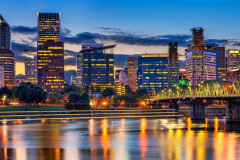
Oregon
Description
Oregon is a state in the Pacific Northwest region of the United States. Oregon is bordered on the west by the Pacific Ocean, on the north by Washington, on the south by California, on the east by Idaho, and on the southeast by Nevada. The Columbia River delineates much of Oregon's northern boundary, and the Snake River delineates much of the eastern boundary. The parallel 42° north delineates the southern boundary with California and Nevada. It is one of only three states of the contiguous United States to have a coastline on the Pacific Ocean, and the proximity to the ocean heavily influences the state's mild winter climate, despite the latitude.
Oregon was inhabited by many indigenous tribes before Western traders, explorers, and settlers arrived. An autonomous government was formed in the Oregon Country in 1843, the Oregon Territory was created in 1848, and Oregon became the 33rd state on February 14, 1859. Today, at 98,000 square miles (255,000 km²), Oregon is the ninth largest and, with a population of 4 million, 26th most populous U.S. state. The capital of Oregon is Salem, the second most populous of its cities, with 160,614 residents (2013 estimate). With 609,456 residents (2013 estimate), Portland is the largest city in Oregon and ranks 29th in the U.S. Its metro population of 2,314,554 (2013 estimate) is 24th. The Willamette Valley in western Oregon is the state's most densely populated area, home to eight of the ten most populous cities.
Oregon's landscape is diverse, with a windswept Pacific coastline; a volcano-studded Cascade Range; abundant bodies of water in and west of the Cascades; dense evergreen, mixed, and deciduous forests at lower elevations; and a high desert sprawling across much of its east all the way to the Great Basin. The tall conifers, mainly Douglas fir, along Oregon's rainy west coast contrast with the lighter-timbered and fire-prone pine and juniper forests covering portions to the east. Abundant alders in the west fix nitrogen for the conifers. Stretching east from central Oregon are semi-arid shrublands, prairies, deserts, steppes, and meadows. At 11,249 feet (3,429 m), Mount Hood is the state's highest point, and Crater Lake National Park is Oregon's only national park.
Etymology
The earliest evidence of the name Oregon has Spanish origins. The term "orejón" comes from the historical chronicle Relación de la Alta y Baja California (1598) written by the new Spaniard Rodrigo Motezuma and made reference to the Columbia river when the Spanish explorers penetrated into the actual north american territory that became part of the Viceroyalty of New Spain. This chronicle is the first topographical and linguistic source with respect to the place name Oregon. There are also two other sources with Spanish origins such as the name Oregano which grows in the southern part of the region. It is most probable that the American territory was named by the Spaniards as there are some populations in Spain such as "Arroyo del Oregón" which is situated in the province of Ciudad Real, also considering that the individualization in Spanish language "El Orejón" with the mutation of the letter "g" instead of "j".
Another early use of the name, spelled Ouragon, was in a 1765 petition by Major Robert Rogers to the Kingdom of Great Britain. The term referred to the then-mythical River of the West (the Columbia River). By 1778 the spelling had shifted to Oregon. In his 1765 petition, Rogers wrote:
The rout [sic]...is from the Great Lakes towards the Head of the Mississippi, and from thence to the River called by the Indians Ouragon...
One theory is the name comes from the French word ouragan ("windstorm" or "hurricane"), which was applied to the River of the West based on Native American tales of powerful Chinook winds of the lower Columbia River, or perhaps from firsthand French experience with the Chinook winds of the Great Plains. At the time, the River of the West was thought to rise in western Minnesota and flow west through the Great Plains.
Joaquin Miller explained in Sunset magazine, in 1904, how Oregon's name was derived:
The name, Oregon, is rounded down phonetically, from Aure il agua—Oragua, Or-a-gon, Oregon—given probably by the same Portuguese navigator that named the Farallones after his first officer, and it literally, in a large way, means cascades: 'Hear the waters.' You should steam up the Columbia and hear and feel the waters falling out of the clouds of Mount Hood to understand entirely the full meaning of the name Aure il agua, Oregon.
Another account, endorsed as the "most plausible explanation" in the book Oregon Geographic Names, was advanced by George R. Stewart in a 1944 article in American Speech. According to Stewart, the name came from an engraver's error in a French map published in the early 18th century, on which the Ouisiconsink (Wisconsin) River was spelled "Ouaricon-sint," broken on two lines with the -sint below, so there appeared to be a river flowing to the west named "Ouaricon."
According to the Oregon Tourism Commission (doing business as Travel Oregon), present-day Oregonians /ˌɒrᵻˈɡoʊniənz/ pronounce the state's name as "or-uh-gun, never or-ee-gone."
After being drafted by the Detroit Lions in 2002, former Oregon Ducks quarterback Joey Harrington distributed "Orygun" stickers to members of the media as a reminder of how to pronounce the name of his home state. The stickers are sold by the University of Oregon Bookstore.
History
Humans have inhabited the area that is now Oregon for at least 15,000 years. In recorded history, mentions of the land date to as early as the 16th century. During the 18th and 19th centuries, European powers – and later the United States – quarreled over possession of the region until 1846, when the U.S. and Great Britain finalized division of the region. Oregon became a state in 1859 and is now home to over 3.97 million residents.
Earliest inhabitants
Human habitation of the Pacific Northwest began at least 15,000 years ago, with the oldest evidence of habitation in Oregon found at Fort Rock Cave and the Paisley Caves in Lake County. Archaeologist Luther Cressman dated material from Fort Rock to 13,200 years ago. By 8000 BC there were settlements throughout the state, with populations concentrated along the lower Columbia River, in the western valleys, and around coastal estuaries.
By the 16th century, Oregon was home to many Native American groups, including the Coquille (Ko-Kwell), Bannock, Chasta, Chinook, Kalapuya, Klamath, Molalla, Nez Perce, Takelma, Tillamook and Umpqua.
European exploration
The first Europeans to visit Oregon were Spanish explorers led by Juan Rodríguez Cabrillo who sighted southern Oregon off the Pacific Coast in 1543. Francis Drake made his way to Nehalem Bay in 1579 and spent 5 weeks in the middle of summer repairing his ship and claimed the land between 38-48 degrees N latitude as a Symbolic Sovereign Act for England. Exploration was retaken routinely in 1774, starting with the expedition of the frigate Santiago by Juan José Pérez Hernández (see Spanish expeditions to the Pacific Northwest), and the coast of Oregon became a valuable trading route to Asia. In 1778, British captain James Cook also explored the coast.
French Canadian and métis trappers and missionaries arrived in the eastern part of the state in the late 18th and early 19th centuries, many having travelled as members of Lewis and Clark and the 1811 Astor expeditions. Some stayed permanently, including Étienne Lussier, believed to be the first European farmer in the state of Oregon. The evidence of this French Canadian presence can be found in the numerous names of French origin in that part of the state, including Malheur Lake and the Malheur River, the Grande Ronde and Deschutes rivers, and the city of La Grande.
During U.S. westward expansion
The Lewis and Clark Expedition traveled through northern Oregon also in search of the Northwest Passage. They built their winter fort in 1805–06 at Fort Clatsop, near the mouth of the Columbia River.
British explorer David Thompson also conducted overland exploration. In 1811, while working for the North West Company, Thompson became the first European to navigate the entire Columbia River. Stopping on the way, at the junction of the Snake River, he posted a claim to the region for Great Britain and the North West Company. Upon returning to Montreal, he publicized the abundance of fur-bearing animals in the area.
Also in 1811, New Yorker John Jacob Astor financed the establishment of Fort Astoria at the mouth of the Columbia River as a western outpost to his Pacific Fur Company; this was the first permanent European settlement in Oregon.
In the War of 1812, the British gained control of all Pacific Fur Company posts. The Treaty of 1818 established joint British and American occupancy of the region west of the Rocky Mountains to the Pacific Ocean. By the 1820s and 1830s, the Hudson's Bay Company dominated the Pacific Northwest from its Columbia District headquarters at Fort Vancouver (built in 1825 by the district's chief factor, John McLoughlin, across the Columbia from present-day Portland).
In 1841, the expert trapper and entrepreneur Ewing Young died leaving considerable wealth and no apparent heir, and no system to probate his estate. A meeting followed Young's funeral at which a probate government was proposed. Doctor Ira Babcock of Jason Lee's Methodist Mission was elected supreme judge. Babcock chaired two meetings in 1842 at Champoeg, (half way between Lee's mission and Oregon City), to discuss wolves and other animals of contemporary concern. These meetings were precursors to an all-citizen meeting in 1843, which instituted a provisional government headed by an executive committee made up of David Hill, Alanson Beers, and Joseph Gale. This government was the first acting public government of the Oregon Country before annexation by the government of the United States.
Also in 1841, Sir George Simpson, governor of the Hudson's Bay Company, reversed the Hudson's Bay Company's long-standing policy of discouraging settlement because it interfered with the lucrative fur trade. He directed that some 200 Red River Colony settlers be relocated to HBC farms near Fort Vancouver, (the James Sinclair expedition), in an attempt to hold Columbia District.
Starting in 1842–1843, the Oregon Trail brought many new American settlers to Oregon Country. For some time, it seemed that Britain and the United States would go to war for a third time in 75 years (see Oregon boundary dispute), but the border was defined peacefully in 1846 by the Oregon Treaty. The border between the United States and British North America was set at the 49th parallel. The Oregon Territory was officially organized in 1848.
Settlement increased with the Donation Land Claim Act of 1850 and the forced relocation of the native population to Indian reservations in Oregon.
After statehood
Oregon was admitted to the Union on February 14, 1859. Founded as a refuge from disputes over slavery, Oregon had a "whites only" clause in its original state Constitution.
At the outbreak of the American Civil War, regular U.S. troops were withdrawn and sent east. Volunteer cavalry recruited in California were sent north to Oregon to keep peace and protect the populace. The First Oregon Cavalry served until June 1865.
Beginning in the 1880s, the growth of railroads expanded the state's lumber, wheat, and other agricultural markets, and the rapid growth of its cities.
20th and 21st centuries
In 1902, Oregon introduced direct legislation by the state's citizens through initiatives and referenda, known as the Oregon System.
On May 5, 1945, six people were killed by a Japanese bomb that exploded on Gearhart Mountain near Bly. This is the only fatal attack on the United States mainland committed by a foreign nation since the Mexican–American War, making Oregon the only U.S. state that has experienced fatal casualties by a foreign army since 1848, as Hawaii was not yet a state when Pearl Harbor was attacked in 1941. The bombing site is now called the Mitchell Recreation Area.
Industrial expansion began in earnest following the 1933–1937 construction of the Bonneville Dam on the Columbia River. Hydroelectric power, food, and lumber provided by Oregon helped fuel the development of the West, although the periodic fluctuations in the U.S. building industry have hurt the state's economy on multiple occasions.
In 1994, Oregon became the first U.S. state to legalize physician-assisted suicide through the Oregon Death with Dignity Act.
A measure to legalize recreational use of marijuana in Oregon was approved on November 4, 2014, making Oregon only the second state to have legalized gay marriage, physician-assisted suicide, and recreational marijuana.
African American history
As the nation expanded west, those making their way to the newly expanded territories often took their slaves with them, despite slavery being prohibited in the new territories. While slaves were present they were not recorded as slaves on documents, due to slavery's illegal status. Some territories took harsh and firm stances against blacks, and Oregon was among them.
In December 1844, Oregon passed its Black Exclusion Law, which prohibited African Americans from entering the territory while simultaneously prohibiting slavery. Slave owners who brought their slaves with them were given three years before they were forced to free them. Any African Americans in the region after the law was passed were forced to leave, those who did not comply were arrested and beaten. They received no less than twenty and no more than thirty-nine stripes across their bare back. If they still did not leave, this process could be repeated every six months.
Although slavery was prohibited in Oregon, it persisted even into its statehood. In fact, in 1852 Robin Holmes was forced to file a lawsuit against his former owner, Nathaniel Ford. Ford held Holmes and his family as slaves in the Oregon territory and eventually freed Holmes, his wife, and infant child; but refused to release Holmes' three older children. The case made its way to the Oregon Supreme Court where Holmes won and Ford was required to release the children.
Slavery played a major part in Oregon's history and even influenced its path to statehood. The territory's request for statehood was delayed several times, as Congress argued among themselves whether it should be admitted as a "free" or "slave" state. Eventually politicians from the south agreed to allow Oregon to enter as a "free" state, in exchange for opening slavery to the southwest United States.
Geography
National parks and historic areas in Oregon Entity Location Crater Lake National Park Southern Oregon John Day Fossil Beds National Monument Eastern Oregon Newberry National Volcanic Monument Central Oregon Cascade–Siskiyou National Monument Southern Oregon Oregon Caves National Monument Southern Oregon California Trail Southern Oregon, California Fort Vancouver National Historic Site Western Oregon, Washington Lewis and Clark National Historic Trail IL, MO, KS, IA, NE, SD,ND, MT, ID, OR, WA Lewis and Clark National and State Historical Parks Western Oregon, Washington Nez Perce National Historical Park MT, ID, OR, WA Oregon Trail MO, KS, NE, WY, ID, OR
Oregon's geography may be split roughly into eight areas:
- Oregon Coast—west of the Coast Range
- Willamette Valley
- Rogue Valley
- Cascade Range
- Klamath Mountains
- Columbia Plateau
- High Desert
- Blue Mountains
The mountainous regions of western Oregon, home to three of the most prominent mountain peaks of the United States including Mount Hood, were formed by the volcanic activity of the Juan de Fuca Plate, a tectonic plate that poses a continued threat of volcanic activity and earthquakes in the region. The most recent major activity was the 1700 Cascadia earthquake. Washington's Mount St. Helens erupted in 1980, an event that was visible from northern Oregon and affected some areas there.
The Columbia River, which forms much of the northern border of Oregon, also played a major role in the region's geological evolution, as well as its economic and cultural development. The Columbia is one of North America's largest rivers, and one of two rivers to cut through the Cascades (the Klamath River in Southern Oregon is the other). About 15,000 years ago, the Columbia repeatedly flooded much of Oregon during the Missoula Floods; the modern fertility of the Willamette Valley is largely a result of those floods. Plentiful salmon made parts of the river, such as Celilo Falls, hubs of economic activity for thousands of years. In the 20th century, numerous hydroelectric dams were constructed along the Columbia, with major impacts on salmon, transportation and commerce, electric power, and flood control.
Today, Oregon's landscape varies from rain forest in the Coast Range to barren desert in the southeast, which still meets the technical definition of a frontier.
Oregon is 295 miles (475 km) north to south at longest distance, and 395 miles (636 km) east to west at longest distance. In land and water area, Oregon is the ninth largest state, covering 98,381 square miles (254,810 km2). The highest point in Oregon is the summit of Mount Hood, at 11,249 feet (3,429 m), and its lowest point is the sea level of the Pacific Ocean along the Oregon Coast. Oregon's mean elevation is 3,300 feet (1,006 m). Crater Lake National Park is the state's only national park and the site of Crater Lake, the deepest lake in the U.S. at 1,943 feet (592 m). Oregon claims the D River as the shortest river in the world, though the state of Montana makes the same claim of its Roe River. Oregon is also home to Mill Ends Park (in Portland), the smallest park in the world at 452 square inches (0.29 m2).
Oregon's geographical center is farther west than that of any of the other 48 contiguous states (although the westernmost point of the lower 48 states is in Washington). Its antipodes, diametrically opposite its geographical center on the Earth's surface, is at 44°00′S 59°30′E / 44°S 59.5°E / -44; 59.5 in the Indian Ocean northwest of Port-aux-Français in the French Southern and Antarctic Lands. Oregon lies in two time zones. Most of Malheur County is in the Mountain Time Zone while the rest of the state lies in the Pacific Time Zone.
Oregon is home to what is considered the largest single organism in the world, an Armillaria solidipes fungus beneath the Malheur National Forest of eastern Oregon.
- Images of Oregon
-
Mount Hood, with Trillium Lake in the foreground
-
An aerial view of Crater Lake
-
The High Desert region of Oregon
-
Kalmiopsis Wilderness
-
Portland
-
Downtown Eugene as seen from Skinner Butte in North Eugene
-
Roxy Ann Peak, seen from Medford
-
Map of Oregon's population density
-
Nearly half of Oregon's land is held by the U.S. Forest Service and the Bureau of Land Management
-
Willamette Valley basin map
Major cities
Further information: List of cities and unincorporated communities in OregonOregon's population is largely concentrated in the Willamette Valley, which stretches from Eugene in the south (home of the University of Oregon) through Corvallis (home of Oregon State University) and Salem (the capital) to Portland (Oregon's largest city).
Astoria, at the mouth of the Columbia River, was the first permanent English-speaking settlement west of the Rockies in what is now the United States. Oregon City, at the end of the Oregon Trail, was the Oregon Territory's first incorporated city, and was its first capital from 1848 until 1852, when the capital was moved to Salem. Bend, near the geographic center of the state, is one of the ten fastest-growing metropolitan areas in the United States. In the southern part of the state, Medford is a rapidly growing metro area, which is home to The Rogue Valley International-Medford Airport, the third-busiest airport in the state. To the south, near the California-Oregon border, is the community of Ashland, home of the Tony Award-winning Oregon Shakespeare Festival.
Flora and fauna
Typical of a western state, Oregon is home to a unique and diverse array of wildlife. About 46% of the state is covered in forest, mostly west of the Cascades where up to 80% of the land is forest. Sixty percent of the forests in Oregon are within federal land. Oregon remains the top timber producer of the lower 48 states.
- Typical tree species include the Douglas fir, the state tree, as well as redwood, ponderosa pine (generally east of the Cascades), western red cedar, hemlock, and ferns. Ponderosa pine are more common in the Blue Mountains in the eastern part of the state and firs are more common in the west.
- There are many species of mammals that live in the state, which include, but are not limited to, opossums, shrews, moles, little pocket mice, great basin pocket mice, dark kangaroo mouse, California kangaroo rat, chisel-toothed kangaroo rat, ord's kangaroo rat,bats, rabbits, pikas, mountain beavers, chipmunks, western gray squirrels, yellow-bellied marmots, beavers, porcupines, coyotes, wolves, red foxes, common grey fox, kit fox,black bears, raccoons, badgers, skunks, cougars, bobcats, lynxes, deer, elk, and moose.
- Marine mammals include seals, sea lions, humpback, killer whales, gray whales, blue whales, sperm whale, pacific whitesided dolphin, and bottlenose dolphin.
- Notable birds include American widgeons, mallard ducks, great blue herons, bald eagles, golden eagles, western meadowlarks (the state bird), barn owls, great horned owls, rufous hummingbirds, pileated woodpeckers, wrens, towhees, sparrows, and buntings.
Moose have not always inhabited the state but came to Oregon in the 1960s; the Wallowa Valley herd now numbers about 60. Gray wolves were extirpated from Oregon around 1930 but have since found their way back; there are now two packs living in the south-central part of the state. Although their existence in Oregon is unconfirmed, reports of grizzly bears still turn up the state and it is probable that some still move into eastern Oregon from Idaho. There are some areas in Oregon where humans find themselves living in the same area as wildlife. This is bound to happen more as the human population grows. When wildlife resources dwindle (food, water and shelter) they will often look for food and shelter in homes and garages.
Oregon has three national park sites: Crater Lake National Park in the southern part of the Cascades, John Day Fossil Beds National Monument, and Lewis and Clark National and State Historical Parks.