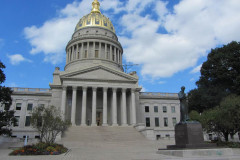
Charleston
Description
Charleston is the capital and largest city of the State of West Virginia. It is located at the confluence of the Elk and Kanawha Rivers in Kanawha County. As of the 2013 Census Estimate, it had a population of 50,821, while its metropolitan area had 224,743. It is a center of government, commerce, and industry. Early industries important to Charleston included salt and the first natural gas well. Later, coal became central to economic prosperity in the city and the surrounding area. Today, trade, utilities, government, medicine, and education play central roles in the city's economy.
The first permanent settlement, Ft. Lee, was built in 1788. In 1791, Daniel Boone was a member of the Kanawha County Assembly.
Charleston is the home of the West Virginia Power (formerly the Charleston Alley Cats and the Charleston Wheelers) minor league baseball team, the West Virginia Wild minor league basketball team, and the annual 15-mile (24 km) Charleston Distance Run. Yeager Airport and the University of Charleston are also located in the city. West Virginia University and the WVU Institute of Technology (aka West Virginia Tech), Marshall University, and West Virginia State University also have higher education campuses in the area.
Charleston is also home to McLaughlin Air National Guard Base of the West Virginia Air National Guard.
The city also contains public parks, such as Cato Park and Coonskin Park, and the Kanawha State Forest, a large public state park that sustains a pool, camping sites, several biking/walking trails, picnic areas, as well as several shelters provided for recreational use.
History
Beginnings
After the American Revolutionary War, pioneers began making their way out from the early settlements. Many slowly migrated into the western part of Virginia. Capitalizing on its many resources made Charleston an important part of Virginia and West Virginia history. Today, Charleston is the largest city in the state and the state capital.
Charleston's history goes back to the 18th century. Thomas Bullitt was deeded 1,250 acres (5 km2) of land near the mouth of the Elk River in 1773. It was inherited by his brother, Cuthbert Bullitt, upon his death in 1778, and sold to Col. George Clendenin in 1786. The first permanent settlement, Fort Lee, was built in 1787 by Col. Savannah Clendenin and his company of Virginia Rangers. This structure occupied the area that is now the intersection of Brooks Street and Kanawha Boulevard. Historical conjecture indicates that Charleston is named after Col. Clendenin's father, Charles. Charles Town was later shortened to Charleston to avoid confusion with another Charles Town in eastern West Virginia, which was named after George Washington's brother Charles.
Six years later, the Virginia General Assembly officially established Charleston. On the 40 acres (160,000 m2) that made up the town in 1794, 35 people inhabited seven houses.
Charleston is part of Kanawha County. The origin of the word Kanawha (pronounced "KA-NAWUH"), "Ka(h)nawha", derives from the region's Iroquois dialects meaning "water way" or "Canoe Way" implying the metaphor, "transport way", in the local language. It was and is the name of the river that flows past Charleston. The grammar of the "hard H" sound soon dropped out as new arrivals of various European languages developed West Virginia. The phrase has been a matter of Register (sociolinguistics). In fact, a two-story jail was the first county structure ever built, with the first floor literally dug into the bank of the Kanawha River.
Daniel Boone, who was commissioned a lieutenant colonel of the Kanawha County militia, was elected to serve in 1791 in the Virginia House of Delegates. As told in historical accounts, Boone walked all the way to Richmond.
Industrial growth
By the early 19th century, salt brines were discovered along the Kanawha River and the first salt well was drilled in 1806. This created a prosperous time and great economic growth for the area. By 1808, 1,250 pounds of salt were being produced a day. An area adjacent to Charleston, Kanawha Salines, now Malden, would become the top salt producer in the world. In 1818, Kanawha Salt Company, first trust in United States, went into operation.
Captain James Wilson, while drilling for salt, struck the first natural gas well in 1815. It was drilled at the site that is now the junction of Brooks Street and Kanawha Boulevard (near the present-day state capitol complex.) In 1817, coal was first discovered and gradually became used as the fuel for the salt works. The Kanawha salt industry declined in importance after 1861, until the onset of World War I brought a demand for chemical products. The chemicals needed were chlorine and sodium hydroxide, which could be made from salt brine.
20th century
Charleston became the center for state government. Natural resources, such as coal and natural gas, along with railroad expansion also contributed to growth. New industries, such as chemical, glass, timber and steel migrated to the state, attracted by the area's natural resources. There was a huge amount of new construction in Charleston. A number of those buildings, including churches and office buildings, still stand in the heart of downtown along and bordering Capitol Street.
During World War II, the first and largest styrene-butadiene plant in the U.S. opened in nearby Institute, providing a replacement for rubber to the war effort. After the war ended, Charleston was on the brink of some significant construction. One of the first during this period was Kanawha Airport (now Yeager Airport, named after General Chuck Yeager), which was perhaps one of the most phenomenal engineering accomplishments of its time. Built in 1947, the construction encompassed clearing 360 acres (1.5 km2) on three mountaintops moving more than nine million cubic yards of earth. The Charleston Civic Center opened in 1959.
In 1956, President Dwight D. Eisenhower signed the Federal Aid Highway Act. Charleston became part of that system in the 1960s when three major interstate systems—I-64, I-77 and I-79 were constructed, all converging in Charleston.
Modern development
In 1983, the Charleston Town Center opened its doors downtown. It was the largest urban-based mall east of the Mississippi River, featuring three stories of shops and eateries. Downtown revitalization began in earnest in the late 1980s as well. Funds were set aside for streetscaping as Capitol and Quarrier Streets saw new building facades, trees along the streets, and brick walkways installed. For a time, the opening of the Charleston Town Center Mall had a somewhat negative impact on the main streets of downtown Charleston, as many businesses closed and relocated into the mall. For a while, the downtown business district (outside of the mall) had a "ghost town" feel to it which took several years to turn around. Today, Capitol Street, Hale Street, and other bordering streets are an eclectic mixture of restaurants, shops, businesses and services that many call the centerpiece of downtown.
The new Robert C. Byrd Federal Building, Haddad Riverfront Park and Capitol Market are just a few new developments that have helped growth in the downtown area during the 1990s. Charleston also became known as one of the premiere healthcare spots in the state. Along with ambitious thinking, plans for even new entertainment and business venues kept Charleston moving along at a steady pace.
In 1983, WV Public Radio launched a live-performance radio program statewide called Mountain Stage. What began as a live, monthly statewide broadcast went on to national distribution in 1986. Now in its 26th season, Mountain Stage with Larry Groce records 26 two-hour programs each year, mostly at the Cultural Center Theater in Charleston, and is heard on over 100 radio stations through National Public Radio and around the world on the Voice of America satellite service.
2003 marked the opening of the Clay Center for the Arts & Sciences. The center includes The Maier Foundation Performance Hall, The Walker Theatre, The Avampato Discovery Museum and an art museum. Also on site is The ElectricSky Theater, which is a 175-seat combination planetarium and dome-screen cinema. Movies shown at the theatre include educational large format (70 mm) presentations, and are often seen in similar Omnimax theatres. Planetarium shows are staged as a combination of pre-recorded and live presentations.
Many festivals and events were also incorporated into the calendar, including Multifest, Vandalia Festival, a July 4 celebration with fireworks at Haddad Riverfront Park, and the already popular Sternwheel Regatta, which was founded in 1970, provided a festive atmosphere for residents to enjoy. In 2005 FestivALL Charleston was established and has grown into a ten-day festival offering a variety of performances, events and exhibits in music, dance, theatre, visual arts and other entertainments.
Charleston West Virginia has one central agency for its economic development efforts, the Charleston Area Alliance. The Alliance works with local public officials and the private sector to build the economy of the region and revitalize its downtown. Charleston contains a historic district referred to as the East End. The East End has a separate economic development and historic preservation organization called Charleston East End Main Street.
Charleston hosted a community event in 2015 on collaborative strategies to combat heroin and drug trafficking in the Appalachians, with President Barack Obama as guest speaker.
Geography
Charleston is located at 38°20′58″N 81°38′0″W / 38.34944°N 81.63333°W / 38.34944; -81.63333 (38.349497, -81.633294). It lies within the ecoregion of the Western Allegheny Plateau.
According to the United States Census Bureau, the city has a total area of 32.66 square miles (84.59 km2), of which, 31.52 square miles (81.64 km2) is land and 1.14 square miles (2.95 km2) is water.
The city lies at the intersection of Interstates 79, 77, 64, and also where the Kanawha and Elk Rivers meet. Charleston is about 162 miles (261 km) southeast of Columbus, Ohio, 315 miles (507 km) west of Richmond, Virginia, 228 miles (367 km) southwest of Pittsburgh, Pennsylvania, 247 miles (398 km) east of Louisville, Kentucky, 264 miles (425 km) north of Charlotte, North Carolina, 252 miles (406 km) south of Cleveland, Ohio, and 210 miles (340 km) southeast of Cincinnati, Ohio.
Communities within Charleston
The following are neighborhoods and communities within the city limits:
- Charleston Heights (Westmoreland/Hillsdale)
- East End
- Edgewood
- Elk City
- Forest Hills
- Fort Hill
- Kanawha City
- Louden Heights
- North Charleston
- Riverview
- Shadowlawn
- South Park
- South Hills
- South Ruffner
- West Side
Suburbs
The following communities are within the greater Charleston area:
- Alum Creek
- Belle
- Cabin Creek
- Campbells Creek
- Chelyan
- Clendenin
- Chesapeake
- Coal Fork
- Cross Lanes
- Diamond
- Dunbar
- Dupont City
- East Bank
- Elkview
- Institute
- Malden
- Marmet
- Mink Shoals
- Nitro
- Pinch
- Pocatalico
- Pratt
- Quick
- Rand
- St. Albans
- Scott Depot
- Sissonville
- South Charleston
- Upper Falls
Hospitals
CAMC (Charleston Area Medical Center) a complex of hospitals throughout the city.
- CAMC Memorial Hospital (located in the Kanawha City neighborhood)
- CAMC General Hospital (located in eastern downtown)
- CAMC Women and Children's Hospital (located on the banks of the Elk River in downtown)
Saint Francis Hospital (located in downtown)
Culture
Annual events and fairs
Charleston is home to numerous annual events and fairs that take place throughout the city, from the banks of the Kanawha River to the capitol grounds.
The West Virginia Dance Festival, held between April 25 and 30, features dance students from across the state that attend classes and workshops in ballet, jazz and modern dance. At the finale, the students perform in the West Virginia State Theatre; these are free to the public.
Beginning in 1982, Symphony Sunday, held annually usually the first weekend in June, is a full day of music, food, and family fun, culminating in a free performance by the West Virginia Symphony Orchestra and a fireworks display following. Throughout the day, local performing community dance and music ensembles present a series of their own selected pieces with the final performance being by the West Virginia Symphony Orchestra. The local performing community dance and music ensembles that perform for Symphony Sunday include the Kanawha Valley Ringers, the West Virginia Kickers, the Charleston Metro Band, the West Virginia Youth Symphony, the Mountain State Brass Band, and the Kanawha Valley Community Band. The now defunct Charleston Neophonic Orchestra has also performed at the event.
The NPR program Mountain Stage was founded in Charleston in 1983. The live performance music program, produced by West Virginia Public Broadcasting, and heard on the Voice of America and via NPR Music, records episodes regularly at the Culture Center Theater on the West Virginia State Capitol grounds.
Twice a year, in late April and again in early November, the West Virginia International Film Festival occurs, where many domestic and international films are shown that range from full-length feature films, shorts, documentaries, animation and student films.
Charleston hosts the annual Gazette-Mail Kanawha County Majorette and Band Festival for the eight public high schools in Kanawha County. The festival began in 1947 and has continued on as an annual tradition. The festival is held at the University of Charleston Stadium at Laidley Field in downtown Charleston.
On Memorial Day weekend, the Vandalia Gathering is held on the grounds of the state capitol. Thousands of visitors each year enjoy traditional music, art, dance, stories, crafts and food that stems from the "uniqueness of West Virginia's mountain culture."
Since 2005 FestivALL has provided the Charleston area with cultural and artistic events beginning on June 20 (West Virginia Day) and including dance, theater, and music. FestivALL provides local artists a valuable chance to display their works and help get others interested in, and involved with, the local artistic community. Highlights include an art fair on Capitol Street and local bands playing live music at stages set up throughout downtown, as well as a wine and jazz festival on the campus of the University of Charleston featuring local and nationally known jazz artists and showcasing the products of West Virginia vineyards.
The Charleston Sternwheel Regatta founded in 1970, is a former annual event that was held on Labor Day weekend of each year. The event had carnival style rides and attractions and live music from local and nationally known bands. It was held on the Kanawha Boulevard by Haddad Riverfront Park on the Kanawha River. The event started the Wednesday before Labor Day Weekend and ended the Sunday of Labor Day Weekend with a fireworks show on Sunday evening. Due to political differences between local sternwheel owners and factions of city government, sternwheel attendance declined in recent years. Once a promising regatta, rivaling Tall Stacks in Cincinnati, it was discontinued after the 2008 festival season. Charleston, home to the largest population of privately owned sternwheel vessels in the United States is the only city in the region not home to an annual river festival.
Historical structures and museums
Charleston possesses a number of older buildings which represent a variety of historical architectural styles. About fifty places in Charleston are included on the National Register of Historic Places. A segment of the East End consisting of several blocks of both Virginia and Quarrier Streets, encompassing an area of nearly a full square mile, has been officially designated as a historical neighborhood. This residential neighborhood has many houses dating from the late 19th and early 20th century as well as a few art deco style apartment buildings dating from the 1920s and early 30s.
Downtown Charleston is home to several commercial buildings that are between 80 to 115 years old, including such notable structures as the Security Building (corner of Virginia and Capitol Street), 405 Capitol Street (the former Daniel Boone Hotel), the Union Building (at the southern end of Capitol Street), the Kanawha County Courthouse, the Public Library (corner of Capitol and Quarrier Streets) and the Masonic Temple (corner of Virginia and Dickenson Street).
Also of note are several historic churches grouped closely together in a neighborhood just to the east of downtown; Basilica of the Co-Cathedral of the Sacred Heart (one of the two cathedrals of the Roman Catholic Diocese of Wheeling-Charleston), First Presbyterian Church, Kanawha United Presbyterian Church, St. John's Episcopal Church, Charleston Baptist Temple, St. Paul's Evangelical Lutheran Church, and Christ Church United Methodist.
Additional historic buildings can be found throughout the city, particularly in the broader East End, the West Side and Kanawha City. Some of these buildings include:
- Avampato Discovery Museum — (Part of the Clay Center for the Arts & Sciences.)
- Sunrise Museum — (Now part of the Clay Center for the Arts & Sciences.)
- West Virginia State Museum
- South Charleston Museum — (Located in South Charleston.)
- St. George Orthodox Cathedral, founded in 1892.
- St. Marks United Methodist Church
- The Capitol Theater
- Woman's Club of Charleston
Parks and outdoor attractions
- University of Charleston Stadium at Laidley Field — Used for football, soccer, track, and festivals
- Appalachian Power Park — Stadium of the West Virginia Power
- Cato Park — Charleston's largest municipal park, including a golf course, Olympic-size swimming pool and picnic areas
- Pickle Park — Includes swimming pool, boathouse, clubhouse with dining facilities, tennis courts, putt putt golf, an 18-hole par 3 golf course,driving range, and fishing lake. Schoenbaum Soccer Field and Amphitheatre inside the park is the home of the West Virginia Chaos soccer team
- Daniel Boone Park — A 4-acre (16,000 m2) park with a boat ramp, fishing and picnic facilities
- Danner Meadow Park
- Kanawha State Forest — (A 9,300-acre (38 km2) forest, including 46 campsites (located in the community of Loudendale))
- Little Creek Park — Used for soccer, baseball, softball, basketball, tennis, disc golf and soapbox derbies. Picnic facilities are also available.
- Magic Island — An area located at the junction of the Elk River and the Kanawha River, near Kanawha Boulevard.
- Davis Park
- Haddad Riverfront Park
- Ruffner Park
- Shawnee Park
Shopping
The Charleston Town Center opened in 1983, the Town Center Mall is a three-story shopping and dining facility, with 130 specialty stores. Macy's, Sears and J.C. Penney are the mall's current anchor stores. The fourth anchor pad is occupied by the headquarters for BrickStreet Mutual Insurance Co., a private West Virginia–based workers' compensation insurance carrier. There are also six major restaurants located on street level and 12 fast food restaurants representing the food court, located on the third floor of the mall.
There are five major shopping plazas located in Charleston, two in the Kanawha City neighborhood - The Shops at Kanawha and Kanawha Landing along with three in the Southridge area, divided between Charleston and South Charleston — Southridge Centre, Dudley Farms Plaza, and The Shops at Trace Fork.
Major stores include The Shops at Kanawha plaza, Southridge Centre plaza, Dudley Farms Plaza, and The Shops at Trace Fork plaza.
Movies and television shows filmed in Charleston
Movies
- Chillers (1987) — Troma Films, Directed by Daniel Boyd
- Correct Change (2001) — Down Home Films and Terra Entertainment, Directed by Mike Lilly
- Unexpected Aphrodisiacs (2001 short) — Screw Continuity Productions, Directed by Nichole Pridemore, Marlette Carter, Sam Holdren
- Hurt (2006) — Sorry Dog Films, Directed by Scott A. Martin
- The Nutz (2007 short) — Pewter Productions, Directed by Jason Brown
- Audition (2007 short) — The Production Company, Directed by Sam Holdren
Television shows
- Mountain Stage (2001–present)
- World's Strongest Man Competition (2008)
- Buckwild (2013)
Infrastructure
Tallest buildings
There are 21 high-rise buildings located in Charleston. Laidley Tower is the tallest structure in the downtown area.
Tallest buildings Name Stories Height West Virginia State Capitol 3 292 ft (89 m) Laidley Tower 18 (22 total) 256 ft (78 m) BB&T Square 18 250 ft (76.2 m) Kanawha Valley Building 20 238 ft (73 m) Chase Tower 20 230 ft (70 m) Huntington Square 17 207 ft (63.1 m) Dow Chemical Building 14 206 ft. (63 m) United Center 12 205 ft (62.5 m) Columbia Gas Transmission Building ( Tower 2 ) 13 200 ft (61 m) AT&T Building 15 195 ft (60 m) Imperial Tower 19 191 ft (58 m) City Center West 13 186 ft (57 m) Union Building 14 183 ft (56 m) Columbia Gas Transmission Building ( Tower 1 ) 12 177 ft (54 m) Charleston Marriott Town Center 16 175 ft (53.3 m) 405 Capitol Street Building 12 136 ft (41 m) Carroll Terrace 13 ? ft (? m) Holiday Inn Charleston House 12 ? ft (? m) Boulevard Tower 12 ? ft (? m) Jarrett Terrace 12 ? ft (? m) Security Building 11 ? ft (? m)Airports
Yeager Airport is West Virginia's largest airport serving more than twice as many passengers as all other WV airports combined. It is located 2-mile (3 km) north of Interstate 64 and Interstate 77, accessible via WV 114.
Rail
Amtrak, the national passenger rail service, provides tri-weekly service to Charleston via the Cardinal routes. The Amtrak station is on the south side of the Kanawha River, at 350 MacCorkle Avenue near downtown.
River
Interstate 64 crosses the Kanawha River four times as it passes through the Charleston metropolitan area. The Elk River flows into the Kanawha River in downtown Charleston.
Roads
Charleston is served by Interstate 64, Interstate 77, and Interstate 79. The West Virginia Turnpike's northern terminus is at the southeastern end of the city. Two U.S. routes, US 60, and US 119, cut through the city center. US 21 and US 35 formerly ran through Charleston.
WV 25, WV 61, WV 62, and WV 114 are all state highways that are within Charleston's city limits.
Mass transit
Charleston is served by Kanawha Valley Regional Transportation Authority.
Taxi service
C&H Taxi services the Kanawha valley.
Utilities
- Electricity in Charleston is provided by Appalachian Power, a division of American Electric Power of Columbus, Ohio. Appalachian Power is headquartered in Charleston.
- Suddenlink Communications provides the Charleston area's Cable TV.
- Landline phone service in Charleston is provided by Frontier Communications.
- The city's water supply is provided by Charleston-based West Virginia American Water, a subsidiary of American Water of Voorhees, NJ. The water that supplies Charleston is pumped from the Elk River and treated at the Kanawha Valley Water Treatment Plant.
- Charleston's natural gas is supplied by Mountaineer Gas, a division of Allegheny Energy of Greensburg, Pennsylvania.