Wisconsin
Description
Wisconsin is a U.S. state located in the north-central United States, in the Midwest and Great Lakes regions. It is bordered by Minnesota to the west, Iowa to the southwest, Illinois to the south, Lake Michigan to the east, Michigan to the northeast, and Lake Superior to the north. Wisconsin is the 23rd largest state by total area and the 20th most populous. The state capital is Madison, and its largest city is Milwaukee, which is located on the western shore of Lake Michigan. The state is divided into 72 counties.
Wisconsin's geography is diverse, with the Northern Highland and Western Upland along with a part of the Central Plain occupying the western part of the state and lowlands stretching to the shore of Lake Michigan. Wisconsin is second to Michigan in the length of its Great Lakes coastline.
Wisconsin is known as "America's Dairyland" because it is one of the nation's leading dairy producers, particularly famous for cheese. Manufacturing, especially paper products, information technology (IT), and tourism are also major contributors to the state's economy.
Etymology
The word Wisconsin originates from the name given to the Wisconsin River by one of the Algonquian-speaking Native American groups living in the region at the time of European contact. French explorer Jacques Marquette was the first European to reach the Wisconsin River, arriving in 1673 and calling the river Meskousing in his journal. Subsequent French writers changed the spelling from Meskousing to Ouisconsin, and over time this became the name for both the Wisconsin River and the surrounding lands. English speakers anglicized the spelling from Ouisconsin to Wisconsin when they began to arrive in large numbers during the early 19th century. The legislature of Wisconsin Territory made the current spelling official in 1845.
The Algonquian word for Wisconsin and its original meaning have both grown obscure. Interpretations vary, but most implicate the river and the red sandstone that lines its banks. One leading theory holds that the name originated from the Miami word Meskonsing, meaning "it lies red", a reference to the setting of the Wisconsin River as it flows through the reddish sandstone of the Wisconsin Dells. Other theories include claims that the name originated from one of a variety of Ojibwa words meaning "red stone place", "where the waters gather", or "great rock".
History
Wisconsin has been home to a wide variety of cultures over the past 12,000 years. The first people arrived around 10,000 BCE during the Wisconsin Glaciation. These early inhabitants, called Paleo-Indians, hunted now-extinct ice age animals such as the Boaz mastodon, a prehistoric mastodon skeleton unearthed along with spear points in southwest Wisconsin. After the ice age ended around 8000 BCE, people in the subsequent Archaic period lived by hunting, fishing, and gathering food from wild plants. Agricultural societies emerged gradually over the Woodland period between 1000 BCE to 1000 CE. Toward the end of this period, Wisconsin was the heartland of the "Effigy Mound culture", which built thousands of animal-shaped mounds across the landscape. Later, between 1000 and 1500 CE, the Mississippian and Oneota cultures built substantial settlements including the fortified village at Aztalan in southeast Wisconsin. The Oneota may be the ancestors of the modern Ioway and Ho-Chunk tribes who shared the Wisconsin region with the Menominee at the time of European contact. Other Native American groups living in Wisconsin when Europeans first settled included the Ojibwa, Sauk, Fox, Kickapoo, and Pottawatomie, who migrated to Wisconsin from the east between 1500 and 1700.
Jean Nicolet, depicted in a 1910 painting by Frank Rohrbeck, was probably the first European to explore Wisconsin. The mural is located in the Brown County Courthouse in Green Bay.
The first European to visit what became Wisconsin was probably the French explorer Jean Nicolet. He canoed west from Georgian Bay through the Great Lakes in 1634, and it is traditionally assumed that he came ashore near Green Bay at Red Banks. Pierre Radisson and Médard des Groseilliers visited Green Bay again in 1654–1666 and Chequamegon Bay in 1659–1660, where they traded for fur with local Native Americans. In 1673, Jacques Marquette and Louis Jolliet became the first to record a journey on the Fox-Wisconsin Waterway all the way to the Mississippi River near Prairie du Chien. Frenchmen like Nicholas Perrot continued to ply the fur trade across Wisconsin through the 17th and 18th centuries, but the French made no permanent settlements in Wisconsin before Great Britain won control of the region following the French and Indian War in 1763. Even so, French traders continued to work in the region after the war, and some, beginning with Charles de Langlade in 1764, now settled in Wisconsin permanently rather than returning to British-controlled Canada.
The British gradually took over Wisconsin during the French and Indian War, taking control of Green Bay in 1761 and gaining control of all of Wisconsin in 1763. Like the French, the British were interested in little but the fur trade. One notable event in the fur trading industry in Wisconsin occurred in 1791, when two free African Americans set up a fur trading post among the Menominee at present day Marinette. The first permanent settlers, mostly French Canadians, some Anglo-New Englanders and a few African American freedmen, arrived in Wisconsin while it was under British control. Charles Michel de Langlade is generally recognized as the first settler, establishing a trading post at Green Bay in 1745, and moving there permanently in 1764. Settlement began at Prairie du Chien around 1781. The French residents at the trading post in what is now Green Bay, referred to the town as "La Baye", however British fur traders referred to it as "Green Bay", because the water and the shore assumed green tints in early spring. The old French title was gradually dropped, and the British name of "Green Bay" eventually stuck. The region coming under British rule had virtually no adverse effect on the French residents as the British needed the cooperation of the French fur traders and the French fur traders needed the goodwill of the British. During the French occupation of the region licenses for fur trading had been issued scarcely and only to select groups of traders, whereas the British, in an effort to make as much money as possible from the region, issued licenses for fur trading freely, both to British and French residents. The fur trade in what is now Wisconsin reached its height under British rule, and the first self-sustaining farms in the state were established as well. From 1763 to 1780, Green Bay was a prosperous community which produced its own foodstuff, built graceful cottages and held dances and festivities.
Wisconsin became a territorial possession of the United States in 1783 after the American Revolutionary War. However, the British remained in control until after the War of 1812, the outcome of which finally established an American presence in the area. Under American control, the economy of the territory shifted from fur trading to lead mining. The prospect of easy mineral wealth drew immigrants from throughout the U.S. and Europe to the lead deposits located at Mineral Point, Dodgeville, and nearby areas. Some miners found shelter in the holes they had dug and earned the nickname "badgers", leading to Wisconsin's identity as the "Badger State." The sudden influx of white miners prompted tension with the local Native American population. The Winnebago War of 1827 and the Black Hawk War of 1832 culminated in the forced removal of Native Americans from most parts of the state. Following these conflicts, Wisconsin Territory was created by an act of the United States Congress on April 20, 1836. By fall of that year, the best prairie groves of the counties surrounding what is now Milwaukee were occupied by farmers from the New England states.
The Erie Canal facilitated the travel of both Yankee settlers and European immigrants to Wisconsin Territory. Yankees from New England and upstate New York seized a dominant position in law and politics, enacting policies that marginalized the region's earlier Native American and French-Canadian residents. Yankees also speculated in real estate, platted towns such as Racine, Beloit, Burlington, and Janesville, and established schools, civic institutions, and Congregationalist churches. At the same time, many Germans, Irish, Norwegians and other immigrants also settled in towns and farms across the territory, establishing Catholic and Lutheran institutions. The growing population allowed Wisconsin to gain statehood as the 30th state on May 29, 1848. Between 1840 and 1850, Wisconsin's non-Indian population had swollen from 31,000 to 305,000. Over a third of residents (110,500) were foreign born, including 38,000 Germans, 28,000 British immigrants from England, Scotland and Wales, and 21,000 Irish. Another third (103,000) were Yankees from New England and western New York state. Only about 63,000 residents in 1850 had been born in Wisconsin.
Nelson Dewey, the first governor of Wisconsin, was a Democrat. Born in Lebanon, Connecticut, Dewey's father's family had lived in New England since 1633, when their ancestor, Thomas Due, had come to America from Kent County, England. Dewey oversaw the transition from the territorial to the new state government. He encouraged the development of the state's infrastructure, particularly the construction of new roads, railroads, canals, and harbors, as well as the improvement of the Fox and Wisconsin Rivers. During his administration, the State Board of Public Works was organized. Dewey was an abolitionist and the first of many Wisconsin governors to advocate against the spread of slavery into new states and territories. The home Dewey built near Cassville is now a state park.
The Little White Schoolhouse in Ripon, Wisconsin, held the nation's first meeting of the Republican Party
Politics in early Wisconsin were defined by the greater national debate over slavery. A free state from its foundation, Wisconsin became a center of northern abolitionism. The debate became especially intense in 1854 after Joshua Glover, a runaway slave from Missouri, was captured in Racine. Glover was taken into custody under the Federal Fugitive Slave Law, but a mob of abolitionists stormed the prison where Glover was held and helped him escape to Canada. In a trial stemming from the incident, the Wisconsin Supreme Court ultimately declared the Fugitive Slave Law unconstitutional. The Republican Party, founded on March 20, 1854, by anti-slavery expansion activists in Ripon, Wisconsin, grew to dominate state politics in the aftermath of these events. During the Civil War, around 91,000 troops from Wisconsin fought for the Union.
Wisconsin's economy also diversified during the early years of statehood. While lead mining diminished, agriculture became a principal occupation in the southern half of the state. Railroads were built across the state to help transport grains to market, and industries like J.I. Case & Company in Racine were founded to build agricultural equipment. Wisconsin briefly became one of the nation's leading producers of wheat during the 1860s. Meanwhile, the lumber industry dominated in the heavily forested northern sections of Wisconsin, and sawmills sprang up in cities like La Crosse, Eau Claire, and Wausau. These economic activities had dire environmental consequences. By the close of the 19th century, intensive agriculture had devastated soil fertility, and lumbering had deforested most of the state. These conditions forced both wheat agriculture and the lumber industry into a precipitous decline.
Beginning in the 1890s, farmers in Wisconsin shifted from wheat to dairy production in order to make more sustainable and profitable use of their land. Many immigrants carried cheese-making traditions that, combined with the state's suitable geography and dairy research led by Stephen Babcock at the University of Wisconsin, helped the state build a reputation as "America's Dairyland." Meanwhile, conservationists including Aldo Leopold helped reestablish the state's forests during the early 20th century, paving the way for a more renewable lumber and paper milling industry as well as promoting recreational tourism in the northern woodlands. Manufacturing also boomed in Wisconsin during the early 20th century, driven by an immense immigrant workforce arriving from Europe. Industries in cities like Milwaukee ranged from brewing and food processing to heavy machine production and toolmaking, leading Wisconsin to rank 8th among U.S. states in total product value by 1910.
Wisconsin Governor Robert La Follette addressing an assembly in Decatur, Illinois, 1905.
The early 20th century was also notable for the emergence of progressive politics championed by Robert M. La Follette. Between 1901 and 1914, Progressive Republicans in Wisconsin created the nation's first comprehensive statewide primary election system, the first effective workplace injury compensation law, and the first state income tax, making taxation proportional to actual earnings. The progressive Wisconsin Idea also promoted the statewide expansion of the University of Wisconsin through the UW-Extension system at this time. Later, UW economics professors John R. Commons and Harold Groves helped Wisconsin create the first unemployment compensation program in the United States in 1932.
In the immediate aftermath of World War II, citizens of Wisconsin were divided over things such as the creation of the United Nations, support for the European recovery, and the growth of the Soviet Union's power. However, when Europe divided into Communist and capitalist camps and the Communist revolution in China succeeded in 1949, public opinion began to move towards support for the protection of democracy and capitalism against Communist expansion.
Wisconsin took part in several political extremes in the mid to late 20th century, ranging from the anti-communist crusades of Senator Joseph McCarthy in the 1950s to the radical antiwar protests at UW-Madison that culminated in the Sterling Hall bombing in August 1970. The state became a leader in welfare reform under Republican Governor Tommy Thompson during the 1990s. The state's economy also underwent further transformations towards the close of the 20th century, as heavy industry and manufacturing declined in favor of a service economy based on medicine, education, agribusiness, and tourism.
Two U.S. Navy battleships, BB-9 and BB-64, were named for the state.
Geography
Wisconsin is bordered by the Montreal River; Lake Superior and Michigan to the north; by Lake Michigan to the east; by Illinois to the south; and by Iowa to the southwest and Minnesota to the northwest. A border dispute with Michigan was settled by two cases, both Wisconsin v. Michigan, in 1934 and 1935. The state's boundaries include the Mississippi River and St. Croix River in the west, and the Menominee River in the northeast.
With its location between the Great Lakes and the Mississippi River, Wisconsin is home to a wide variety of geographical features. The state is divided into five distinct regions. In the north, the Lake Superior Lowland occupies a belt of land along Lake Superior. Just to the south, the Northern Highland has massive mixed hardwood and coniferous forests including the 1,500,000 acres (6,100 km2) Chequamegon-Nicolet National Forest, as well as thousands of glacial lakes, and the state's highest point, Timms Hill. In the middle of the state, the Central Plain has some unique sandstone formations like the Dells of the Wisconsin River in addition to rich farmland. The Eastern Ridges and Lowlands region in the southeast is home to many of Wisconsin's largest cities. The ridges include the Niagara Escarpment that stretches from New York, the Black River Escarpment and the Magnesian Escarpment.
The bedrock of the Niagara Escarpment is dolomite, while the two shorter ridges have limestone bedrock. In the southwest, the Western Upland is a rugged landscape with a mix of forest and farmland, including many bluffs on the Mississippi River. This region is part of the Driftless Area, which also includes portions of Iowa, Illinois, and Minnesota. This area was not covered by glaciers during the most recent ice age, the Wisconsin Glaciation. Overall, 46% of Wisconsin's land area is covered by forest. Langlade County has a soil rarely found outside of the county called Antigo silt loam.
Areas under the management of the National Park Service include the following:
- Apostle Islands National Lakeshore along Lake Superior
- Ice Age National Scenic Trail
- North Country National Scenic Trail
- Saint Croix National Scenic Riverway
There is one national forest managed by the U.S. Forest Service in Wisconsin, Chequamegon-Nicolet National Forest.
Wisconsin has sister-state relationships with the Germany's Hesse, Japan's Chiba Prefecture, Mexico's Jalisco, China's Heilongjiang, and Nicaragua.
The pole of inaccessibility for Wisconsin, located approximately 15 miles (24 km) southwest of Wausau at 44°52′57″N 89°54′43″W / 44.8824°N 89.912°W / 44.8824; -89.912 (Wisconsin Pole of Inaccessibility), marks the location furthest from any point not within Wisconsin.
Transportation
Wisconsin is served by eight commercial service airports, in addition to a number of general aviation airports.
The Wisconsin Department of Transportation is responsible for planning, building and maintaining the state's highways. Seven Interstate Highways transverse the state.
Amtrak provides daily passenger rail service between Chicago and Milwaukee. It also provides cross-country service via the Empire Builder with station stops in several cities in Wisconsin.
Important municipalities
Further information: List of municipalities in Wisconsin by population and Political subdivisions of Wisconsin
Over 68% of Wisconsin residents live in urban areas, with the Greater Milwaukee area home to roughly one-third of the state's population. Milwaukee is at the northern edge of an urban area bordering Lake Michigan that stretches southward into greater Chicago and northwestern Indiana, with a population of over 11 million. With over 594,000 residents, Milwaukee is the 30th-largest city in the country. The string of cities along the western edge of Lake Michigan is generally considered to be an example of a megalopolis.
With a population of around 233,000 and metropolitan area of over 600,000, Madison has a dual identity as state capital and college town. Madison's suburb, Middleton, was ranked the "Best Place to Live in America" in 2007 by Money Magazine. Medium-size cities dot the state and anchor a network of working farms surrounding them. As of 2011, there were 12 cities in Wisconsin with a population of 50,000 or more, accounting for 73% of the state's employment.
Wisconsin has three types of municipality: cities, villages, and towns. Cities and villages are incorporated urban areas. Towns are unincorporated minor civil divisions of counties with limited self-government.
Culture
Residents of Wisconsin are referred to as Wisconsinites. The traditional prominence of references to dairy farming and cheesemaking in Wisconsin's rural economy (the state's license plates have read "America's Dairyland" since 1940) have led to the nickname (sometimes used pejoratively among non-residents) of "cheeseheads" and to the creation of "cheesehead hats" made of yellow foam in the shape of a wedge of cheese.
Numerous ethnic festivals are held throughout Wisconsin to celebrate the heritage of its citizens. Such festivals include Summerfest, Oktoberfest, Polish Fest, Festa Italiana, Irish Fest, Bastille Days, Syttende Mai (Norwegian Constitution Day), Brat(wurst) Days in Sheboygan, Polka Days, Cheese Days in Monroe and Mequon, African World Festival, Indian Summer, Arab Fest, Wisconsin Highland Games and many others.
Art
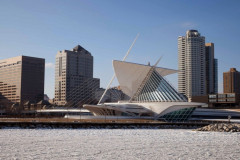
The Milwaukee Art Museum, with its brise soleil designed by Santiago Calatrava, is known for its interesting architecture. Monona Terrace in Madison, a convention center designed by Taliesin architect Anthony Puttnam, is based on a 1930s design by Frank Lloyd Wright. Wright's home and studio in the 20th century was at Taliesin, south of Spring Green. Decades after Wright's death, Taliesin remains an architectural office and school for his followers.
Music
Wisconsin's music festivals include Eaux Claires, Miller Lite Presents Country Fest, Bud Light Presents Country Jam USA, the Coors Hodag Country Festival, Porterfield Country Music Festival, Country Thunder USA in Twin Lakes, and Ford Presents Country USA. Milwaukee hosts Summerfest, dubbed "The World's Largest Music Festival", every year. This festival is held at the lakefront Henry Maier Festival Park just south of downtown, as are a summer-long array of ethnic musical festivals. The Wisconsin Area Music Industry provides an annual WAMI event where it presents an awards show for top Wisconsin artists.
Alcohol culture
Drinking has long been considered a significant part of Wisconsin culture, and the state ranks at or near the top of national measures of per-capita alcohol consumption, consumption of alcohol per state, and proportion of drinkers. Consumption per-capita per-event, however, ranks low among the nation; number of events (number of times alcohol is involved) is significantly higher or highest, but consumption at each event smaller, marking Wisconsin's consumption as frequent and moderate. Factors such as cultural identification with the state's heritage of German immigration, the longstanding presence of major breweries in Milwaukee, and a cold climate are often associated with the prevalence of drinking in Wisconsin.
In Wisconsin, the legal drinking age is 21, except when accompanied by a parent, guardian, or spouse who is at least 21 years old. Age requirements are waived for possessing alcohol when employed by a brewer, brewpub, beer and/or liquor wholesaler, or producer of alcohol fuel. The minimum legal age to purchase alcohol is 21, with no exceptions. The Absolute Sobriety law states that any person not of legal drinking age (currently 21 years of age) may not drive after consuming alcohol.
On September 30, 2003, the state legislature, reluctant to lower a DUI offense from BAC 0.10 to 0.08, did so only as a result of federal government pressure. The Wisconsin Tavern League opposes raising the alcoholic beverage tax. The Milwaukee Journal Sentinel series "Wasted in Wisconsin" examined this situation.
Recreation
The varied landscape of Wisconsin makes the state a popular vacation destination for outdoor recreation. Winter events include skiing, ice fishing and snowmobile derbies. Wisconsin is situated on two Great Lakes and has many inland lakes of varied size; the state contains 11,188 square miles (28,980 km2) of water, more than all but three other states - Alaska, Michigan, and Florida.
Outdoor activities are popular in Wisconsin, especially hunting and fishing. One of the most prevalent game animals is the whitetail deer. Each year in Wisconsin, well over 600,000 deer hunting licenses are sold. In 2008, the Wisconsin Department of Natural Resources projected the pre-hunt deer population to be between 1.5 and 1.7 million.