Anhui
Description
Anhui is a landlocked province of the People's Republic of China located in the eastern region of the country. Located across the basins of the Yangtze River and the Huai River, it borders Jiangsu to the east, Zhejiang to the southeast, Jiangxi to the south, Hubei to the southwest, Henan to the northwest, and Shandong for a tiny section in the north. The provincial capital is Hefei.
The name "Anhui" derives from the names of two cities: Anqing and Huizhou (now Huangshan City). The abbreviation for Anhui is "Chinese: 皖; pinyin: wǎn" after the historical State of Wan, Mount Wan, and the Wan river.
History
The province of Anhui was formed in the 17th century. Before then, there was no coherent concept of "Anhui". In terms of culture, Northern Anhui was firmly a part of the North China Plain together with modern-day Henan province, northern Jiangsu and southern Shandong provinces. Central Anhui was densely populated and constituted mostly of fertile land from the Huai River watershed. In contrast, the culture of Southern Anhui, bordered mostly along the Yangtze, was closer to Jiangxi and southern Jiangsu provinces. The hills of southeastern Anhui formed a unique and distinct cultural sphere of its own.
In the 2007 book China Road, author Rob Gifford stated that the Chinese refer to Anhui as a "big agricultural province" (农业大省). According to Gifford, this is an euphemism for a "very poor" area and that people have referred to Anhui as the "Appalachia of China."
Geography
Anhui is quite diverse topographically. The north of the province is part of the North China Plain while the north-central areas are part of the Huai River watershed. Both of these regions are very flat and densely populated. The land becomes more uneven further south, with the Dabie Mountains occupying much of southwestern Anhui and a series of hills and ranges cutting through southeastern Anhui. The Yangtze River finds its way through south Anhui in between these two mountainous regions. The highest peak in Anhui is Lotus Peak, part of Huangshan in southeastern Anhui. It has an altitude of 1873 m.
Major rivers include the Huai River in the north and the Yangtze in the south. The largest lake is Lake Chaohu situated in the center of the province, with an area of about 800 km2 (310 sq mi). The southeastern part of the province near the Yangtze River has many lakes as well.
As with topography, the province differs in climate from north to south. The north is more temperate and has more clearcut seasons. January temperatures average at around -1 to 2 °C north of the Huai River, and 0 to 3 °C south of the Huai River; in July temperatures average 27 °C or above. Plum rains occur in June and July and may cause flooding.
Transportation
Historically, Anhui's transport network was hampered by the lack of bridges across the Yangtze River, which divides the province into northern and southern regions. The first bridge across the Yangtze in Anhui, the Tongling Yangtze River Bridge was completed in 1995. As of October 2014, Anhui had four bridges across the Yangtze, at Ma'anshan, Wuhu, Tongling, and Anqing.
Rail
Conventional railways in Anhui include the Beijing–Shanghai Railway, Beijing–Kowloon Railway, and Nanjing–Xi'an Railway that traverse the province north of the Yangtze River and the Nanjing−Tongling Railway, Anhui–Jiangxi Railway and Xuancheng–Hangzhou Railway that run south of the river.
High-speed lines include Beijing-Shanghai High-Speed Railway, Hefei–Wuhan Passenger Railway and Hefei–Nanjing Passenger Railway.
Culture
Anhui spans many geographical and cultural regions. The northern, flatter parts of the province, along the Huai River and further north, are most akin to neighbouring provinces like Henan, Shandong and northern Jiangsu. In contrast, the southern, hilly parts of the province are more similar in culture and dialect to other southern, hilly provinces, like Zhejiang and Jiangxi.
Mandarin dialects are spoken over the northern and central parts of the province, north of the Yangzi river. Dialects to the north (e.g. Bengbu dialect) are classified as Zhongyuan Mandarin, together with dialects in provinces such as Henan and Shandong; dialects in the central parts (e.g. Hefei dialect) are classified as Jianghuai Mandarin, together with dialects in the central parts of neighbouring Jiangsu province. Non-Mandarin dialects are spoken to the south of the Yangzi: dialects of Wu are spoken in Xuancheng prefecture-level city, though these are rapidly being replaced by Jianghuai Mandarin; dialects of Gan are spoken in a few counties in the southwest bordering Jiangxi province; and the Huizhou dialects are spoken in about ten counties in the far south, a small but highly diverse and unique group of Chinese dialects.
Huangmeixi, which originated in the environs of Anqing in southwestern Anhui, is a form of traditional Chinese opera popular across China. Huiju, a form of traditional opera originating in the Huizhou-speaking areas of southern Anhui, is one of the major precursors of Beijing Opera; in the 1950s, Huiju (which had disappeared) was revived. Luju is a type of traditional opera found across central Anhui, from east to west.
Anhui cuisine is one of the eight great traditions of Chinese cuisine. Combining elements of cooking from northern Anhui, south-central Anhui, and the Huizhou-speaking areas of southern Anhui, Anhui cuisine is known for its use of wild game and herbs, both land and sea, and comparatively simple methods of preparation.
Anhui has a high concentration of traditional products related to calligraphy: Xuanzhou (today Xuancheng) and Huizhou (today Huangshan City) are revered for producing Xuan Paper and Hui Ink, respectively, which are traditionally considered the best types of paper and ink for Chinese calligraphy. She County is famous for the She Inkstone, one of the most preferred types of inkstones (a required tool in traditional calligraphy).
Religion
The predominant religions in Anhui are Chinese folk religions, Taoist traditions and Chinese Buddhism. According to surveys conducted in 2007 and 2009, 4.64% of the population believes and is involved in cults of ancestors, while 5.30% of the population identifies as Christian. According to a 2010 survey, Muslims constitute 0.58% of the population of Anhui .
The reports didn't give figures for other types of religion; 89.48% of the population may be either irreligious or involved in worship of nature deities, Buddhism, Confucianism, Taoism and folk religious sects.
Avalokitesvara of One Thousand Arms at the Guanyin Nunnery. Langya Buddhist Temple in Chuzhou. Courtyard of a Buddhist temple in Qingyang County, Chizhou.
Tourism
Anhui's principal tourism sites include the following:
- Ancient Villages in Southern Anhui - Xidi and Hongcun (World Heritage Site).
- Chao Lake
- Jing Ting Mountain
- Mount Huangshan (World Heritage Site)
- Mount Jiuhua
- Mount Langya
- Mount Qiyun
- Mount Tianzhu
- Old Town of Tunxi
- Taiji Cave, the longest karst cave in East China.
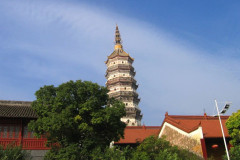
- Zhenfeng Pagoda, a Ming Dynasty pagoda in Anqing City.
- Zuiweng Pavilion, named after the poet Ouyang Xiu (1007−1072 CE).
Development
In 2008, France helped the Anhui Provincial Tourism Bureau develop a rural tourism demonstration project.
Colleges, universities and research institutions
- Anhui Agricultural University, in Hefei
- Anhui Medical University
- Anhui Normal University, in Wuhu
- Anhui University, in Hefei
- Anhui University of Finance and Economics, in Bengbu
- Anhui University of Technology, in Ma'anshan
- Anhui University of Technology and Science, in Wuhu City
- Anhui University of Traditional Chinese Medicine
- Anhui University of Science & Technology, in Huainan
- Anqing Teachers College, in Anqing
- Hefei Normal University, in Hefei
- Hefei University of Technology
- University of Science & Technology of China, located in the Southwest part of Hefei
- Wannan Medical College, in Wuhu City
- Hefei Institutes of Physical Science, Chinese Academy of Sciences in Hefei