
Kyrgyzstan
Hotels
Regions (5)
Towns (15)

Places

Description
Kyrgyzstan ; Russian: Киргизия), officially the Kyrgyz Republic (Kyrgyz: Кыргыз Республикасы Kırgız Respublikası; Russian: Кыргызская Республика Kyrgyzskaya Respublika), formerly known as Kirghizia, is a country in Central Asia. Landlocked and mountainous, Kyrgyzstan is bordered by Kazakhstan to the north, Uzbekistan to the west and southwest, Tajikistan to the southwest and China to the east. Its capital and largest city is Bishkek.
Kyrgyzstan's recorded history spans over 2,000 years, encompassing a variety of cultures and empires. Although geographically isolated by its highly mountainous terrain – which has helped preserve its ancient culture – Kyrgyzstan has historically been at the crossroads of several great civilizations, namely as part of the Silk Road and other commercial and cultural routes. Though long inhabited by a succession of independent tribes and clans, Kyrgyzstan has periodically come under foreign domination and attained sovereignty as a nation-state only after the breakup of the Soviet Union in 1991.
Since independence, Kyrgyzstan has officially been a unitary parliamentary republic, although it continues to endure ethnic conflicts, revolts, economic troubles, transitional governments and political party conflicts. Kyrgyzstan is a member of the Commonwealth of Independent States, the Eurasian Economic Union, the Collective Security Treaty Organization, the Shanghai Cooperation Organisation, the Organisation of Islamic Cooperation, the Turkic Council, the TÜRKSOY community and the United Nations.
Ethnic Kyrgyz make up the majority of the country's 5.7 million people, followed by significant minorities of Uzbeks and Russians. The official language, Kyrgyz, is closely related to the other Turkic languages, although Russian remains widely spoken, a legacy of a century-long policy of multiculturalism. The majority of the population (64 percent) are non-denominational Muslims. In addition to its Turkic origins, Kyrgyz culture bears elements of Persian, Mongolian and Russian influence.
Etymology
"Kyrgyz" is believed to have been derived from the Turkic word for "forty", in reference to the forty clans of Manas, a legendary hero who united forty regional clans against the Uyghurs. Literally, Kyrgyz means We are forty. At the time, in the early 9th century AD, the Uyghurs dominated much of Central Asia (including Kyrgyzstan), Mongolia, and parts of Russia and China.
The 40-ray sun on the flag of Kyrgyzstan is a reference to those same forty tribes and the graphical element in the sun's center depicts the wooden crown, called tunduk, of a yurt – a portable dwelling traditionally used by nomads in the steppes of Central Asia.
History
Antiquity
The Kyrgyz state reached its greatest expansion after defeating the Uyghur Khaganate in 840 A.D. From the 10th century the Kyrgyz migrated as far as the Tian Shan range and maintained their dominance over this territory for about 200 years.
In the twelfth century the Kyrgyz dominion had shrunk to the Altay Range and Sayan Mountains as a result of the Mongol expansion. With the rise of the Mongol Empire in the thirteenth century, the Kyrgyz migrated south. The Kyrgyz peacefully became a part of Mongol Empire in 1207.
Chinese and Muslim sources of the 7th–12th centuries AD describe the early Kyrgyz as red-haired with white skin and blue eyes, which is indicative of ancient Indo-European tribes like the Slavic peoples. The descent of the Kyrgyz from the autochthonous Siberian population is confirmed on the other hand by the recent genetic studies. Because of the processes of migration, conquest, intermarriage, and assimilation, many of the Kyrgyz peoples that now inhabit Central and Southwest Asia are of mixed origins, often stemming from fragments of many different tribes, though they now speak closely related languages.
Issyk Kul Lake was a stopover on the Silk Road, a land route for traders, merchants and other travelers from the Far East to Europe.
Kyrgyz tribes were overrun in the 17th century by the Mongols, in the mid-18th century by the Manchurian Qing Dynasty, and in the early 19th century by the Uzbek Khanate of Kokand.
In the late nineteenth century, the majority part of what is today Kyrgyzstan was ceded to Russia through two treaties between China (then ruled by the Qing Dynasty) and Russia. The territory, then known in Russian as "Kirgizia", was formally incorporated into the Russian Empire in 1876. The Russian takeover was met with numerous revolts against Tsarist authority, and many of the Kyrgyz opted to move to the Pamir Mountains and Afghanistan.
In addition, the suppression of the 1916 rebellion against Russian rule in Central Asia caused many Kyrgyz later to migrate to China. Since many ethnic groups in the region were (and still are) split between neighboring states at a time when borders were more porous and less regulated, it was common to move back and forth over the mountains, depending on where life was perceived as better; this might mean better rains for pasture or better government during oppression.
-
Silk road caravansary utilized during the Islamic Golden Age
-
Kyrgyz nomads, 1869–1870, by Vasily Vereshchagin
-
Kyrgyz yurt, 1869–1870, by Vasily Vereshchagin
-
Kyrgyz people
-
A Nomadic Kyrgyz family on the Golodnaya Steppe in Uzbekistan, 1911, Prokudin-Gorskii
Soviet Kyrgyzstan
Soviet power was initially established in the region in 1919, and the Kara-Kyrgyz Autonomous Oblast was created within the Russian SFSR (the phrase Kara-Kirghiz was used until the mid-1920s by the Russians to distinguish them from the Kazakhs, who were also referred to as Kirghiz). On 5 December 1936, the Kirghiz Soviet Socialist Republic was established as a full republic of the Soviet Union.
During the 1920s, Kyrgyzstan developed considerably in cultural, educational and social life. Literacy was greatly improved, and a standard literary language was introduced by imposing Russian on the populace. Economic and social development also was notable. Many aspects of Kyrgyz national culture were retained despite the suppression of nationalist activity under Joseph Stalin, who controlled the Soviet Union from the late 1920s until 1953.
The early years of glasnost had little effect on the political climate in Kyrgyzstan. However, the Republic's press was permitted to adopt a more liberal stance and to establish a new publication, Literaturny Kirghizstan, by the Union of Writers. Unofficial political groups were forbidden, but several groups that emerged in 1989 to deal with the acute housing crisis were permitted to function.
According to the last Soviet census in 1989, ethnic Kyrgyz made up only 22% of the residents of the northern city of Frunze (now Bishkek), while more than 60% were Russians, Ukrainians, and people from other Slavic nations. Nearly 10% of the capital's population were Jewish (a rather unique fact, for almost any place in the Soviet Union, except the Jewish Autonomous Republic).
In June 1990, ethnic tensions between Uzbeks and Kyrgyz surfaced in the Osh Oblast (southern Kyrgyzstan), where Uzbeks form a minority of the population. Attempts to appropriate Uzbek collective farms for housing development triggered the Osh Riots. A state of emergency and curfew were introduced and Askar Akayev, the youngest of five sons born into a family of collective farm workers (in northern Kyrgyzstan), was elected President in October of that same year.
By then, the Kyrgyzstan Democratic Movement (KDM) had developed into a significant political force with support in Parliament. In December 1990, the Supreme Soviet voted to change the republic's name to the Republic of Kyrgyzstan. (In 1993, it became the Kyrgyz Republic.) The following January, Akayev introduced new government structures and appointed a new government composed mainly of younger, reform-oriented politicians. In February 1991, the name of the capital, Frunze, was changed back to its pre-revolutionary name of Bishkek.
Despite these political moves toward independence, economic realities seemed to work against secession from the Soviet Union. In a referendum on the preservation of the Soviet Union in March 1991, 88.7% of the voters approved the proposal to retain the Soviet Union as a "renewed federation". Nevertheless, secessionist forces pushed Kyrgyzstan's independence through in August of that same year.
On 19 August 1991, when the State Emergency Committee assumed power in Moscow, there was an attempt to depose Akayev in Kyrgyzstan. After the coup collapsed the following week, Akayev and Vice President German Kuznetsov announced their resignations from the Communist Party of the Soviet Union (CPSU), and the entire bureau and secretariat resigned. This was followed by the Supreme Soviet vote declaring independence from the Soviet Union on 31 August 1991 as the Republic of Kyrgyzstan.
Independence
In October 1991, Akayev ran unopposed and was elected president of the new independent Republic by direct ballot, receiving 95 percent of the votes cast. Together with the representatives of seven other Republics that same month, he signed the Treaty of the New Economic Community. Finally, on 21 December 1991, Kyrgyzstan joined with the other four Central Asian Republics to formally enter the new Commonwealth of Independent States. Kyrgyzstan gained full independence a few days later on 25 December 1991. The following day, on 26 December 1991, the Soviet Union ceased to exist. In 1992, Kyrgyzstan joined the United Nations and the Organization for Security and Co-operation in Europe (OSCE). On 5 May 1993, the official name changed from the Republic of Kyrgyzstan to the Kyrgyz Republic.
In 2005, a popular uprising known as the "Tulip Revolution", took place after the parliamentary elections in March 2005, forced President Askar Akayev's resignation on 4 April 2005. Opposition leaders formed a coalition, and a new government was formed under President Kurmanbek Bakiyev and Prime Minister Feliks Kulov. The nation's capital was looted during the protests.
Political stability appeared to be elusive, however, as various groups and factions allegedly linked to organized crime jockeyed for power. Three of the 75 members of Parliament elected in March 2005 were assassinated, and another member was assassinated on 10 May 2006 shortly after winning his murdered brother's seat in a by-election. All four are reputed to have been directly involved in major illegal business ventures. On 6 April 2010, civil unrest broke out in the town of Talas after a demonstration against government corruption and increased living expenses. The protests became violent, spreading to Bishkek by the following day. Protesters attacked President Bakiyev's offices, as well as state-run radio and television stations. There were conflicting reports that Interior Minister Moldomusa Kongatiyev had been beaten. On 7 April 2010, President Bakiyev imposed a state of emergency. Police and special services arrested many opposition leaders. In response, protesters took control of the internal security headquarters (former KGB headquarters) and a state television channel in the capital, Bishkek. Reports by Kyrgyzstan government officials indicated that at least 75 people were killed and 458 hospitalized in bloody clashes with police in the capital. Reports say that at least 80 people died as a result of clashes with police. A transition government, led by former foreign minister Roza Otunbayeva, by 8 April 2010 had taken control of state media and government facilities in the capital, but Bakiyev had not resigned from office.
President Bakiyev returned to his home in Jalal-Abad and stated his terms of resignation at a press conference on 13 April 2010. On 15 April 2010, Bakiyev left the country and flew to neighboring Kazakhstan, along with his wife and two children. The country's provisional leaders announced that Bakiyev signed a formal letter of resignation prior to his departure.
Prime Minister Daniar Usenov accused Russia of supporting the protests; this accusation was denied by Russian Prime Minister, Vladimir Putin. Opposition members also called for the closing of the US-controlled Manas Air Base. Russia's President Dmitry Medvedev ordered measures to ensure the safety of Russian nationals and tighten security around Russian sites in Kyrgyzstan to protect them against possible attacks.
The 2010 South Kyrgyzstan ethnic clashes occurred between the two main ethnic groups—the Uzbeks and Kyrgyz—in Osh, the second largest city in the country, on 11 June 2010. The clashes incited fears that the country could be heading towards a civil war.
Finding it difficult to control the situation, Otunbayeva, the interim leader, sent a letter to the Russian president, Dimitry Medvedev, asking him to send Russian troops to help the country control the situation. Medvedev's Press Attaché, Natalya Timakova, said in a reply to the letter, "It is an internal conflict and for now Russia does not see the conditions for taking part in its resolution". The clashes caused a shortage of food and other essential commodities with more than 200 killed and 1,685 people hurt, as of 12 June 2010. The Russian government, however, said it would be sending humanitarian aid to the troubled nation.
According to local sources, there was a clash between two local gangs and it did not take long for the violence to spread to the rest of the city. There were also reports that the armed forces supported ethnic Kyrgyz gangs entering the city, but the government denied the allegations.
The riots spread to neighboring areas, and the government declared a state of emergency in the entire southern Jalal-Abad region. To control the situation, the interim government gave special shoot-to-kill powers to the security forces. The Russian government decided to send a battalion to the country to protect Russian facilities.
Otunbayeva accused the family of Bakiyev of "instigating the riots". AFP reported "a veil of smoke covering the whole city". Authorities in neighboring Uzbekistan said at least 30,000 Uzbeks had crossed the border to escape the riots. Osh became relatively calm on 14 June 2010, but Jalal-Abad witnessed sporadic incidents of arson. The entire region was still under a state of emergency as Uzbeks were reluctant to leave their houses for fear of attacks by the mobs. The United Nations decided to send an envoy to assess the situation.
Temir Sariyev, deputy chief of the interim government, said there were local clashes and that it was not possible [for the government] to fully control the situation. He added that there were not sufficient security forces to contain the violence. Media agencies reported on 14 June 2010 that the Russian government was considering a request by the Kyrgyz government. An emergency meeting of Collective Security Treaty Organisation (CSTO) was held on the same day (14 June) to discuss the role it could play in helping to end the violence. Ethnic violence waned, according to the Kyrgyz government, by 15 June 2010 and Kyrgyz president Roza Otunbayeva held a news conference that day and declared that there was no need for Russia to send in troops to quell the violence. There were at least 170 people left dead by 15 June 2010 but Pascale Meige Wagner of the International Committee of the Red Cross said the [official] death toll was an underestimate. The UN High Commissioner told reporters in Geneva that evidence suggested that the violence seemed to have been staged up. Ethnic Uzbeks threatened to blow up an oil depot in Osh if they failed to get guarantees of protection. The United Nations said it believed that the attacks were "orchestrated, targeted and well-planned". Kyrgyz officials told the media that a person suspected to be behind the violence in Jalal-Abad had been detained.
On 2 August 2010, a Kyrgyz government commission began investigating the causes of the clashes. Members of the National Commission, led by former parliament speaker Abdygany Erkebaev, met with people from the predominantly ethnic Uzbek villages of Mady, Shark, and Kyzyl-Kyshtak in the Kara-Suu district of Osh Oblast. This National Commission, including representatives of many ethnic groups, was established by a presidential decree.
President Roza Otunbayeva also said in August 2010 that an international commission would also be formed to investigate the clashes.
The commission's report, released in January 2011, concluded that the events in southern Kyrgyzstan constituted a “planned, large-scale provocation, oriented towards the splitting of Kyrgyzstan and disrupting the unity of its people.” Responsibility for this provocation was seen as lying with “nationalistically-minded leaders of the Uzbek community”. In the aftermath of the turmoil, on 5 August 2010, Kyrgyz forces arrested party leader Urmat Baryktabasov on suspicion of plotting an overthrow of the government, after troops allegedly fired blank rounds at a crowd trying to join mass demonstrations near the Parliament in the capital Bishkek. Acting President Roza Otunbayeva said security forces seized firearms and grenades from him and 26 supporters.
Geography
Kyrgyzstan is a landlocked country in Central Asia, bordering Kazakhstan, China, Tajikistan and Uzbekistan. It lies between latitudes 39° and 44° N, and longitudes 69° and 81° E. It is farther from the sea than any other individual country, and all its rivers flow into closed drainage systems which do not reach the sea. The mountainous region of the Tian Shan covers over 80% of the country (Kyrgyzstan is occasionally referred to as "the Switzerland of Central Asia", as a result), with the remainder made up of valleys and basins.
Issyk-Kul Lake, or Ysyk-Köl in Kyrgyz, in the north-eastern Tian Shan is the largest lake in Kyrgyzstan and the second largest mountain lake in the world after Titicaca. The highest peaks are in the Kakshaal-Too range, forming the Chinese border. Peak Jengish Chokusu, at 7,439 m (24,406 ft), is the highest point and is considered by geologists to be the northernmost peak over 7,000 m (22,966 ft) in the world. Heavy snowfall in winter leads to spring floods which often cause serious damage downstream. The runoff from the mountains is also used for hydro-electricity.
Kyrgyzstan has significant deposits of metals including gold and rare earth metals. Due to the country's predominantly mountainous terrain, less than 8% of the land is cultivated, and this is concentrated in the northern lowlands and the fringes of the Fergana Valley.
Bishkek in the north is the capital and largest city, with approximately 900,000 inhabitants (as of 2005). The second city is the ancient town of Osh, located in the Fergana Valley near the border with Uzbekistan. The principal river is the Kara Darya, which flows west through the Fergana Valley into Uzbekistan. Across the border in Uzbekistan it meets another major Kyrgyz river, the Naryn.
The confluence forms the Syr Darya, which originally flowed into the Aral Sea. As of 2010, it no longer reaches the sea, as its water is withdrawn upstream to irrigate cotton fields in Tajikistan, Uzbekistan, and southern Kazakhstan. The Chu River also briefly flows through Kyrgyzstan before entering Kazakhstan.
Enclaves and exclaves
There is one exclave, the tiny village of Barak (population 627), in the Fergana Valley. The village is surrounded by Uzbek territory. It is located on the road from Osh (Kyrgyzstan) to Khodjaabad (Uzbekistan) about 4 kilometres (2 miles) north-west from the Kyrgyz–Uzbek border in the direction of Andijan. Barak is administratively part of Kara-Suu District in Kyrgyzstan's Osh Region.
There are four Uzbek enclaves within Kyrgyzstan. Two of them are the towns of Sokh (area 325 km2 (125 sq mi) and a population of 42,800 in 1993, although some estimates go as high as 70,000; 99% are Tajiks, the remainder Uzbeks) and Shakhimardan (also known as Shahimardan, Shohimardon, or Shah-i-Mardan, area 90 km2 (35 sq mi) and a population of 5,100 in 1993; 91% are Uzbeks, the remainder Kyrgyz); the other two are the tiny territories of Chong-Kara (roughly 3 km (2 mi) long by 1 km (0.6 mi) wide) and Jangy-ayyl (a dot of land barely 2–3 km (1–2 mi) across). Chong-Kara is on the Sokh river, between the Uzbek border and the Sokh enclave. Jangy-ayyl is about 60 kilometres (37 mi) east of Batken, in a northward projection of the Kyrgyz-Uzbek border near Khalmion.
There also are two enclaves belonging to Tajikistan: Vorukh (exclave area between 95–130 km2 (37–50 sq mi), population estimated between 23,000 and 29,000, 95% Tajiks and 5% Kyrgyz, distributed among 17 villages), located 45 kilometres (28 mi) south of Isfara on the right bank of the Karafshin river, and a small settlement near the Kyrgyz railway station of Kairagach.
Culture
- Manas, an epic poem
- Komuz, a three-stringed lute
- Tush kyiz, large, elaborately embroidered wall hangings
- Shirdak, flat cushions made in shadow-pairs
- Other textiles, especially made from felt
- Falconry
Traditions
In addition to celebrating the New Year each 1 January, the Kyrgyz observe the traditional New Year festival Nowruz on the vernal equinox. This spring holiday is celebrated with feasts and festivities such as the horse game Ulak Tartish.
Illegal, but still practiced, is the tradition of bride kidnapping.
It is debatable whether bride kidnapping is actually traditional. Some of the confusion may stem from the fact that arranged marriages were traditional, and one of the ways to escape an arranged marriage was to arrange a consensual "kidnapping."
Flag
The 40-rayed yellow sun in the center of the flag represent the 40 tribes that once made up the entirety of Kyrgyz culture before the intervention of Russia during the rise of the Soviet Union. The lines inside the sun represent the crown or tündük (Kyrgyz түндүк) of a yurt, a symbol replicated in many facets of Kyrgyz architecture. The red portion of the flag represents peace and openness of Kyrgyzstan.
Under Soviet rule and before 1992, it had the flag of the Soviet Union with two big blue stripes and a white thin stripe in the middle.
Horse riding
The traditional national sports reflect the importance of horse riding in Kyrgyz culture.
Very popular, as in all of Central Asia, is Ulak Tartysh, a team game resembling a cross between polo and rugby in which two teams of riders wrestle for possession of the headless carcass of a goat, which they attempt to deliver across the opposition's goal line, or into the opposition's goal: a big tub or a circle marked on the ground.
Other popular games on horseback include:
- At Chabysh – a long-distance horse race, sometimes over a distance of more than 50 km
- Jumby Atmai – a large bar of precious metal (the "jumby") is tied to a pole by a thread and contestants attempt to break the thread by shooting at it, while at a gallop
- Kyz Kuumai – a man chases a girl in order to win a kiss from her, while she gallops away; if he is not successful she may in turn chase him and attempt to beat him with her "kamchi" (horsewhip)
- Oodarysh – two contestants wrestle on horseback, each attempting to be the first to throw the other from his horse
- Tyin Emmei – picking up a coin from the ground at full gallop
Public holidays
This is the list of public holidays in Kyrgyzstan:
- 1 January – New Year's Day
- 7 January – Orthodox Christmas
- 23 February – Fatherland Defender's Day
- 8 March – Women's Day
- 21–23 March – Nooruz Mairamy, Persian New Year (spring festival)
- 7 April – Day of National Revolution
- 1 May – Labor Day
- 5 May – Constitution Day
- 8 May – Remembrance Day
- 9 May – Victory Day
- 31 August – Independence Day
- 7 November – Day of the Great October Socialist Revolution
Two additional Muslim holidays Orozo Ait and Kurman Ait are defined by lunar calendar.
Tourism
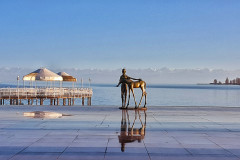
One of the most popular tourist destination points in Kyrgyzstan is Issyk Kul Lake. Numerous hotels, vacation resorts, boarding houses and sanatoriums are located along its Northern shore. The most popular beach zones are in the city of Cholpon-Ata and the settlements nearby, such as Kara-Oi (Dolinka), Bosteri and Korumdy. The number of tourists visiting the lake was more than a million a year in 2006 and 2007. However, due to the economical and political instability in the region, the number has declined in recent years.
For those interested in trekking and camping, every region offers attractions and challenges. Some of the most popular locations for camping are southern Osh, the area between Naryn City and the Torugart pass, and the mountains and glaciers surrounding Karakol in Issyk-Kul. Local guides and porters can be hired from many tour companies in Bishkek and in the regional capitals.
Skiing is still in its infancy as a tourism industry, but there is one fairly cheap and well-equipped base about a half-hour from Bishkek. The ski base of Toguz Bulak is 45 km (28 mi) from Bishkek, on the way to Issyk Ata valley. In the Karakol Valley National Park, outside Karakol, there is also a ski base with three T-bars and rental equipment available of good quality.
Transport
Transport in Kyrgyzstan is severely constrained by the country's alpine topography. Roads have to snake up steep valleys, cross passes of 3,000 metres (9,800 ft) altitude and more, and are subject to frequent mud slides and snow avalanches. Winter travel is close to impossible in many of the more remote and high-altitude regions.
Additional problems come from the fact that many roads and railway lines built during the Soviet period are today intersected by international boundaries, requiring time-consuming border formalities to cross where they are not completely closed. Horses are still a much-used transport option, especially in more rural areas; Kyrgyzstan's road infrastructure is not extensive, so horses are able to reach locations that motor vehicles cannot, and they do not require expensive, imported fuel.
Airports
At the end of the Soviet period there were about 50 airports and airstrips in Kyrgyzstan, many of them built primarily to serve military purposes in this border region so close to China. Only a few of them remain in service today. The Kyrgyzstan Air Company provides air transport to China, Russia, and other local countries.
- Manas International Airport near Bishkek is the main international airport, with services to Moscow, Tashkent, Almaty, Beijing, Urumqi, Istanbul, London, Baku, Dubai (from 7 February 2012).
- Osh Airport is the main air terminal in the south of the country, with daily connections to Bishkek.
- Jalal-Abad Airport is linked to Bishkek by daily flights. The national flag carrier, Kyrgyzstan, operates flights on BAe-146 aircraft. During the summer months, a weekly flight links Jalal-Abad with the Issyk-Kul Region.
- Other facilities built during the Soviet era are either closed down, used only occasionally or restricted to military use (e.g., Kant Air Base near Bishkek, which is used by the Russian Air Force).
Banned airline status
Kyrgyzstan appears on the European Union's list of prohibited countries for the certification of airlines. This means that no airline which is registered in Kyrgyzstan may operate services of any kind within the European Union, due to safety standards which fail to meet European regulations.
Railways
The Chuy Valley in the north and the Ferghana valley in the south were endpoints of the Soviet Union's rail system in Central Asia. Following the emergence of independent post-Soviet states, the rail lines which were built without regard for administrative boundaries have been cut by borders, and traffic is therefore severely curtailed. The small bits of rail lines within Kyrgyzstan, about 370 km (230 mi) (1,520 mm (59.8 in) broad gauge) in total, have little economic value in the absence of the former bulk traffic over long distances to and from such centres as Tashkent, Almaty, and the cities of Russia.
There are vague plans about extending rail lines from Balykchy in the north and/or from Osh in the south into China, but the cost of construction would be enormous.
Rail links with adjacent countries
- Kazakhstan – yes – Bishkek branch – same gauge
- Uzbekistan – yes – Osh branch – same gauge
- Tajikistan – no – same gauge
- China – no – Break of gauge 1524 mm/1435 mm
Waterways
Water transport exists only on Issyk Kul Lake, and has drastically shrunk since the end of the Soviet Union.
Ports and harbours
Balykchy (Ysyk-Kol or Rybach'ye), on Issyk Kul Lake.