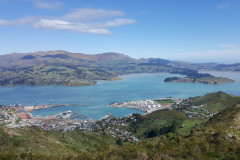
Canterbury
Description
Canterbury is a region of New Zealand, located in the central-eastern South Island. The region covers an area of 44,508 square kilometres (17,185 sq mi), and is home to a population of 600,100 (June 2016).
The region in its current form was established in 1989 during nationwide local government reforms. The Kaikoura District joined the region in 1992 following the abolition of the Nelson-Marlborough Regional Council.
Christchurch, the South Island's largest city and the country's third-largest urban area, is the seat of the region and home to 65 percent of the region's population. Other major towns and cities include Timaru, Ashburton, Rangiora and Rolleston.
History
Colonisation
In 1848, Edward Gibbon Wakefield, a Briton, and John Robert Godley, an Anglo-Irish aristocrat, founded the Canterbury Association to establish an Anglican colony in the South Island. The colony was based upon theories developed by Wakefield while in prison for eloping with a woman not-of-age. Due to ties to the prestigious Oxford University, the Canterbury Association succeeded in raising sufficient funds and recruiting middle-class and upper-class settlers. In April 1850, a preliminary group led by Godley landed at Port Cooper—modern-day Lyttelton Harbour—and established a port, housing and shops in preparation for the main body of settlers. In December 1850, the first wave of 750 settlers arrived at Lyttelton in a fleet of four ships.
Following 1850, the province's economy developed with the introduction of sheep farming. The Canterbury region's tussock plains in particular were suitable for extensive sheep farming. Since they were highly valued by settlers for their meat and wool, there were over half a million sheep in the region by the early 1850s. By the 1860s, this figure had risen to three million. During this period, the architect Benjamin Mountfort designed many civic and ecclesiastical buildings in the Gothic Revival style.
Canterbury Province
The Canterbury Province was formed in 1853 following the passing of the New Zealand Constitution Act 1852 from the part of New Munster Province and covered both the east and west coasts of the South Island. The province was abolished, along with other provinces of New Zealand, when the Abolition of the Provinces Act came into force on 1 Nov 1876. The modern Canterbury Region has slightly different boundaries, particularly in the North, where it includes some districts from the old Nelson Province.
Geography
The area administered by the Canterbury Regional Council consists of all the river catchments on the east coast of the South Island from that of the Clarence River, north of Kaikoura, to that of the Waitaki River, in South Canterbury. It is New Zealand's largest region by area, with an area of 45,346 km2.
Canterbury was traditionally bounded in the north by the Conway River, to the west by the Southern Alps, and to the south by the Waitaki River. The area is commonly divided into North Canterbury (north of the Rakaia River to the Conway River), Mid Canterbury (from the Rakaia River to the Rangitata River), South Canterbury (south of the Rangitata River to the Waitaki River) and Christchurch City.
Environment
Like much of the Canterbury-Otago tussock grasslands the Canterbury Plains have been highly modified since human settlement and now support a large agricultural industry. Prior to the arrival of Māori settlers in the 13th century, much of the modern Canterbury region was covered in scrub and beech forests. Forest fires destroyed much of the original forest cover which was succeeded by tussock grassland. By the 19th century, only ten percent of this forest cover remained and the European settlers introduced several new exotic grass, lupin, pine and macrocarpa that gradually supplanted the native vegetation. Much of the native vegetation was isolated to the alpine zones and Banks Peninsula. Recently, the amount of forest on Banks Peninsula has increased from a minimum of about one percent of its original forest cover.
The amount of dairy farming is increasing with a corresponding increase in demand for water. Water use is now becoming a contentious issue in Canterbury. Lowland rivers and streams are generally polluted and some of the aquifers are being overdrawn. The Central Plains Water scheme is a proposal for water storage that has attracted much controversy. The Canterbury Water Management Strategy is one of the many means being used to address the water issue.
The Canterbury mudfish (kowaro) is an endangered species that is monitored by the Department of Conservation.
Transport
State Highway 1 runs the length of Canterbury, connecting north to Blenheim and the Cook Strait ferry terminal at Picton and south to Oamaru, Dunedin and Invercargill.
Christchurch International Airport, located in Harewood on the northwester outskirts of Christchurch, is the region's main airport. Regular flights operate from Christchurch to most major centres in New Zealand, as well as Australia, the Pacific Islands and eastern Asia. Timaru's Richard Pearse Airport serves South Canterbury with daily flights to Wellington.
Film location
Canterbury was the location used in the filming The Lord of the Rings for the fictional city of Edoras, Rohan, on Mount Sunday, as well as Helm's deep backdrop, several miles down the valley.