
Republic of Ireland
Hotels
Regions (2)
Towns (14)


Description
Ireland ; Irish: Éire ( listen)), also known as the Republic of Ireland (Poblacht na hÉireann), is a sovereign state in north-western Europe occupying 26 of 32 counties of the island of Ireland. The capital and largest city is Dublin, which is located on the eastern part of the island, and whose metropolitan area is home to around a third of the country's 4.75 million inhabitants. The state shares its only land border with Northern Ireland, a part of the United Kingdom. It is otherwise surrounded by the Atlantic Ocean, with the Celtic Sea to the south, Saint George's Channel to the south-east, and the Irish Sea to the east. It is a unitary, parliamentary republic. The legislature, the Oireachtas, consists of a lower house, Dáil Éireann, an upper house, Seanad Éireann, and an elected President (Uachtarán) who serves as the largely ceremonial head of state, but with some important powers and duties. The head of government is the Taoiseach (Prime Minister, literally 'Chief', a title not used in English), who is elected by the Dáil and appointed by the President; the Taoiseach in turn appoints other government ministers.
The state was created as the Irish Free State in 1922 as a result of the Anglo-Irish Treaty. It had the status of Dominion until 1937 when a new constitution was adopted, in which the state was named "Ireland" and effectively became a republic, with an elected non-executive president as head of state. It was officially declared a republic in 1949, following the Republic of Ireland Act 1948. Ireland became a member of the United Nations in December 1955. It joined the European Economic Community (EEC), the predecessor of the European Union, in 1973. The state had no formal relations with Northern Ireland for most of the twentieth century, but during the 1980s and 1990s the British and Irish governments worked with the Northern Ireland parties towards a resolution to "the Troubles". Since the signing of the Good Friday Agreement in 1998, the Irish government and Northern Ireland Executive have co-operated on a number of policy areas under the North-South Ministerial Council created by the Agreement.
Ireland ranks among the top twenty-five wealthiest countries in the world in terms of GDP per capita, and as the tenth most prosperous country in the world according to The Legatum Prosperity Index 2015. After joining the EEC, Ireland enacted a series of liberal economic policies that resulted in rapid economic growth. The country achieved considerable prosperity between the years of 1995 and 2007, which became known as the Celtic Tiger period. This was halted by an unprecedented financial crisis that began in 2008, in conjunction with the concurrent global economic crash. However, as the Irish economy was the fastest growing in the EU in 2015, Ireland is again quickly ascending league tables comparing wealth and prosperity internationally. For example, in 2015, Ireland was ranked as the joint sixth (with Germany) most developed country in the world by the United Nations Human Development Index. It also performs well in several national performance metrics, including freedom of the press, economic freedom and civil liberties. Ireland is a member of the European Union and is a founding member of the Council of Europe and the OECD. The Irish government has followed a policy of military neutrality through non-alignment since immediately prior to World War II and the country is consequently not a member of NATO, although it is a member of Partnership for Peace.
Name
The 1922 state, comprising 26 of the 32 counties of Ireland, was "styled and known as the Irish Free State". The Constitution of Ireland, adopted in 1937, provides that "the name of the State is Éire, or, in the English language, Ireland". Section 2 of the Republic of Ireland Act 1948 states, "It is hereby declared that the description of the State shall be the Republic of Ireland." The 1948 Act does not name the state as "Republic of Ireland", because to have done so would have put it in conflict with the Constitution.
The government of the United Kingdom used the name "Eire" (without the diacritic) and, from 1949, "Republic of Ireland", for the state; it was not until the 1998 Good Friday Agreement that it used the name "Ireland".
As well as "Ireland", "Éire" or "the Republic of Ireland", the state is also referred to as "the Republic", "Southern Ireland" or "the South". In an Irish republican context it is often referred to as "the Free State" or "the 26 Counties".
History
For the history of the entire island, see History of Ireland.Home-rule movement
From the Act of Union on 1 January 1801, until 6 December 1922, the island of Ireland was part of the United Kingdom of Great Britain and Ireland. During the Great Famine, from 1845 to 1849, the island's population of over 8 million fell by 30%. One million Irish died of starvation and/or disease and another 1.5 million emigrated, mostly to the United States. This set the pattern of emigration for the century to come, resulting in a constant population decline up to the 1960s.
From 1874, and particularly under Charles Stewart Parnell from 1880, the Irish Parliamentary Party gained prominence. This was firstly through widespread agrarian agitation via the Irish Land League, that won land reforms for tenants in the form of the Irish Land Acts, and secondly through its attempts to achieve Home Rule, via two unsuccessful bills which would have granted Ireland limited national autonomy. These led to "grass-roots" control of national affairs, under the Local Government Act 1898, that had been in the hands of landlord-dominated grand juries of the Protestant Ascendancy.
Home Rule seemed certain when the Parliament Act 1911 abolished the veto of the House of Lords, and John Redmond secured the Third Home Rule Act in 1914. However, the Unionist movement had been growing since 1886 among Irish Protestants after the introduction of the first home rule bill, fearing discrimination and loss of economic and social privileges if Irish Catholics achieved real political power. In the late nineteenth and early twentieth century unionism was particularly strong in parts of Ulster, where industrialisation was more common in contrast to the more agrarian rest of the island. It was feared that any tariff barriers would heavily affect that region. In addition, the Protestant population was more prominent in Ulster, with a majority in four counties. Under the leadership of the Dublin-born Sir Edward Carson of the Irish Unionist Party and the Ulsterman Sir James Craig of the Ulster Unionist Party, unionists became strongly militant in order to oppose "the Coercion of Ulster". After the Home Rule Bill passed parliament in May 1914, to avoid rebellion with Ulster, the British Prime Minister H. H. Asquith introduced an Amending Bill reluctantly conceded to by the Irish Party leadership. This provided for the temporary exclusion of Ulster from the workings of the bill for a trial period of six years, with an as yet undecided new set of measures to be introduced for the area to be temporarily excluded.
Revolution and steps to independence
Though it received the Royal Assent and was placed on the statute books in 1914, the implementation of the Third Home Rule Act was suspended until after the First World War which defused the threat of civil war in Ireland. With hope of ensuring the implementation of the Act at the end of the war through Ireland's engagement in the war, Redmond and his Irish National Volunteers supported Britain and its Allies. 175,000 men joined Irish regiments of the 10th (Irish) and 16th (Irish) divisions of the New British Army, while Unionists joined the 36th (Ulster) divisions.
The remainder of the Irish Volunteers, who opposed any support of Britain, launched an armed insurrection against British rule in the 1916 Easter Rising, together with the Irish Citizen Army. This commenced on 24 April 1916 with the declaration of independence. After a week of heavy fighting, primarily in Dublin, the surviving rebels were forced to surrender their positions. The majority were imprisoned but fifteen of the prisoners (including most of the leaders) were executed as traitors to Britain. This included Patrick Pearse, the spokesman for the rising and who provided the signal to the volunteers to start the rising, as well as James Connolly, socialist and founder of the Industrial Workers of the World union and both the Irish and Scottish Labour movements. These events, together with the Conscription Crisis of 1918, had a profound effect on changing public opinion in Ireland.
In January 1919, after the December 1918 general election, 73 of Ireland's 106 Members of Parliament (MPs) elected were Sinn Féin members who refused to take their seats in the British House of Commons. Instead, they set up an Irish parliament called Dáil Éireann. This first Dáil in January 1919 issued a Declaration of Independence and proclaimed an Irish Republic. The Declaration was mainly a restatement of the 1916 Proclamation with the additional provision that Ireland was no longer a part of the United Kingdom. The new Irish Republic was recognised internationally only by the Russian Soviet Republic. The Irish Republic's Aireacht (Ministry) sent a delegation under Ceann Comhairle (Head of Council, or Speaker, of the Daíl) Seán T. O'Kelly to the Paris Peace Conference of 1919, but it was not admitted.
After the War of Independence and truce called in July 1921, representatives of the British government and the Irish treaty delegates, led by Arthur Griffith, Robert Barton and Michael Collins, negotiated the Anglo-Irish Treaty in London from 11 October to 6 December 1921. The Irish delegates set up headquarters at Hans Place in Knightsbridge and it was here in private discussions that the decision was taken on 5 December to recommend the treaty to Dáil Éireann. The Second Dáil Éireann narrowly ratified the Treaty.
In accordance with the treaty, on 6 December 1922 the entire island of Ireland became a self-governing Dominion called the Irish Free State (Saorstát Éireann). Under the Constitution of the Irish Free State, the Parliament of Northern Ireland had the option to leave the Irish Free State one month later and return to the United Kingdom. During the intervening period, the powers of the Parliament of the Irish Free State and Executive Council of the Irish Free State did not extend to Northern Ireland. Northern Ireland exercised its right under the treaty to leave the new Dominion and rejoined the United Kingdom on 8 December 1922. It did so by making an address to the King requesting, "that the powers of the Parliament and Government of the Irish Free State shall no longer extend to Northern Ireland." The Irish Free State was a constitutional monarchy sharing a monarch with the United Kingdom and other Dominions of the British Commonwealth. The country had a governor-general (representing the monarch), a bicameral parliament, a cabinet called the "Executive Council", and a prime minister called the President of the Executive Council.
Irish Civil War
The Irish Civil War was the consequence of the creation of the Irish Free State. Anti-treaty forces, led by Éamon de Valera, objected to the fact that acceptance of the treaty abolished the Irish Republic of 1919 to which they had sworn loyalty, arguing in the face of public support for the settlement that the "people have no right to do wrong". They objected most to the fact that the state would remain part of the British Empire and that members of the Free State Parliament would have to swear what the Anti-treaty side saw as an oath of fidelity to the British King. Pro-treaty forces, led by Michael Collins, argued that the treaty gave "not the ultimate freedom that all nations aspire to and develop, but the freedom to achieve it".
At the start of the war, the Irish Republican Army (IRA) split into two opposing camps: a pro-treaty IRA and an anti-treaty IRA. The pro-treaty IRA disbanded and joined the new National Army. However, because the anti-treaty IRA lacked an effective command structure and because of the pro-treaty forces' defensive tactics throughout the war, Michael Collins and his pro-treaty forces were able to build up an army with many tens of thousands of World War I veterans from the 1922 disbanded Irish regiments of the British Army, capable of overwhelming the anti-treatyists. British supplies of artillery, aircraft, machine-guns and ammunition boosted pro-treaty forces, and the threat of a return of Crown forces to the Free State removed any doubts about the necessity of enforcing the treaty. The lack of public support for the anti-treaty forces (often called the Irregulars) and the determination of the government to overcome the Irregulars contributed significantly to their defeat.
1937 Constitution
Following a national referendum, on 29 December 1937 the new Constitution of Ireland (Bunreacht na hÉireann) came into force. This replaced the Constitution of the Irish Free State and called the state Ireland, or Éire in Irish. Articles 2 and 3 of the constitution asserted a nominal territorial claim over the whole island, considering the partition of Ireland under the 1922 Anglo-Irish Treaty illegitimate. The former Irish Free State government had taken steps to abolish the Office of Governor-General some months before the new Constitution came into force. Although the constitution established the office of President of Ireland, the question over whether Ireland was a republic remained open. Diplomats were accredited to the king, but the president exercised the internal functions of a head of state. For instance, the President gave assent to new laws with his own authority, without reference to King George VI who was only an "organ", that was provided for by statute law.
Ireland remained neutral during World War II, a period it described as the Emergency. Ireland's link with the Commonwealth was terminated with the passage of the Republic of Ireland Act 1948, which came into force on 18 April 1949 and declared that the state was a republic. At the time, a declaration of a republic terminated Commonwealth membership. This rule was changed 10 days after Ireland declared itself a republic, with the London Declaration of 28 April 1949. Ireland did not reapply when the rules were altered to permit republics to join. Later, the Crown of Ireland Act was repealed in Ireland by the Statute Law Revision (Pre-Union Irish Statutes) Act, 1962.
Recent history
Ireland became a member of the United Nations in December 1955, after having been denied membership because of its neutral stance during the Second World War and not supporting the Allied cause. At the time, joining the UN involved a commitment to using force to deter aggression by one state against another if the UN thought it was necessary.
Interest towards membership of the European Economic Community (EEC) developed in Ireland during the 1950s, with consideration also given to membership of the European Free Trade Area. As the United Kingdom intended on EEC membership, Ireland applied for membership in July 1961 due to the substantial economic linkages with the United Kingdom. However, the founding EEC members remained skeptical regarding Ireland's economic capacity, neutrality, and unattractive protectionist policy. Many Irish economists and politicians realised that economic policy reform was necessary. The prospect of EEC membership became doubtful in 1963 when French President General Charles de Gaulle stated that France opposed Britain's accession, which ceased negotiations with all other candidate countries. However, in 1969 his successor, Georges Pompidou, was not opposed to British and Irish membership. Negotiations began and in 1972 the Treaty of Accession was signed. A referendum held in 1972 confirmed Ireland's entry, and it finally joined the EEC in 1973.
The economic crisis of the late 1970s was fuelled by the Fianna Fáil government's budget, the abolition of the car tax, excessive borrowing, and global economic instability including the 1979 oil crisis. There were significant policy changes from 1989 onwards, with economic reform, tax cuts, welfare reform, an increase in competition, and a ban on borrowing to fund current spending. This policy began in 1989–1992 by the Fianna Fáil/Progressive Democrat government, and continued by the subsequent Fianna Fáil/Labour government and Fine Gael/Labour/Democratic Left government. Ireland became one of the world's fastest growing economies by the late 1990s in what was known as the Celtic Tiger period, which lasted until the global Financial crisis of 2007–08. However, since 2014, Ireland has experienced strong economic growth.
In the Northern Ireland question, the British and Irish governments started to seek a peaceful resolution to the violent conflict involving many paramilitaries and the British Army in Northern Ireland known as "The Troubles". A peace settlement for Northern Ireland, known as the Good Friday Agreement, was approved in 1998 in referendums north and south of the border. As part of the peace settlement, the territorial claim to Northern Ireland in Articles 2 and 3 of the Constitution of Ireland was removed by referendum. In its white paper on Brexit the United Kingdom government reiterated its commitment to the Good Friday Agreement. With regard to Northern Ireland's status, it said that the UK Government's "clearly-stated preference is to retain Northern Ireland’s current constitutional position: as part of the UK, but with strong links to Ireland".
Geography
The state extends over an area of about five-sixths (70,273 km2 or 27,133 sq mi) of the island of Ireland (84,421 km2 or 32,595 sq mi), with Northern Ireland constituting the remainder. The island is bounded to the north and west by the Atlantic Ocean and to the northeast by the North Channel. To the east, the Irish Sea connects to the Atlantic Ocean via St George's Channel and the Celtic Sea to the southwest.
The western landscape mostly consists of rugged cliffs, hills and mountains. The central lowlands are extensively covered with glacial deposits of clay and sand, as well as significant areas of bogland and several lakes. The highest point is Carrauntoohil (1,038 m or 3,406 ft), located in the Macgillycuddy's Reeks mountain range in the southwest. River Shannon, which traverses the central lowlands, is the longest river in Ireland at 386 kilometres or 240 miles in length. The west coast is more rugged than the east, with numerous islands, peninsulas, headlands and bays.
Before the arrival of the first settlers in Ireland about 9,000 years ago, the land was largely covered by forests of oak, ash, elm, hazel, yew, and other native trees. The growth of blanket bog and the extensive clearing of woodland to facilitate farming are believed to be the main causes of deforestation during the following centuries. Today, about 12% of Ireland is forested, of which a significant majority is composed of mainly non-native coniferous plantations for commercial use. Ideal soil conditions, high rainfall and a mild climate give Ireland the highest growth rates for forests in Europe. Hedgerows, which are traditionally used to define land boundaries, are an important substitute for woodland habitat, providing refuge for native wild flora and a wide range of insect, bird and mammal species.
Agriculture accounts for about 64% of the total land area. This has resulted in limited land to preserve natural habitats, in particular for larger wild mammals with greater territorial requirements. The long history of agricultural production coupled with modern agricultural methods, such as pesticide and fertiliser use, has placed pressure on biodiversity.
Culture
Ireland's culture was for centuries predominantly Gaelic, and it remains one of the six principal Celtic nations. Following the Anglo-Norman invasion in the 12th century, and gradual British conquest and colonisation beginning in the 16th century, Ireland became influenced by English and Scottish culture. Subsequently, Irish culture, though distinct in many aspects, shares characteristics with the Anglosphere, Catholic Europe, and other Celtic regions. The Irish diaspora, one of the world's largest and most dispersed, has contributed to the globalisation of Irish culture, producing many prominent figures in art, music, and science.
Music and dance
Irish traditional music has remained vibrant, despite globalising cultural forces, and retains many traditional aspects. It has influenced various music genres, such as American country and roots music, and to some extent modern rock. It has occasionally been blended with styles such as rock and roll and punk rock. Ireland has also produced many internationally known artists in other genres, such as rock, pop, jazz, and blues. Ireland's best selling musical act is the rock band U2, who have sold 170 million copies of their albums worldwide since their formation in 1976.
There are a number of classical music ensembles around the country, such as the RTÉ Performing Groups. Ireland also has three opera organisations. Opera Ireland produces large-scale operas in Dublin, the Opera Theatre Company tours its chamber-style operas throughout the country, and the annual Wexford Opera Festival, which promotes lesser-known operas, takes place during October and November.
Ireland has participated in the Eurovision Song Contest since 1965. Its first win was in 1970, when Dana won with All Kinds of Everything. It has subsequently won the competition six more times, the highest number of wins by any competing country. The phenomenon Riverdance originated as an interval performance during the 1994 contest.
Irish dance can broadly be divided into social dance and performance dance. Irish social dance can be divided into céilí and set dancing. Irish set dances are quadrilles, danced by 4 couples arranged in a square, while céilí dances are danced by varied formations of couples of 2 to 16 people. There are also many stylistic differences between these two forms. Irish social dance is a living tradition, and variations in particular dances are found across the country. In some places dances are deliberately modified and new dances are choreographed. Performance dance is traditionally referred to as stepdance. Irish stepdance, popularised by the show Riverdance, is notable for its rapid leg movements, with the body and arms being kept largely stationary. The solo stepdance is generally characterised by a controlled but not rigid upper body, straight arms, and quick, precise movements of the feet. The solo dances can either be in "soft shoe" or "hard shoe".
Architecture
Ireland has a wealth of structures, surviving in various states of preservation, from the Neolithic period, such as Brú na Bóinne, Poulnabrone dolmen, Castlestrange stone, Turoe stone, and Drombeg stone circle. As the Romans never conquered Ireland, architecture of Greco-Roman origin is extremely rare. The country instead had an extended period of Iron Age architecture. The Irish round tower originated during the Early Medieval period.
Christianity introduced simple monastic houses, such as Clonmacnoise, Skellig Michael and Scattery Island. A stylistic similarity has been remarked between these double monasteries and those of the Copts of Egypt. Gaelic kings and aristocrats occupied ringforts or crannógs. Church reforms during the 12th century via the Cistercians stimulated continental influence, with the Romanesque styled Mellifont, Boyle and Tintern abbeys. Gaelic settlement had been limited to the Monastic proto-towns, such as Kells, where the current street pattern preserves the original circular settlement outline to some extent. Significant urban settlements only developed following the period of Viking invasions. The major Hiberno-Norse Longphorts were located on the coast, but with minor inland fluvial settlements, such as the eponymous Longford.
Castles were built by the Anglo-Normans during the late 12th century, such as Dublin Castle and Kilkenny Castle, and the concept of the planned walled trading town was introduced, which gained legal status and several rights by grant of a Charter under Feudalism. These charters specifically governed the design of these towns. Two significant waves of planned town formation followed, the first being the 16th and 17th century plantation towns, which were used as a mechanism for the Tudor English kings to suppress local insurgency, followed by 18th century landlord towns. Surviving Norman founded planned towns include Drogheda and Youghal; plantation towns include Portlaoise and Portarlington; well-preserved 18th century planned towns include Westport and Ballinasloe. These episodes of planned settlement account for the majority of present-day towns throughout the country.
Gothic cathedrals, such as St Patrick's, were also introduced by the Normans. Franciscans were dominant in directing the abbeys by the Late Middle Ages, while elegant tower houses, such as Bunratty Castle, were built by the Gaelic and Norman aristocracy. Many religious buildings were ruined with the Dissolution of the Monasteries. Following the Restoration, palladianism and rococo, particularly country houses, swept through Ireland under the initiative of Edward Lovett Pearce, with the Houses of Parliament being the most significant.
With the erection of buildings such as The Custom House, Four Courts, General Post Office and King's Inns, the neoclassical and Georgian styles flourished, especially in Dublin. Georgian townhouses produced streets of singular distinction, particularly in Dublin, Limerick and Cork. Following Catholic Emancipation, cathedrals and churches influenced by the French Gothic Revival emerged, such as St Colman's and St Finbarre's. Ireland has long been associated with thatched roof cottages, though these are nowadays considered quaint.
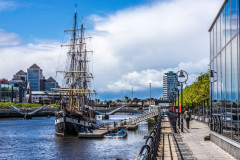
Beginning with the American designed art deco church at Turner's Cross in 1927, Irish architecture followed the international trend towards modern and sleek building styles since the 20th century. Recent developments include the regeneration of Ballymun and an urban extension of Dublin at Adamstown. Since the establishment of the Dublin Docklands Development Authority in 1997, the Dublin Docklands area underwent large-scale redevelopment, which included the construction of the Convention Centre Dublin and Grand Canal Theatre. Completed in 2008, the Elysian tower in Cork is the tallest storeyed building in the Republic of Ireland (the Obel Tower in Belfast, Northern Ireland being the tallest in Ireland), at a height of 71 metres (233 feet), surpassing Cork County Hall. The Royal Institute of the Architects of Ireland regulates the practice of architecture in the state.
Cuisine
Irish cuisine was traditionally based on meat and dairy products, supplemented with vegetables and seafood. Examples of popular Irish cuisine include boxty, colcannon, coddle, stew, and bacon and cabbage. Ireland is famous for the full Irish breakfast, which involves a fried or grilled meal generally consisting of bacon, egg, sausage, pudding, and fried tomato. Apart from the significant influence by European and international dishes, there has been a recent emergence of a new Irish cuisine based on traditional ingredients handled in new ways. This cuisine is based on fresh vegetables, fish, oysters, mussels and other shellfish, and the wide range of hand-made cheeses that are now being produced across the country. Shellfish have increased in popularity, especially due to the high quality shellfish available from the country's coastline. The most popular fish include salmon and cod. Traditional breads include soda bread and wheaten bread. Barmbrack is a yeasted bread with added sultanas and raisins.
Popular everyday beverages among the Irish include tea and coffee. Alcoholic drinks associated with Ireland include Poitín and the world-famous Guinness, which is a dry stout that originated in the brewery of Arthur Guinness at St. James's Gate in Dublin. Irish whiskey is also popular throughout the country, and comes in various forms, including single malt, single grain and blended whiskey.
Society
Ireland ranks fifth in the world in terms of gender equality. In 2011, Ireland was ranked the most charitable country in Europe, and second most charitable in the world. Contraception was controlled in Ireland until 1979, however, the receding influence of the Catholic Church has led to an increasingly secularised society. In 1983, the Eighth Amendment recognised "the right to life of the unborn", subject to qualifications concerning the "equal right to life" of the mother. The case of Attorney General v. X subsequently prompted passage of the Thirteenth and Fourteenth Amendments, guaranteeing the right to have an abortion performed abroad, and the right to learn about "services" that are illegal in Ireland but legal abroad. The prohibition on divorce in the 1937 Constitution was repealed in 1995 under the Fifteenth Amendment. Divorce rates in Ireland are very low compared to European Union averages (0.7 divorced people per 1,000 population in 2011) while the marriage rate in Ireland is slightly above the European Union average (4.6 marriages per 1,000 population per year in 2012).
Capital punishment is constitutionally banned in Ireland, while discrimination based on age, gender, sexual orientation, marital or familial status, religion, race or membership of the travelling community is illegal. The legislation which outlawed homosexual acts was repealed in 1993. In 2010, the Dáil and the Seanad passed the Civil Partnership and Certain Rights and Obligations of Cohabitants Act, which recognised civil partnerships between same-sex couples. It permits same-sex couples to register their relationship before a registrar. A Sunday Times poll carried out in March 2011 showed that 73% of people believe that same-sex couples should be allowed to marry, while 60% believe that same-sex couples should be allowed to adopt children. In April 2012, the Constitutional Convention voted overwhelmingly in favour of extending marriage rights to same-sex couples. On 23 May 2015, Ireland became the first country to legalise same-sex marriage by popular vote.
Ireland became the first country in the world to introduce an environmental levy for plastic shopping bags in 2002 and a public smoking ban in 2004. Recycling in Ireland is carried out extensively and Ireland has the second highest rate of packaging recycling in the European Union. It was the first country in Europe to ban incandescent lightbulbs in 2008 and the first EU country to ban in-store tobacco advertising and product display in 2009. In 2015 Ireland became the second country in the world to introduce plain cigarette packaging. Despite the above measures to discourage tobacco use, smoking rates in Ireland remain above 20% of the adult population and above those in other developed countries.
State symbols
The state shares many symbols with the island of Ireland. These include the colours green and blue, animals such as the Irish wolfhound and stags, structures such as round towers and celtic crosses, and designs such as Celtic knots and spirals. The shamrock, a type of clover, has been a national symbol of Ireland since the 17th century when it became customary to wear it as a symbol on St. Patrick's Day. These symbols are used by state institutions as well as private bodies in the Republic of Ireland.
The flag of Ireland is a tricolour of green, white and orange. The flag originates with the Young Ireland movement of the mid-19th century but was not popularised until its use during the Easter Rising of 1916. The colours represent the Gaelic tradition (green) and the followers of William of Orange in Ireland (orange), with white representing the aspiration for peace between them. It was adopted as the flag of the Irish Free State in 1922 and continues to be used as the sole flag and ensign of the state. A naval jack, a green flag with a yellow harp, is set out in Defence Forces Regulations and flown from the mast head of ships in addition to the national flag in limited circumstances (e.g. when a ship is not underway). It is based on the unofficial green ensign of Ireland used in the 18th and 19th centuries and the traditional green flag of Ireland dating from the 16th century.
Like the national flag, the national anthem, Amhrán na bhFiann (English: A Soldier's Song), has its roots in the Easter Rising, when the song was sung by the rebels. Although originally published in English in 1912, the song was translated into Irish in 1923 and the Irish-language version is more commonly sung today. The song was officially adopted as the anthem of the Irish Free State in 1926 and continues as the national anthem of the state. The first four bars of the chorus followed by the last five comprise the presidential salute.
The arms of Ireland originate as the arms of the monarchs of Ireland and was recorded as the arms of the King of Ireland in the 12th century. From the union of the crowns of England, Scotland and Ireland in 1603, they have appeared quartered on the royal coat of arms of the United Kingdom. Today, they are the personal arms of the President of Ireland whilst he or she is in office and are flown as the presidential standard. The harp symbol is used extensively by the state to mark official documents, Irish coinage and on the seal of the President of Ireland.