
Chechnya
Description
The Chechen Republic , commonly referred to as Chechnya (/ˈtʃɛtʃniə/; Russian: Чечня́; IPA: [tɕɪˈtɕnʲa]; Chechen: Нохчийчоь, Noxçiyçö), also spelled Chechnia or Chechenia, sometimes referred to as Ichkeria (lit land of minerals), is a federal subject (a republic) of Russia.
It is located in the North Caucasus, situated in the southernmost part of Eastern Europe, and within 100 kilometers of the Caspian Sea. The capital of the republic is the city of Grozny. As of the 2010 Russian Census, the republic was reported to have a population of 1,268,989 people; however, that number has been questioned by multiple demographers, who think such population growth after two deadly wars is highly implausible.
After the dissolution of the Soviet Union in 1991, the Chechen-Ingush ASSR was split into two parts: the Republic of Ingushetia and the Chechen Republic. The latter proclaimed the Chechen Republic of Ichkeria, which sought independence. Following the First Chechen War with Russia, Chechnya gained de facto independence as the Chechen Republic of Ichkeria. Russian federal control was restored during the Second Chechen War. Since then there has been a systematic reconstruction and rebuilding process, though sporadic fighting continues in the mountains and southern regions of the republic.
History
Origin of Chechnya's population
According to Leonti Mroveli, the 11th-century Georgian chronicler, the word Caucasian is derived from the Vainakh ancestor Kavkas.
According to Professor George Anchabadze of Ilia State University
The Vainakhs are the ancient natives of the Caucasus. It is noteworthy, that according to the genealogical table drawn up by Leonti Mroveli, the legendary forefather of the Vainakhs was "Kavkas", hence the name Kavkasians, one of the ethnicons met in the ancient Georgian written sources, signifying the ancestors of the Chechens and Ingush. As appears from the above, the Vainakhs, at least by name, are presented as the most "Caucasian" people of all the Caucasians (Caucasus – Kavkas – Kavkasians) in the Georgian historical tradition.American linguist Dr. Johanna Nichols " has used language to connect the modern people of the Caucasus region to the ancient farmers of the Fertile Crescent" and her research suggests that "farmers of the region were proto-Nakh-Daghestanians." Nichols stated: "The Nakh–Dagestanian languages are the closest thing we have to a direct continuation of the cultural and linguistic community that gave rise to Western civilization." Dr. Henry Harpending, University of Utah, supports her claims.
Prehistory
People living in prehistoric mountain cave settlements used tools, mastered fire, and used animal skin for warmth and other purposes. Traces of human settlement that date back to 40,000 BC were found near Lake Kezanoi. Cave paintings, artifacts, and other archaeological evidence indicates continuous habitation for some 8,000 years.
Early history
10,000–8000 BCE Migration of Nakh peoples to the slopes of the Caucasus from the Fertile Crescent. Invention of agriculture, irrigation, and the domestication of animals. 6000–4000 BCE Neolithic era. Pottery is known to the region. Old settlements near Ali-Yurt and Magas, discovered in the modern times, revealed tools made out of stone: stone axes, polished stones, stone knives, stones with holes drilled in them, clay dishes etc. Settlements made out of clay bricks discovered in the plains. In the mountains there were discovered settlements made out of stone and surrounded by walls; some of them dated back to 8000 BC. 4000–3000 BCE Invention of the wheel (3000 BC), horseback riding, metal works (copper, gold, silver, iron), dishes, armor, daggers, knives, arrow tips. The artifacts were found near Nasare-Cort, Muzhichi, Ja-E-Bortz (also known as Surkha-khi), Abbey-Gove (also known as Nazran or Nasare) 900–1200 AD The kingdom in the center of the Caucasus splits into Alania and Noble Alania (known from Russian as Царственные Аланы). German scientist Peter Simon Pallas believed that Ingush people (Kist) were the direct descendants from Alania. 1239 AD Destruction of the Alania capital of Maghas (both names known solely from Muslim Arabs) and Alan confederacy of the Northern Caucasian highlanders, nations, and tribes by Batu Khan (a Mongol leader and a grandson of Genghis Khan) "Magas was destroyed in the beginning of 1239 by the hordes of Batu Khan. Historically Magas was located at approximately the same place on which the new capital of Ingushetia is now built" – D.V.Zayats 1300–1400 AD War between the Alans, Tamerlan, Tokhtamysh, and the Battle of the Terek River. The Alan tribes build fortresses, castles, and defense walls locking the mountains from the invaders. Part of the lowland tribes occupied by Mongols. The insurgency against Mongols begins. In 1991 the Jordanian historian Abdul-Ghani Khassan presented the photocopy from old Arabic scripts claiming that Alania was in Chechnya and Ingushetia, and the document from Alanian historian Azdin Vazzar (1395–1460) who claimed to be from Nokhcho (Chechen) tribe of Alania. 1500 AD First Russian involvement in the Caucasus. 1558 Temryuk of Kabarda sends his emissaries to Moscow requesting help against Vainakh tribes from Ivan the Terrible. Ivan the Terrible marries Temryuk's daughter Maria Temryukovna. Alliance formed to gain the ground in the central Caucasus for the expanding Tsardom of Russia against stubborn Vainakh defenders. Chechnya was a nation in the Northern Caucasus that fought against foreign rule continually since the 15th century. The Chechens converted over the next few centuries to Sunni Islam, as Islam was associated with resistance to Russian encroachment.Russo-Persian Wars and Caucasian Wars
As Russia set off for the first time to increase its political influence in the Caucasus and the Caspian Sea at the expense of Safavid Persia, Peter I launched the Russo-Persian War (1722–1723), in which Russia succeeded in taking much of the Caucasian territories from Iran for several years. Notable in Chechen history, this particular Russo-Persian War marked the first military encounter between Imperial Russia and the Vainakh.
As the Russians took control of the Caspian corridor and moved into Persian-ruled Dagestan, Peter's forces ran into mountain tribes. Peter sent a cavalry force to subdue them, but the Chechens routed them. In 1732, after Russia already ceded back most of the Caucasus to Persia, now led by Nader Shah, following the Treaty of Resht, Russian troops clashed again with Chechens in a village called Chechen-aul along the Argun River. The Russians were defeated again and withdrew, but this battle is responsible for the apocryphal story about how the Nokchi came to be known as "Chechens"-the people ostensibly named for the place the battle had taken place. The name Chechen was however already used since as early as 1692.
Under intermittent Persian rule since 1555, in 1783 the eastern Georgians of Kartl-Kakheti led by Erekle II and Russia signed the Treaty of Georgievsk. According to this treaty, Kartl-Kakheti received protection from Russia, and Georgia abjured any dependence on Iran. In order to increase its influence in the Caucasus and to secure communications with Kartli and other minority Christian regions of the Transcaucasia which it considered useful in its wars against Persia and Turkey, the Russian Empire began conquering the Northern Caucasus mountains. The Russian Empire used Christianity to justify its conquests, allowing Islam to spread widely because it positioned itself as the religion of liberation from tsardom, which viewed Nakh tribes as "bandits". The rebellion was led by Mansur Ushurma, a Chechen Naqshbandi (Sufi) sheikh—with wavering military support from other North Caucasian tribes. Mansur hoped to establish a Transcaucasus Islamic state under shari'a law. He was unable to fully achieve this because in the course of the war he was betrayed by the Ottomans, handed over to Russians, and executed in 1794.
Following the forced ceding of the current territories of Dagestan, most of Azerbaijan, and Georgia by Persia to Russia, following the Russo-Persian War (1804–1813) and its outcoming Treaty of Gulistan, Russia significantly widened its foothold in the Caucasus at the expense of Persia. Another successful Caucasus war against Persia several years later, starting in 1826 and ending in 1828 with the Treaty of Turkmenchay, and a successful war against Ottoman Turkey in 1828, enabled Russia to use a much larger portion of its army in subduing the natives of the North Caucasus.
The resistance of the Nakh tribes never ended and was a fertile ground for a new Muslim-Avar commander, Imam Shamil, who fought against the Russians from 1834 to 1859 (see Murid War). In 1859, Shamil was captured by Russians at aul Gunib. Shamil left Boysangur Benoiski, a Chechen with one arm, one eye, and one leg, in charge of command at Gunib. Benoiski broke through the siege and continued to fight Russia for another two years until he was captured and killed by Russians. The Russian tsar hoped that by sparing the life of Shamil, the resistance in the North Caucasus would stop, but it did not. Russia began to use a colonization tactic by destroying Nakh settlements and building Cossack defense lines in the lowlands. The Cossacks suffered defeat after defeat, and were constantly attacked by mountaineers, who were robbing them of food and weaponry.
The tsarists' regime used a different approach at the end of the 1860s. They offered Chechens and Ingush to leave the Caucasus for the Ottoman Empire (see Muhajir (Caucasus)). It is estimated that about 80% of Chechens and Ingush left the Caucasus during the deportation. It weakened the resistance which went from open warfare to insurgent warfare. One of the notable Chechen resistance fighters at the end of the 19th century was a Chechen abrek Zelimkhan Gushmazukaev and his comrade-in-arms Ingush abrek Sulom-Beck Sagopshinski. Together they built up small units which constantly harassed Russian military convoys, government mints, and government post-service, mainly in Ingushetia and Chechnya. Ingush aul Kek was completely burned when the Ingush refused to hand over Zelimkhan. Zelimkhan was killed in the beginning of the 20th century. The war between Nakh tribes and Russia resurfaced during the times of the Russian Revolution, which saw the Nakh struggle against Anton Denikin, and later against the Soviet Union.
Independent state
On December 21, 1917, Ingushetia, Chechnya, and Dagestan declared independence from Russia and formed a single state: "United Mountain Dwellers of the North Caucasus" (also known as Mountainous Republic of the Northern Caucasus) which was recognized by major world powers. The capital of the new state was moved to Temir-Khan-Shura (Dagestan). Tapa Chermoyev, a prominent Chechen statesman, was elected the first prime minister of the state. The second prime minister elected was Vassan-Girey Dzhabagiev, an Ingush statesman, who also was the author of the constitution of the republic in 1917, and in 1920 he was re-elected for the third term. In 1921 the Russians attacked and occupied the country and forcefully absorbed it into the Soviet state. The Caucasian war for independence restarted, and the government went into exile.
Soviet rule
During the Soviet rule, Chechnya and Ingushetia were combined together to form Chechen-Ingush Autonomous Soviet Socialist Republic. In the 1930s Chechnya was flooded with many Ukrainians fleeing the genocide known as Holodomor. Despite the threats from the Russian government not to provide food and shelter to starving Ukrainians the rebellious peoples did not follow Russian orders. As the result many of the Ukrainians settled in Chechen-Ingush ASSR on the permanent basis and were able to survive the famine.
Despite the fact that over 50,000 Chechens and over 12,000 Ingush were fighting against Nazi Germany on the front line (including heroes of the USSR: Abukhadzhi Idrisov, Khanpasha Nuradilov, Movlid Visaitov), and despite the fact that Nazi German troops were stopped at two Chechen-Ingush ASSR cities Malgobek and Ordzhonikidze (renamed to Vladikavkaz) to a complete stop after capturing half of the Caucasus in less than a month; Chechens and Ingush were falsely accused as Nazi supporters and entire nations were deported during Operation Lentil to the Kazakh SSR (later Kazakhstan) in 1944 near the end of World War II where over 60% of Chechen and Ingush populations perished. American historian Norman Naimark writes:
Troops assembled villagers and townspeople, loaded them onto trucks – many deportees remembered that they were Studebakers, fresh from Lend-Lease deliveries over the Iranian border – and delivered them at previously designated railheads. …Those who could not be moved were shot. …[A] few fighters aside, the entire Chechen and Ingush nations, 496,460 people, were deported from their homeland.The deportation was supposedly justified by the materials prepared by notorious NKVD officer Bogdan Kobulov accusing Chechens and Ingush in a mass conspiracy preparing rebellion and providing assistance to the German forces. Many of the materials were later proved to be fabricated. Even distinguished Red Army officers who fought bravely against Germans (e.g. the commander of 255th Separate Chechen-Ingush regiment Movlid Visaitov, the first to contact American forces at Elbe river) were deported. There is a theory that the real reason why Chechens and Ingush were deported is the desire of Russia to attack Turkey, a non-communist country, as Chechens and Ingush could impede such plans. In 2004, European Parliament recognized deportation of Chechens and Ingush as an act of genocide.
The territory of the Chechen-Ingush Autonomous Soviet Socialist Republic was divided between Stavropol Krai (where Grozny Okrug was formed), the Dagestan ASSR, the North Ossetian ASSR, and the Georgian SSR.
The Chechens and Ingush were allowed to return to their land after 1956 during de-Stalinization under Nikita Khrushchev when Chechen-Ingush Autonomous Soviet Socialist Republic was restored but both boundaries and ethnic composition of the territory significantly changed. There were many (predominantly Russian) migrants from other parts of the Soviet Union, who often settled in the abandoned family homes of Chechens and Ingushes. The republic lost its Prigorodny District which transferred to North Ossetian ASSR, but gained predominantly Russian Naursky District and Shelkovskoy District that is considered the homeland for Terek Cossacks.
The Russification policies towards Chechens continued after 1956, with Russian language proficiency required in many aspects of life, and for advancement in the Soviet system.
Since 1990
Part of a series on the History of Chechnya Prehistory- Kura–Araxes culture
- Kayakent culture
- Kharachoi culture
- Koban culture
- "Ichkerian" Era
- Caucasian Imamate
- Russian Empire
- v
- t
- e
On November 26, 1990, the Supreme Council of Chechen-Ingush ASSR adopted the "Declaration of State Sovereignty of the Chechen-Ingush Republic". This declaration was part of the reorganization of the Soviet Union. This new treaty would have been signed August 22, 1991, which would have transformed 15 republic states into more than 80. The August 19–21, 1991 Soviet coup d'état attempt led to the abandonment of this reorganization.
With the impending dissolution of the Soviet Union in 1991, an independence movement, the Chechen National Congress, was formed, led by ex-Soviet Air Force general and new Chechen President Dzhokhar Dudayev. It campaigned for the recognition of Chechnya as a separate nation. This movement was opposed by Boris Yeltsin's Russian Federation, which argued that Chechnya had not been an independent entity within the Soviet Union—as the Baltic, Central Asian, and other Caucasian States had—but was part of the Russian Soviet Federative Socialist Republic and hence did not have a right under the Soviet constitution to secede. It also argued that other republics of Russia, such as Tatarstan, would consider seceding from the Russian Federation if Chechnya were granted that right. Finally, it argued that Chechnya was a major hub in the oil infrastructure of the federation and hence its secession would hurt the country's economy and energy access.
In the ensuing decade, the territory was locked in an ongoing struggle between various factions, usually fighting unconventionally and forgoing the position held by the several successive Russian governments through the current administration.
First Chechen WarThe First Chechen War took place over a two-year period that lasted from 1994 to 1996, when Russian forces attempted to regain control over Chechnya, which had declared independence in November 1991. Despite overwhelming numerical superiority in men, weaponry, and air support, the Russian forces were unable to establish effective permanent control over the mountainous area due to numerous successful full-scale battles and insurgency raids. In three months, Russia lost more tanks (over 1,997 tanks) in Grozny than during the Battle of Berlin in 1945. The Budyonnovsk hospital hostage crisis in 1995 shocked the Russian public and led to international condemnation of the Chechen rebels.
In April 1996 the first democratically elected president of Chechnya, Dzhokhar Dudayev, was killed by two laser guided missiles fired from a warplane which had an equipment of voice recognition and triangulation on Dudayev's position.
The widespread demoralization of the Russian forces in the area and a successful offensive to re-take Grozny by Chechen resistance forces led by Aslan Maskhadov prompted Russian President Boris Yeltsin to declare a ceasefire in 1996, and sign a peace treaty a year later that saw a withdrawal of Russian forces.
Inter-war periodAfter the war, parliamentary and presidential elections took place in January 1997 in Chechnya and brought to power new President Aslan Maskhadov, chief of staff and prime minister in the Chechen coalition government, for a five-year term. Maskhadov sought to maintain Chechen sovereignty while pressing the Russian government to help rebuild the republic, whose formal economy and infrastructure were virtually destroyed. Russia continued to send money for the rehabilitation of the republic; it also provided pensions and funds for schools and hospitals. Most of these funds were taken by Chechen authorities and divided between favoured warlords. Nearly half a million people (40% of Chechnya's prewar population) had been internally displaced and lived in refugee camps or overcrowded villages. There was an economic downturn. Two Russian brigades were permanently stationed in Chechnya.
In lieu of the devastated economic structure, kidnapping emerged as the principal source of income countrywide, procuring over US$200 million during the three-year independence of the chaotic fledgling state, although victims were rarely killed. In 1998, 176 people were kidnapped, 90 of whom were released, according to official accounts. President Maskhadov started a major campaign against hostage-takers, and on October 25, 1998, Shadid Bargishev, Chechnya's top anti-kidnapping official, was killed in a remote-controlled car bombing. Bargishev's colleagues then insisted they would not be intimidated by the attack and would go ahead with their offensive. Political violence and religious extremism, blamed on "Wahhabism", was rife. In 1998, Grozny authorities declared a state of emergency. Tensions led to open clashes between the Chechen National Guard and Islamist militants, such as the July 1998 confrontation in Gudermes.
Second Chechen WarThe War of Dagestan began on August 7, 1999, during which the Islamic International Brigade (IIPB) began an unsuccessful incursion into the neighbouring Russian republic of Dagestan in favor of the Shura of Dagestan which sought independence from Russia. In September, a series of apartment bombs that killed around 300 people in several Russian cities, including Moscow, were blamed on the Chechen separatists. Some journalists contested the official explanation, instead blaming the Russian Secret Service for blowing up the buildings to initiate a new military campaign against Chechnya. In response to the bombings, a prolonged air campaign of retaliatory strikes against the Ichkerian regime and a ground offensive that began in October 1999 marked the beginning of the Second Chechen War. Much better organized and planned than the first Chechen War, the Russian military took control over most regions. The Russian forces used brutal force, killing 60 Chechen civilians during a mop-up operation in Aldy, Chechnya on February 5, 2000. After the re-capture of Grozny in February 2000, the Ichkerian regime fell apart.
Chechen rebels continued to fight Russian troops and conduct terrorist attacks.[page needed] In October 2002, 40–50 Chechen rebels seized a Moscow theater and took about 900 civilians hostage. The crisis ended with a large death toll mostly due to an unknown aerosol pumped throughout the building by Russian special forces to incapacitate the people inside.
In September 2004, separatist rebels occupied a school in the town of Beslan, North Ossetia, demanding recognition of the independence of Chechnya and a Russian withdrawal. 1,100 people (including 777 children) were taken hostage. The attack lasted three days, resulting in the deaths of over 331 people, including 186 children.
In response to the increasing terrorism, Russia tightened its grip on Chechnya and expanded its anti-terrorist operations throughout the region. Russia installed a pro-Russian Chechen regime. In 2003, a referendum was held on a constitution that reintegrated Chechnya within Russia, but provided limited autonomy. According to the Chechen government, the referendum passed with 95.5% of the votes and almost 80% turnout. The Economist was skeptical of the results, arguing that "few outside the Kremlin regard the referendum as fair". After the 2004 school siege, Russian president Vladimir Putin announced sweeping security and political reforms, sealing borders in the Caucasus region and revealing plans to give the central government more power. He also vowed to take tougher action against domestic terrorism, including preemptive strikes against Chechen separatists. In 2005 and 2006, prominent separatist leaders Aslan Maskhadov and Shamil Basayev were killed.
In April 2009, Russia ended its counter-terrorism operation and pulled out the bulk of its army. Three months later, the leader of the separatist government, Akhmed Zakayev, called for a halt to armed resistance against the Chechen police force starting on August 1, 2009.
Insurgency in the North Caucasus continued even after this date. The Caucasus Emirate has fully adopted the tenets of being a Salafist-takfiri jihadist group through its strict adherence to upholding tawhid, its obedience to the literal interpretation of the Quran and the Sunnah, and its complete rejection of bid‘ah, taqlid, and ijtihad.
Geography
Situated in the eastern part of the North Caucasus, partially in Eastern Europe, Chechnya is surrounded on nearly all sides by Russian Federal territory. In the west, it borders North Ossetia and Ingushetia, in the north, Stavropol Krai, in the east, Dagestan, and to the south, Georgia. Its capital is Grozny.
- Area: 15,300 km
- Borders:
- Internal:
- Republic of Dagestan (NE)
- Republic of Ingushetia (W)
- Republic of North Ossetia–Alania (W)
- Stavropol Krai (NW)
- Foreign:
- Georgia (S)
- Internal:
Rivers:
- Terek
- Sunzha
- Argun
Human rights
In 2006 Human Rights Watch reported that pro-Moscow Chechen forces under the command, in effect, of chapter of republic Ramzan Kadyrov, as well as federal police personnel, used torture to get information about separatist forces. "If you are detained in Chechnya, you face a real and immediate risk of torture. And there is little chance that your torturer will be held accountable", said Holly Cartner, Director Europe and Central Asia division of HRW.
Human rights groups criticized the conduct of the 2005 parliamentary elections as unfairly influenced by the central Russian government and military.
The Internal Displacement Monitoring Centre reports that after hundreds of thousands of ethnic Russians and Chechens fled their homes following inter-ethnic and separatist conflicts in Chechnya in 1994 and 1999, more than 150,000 people still remain displaced in Russia today.
On September 1, 1997, Criminal Code reportedly being implemented in the Chechen Republic-Ichkeriya, Article 148 punishes "anal sexual intercourse between a man and a woman or a man and a man". For first- and second-time offenders, the punishment is caning. A third conviction leads to the death penalty, which can be carried out in a number of ways including stoning or beheading.
On February 1, 2009, the New York Times released extensive evidence to support allegations of consistent torture and executions under the Kadyrov government. The accusations were sparked by the assassination in Austria of a former Chechen rebel who had gained access to Kadyrov's inner circle, 27-year-old Umar Israilov.
On July 1, 2009, Amnesty International released a detailed report covering the human rights violations committed by the Russian Federation against Chechen citizens. Among the most prominent features was that those abused had no method of redress against assaults, ranging from kidnapping to torture, while those responsible were never held accountable. This led to the conclusion that Chechnya was being ruled without law, being run into further devastating destabilization.
On March 10, 2011, Human Rights Watch reported that since Chechenization, the government has pushed for enforced Islamic dress code and other traditions which violently repress women. The president Ramzan Kadyrov is quoted as saying "I have the right to criticize my wife. She doesn’t. With us [in Chechen society], a wife is a housewife. A woman should know her place. A woman should give her love to us [men]... She would be [man’s] property. And the man is the owner. Here, if a woman does not behave properly, her husband, father, and brother are responsible. According to our tradition, if a woman fools around, her family members kill her... That’s how it happens, a brother kills his sister or a husband kills his wife... As a president, I cannot allow for them to kill. So, let women not wear shorts...". He has also openly defended honor killings on several occasions.
Towns
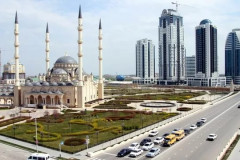
All accomodation types
Hotels
 from 11 USDNokhchostar Hotel
Hostels
 Hostel Enkor
 from 5 USDTravel Hostel
 Offerfrom 6 USDBest Hostel
 High ratingfrom 9 USDMinutka Guest House