
Bolshoye Boldino
Description
Bol'shoye Boldino is a village in the Nizhny Novgorod region, the administrative center of Bol and Bol village district. Bol'shoye Boldino and the surrounding land for four centuries, belonged to the genus of Pushkin — one of the oldest noble families of Russia. Currently, the historic part of the village is a monument of culture of Federal value.
Bol'shoye Boldino is located 170 km South-East of Nizhny Novgorod (straight) and 38 km from the railway station Uzhivka, on the higher right Bank of the Azanka river (a tributary of the Checks). The road distance from Nizhny Novgorod (via bol'shoye Murashkino, Buturlino, Gagin) is 205 km.
History
The origin of the name
In ancient times the area which is modern bol'shoye Boldino, was inhabited by Mordvinian tribes engaged in collecting honey from wild bees — apiculture. This explains the ancient name of the village — Zaborchiki (village for bortnem forest), under which it was first mentioned in the cadastre documents 1585.
There are several versions of the origin of the modern name of the village. One version ascribes the name of Tatar origin — Spruce Boldin. Later in the documents, this name began to be used in abbreviated spelling: Baldino. According to another version, the name comes from the native Mordovian behalf of Baldy. In historical documents of the XVII century Boldino first referred to as the village: "...in Arzamas district village Oboldina" (1612), but in 1619 it is called village: "...in Arzamas [County] in Zaleski will be for Shatilovsky winches village of Boldino, which was a village Zaborchiki under a large Mordovian black forest". From that time and onwards the village was called just Boldin, and then bol'shoye Boldino.
XVI—XVII century
For several centuries the village of Great Boldino belonged to Pushkin.
Bol'shoye Boldino is first mentioned in archival documents Dating from the year 1585, which States that the village of Boldino of the Arzamas district listed for the Governor and okolnichy the evstafiy Mikhailovich Pushkin. Eustace M. distinguished himself in the defense of Smolensk of the invasion Lithuanians in 1580, led a difficult diplomatic negotiations with the Polish king Stefan Batory. Over the merits of Pushkin received the village as a local possession of Ivan the terrible.
In 1612 Boldin was given to Ivan Fedorovich Pushkin, member of the Nizhny Novgorod militia Dmitry Pozharsky and Kuzma Minin. After the childless death of Ivan Tsar Mikhail Fedorovich in 1619 complained Boldin, the brother of the deceased, Fedor Fedorovich Pushkin (nicknamed Withered arm), distinguished himself during the defense of Moscow from the troops of the Polish king Wladyslaw IV.
The regional archives contain a handwritten statement of the scribe books 1621-1623 years, Arzamas district, among villages which is bol'shoye Boldino:
The village of Boldino in the river on Usance what was the village of Zaborchiki <...> In the same village for Fedor Fedorov son Pushkin in Gosudareva Tsar and Grand Prince Mikhail Fedorovich BCEAO Russia patrimonial Charter the Charter that was given to him for the Moscow siege seat of the 12th year <...> of the patrimonial clerk Bear Yes Fedorov peasants Ivashko Nikiforov <...> Yes, and twenty yards of the peasant Yes, a twenty-four yard Bobyl'sky, and people in peasant and Bobyl'sky yards to forty-five. The arable land of the landowners daudzai five-farthing Yes, peasant arable land, eight of the fallow farthing sixty seven network and obaeva of arable land and the fallow farthing in a hundred box, and two because well. The land is good. Hay between gender and Zapol and no description on the river Asanka on both sides of the four stacks.
The prevalence of households without land property against the peasant says that at the time agriculture in the life of Boldyrev was far superior even though the land was considered "good". More than half of the villagers were loners, cut off from the earth and dedicated to the craft of beekeeping and hunting.
About the boundaries of name Boldin Pushkins in the XVII century says copy with the exemption of books on "real and personal estate to" Elizabeth Lvovna Doncovoi, nee Pushkina:
Meza Fedor Fedorov son Pushkin's patrimonial lands of the village of Boldin from Oratorskogo the USAD, near the black forest to the old town of Sochi, near the black forest to the river of Mokranjac and Marchandeau down to the river Asenci, and the river Ozankoy down to the mouth of the river of Gimalai, and the river Simulacao up to the sand of the enemy, the enemy of the black forest to Omsk Poimala the enemy, and in Russian alder enemy, and the enemy to the river Usance W down Usance and the tracts on the right side of the earth Oratorskogo County village of Boldin and on the left side of the land of the Arzamas district.
XVIII century
In 1718 Boldin came into the possession of the great-grandfather of the poet, Alexander Pushkin, in his will to his great-uncle. From 1741 to 1790 Boldin owned a manor Lev Alexandrovich Pushkin — the grandfather of the poet. Despite the fact that the owner of the estate lived in Moscow, Nizhny Novgorod patrimony at this time expanded and strengthened.
After the death of Leo A. Boldin estate, which, in addition to the Boldin included the village of Maloye Boldino and Kistenevo village, passed to his children from two marriages. Part of the inheritance received from the father of the poet Sergei L., which under section brother Vasily Lvovich got half the village of Boldin with a new HOMESTEAD. Later, Sergei Lvovich moved back and Kistenevo, some of which he identified later son Alexander.
XIX century
In the 1830-ies of the XIX century the village was visited on three occasions by A. S. Pushkin. The pre-wedding period of seclusion in the autumn of 1830, known as the Boldino autumn is the most productive and creative time in the life of the poet. Stay in the estate because of the announced cholera quarantine coincided with the preparations for the long-awaited marriage to Natalia Goncharova. During this time, Pushkin completed work on "Eugene Onegin," cycles "Belkin's stories" and "Little tragedies", it is written: verse novel (poem) "little House in Kolomna", lyrical poems ("the Devils", "the Crazy years extinct fun...", "Rhyme", "On the translation of the Iliad", "Labor", "Farewell", "Spell", "Verses composed at night during insomnia", "Two feelings wonderfully close to us..." — only about thirty). In the second autumn in Boldino, in October 1833, the poet had written "the bronze horseman", "Angelo", "the Tale of the dead Princess...", "the Tale of the fisherman and the fish", "the Queen of spades" and a number of poems and also finished the "History of Pugachev". In the autumn of 1834 Pushkin again spent quite some time in Boldin, but wrote only one piece, albeit significant: it was "the Tale of Golden Cockerel".
The twentieth century
The last owner of the village from the kind of Pushkin was Leo A., Grand-nephew of the poet. In 1911 Boldin, the estate was acquired by the state, based on the decision of the Council of Ministers "On the purchase of the property of the state for 30 thousand rubles belonging to the nobility of the Pushkin family estate in the village of Boldino of the Lukoyanov district of Nizhny Novgorod province...".
After the revolution, the manor house was opened four-year school, in patrimonial office until 1945 worked as a kindergarten. Manor Park was abandoned, and in the 1930-ies have repeatedly raised the issue of the creation of the Museum-reserve. In 1937, the day of the centenary commemoration of the great poet, in Boldin was a memorial plaque on the manor house. 20 June 1944 the Bureau of the Gorky regional Committee of the CPSU(b) for the first time addressed the issue of the restoration of the Pushkin Park and the Museum in the village. Finally, in the year of the 150th anniversary of the birth of Alexander Pushkin, June 18, 1949, Boldin hosted the Grand opening of the Museum. Over the next few years work continued on the development and improvement of the Museum-reserve. In 1973-1974, in the Gorky region, was celebrated the 175th anniversary of the birth of the poet.
In 1980-1990 the XX century the property has been fully restored. The historical places appeared again lordly kitchen, stable with coach-house and barn, human, bath. In these open buildings exhibits and displays of ethnographic character. The 200th anniversary of the birth of Pushkin in Boldino restored stone Church of the assumption. Two years before this was opened children's Museum of Pushkin's fairy tales in the homes of Church clergy.
Architecture and remarkables
Museum
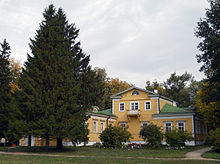
The main attraction of the village — state literary-memorial and natural reserve Museum Alexander Pushkin "Boldino". A Museum dedicated to the Boldino period of the life and work of the poet, housed in a former manor house of Pushkin, in manor Park with an area of 8.5 hectares.