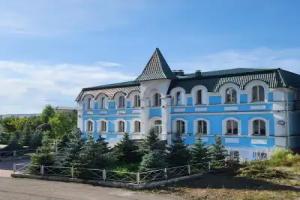
Tuva
Description
The Tyva Republic is a federal subject of Russia (a republic, also defined in the Constitution of the Russian Federation as a state ). It lies in the geographical center of Asia, in southern Siberia. The republic borders the Altai Republic, the Republic of Khakassia, Krasnoyarsk Krai, Irkutsk Oblast, and the Republic of Buryatia in Russia and Mongolia to the south. Its capital is the city of Kyzyl. Population: 307,930 (2010 Census).
From 1921 until 1944, Tuva constituted a sovereign, independent nation, under the name of Tannu Tuva, officially, the Tuvan People's Republic, or the People's Republic of Tannu Tuva. The independence of Tannu Tuva, however, was recognized only by its neighbours: the Soviet Union and Mongolia.
Forests, mountains, and steppe make up a large part of the geography of Tuva.
A majority of the people are Tyvans, but Russian is also spoken extensively. Tuva is governed by the Great Khural, which elects a chairman for a four-year term. The current chairman is Sholban Kara-ool.
History
The Xiongnu Empire (209 BC–93 CE) governed the territory of modern Tyva. The identity of the ethnic core of Xiongnu has been a subject of varied hypotheses. Proposals by scholars include Mongolic and Turkic. Tatar Mongols lived in Tyva and they moved to Lake Hulun. The Oirat Mongols lived in eastern Tyva, and they moved to the south.
The territory of Tyva has been ruled by the Mongolic Xianbei state (93–234), Rouran Khaganate (330–555), Mongol Empire (1206–1368), Northern Yuan (1368–1691), Khotgoid Khanate and Zunghar Khanate (1634–1758). The historic region of Tannu Uriankhai, of which Tyva is a part, was controlled by the Mongols from 1207 to 1758, when it was brought under Manchu rule (Qing Dynasty until 1911).
During the 1911 revolution in China, tsarist Russia formed a separatist movement among the Tyvans. Tsar Nicholas II ordered Russian troops into Tyva in 1912, as Russian settlers were allegedly being attacked. Tyva became nominally independent as the Urjanchai Republic before being brought under Russian protectorate as Uryankhay Kray under Tsar Nicholas II on 17 April 1914. This move was apparently requested by a number of prominent Tyvans, including the High Lama, although it is possible they were actually acting under the coercion of Russian soldiers. A Tyvan capital was established, called Belotsarsk (Белоца́рск; literally, "(Town) of the White Tsar"). Meanwhile, in 1911 Mongolia became independent, though under Russian protection.
Following the Russian Revolution of 1917 that ended the imperial autocracy, most of Tyva was occupied from 5 July 1918 to 15 July 1919 by Aleksandr Kolchak's "White" Russian troops. Pyotr Ivanovich Turchaninov was named governor of the territory. In the autumn of 1918 the southwestern part was occupied by Chinese troops and the southern part by Mongol troops led by Khatanbaatar Magsarjav. From July 1919 to February 1920 the communist Red Army controlled Tyva, but from 19 February 1920 to June 1921 it was occupied by China (governor was Yan Shichao [traditional, Wade–Giles transliteration: Yan Shi-ch'ao]).
On August 14, 1921 the Bolsheviks established a Tuvan People's Republic, popularly called Tannu-Tuva. In 1926, the capital (Belotsarsk; Khem-Beldyr since 1918) was renamed Kyzyl, meaning "red". Tyva was de jure an independent state between the World Wars. The state's first ruler, Prime Minister Donduk, sought to strengthen ties with Mongolia and establish Buddhism as the state religion. This unsettled the Kremlin, which orchestrated a coup carried out in 1929 by five young Tyvan graduates of Moscow's Communist University of the Toilers of the East. In 1930 the pro-Soviet region discarded the state's Mongol script in favor of a Latin alphabet designed for Tyva by Russian linguists, and in 1943 Cyrillic script replaced the Latin. Under the leadership of Party Secretary Salchak Toka, ethnic Russians were granted full citizenship rights and Buddhist and Mongol influences on the Tuvan state and society were systematically reduced.
Tyva voluntarily became a part of The Soviet Union in 1944, with the approval of Tyva's Little Khural (parliament). The exact circumstances surrounding Tannu-Tuva's incorporation into the USSR in 1944 remain obscure. Salchak Toka, the leader of Tyvan communists, was given the title of First Secretary of the Tyvan Communist Party, and became the de facto ruler of Tyva until his death in 1973. Tyva was made the Tuvan Autonomous Oblast and then became the Tuva ASSR on October 10, 1961.
In February 1990, the Tuvan Democratic Movement was founded by Kaadyr-ool Bicheldei, a philologist at Kyzyl University. The party aimed to provide jobs and housing (both were in short supply), and also to improve the status of Tyvan language and culture. Later on in the year there was a wave of attacks against Tyva's sizeable Russian community, including sniper attacks on trucks and attacks on outlying settlements with 168 murdered. Russian troops eventually were called in. Many Russians moved out of the republic during this period. To this day, Tyva remains remote and difficult to access.
Tyva was a signatory to the March 31, 1992 treaty that created the Russian Federation. A new constitution for the republic was drawn up on October 22, 1993. This created a 32-member parliament (Supreme Khural) and a Grand Khural, which is responsible for foreign policy and any possible changes to the constitution, and ensures that Tyvan law is given precedence. The constitution also allowed for a referendum if Tyva ever sought independence. This constitution was passed by 53.9% (or 62.2%, according to source) of Tyvans in a referendum on December 12, 1993. At the same time, the official name was changed from Tuva (Тува) to Tyva (Тыва).
Geography
The republic is situated in the far south of Siberia. Its capital city of Kyzyl is located near the geographic "center of Asia". The eastern part of the republic is forested and elevated, and the west is a drier lowland.
Biosphere reserve
- Ubsunur Hollow is a biosphere reserve, an environmentally protected zone and a top attraction.
Rivers
There are over 8,000 rivers in the republic. The area includes the upper course of the Yenisei River, the fifth longest river in the world. Most of the republic's rivers are Yenisei tributaries. There are also numerous mineral springs in the area.
Major rivers include:
- Bolshoy Yenisei River (also called Ulug-Khem)
- Kantegir River
- Khemchik River
- Maly Yenisei River (also called Ka-Khem or Kaa-Khem)
- Upper Yenisei River (also called Biy-Khem or Bii-Khem)
Lakes
There are numerous lakes on the republic's territory, many of which are glacial and salt lakes. Major lakes include:
- Todzha Lake, a.k.a. Azas Lake (100 km²)—the largest in the republic
- Uvs Lake – shared with Mongolia and a World Heritage Site
- Kadysh Lake
- Many-Khol Lake
Mountains
The area of the republic is a mountain basin, ca. 600 m high, encircled by the Sayan and Tannu-Ola ranges. Mountains and hills cover over 80% of the republic's territory. Mount Mongun-Tayga 'Silver Mountain' (3,970 m) is the highest point in the republic and is named from its glacier.
Natural resources
Major natural mineral resources of Tyva include coal, iron ore, gold, and cobalt. Asbestos was formerly important. Wildlife is varied: wolves and bears, snow leopards, ground squirrels, flying foxes, eagles, and fish – some very large.
Tourism
Tyva is a region with a unique history, culture and nature. All native zones of the Earth except savanna (even rain forest, see Southern Siberian rainforest) are featured in Tyva. Tyva is well known for its spa-tourism. There are more than 100 mineral springs in Tyva. The biggest of them are the warm mineral springs Ush-Beldir and Tarys, the temperature of the water is 52-85 °C. Cold mineral springs and salty lakes are popular among tourists and the general population for their medicinal qualities. The geographical location of Tyva between the east-Siberian taiga and central-Asian landscape engenders a wealth of flora and fauna. More than 90% of the territory is chase. Rare animals such as sable, lynx, wolverine, weasel, maral, Siberian ibex, and musk deer are only the part of Tyvan fauna.
Historical objects and ethnic culture are of interest: traditional habitat – yurts, national cuisine and handicraft, tuvan throat singing khomeii, national sports – wrestling competition Khuresh and horse riding. Annual festival "Ustuu-Khuree" and Naadym are of interest to tourists.
Transportation
Tyva has as yet no railway — although famous postage stamps in the 1930s, designed in Moscow during the time of Tyvan independence, mistakenly depict locomotives as demonstrating Soviet-inspired progress there. There is however a plan for construction of a railway line from the capital Kyzyl to Kuragino in Krasnoyarsk Krai. The railway will run for 410 km. The main purpose for building the railway is to transport coal from coal mines in Kyzyl.
There are three roads leading to Tyva, a paved highway over the passes between Khakassia (Abakan) and Kyzyl and a dirt track over the mountains from Khakassia to Ak Dovurak,: both of these can be cut off by snowfall and avalanches from time to time in winter. The third road goes south, turning into a track before entering Mongolia. The only external bus and taxi services are between Khakassia (Abakan) and Kyzyl.
Kyzyl has both large public buses and private minibus services.Both buses and taxis also connect Kyzyl with the larger settlements.
Passenger ferries ply the Greater Yenisei (Bii-Khem) between Kyzyl and Toora-Khem in Todzha (Upper Tyva) when there is neither too little nor too much water over the rapids.
There is a small airfield in Kyzyl with intermittent flights.
Culture
The Tuvan people are famous for Tuvan throat singing.
Khuresh, the Tyvan form of wrestling, is a very popular sport. Competitions are held at the annual Naadym festival at Tos-Bulak.
Sainkho Namtchylak is one of the few singers from Tyva to have an international following. She is also very involved with Tyvan culture. Every year she invites Western musicians to perform in Kyzyl and to learn about the country, its culture and its music. In recent years Kongar-ool Ondar has become well known in the West as well, in large part because of the film Genghis Blues featuring Ondar and American blues singer Paul Pena. Huun-Huur-Tu has been one of the most well known Tyvan music ensembles since the late 1990s, while the Alash ensemble came to prominence in the early 2000s.
The Tyvan language is Turkic, although with many loan-words from Mongolian. It is currently written with a modified Cyrillic alphabet, previously used Turkic runes, later Mongolian, then Latin alphabets. Then, Tyva was administered as part of Outer Mongolia, and the language difference was a determining factor in Tyva seeking full independence from Outer Mongolia, following the collapse of Qing Dynasty of China in 1911.
Oral traditions
The Tuvan people have a rich tradition of orally transmitted folklore, including many genres, ranging from very brief riddles and aphorisms, to tongue twisters, magical tales, hero tales, scary stories, and epics that would take many hours to recite. A few examples and excerpts of the epic genres, such as Boktu-Kirish, Bora-Sheelei have been published. This art form is now endangered as the traditional tale-tellers grow old and are not replaced by younger practitioners.
Miscellaneous
- In the 1920s and 1930s, postage stamps from Tuva were issued. Many philatelists, including the physicist Richard Feynman, have been fascinated with Tuva because of these stamps. The stamps were issued mainly during the brief period of Tuvan independence, and were not accepted by serious collectors until recently as they were thought to be produced in Moscow and not to represent a genuine postal service. Feynman's efforts to reach Tuva are chronicled in the book Tuva or Bust! and the video The Quest For Tannu Tuva: Richard Feynman – The Last Journey of a Genius (1988) which can be viewed online on YouTube. Project Tuva was named in honor of his efforts.
- Tuva was featured prominently in the award-winning documentary Genghis Blues.
- United Nations Human Development Index: Russian Federation – Republic of Tyva, rank: 79/79 (the lowest).
- Tuvan stamps are mentioned in a line of Gregory Corso's poem Marriage.
- Tuvan Sergey Shoygu, Russia's Minister for Emergency Situations since 1994, is Russia's longest-serving minister, and a leader of Russia's governing party 'Unity'.
- Tuvans make wishes each morning, sprinkling milk on the ground, to the north, south, east and west, with a special wooden spoon with nine small hollows for the various milk products made.
- According to Ilya Zakharov of Moscow's Vavilov Institute of General Genetics, genetic evidence suggests that the modern Tuvan people are the closest genetic relatives to the native peoples of North and South America.
- Some Tuvans, even near Kyzyl, still live in traditional yurts, round, demountable and portable dwellings with sectional lath trellis walls, decorated pole roofs and covered with white felt and canvas, with colourful cloth lining. There is a central smoke-hole above the hearth or stove. It is used to tell the time as the sunlight moves around inside the yurt. The interior is arranged with the man's side to the left, the woman's to the right of the door facing East, with the altar cupboard facing that.
- Tuvans, as traditional nomads, knew no fixed national borders, which has led to small numbers being in areas outside the present Republic's boundaries, including as follows.
- China – Xinjiang: 'Tuwa' by Lake Kanas, Altay Prefecture.
- Russia – Irkutsk Oblast: 'Tofa' adjacent to north-east Tyva; Buryatia: 'Soyot' of the Upper Oka river.
- Mongolia – northern: 'Tsaatan'; north-western: 'Dukha/Duva'; western: 'Tsengel'.
- Sayan Mountains in Tuva was featured in Bear Grylls' Man vs Wild popular adventure TV show.