Colorado
Description
Colorado is a state in the United States encompassing most of the Southern Rocky Mountains as well as the northeastern portion of the Colorado Plateau and the western edge of the Great Plains. Colorado is part of the Western United States, the Southwestern United States, and the Mountain States. Colorado is the 8th most extensive and the 22nd most populous of the 50 United States. The United States Census Bureau estimates that the population of Colorado was 5,456,574 on July 1, 2015, an increase of 8.50% since the 2010 United States Census.
The state was named for the Colorado River, which Spanish travelers named the Río Colorado for the ruddy (Spanish: colorado) silt the river carried from the mountains. The Territory of Colorado was organized on February 28, 1861, and on August 1, 1876, U.S. President Ulysses S. Grant signed Proclamation 230 admitting Colorado to the Union as the 38th state. Colorado is nicknamed the "Centennial State" because it became a state in the same year as the centennial of the United States Declaration of Independence.
Colorado is bordered by Wyoming to the north, Nebraska to the northeast, Kansas to the east, Oklahoma to the southeast, New Mexico to the south, Utah to the west, and Arizona to the southwest, at the Four Corners. Colorado is noted for its vivid landscape of mountains, forests, high plains, mesas, canyons, plateaus, rivers, and desert lands.
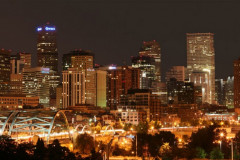
Denver is the capital and the most populous city of Colorado. Residents of the state are properly known as "Coloradoans", although the term "Coloradan" is used in modern times.
Geography
Colorado is notable for its diverse geography, ranging from alpine mountains, arid plains and deserts with huge sand dunes, deep canyons, sandstone and granite rock formations, rivers, lakes, and lush forests. The borders of Colorado were originally defined to be lines of latitude and longitude, making its shape a latitude-longitude quadrangle which stretches from 37°N to 41°N latitude and from 102°03'W to 109°03'W longitude (25°W to 32°W from the Washington Meridian). Colorado, Wyoming and Utah are the only states which have boundaries defined solely by lines of latitude and longitude.
Mountains
The summit of Mount Elbert at 14,440 feet (4,401.2 m) elevation in Lake County is the highest point in Colorado and the Rocky Mountains of North America. Colorado is the only U.S. state that lies entirely above 1000 meters elevation. The point where the Arikaree River flows out of Yuma County, Colorado, and into Cheyenne County, Kansas, is the lowest point in Colorado at 3,317 feet (1,011 m) elevation. This point, which holds the distinction of being the highest low elevation point of any state, is higher than the high elevation points of 18 states and the District of Columbia.
Plains
A little less than one half of the area of Colorado is flat and rolling land. East of the Rocky Mountains are the Colorado Eastern Plains of the High Plains, the section of the Great Plains within Nebraska at elevations ranging from roughly 3,350 to 7,500 feet (1,020 to 2,290 m). The Colorado plains are usually thought of as prairies, but actually they have many patches of deciduous forests, buttes, and canyons, much like the high plains in New Mexico as well. Eastern Colorado is presently mainly covered in farmland, along with small farming villages and towns. Precipitation is fair, averaging from 15 to 25 inches (380 to 640 mm) annually. Corn, wheat, hay, soybeans, and oats are all typical crops, and most of the villages and towns in this region boast both a water tower and a grain elevator. As well as the farming of crops, Eastern Colorado has a good deal of livestock raising, such as at cattle ranches and hog farms and irrigation water is available from the South Platte, the Arkansas River, and a few other streams, and also from subterranean sources, including artesian wells. However, heavy use of ground water from wells for irrigation has caused underground water reserves to decline.
Front range
Roughly 70% of Colorado's population resides along the eastern edge of the Rocky Mountains in the Front Range Urban Corridor between Cheyenne, Wyoming, and Pueblo, Colorado. This region is partially protected from prevailing storms that blow in from the Pacific Ocean region by the high Rockies in the middle of Colorado. The only other significant population centers are the cities of Grand Junction, Durango, and Montrose, all in western Colorado.
Continental Divide
The Continental Divide of the Americas extends along the crest of the Rocky Mountains. The area of Colorado to the west of the Continental Divide is called the Western Slope of Colorado. Drainage water west of the Continental Divide flows to the southwest via the Colorado River and the Green River into the Gulf of California.
Within the interior of the Rocky Mountains are several large parks which are high broad basins. In the north, on the east side of the Continental Divide is the North Park of Colorado. The North Park is drained by the North Platte River, which flows north into Wyoming and Nebraska. Just to the south of North Park, but on the western side of the Continental Divide, is the Middle Park of Colorado, which is drained by the Colorado River. The South Park of Colorado is the region of the headwaters of the South Platte River.
Southern region
In southmost Colorado is the large San Luis Valley, where the headwaters of the Rio Grande are located. The valley sits between the Sangre De Cristo Mountains and San Juan Mountains, and consists of large desert lands that eventually run into the mountains. The Rio Grande drains due south into New Mexico, Mexico, and Texas. Across the Sangre de Cristo Range to the east of the San Luis Valley lies the Wet Mountain Valley. These basins, particularly the San Luis Valley, lie along the Rio Grande Rift, a major geological formation of the Rocky Mountains, and its branches.
Peaks
To the west of the Great Plains of Colorado rises the eastern slope of the Rocky Mountains. Notable peaks of the Rocky Mountains include Longs Peak, Mount Evans, Pikes Peak, and the Spanish Peaks near Walsenburg, in southern Colorado. This area drains to the east and the southeast, ultimately either via the Mississippi River or the Rio Grande into the Gulf of Mexico.
The Rocky Mountains within Colorado contain about 53 peaks that are 14,000 feet (4,267 m) or higher in elevation above sea level, known as fourteeners. These mountains are largely covered with trees such as conifers and aspens up to the tree line, at an elevation of about 12,140 feet (3,700 m) in southern Colorado to about 10,500 feet (3,200 m) in northern Colorado. Above this only alpine vegetation grows. Only small parts of the Colorado Rockies are snow-covered year round.
Much of the alpine snow melts by mid-August with the exception of a few snowcapped peaks and a few small glaciers. The Colorado Mineral Belt, stretching from the San Juan Mountains in the southwest to Boulder and Central City on the front range, contains most of the historic gold- and silver-mining districts of Colorado. Mount Elbert is the highest summit of the Rocky Mountains. The 30 highest major summits of the Rocky Mountains of North America all lie within the state.
Colorado Western Slope
The Western Slope of Colorado is drained by the Colorado River and its tributaries (primarily the Gunnison River, Green River and the San Juan River) or by evaporation in its arid areas. The Colorado River flows through Glenwood Canyon and then through an arid valley made up of desert from Rifle to Parachute, through the desert canyon of De Beque Canyon, and into the arid desert of Grand Valley, where the city of Grand Junction is located. Also prominent in or near the southern portion of the Western Slope are the Grand Mesa, which lies to the southeast of Grand Junction; the high San Juan Mountains, a rugged mountain range; and to the west of the San Juan Mountains, the Colorado Plateau, a high arid region that borders Southern Utah.
The city of Grand Junction, Colorado is the largest city on the Western Slope. Grand Junction and Durango are the only major centers of television broadcasting west of the Continental Divide in Colorado, though most mountain resort communities publish daily newspapers. Higher education in and near the Western Slope can be found at Colorado Mesa University in Grand Junction, Western State College of Colorado in Gunnison, Fort Lewis College in Durango, and Colorado Mountain College in Glenwood Springs and Steamboat Springs.
Grand Junction is located along Interstate 70, the only major highway in Western Colorado. Grand Junction is also along the major railroad of the Western Slope, the Union Pacific. This railroad also provides the tracks for Amtrak's California Zephyr passenger train, which crosses the Rocky Mountains between Denver and Grand Junction via a route on which there are no continuous highways.
The Western Slope lies in close proximity to multiple notable destinations in the Colorado Rocky Mountains, including Glenwood Springs, with its resort hot springs, and the ski resorts of Aspen, Breckenridge, Vail, Crested Butte, Steamboat Springs, and Telluride.
The northwestern corner of Colorado is a sparsely populated region, and it contains part of the noted Dinosaur National Monument, which is not only a paleontological area, but is also a scenic area of rocky hills, canyons, arid desert, and streambeds. Here, the Green River briefly crosses over into Colorado.
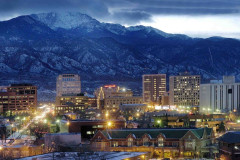
From west to east, the land of Colorado consists of desert lands, desert plateaus, alpine mountains, National Forests, relatively flat grasslands, scattered forests, buttes, and canyons in the western edge of the Great Plains. The famous Pikes Peak is located just west of Colorado Springs. Its isolated peak is visible from nearly the Kansas border on clear days, and also far to the north and the south.
Desert lands in Colorado are located in and around areas such as the Pueblo, Canon City, Florence, Great Sand Dunes National Park and Preserve, San Luis Valley, Cortez, Canyon of the Ancients National Monument, Hovenweep National Monument, Ute Mountain, Delta, Grand Junction, Colorado National Monument, and other areas surrounding the Uncompahgre Plateau and Uncompahgre National Forest.
Colorado is one of four states in the United States that share a common geographic point the Four Corners together with Arizona, New Mexico, and Utah. At this intersection, it is possible to stand in four states at once.
History
The region that is today the state of Colorado has been inhabited by Native Americans for more than 13,000 years. The Lindenmeier Site in Larimer County contains artifacts dating from approximately 11200 BC to 3000 BC. The eastern edge of the Rocky Mountains was a major migration route that was important to the spread of early peoples throughout the Americas. The Ancient Pueblo peoples lived in the valleys and mesas of the Colorado Plateau. The Ute Nation inhabited the mountain valleys of the Southern Rocky Mountains and the Western Rocky Mountains, even as far east as the Front Range of present day. The Apache and the Comanche also inhabited Eastern and Southeastern parts of the state. At times, the Arapaho Nation and the Cheyenne Nation moved west to hunt across the High Plains.
The U.S. acquired a territorial claim to the eastern Rocky Mountains with the Louisiana Purchase from France in 1803. This U.S. claim conflicted with the claim by Spain to the upper Arkansas River Basin as the exclusive trading zone of its colony of Santa Fé de Nuevo Méjico. In 1806, Zebulon Pike led a U.S. Army reconnaissance expedition into the disputed region. Colonel Pike and his men were arrested by Spanish cavalrymen in the San Luis Valley the following February, taken to Chihuahua, and expelled from Mexico the following July.
The U.S. relinquished its claim to all land south and west of the Arkansas River and south of 42nd parallel north and west of the 100th meridian west as part of its purchase of Florida from Spain with the Adams-Onís Treaty of 1819. The treaty took effect February 22, 1821. Having settled its border with Spain, the U.S. admitted the southeastern portion of the Territory of Missouri to the Union as the state of Missouri on August 10, 1821. The remainder of Missouri Territory, including what would become northeastern Colorado, became unorganized territory, and remained so for 33 years over the question of slavery. After 11 years of war, Spain finally recognized the independence of Mexico with the Treaty of Córdoba signed on August 24, 1821. Mexico eventually ratified the Adams-Onís Treaty in 1831. The Texian Revolt of 1835–36 fomented a dispute between the U.S. and Mexico which eventually erupted into the Mexican–American War in 1846. Mexico surrendered its northern territory to the U.S. with the Treaty of Guadalupe Hidalgo at the conclusion of the war in 1848.
Most American settlers traveling overland west to the Oregon Country, namely the new goldfields of California, or the new Mormon settlements of the State of Deseret in the Salt Lake Valley, avoided the rugged Southern Rocky Mountains, and instead followed the North Platte River and Sweetwater River to South Pass (Wyoming), the lowest crossing of the Continental Divide between the Southern Rocky Mountains and the Central Rocky Mountains. In 1849, the Mormons of the Salt Lake Valley organized the extralegal State of Deseret, claiming the entire Great Basin and all lands drained by the rivers Green, Grand, and Colorado. The federal government of the U.S. flatly refused to recognize the new Mormon government, because it was theocratic and sanctioned plural marriage. Instead, the Compromise of 1850 divided the Mexican Cession and the northwestern claims of Texas into a new state and two new territories, the state of California, the Territory of New Mexico, and the Territory of Utah. On April 9, 1851, Mexican American settlers from the area of Taos settled the village of San Luis, then in the New Mexico Territory, later to become Colorado's first permanent Euro-American settlement.
In 1854, Senator Stephen A. Douglas persuaded the U.S. Congress to divide the unorganized territory east of the Continental Divide into two new organized territories, the Territory of Kansas and the Territory of Nebraska, and an unorganized southern region known as the Indian territory. Each new territory was to decide the fate of slavery within its boundaries, but this compromise merely served to fuel animosity between free soil and pro-slavery factions.
The gold seekers organized the Provisional Government of the Territory of Jefferson on August 24, 1859, but this new territory failed to secure approval from the Congress of the United States embroiled in the debate over slavery. The election of Abraham Lincoln for the President of the United States on November 6, 1860, led to the secession of nine southern slave states and the threat of civil war among the states. Seeking to augment the political power of the Union states, the Republican Party-dominated Congress quickly admitted the eastern portion of the Territory of Kansas into the Union as the free State of Kansas on January 29, 1861, leaving the western portion of the Kansas Territory, and its gold-mining areas, as unorganized territory.
Territory act
Thirty days later on February 28, 1861, outgoing U.S. President James Buchanan signed an Act of Congress organizing the free Territory of Colorado. The original boundaries of Colorado remain unchanged today. The name Colorado was chosen because it was commonly believed that the Colorado River originated in the territory. In 1776, Spanish priest Silvestre Vélez de Escalante recorded that Native Americans in the area knew the river as el Rio Colorado for the red-brown silt that the river carried from the mountains. In 1859, a U.S. Army topographic expedition led by Captain John Macomb located the confluence of the Green River with the Grand River in what is now Canyonlands National Park in Utah. The Macomb party designated the confluence as the source of the Colorado River.
On April 12, 1861, South Carolina artillery opened fire on Fort Sumter to start the American Civil War. While many gold seekers held sympathies for the Confederacy, the vast majority remained fiercely loyal to the Union cause.
In 1862, a force of Texas cavalry invaded the Territory of New Mexico and captured Santa Fe on March 10. The object of this Western Campaign was to seize or disrupt the gold fields of Colorado and California and to seize ports on the Pacific Ocean for the Confederacy. A hastily organized force of Colorado volunteers force-marched from Denver City, Colorado Territory, to Glorieta Pass, New Mexico Territory, in an attempt to block the Texans. On March 28, the Coloradans and local New Mexico volunteers stopped the Texans at the Battle of Glorieta Pass, destroyed their cannon and supply wagons, and ran off 500 of their horses and mules. The Texans were forced to retreat to Santa Fe. Having lost the supplies for their campaign and finding little support in New Mexico, the Texans abandoned Santa Fe and returned to San Antonio in defeat. The Confederacy made no further attempts to seize the Southwestern United States.
In 1864, Territorial Governor John Evans appointed the Reverend John Chivington as Colonel of the Colorado Volunteers with orders to protect white settlers from Cheyenne and Arapaho warriors who were accused of stealing cattle. Colonel Chivington ordered his men to attack a band of Cheyenne and Arapaho encamped along Sand Creek. Chivington reported that his troops killed more than 500 warriors. The militia returned to Denver City in triumph, but several officers reported that the so-called battle was a blatant massacre of Indians at peace, that most of the dead were women and children, and that bodies of the dead had been hideously mutilated and desecrated. Three U.S. Army inquiries condemned the action, and incoming President Andrew Johnson asked Governor Evans for his resignation, but none of the perpetrators was ever punished. This event is now known as the Sand Creek massacre.
In the midst and aftermath of Civil War, many discouraged prospectors returned to their homes, but a few stayed and developed mines, mills, farms, ranches, roads, and towns in Colorado Territory. On September 14, 1864, James Huff discovered silver near Argentine Pass, the first of many silver strikes. In 1867, the Union Pacific Railroad laid its tracks west to Weir, now Julesburg, in the northeast corner of the Territory. The Union Pacific linked up with the Central Pacific Railroad at Promontory Summit, Utah, on May 10, 1869, to form the First Transcontinental Railroad. The Denver Pacific Railway reached Denver in June the following year, and the Kansas Pacific arrived two months later to forge the second line across the continent. In 1872, rich veins of silver were discovered in the San Juan Mountains on the Ute Indian reservation in southwestern Colorado. The Ute people were removed from the San Juans the following year.
Statehood
The United States Congress passed an enabling act on March 3, 1875, specifying the requirements for the Territory of Colorado to become a state. On August 1, 1876 (28 days after the Centennial of the United States), U.S. President Ulysses S. Grant signed a proclamation admitting Colorado to the Union as the 38th state and earning it the moniker "Centennial State".
The discovery of a major silver lode near Leadville in 1878 triggered the Colorado Silver Boom. The Sherman Silver Purchase Act of 1890 invigorated silver mining, and Colorado's last, but greatest, gold strike at Cripple Creek a few months later lured a new generation of gold seekers. Colorado women were granted the right to vote beginning on November 7, 1893, making Colorado the second state to grant universal suffrage and the first one by a popular vote (of Colorado men). The repeal of the Sherman Silver Purchase Act in 1893 led to a staggering collapse of the mining and agricultural economy of Colorado, but the state slowly and steadily recovered. Between the 1880s and 1930s, Denver's floriculture industry developed into a major industry in Colorado. This period became known locally as the Carnation Gold Rush.
Colorado became the first western state to host a major political convention when the Democratic Party met in Denver in 1908. By the U.S. Census in 1930, the population of Colorado first exceeded one million residents. Colorado suffered greatly through the Great Depression and the Dust Bowl of the 1930s, but a major wave of immigration following World War II boosted Colorado's fortune. Tourism became a mainstay of the state economy, and high technology became an important economic engine. The United States Census Bureau estimated that the population of Colorado exceeded five million in 2009.
Three warships of the U.S. Navy have been named the USS Colorado. The first USS Colorado was named for the Colorado River. The later two ships were named in honor of the state, including the battleship USS Colorado which served in World War II in the Pacific beginning in 1941. At the time of the Attack on Pearl Harbor, this USS Colorado was located at the naval base in San Diego, Calif. and hence went unscathed.
Culture
- List of museums in Colorado
Fine arts
- Music of Colorado
- Theater in Colorado
A number of film productions have shot on location in Colorado, especially prominent Westerns like True Grit, The Searchers and Butch Cassidy and the Sundance Kid. A number of historic military forts, railways with trains still operating, mining ghost towns have been utilized and transformed for historical accuracy in well known films. There are also a number of scenic highways and mountain passes that helped to feature the open road in films such as Vanishing Point, Bingo and Starman. Some Colorado landmarks have been featured in films, such as The Stanley Hotel in Dumb and Dumber and the Sculptured House in Sleeper. In 2015, Furious 7 to film driving sequences Pikes Peak Highway in Colorado. The TV Series, Good Luck Charlie was being filmed in Denver, Colorado. The Colorado Office of Film and Television has noted that over 400 films have been shot in Colorado.
There are also a number of established film festivals in Colorado, including Aspen Shortsfest, Boulder International Film Festival, Castle Rock Film Festival, Denver Film Festival, Festivus film festival, Mile High Horror Film Festival, Moondance International Film Festival, Mountainfilm in Telluride, Rocky Mountain Women's Film Festival, and Telluride Film Festival.
Cuisine
Colorado is known for its Southwest and Rocky Mountain cuisine. Mexican restaurants are prominent throughout the state.
Boulder, Colorado was named America's Foodiest Town 2010 by Bon Appétit. Boulder, and Colorado in general, is home to a number of national food and beverage companies, top-tier restaurants and farmers' markets. Boulder, Colorado also has more Master Sommeliers per capita than any other city, including San Francisco and New York.
The Food & Wine Classic is held annually each June in Aspen, Colorado. Aspen also has a reputation as the culinary capital of the Rocky Mountain region.
Denver is known for steak, but now has a diverse culinary scene with many top-tier restaurants.
Wine and beer
Colorado wines include award-winning varietals that have attracted favorable notice from outside the state. With wines made from traditional Vitis vinifera grapes along with wines made from cherries, peaches, plums and honey, Colorado wines have won top national and international awards for their quality. Colorado's grape growing regions contain the highest elevation vineyards in the United States, with most viticulture in the state practiced between 4,000 and 7,000 feet (1,219 and 2,134 m) above sea level. The mountain climate ensures warm summer days and cool nights. Colorado is home to two designated American Viticultural Areas of the Grand Valley AVA and the West Elks AVA, where most of the vineyards in the state are located. However, an increasing number of wineries are located along the Front Range.
Colorado is home to many nationally praised microbreweries, including New Belgium Brewing Company, Odell Brewing Company, Great Divide Brewing Company, and Oskar Blues Brewery. The area of northern Colorado near the between the cities of Denver, Boulder, and Fort Collins is known as the "Napa Valley of Beer" due to its high density of craft breweries.
Marijuana and Hemp
Colorado is open to pot tourism. With the adoption of their 64th state amendment In 2013 Colorado became the first state in the union to legalize the medicinal (2000), recreational (2014) and industrial (2013) use of marijuana. Colorado's marijuana industry sold 996 million dollars worth of marijuana in 2015. Colorado regulates hemp as any part of the plant with less than 0.03% THC.
Amendment 64, adopted by the voters in the 2014 general election, forces the Colorado state legislature to enact legislation governing the cultivation, processing and sale of recreational marijuana and industrial hemp. On April 4, 2014 Senate Bill 14-184 addressing oversight of Colorado's industrial hemp program was first introduced, ultimately being signed into law by Governor John Hickenlooper on May 31, 2014.
Medicinal useOn November 7, 2000, 54% of Colorado voters passed Amendment 20, which amends the Colorado State constitution to allow the medical use of marijuana. A patient's medical use of marijuana, within the following limits, is lawful:
- (I) No more than two ounces of a usable form of marijuana; and
- (II) No more than twelve marijuana plants, with six or fewer being mature, flowering plants that are producing a usable form of marijuana.
Currently Colorado has listed "eight medical conditions for which patients can use marijuana – cancer, glaucoma, HIV/AIDS, muscle spasms, seizures, severe pain, severe nausea and cachexia or dramatic weight loss and muscle atrophy." Colorado Governor John Hickenlooper has allocated about half of the state's $13 million "Medical Marijuana Program Cash Fund" to medical research in the 2014 budget.
Recreational useOn November 6, 2012, voters amended the state constitution to protect "personal use" of marijuana for adults, establishing a framework to regulate marijuana in a manner similar to alcohol. The first recreational marijuana shops in Colorado, and by extension the United States, opened their doors on January 1, 2014. In Colorado marijuana sales generate high amounts of tax money to be used for repairs, schools etc.
Transportation
Colorado's primary mode of transportation (in terms of passengers) is its highway system. Interstate 25 (I-25) is the primary north–south highway in the state, connecting Pueblo, Colorado Springs, Denver, and Fort Collins, and extending north to Wyoming and south to New Mexico. I-70 is the primary east–west corridor. It connects Grand Junction and the mountain communities with Denver, and enters Utah and Kansas. The state is home to a network of US and Colorado highways that provide access to all principal areas of the state. Smaller communities are only connected to this network via county roads.
Denver International Airport (DIA) is the fourth busiest domestic U.S. airport and thirteenth busiest world airport DIA handles by far the largest volume of commercial air traffic in Colorado, and is the busiest U.S. hub airport between Chicago and the Pacific coast, making Denver the most important airport for connecting passenger traffic in the western United States.
Extensive public transportation bus services are offered both intra-city and inter-city—including the Denver metro area's extensive RTD services. The Regional Transportation District (RTD) operates the popular RTD Bus & Light Rail transit system in the Denver Metropolitan Area. As of January 2013 the RTD rail system had 170 light rail vehicles, serving 47 miles (76 km) of track.
Amtrak operates two legendary passenger rail lines in Colorado, the California Zephyr and Southwest Chief. Colorado's contribution to world railroad history was forged principally by the Denver and Rio Grande Western Railroad which began in 1870 and wrote the book on mountain railroading. In 1988 the "Rio Grande" acquired, but was merged into, the Southern Pacific Railroad by their joint owner Philip Anschutz. On September 11, 1996, Anschutz sold the combined company to the Union Pacific Railroad, creating the largest railroad network in the United States. The Anschutz sale was partly in response to the earlier merger of Burlington Northern and Santa Fe which formed the large Burlington Northern and Santa Fe Railway (BNSF), Union Pacific's principal competitor in western U.S. railroading. Both Union Pacific and BNSF have extensive freight operations in Colorado.
Colorado's freight railroad network consists of 2,688 miles of Class I trackage. It is integral to the U.S. economy, being a critical artery for the movement of energy, agriculture, mining, and industrial commodities as well as general freight and manufactured products between the East and Midwest and the Pacific coast states.
In August 2014, Colorado began to issue driver licenses to aliens not lawfully in the United States who lived in Colorado. In September 2014, KCNC reported that 524 non-citizens were issued licenses issued to U.S. Citizens living in Colorado.
Military installations
Colorado is currently the home of seven major military bases and installations.
- Air Reserve Personnel Center
- Buckley Air Force Base
- Fort Carson (U.S. Army)
- Piñon Canyon Maneuver Site
- Peterson Air Force Base
- Cheyenne Mountain Division
- Pueblo Chemical Depot (U.S. Army)
- Schriever Air Force Base
- United States Air Force Academy
Former Military installations and outposts include:
- Camp Collins (1862-1870)
- Camp Hale (1942-1945)
- Fitzsimons Army Hospital (1918-1999)
- Fort Garland (1858–1883)
- Fort Logan (1887-1946)
- Lowry Air Force Base (1938-1994)