Georgia
Description
Georgia (i/ˈdʒɔːrdʒə/ JOR-juh) is a state located in the southeastern United States. It was established in 1732, the last of the original Thirteen Colonies. Named after King George II of Great Britain, Georgia was the fourth state to ratify the United States Constitution, on January 2, 1788. It declared its secession from the Union on January 19, 1861, and was one of the original seven Confederate states. It was the last state to be restored to the Union, on July 15, 1870. Georgia is the 24th largest and the 8th most populous of the 50 United States. From 2007 to 2008, 14 of Georgia's counties ranked among the nation's 100 fastest-growing, second only to Texas. Georgia is known as the Peach State and the Empire State of the South. Atlanta is the state's capital and its most populous city.
Georgia is bordered on the south by Florida, on the east by the Atlantic Ocean and South Carolina, on the west by Alabama, and on the north by Tennessee and North Carolina. The northern part of the state is in the Blue Ridge Mountains, part of the Appalachian Mountains system. The Piedmont extends through the central part of the state from the foothills of the Blue Ridge to the Fall Line, where the rivers cascade down in elevation to the coastal plain of the southern part of the state. The highest point in Georgia is Brasstown Bald at 4,784 feet (1,458 m) above sea level; the lowest point is the Atlantic Ocean. Georgia is the largest state east of the Mississippi River in land area.
History
Before settlement by Europeans, Georgia was inhabited by the mound building cultures. The British colony of Georgia was founded by James Oglethorpe on February 12, 1733. The colony was administered by the Trustees for the Establishment of the Colony of Georgia in America under a charter issued by (and named for) King George II. The Trustees implemented an elaborate plan for the colony's settlement, known as the Oglethorpe Plan, which envisioned an agrarian society of yeoman farmers and prohibited slavery. In 1742 the colony was invaded by the Spanish during the War of Jenkins' Ear. In 1752, after the government failed to renew subsidies that had helped support the colony, the Trustees turned over control to the crown. Georgia became a crown colony, with a governor appointed by the king.
The Province of Georgia was one of the Thirteen Colonies that revolted against British rule in the American Revolution by signing the 1776 Declaration of Independence. The State of Georgia's first constitution was ratified in February 1777. Georgia was the 10th state to ratify the Articles of Confederation on July 24, 1778, and was the 4th state to ratify the current Constitution on January 2, 1788.
In 1829, gold was discovered in the North Georgia mountains, which led to the Georgia Gold Rush and an established federal mint in Dahlonega, which continued its operation until 1861. The subsequent influx of white settlers put pressure on the government to take land from the Cherokee Nation. In 1830, President Andrew Jackson signed the Indian Removal Act into law, sending many eastern Native American nations to reservations in present-day Oklahoma, including all of Georgia's tribes. Despite the Supreme Court's ruling in Worcester v. Georgia that states were not permitted to redraw the Indian boundaries, President Jackson and the state of Georgia ignored the ruling. In 1838, his successor, Martin Van Buren, dispatched federal troops to gather the Cherokee and deport them west of the Mississippi. This forced relocation, known as the Trail of Tears, led to the death of over 4,000 Cherokees.
In early 1861, Georgia joined the Confederacy and became a major theater of the Civil War. Major battles took place at Chickamauga, Kennesaw Mountain, and Atlanta. In December 1864, a large swath of the state from Atlanta to Savannah was destroyed during General William Tecumseh Sherman's March to the Sea. 18,253 Georgian soldiers died in service, roughly 1 of every 5 who served. In 1870, following reconstruction, Georgia became the last Confederate state restored to the Union.
With white Democrats having regained power in the state legislature, they passed a poll tax in 1877, which disenfranchised many poor blacks and whites, preventing them from registering. In 1908, the state established a white primary; with the only competitive contests within the Democratic Party, it was another way to exclude blacks from politics. They constituted 46.7% of the state's population in 1900, but the proportion of Georgia's population that was African American dropped thereafter to 28% primarily due to leaving the state during the Great Migration. This disfranchisement persisted through the mid-1960s, until federal legislation with the Voting Rights Act of 1965.
Geography
Boundaries
Beginning from the Atlantic Ocean, the state's eastern border with South Carolina runs up the Savannah River, northwest to its origin at the confluence of the Tugaloo and Seneca Rivers. It then continues up the Tugaloo (originally Tugalo) and into the Chattooga River, its most significant tributary. These bounds were decided in the 1797 Treaty of Beaufort, and tested in the U.S. Supreme Court in the two Georgia v. South Carolina cases in 1923 and 1989.
The border then takes a sharp turn around the tip of Rabun County, at latitude 35°N, though from this point it diverges slightly south (due to inaccuracies in the original survey). This was originally the Georgia and North Carolina border all the way back to the Mississippi River, until Tennessee was divided from North Carolina, and the Yazoo companies induced the legislature of Georgia to pass an act, approved by the governor in 1795, to sell the greater part of Georgia's territory presently comprising Alabama and Mississippi.
The state's western border then departs in another straight line south-southeastward, at a point southwest of Chattanooga, to meet the westernmost point of the Chattahoochee River near West Point. It continues down to the point where it ends at the Flint River (the confluence of the two forming Florida's Apalachicola River), and goes almost due east and very slightly south, in a straight line to the origin of the St. Mary's River, which then forms the remainder of the boundary back to the ocean.
The water boundaries are still set to be the original thalweg of the rivers. Since then, several have been inundated by lakes created by dams, including the Apalachicola/Chattahoochee/Flint point now under Lake Seminole.
Georgia state legislators have claimed that in an 1818 survey, the state's border with Tennessee was erroneously placed one mile (1.6 km) farther south than intended, and they proposed a correction in 2010. The state was then in the midst of a significant drought, and the new border would allow Georgia access to water from the Tennessee River.
Geology and terrain
Each region has its own distinctive characteristics. For instance, the Ridge and Valley, which lies in the northwest corner of the state, includes limestone, sandstone, shale and other sedimentary rocks, which have yielded construction-grade limestone, barite, ocher, and small amounts of coal.
Flora
The state of Georgia has approximately 250 tree species and 58 protected plants. Georgia's native trees include red cedar, a variety of pines, oaks, hollies, cypress, sweetgum, scaly-bark and white hickories and sabal palmetto. East Georgia is in the subtropical coniferous forest biome and conifer species as other broadleaf evergreen flora make up the majority of the southern and coastal regions. Yellow jasmine, and mountain laurel make up just a few of the flowering shrubs in the state.
Fauna
White-tailed (Virginia) deer are in nearly all counties. The northern mockingbird and brown thrasher are among the 160 bird species that live in the state.
Reptiles and amphibians include the eastern diamondback, copperhead, and cottonmouth, salamanders, frogs, alligators and toads. There are about 79 species of reptile and 63 amphibians known to live in Georgia.
The most popular freshwater game fish are trout, bream, bass, and catfish, all but the last of which are produced in state hatcheries for restocking. Popular saltwater game fish include red drum, spotted seatrout, flounder, and tarpon. Porpoises, whales, shrimp, oysters, and blue crabs are found inshore and offshore of the Georgia coast.
Cultural
Fine and performing arts
Georgia's major fine art museums include the High Museum of Art and the Michael C. Carlos Museum, both in Atlanta; the Georgia Museum of Art on the campus of the University of Georgia in Athens; Telfair Museum of Art and the SCAD Museum of Art in Savannah; and the Morris Museum of Art in Augusta.
The state theatre of Georgia is the Springer Opera House located in Columbus.
The Atlanta Opera brings opera to Georgia stages. The Atlanta Symphony Orchestra is the most widely recognized orchestra and largest arts organization in the southeastern United States.
There are a number of performing arts venues in the state, among the largest are the Fox Theatre, and the Alliance Theatre at the Woodruff Arts Center, both on Peachtree Street in Midtown Atlanta as well as the Cobb Energy Performing Arts Centre, located in Northwest Atlanta.
Television
Well-known television shows set in Atlanta include, from Tyler Perry Studios, House of Payne and Tyler Perry's Meet the Browns, The Real Housewives of Atlanta, the CBS sitcom Designing Women, Matlock, the popular AMC series The Walking Dead, Lifetime Drop Dead Diva, Rectify and numerous HGTV original productions.
The Dukes of Hazzard, a 1980s TV show that spun off several films, was set in the fictional Hazzard County, Georgia. The show was filmed at Warner Bros. back lot in Burbank, California and on location in Conyers and Covington, Georgia as well as some locations in Atlanta.
Also filmed in Georgia is The Vampire Diaries, using Covington as the setting for the fictional Mystic Falls.
Music
A number of notable musicians in various genres of popular music are from Georgia. Included is Ray Charles (whose many hits include "Georgia on My Mind", now the official state song), and Gladys Knight (known for her Georgia-themed song, "Midnight Train to Georgia").
Rock groups from Georgia include the Atlanta Rhythm Section, The Black Crowes, and The Allman Brothers.
The university city of Athens sparked an influential rock music scene in the 1980s and 1990s. Among the groups achieving their initial prominence in that city were R.E.M., Widespread Panic, and the B-52's.
Since the 1990s, various hip-hop and R&B musicians have included top-selling artists such as Outkast, Usher, Ludacris, TLC, B.o.B., and Ciara. Atlanta is mentioned in a number of these artists' tracks, such as Usher's "A-Town Down" reference in his 2004 hit Yeah! (which also features Atlanta artists Lil Jon and Ludacris), Ludacris' "Welcome to Atlanta", Outkast's album "ATLiens", and B.o.B.'s multiple references to Decatur, such as in his hit song "Strange Clouds".
Parks and recreational activities
There are 63 parks in Georgia, 48 of which are state parks and 15 that are historic sites, and numerous state wildlife preserves, under the supervision of the Georgia Department of Natural Resources. Other historic sites and parks are supervised by the National Park Service and include the Andersonville National Historic Site in Andersonville; Appalachian National Scenic Trail; Chattahoochee River National Recreation Area near Atlanta; Chickamauga and Chattanooga National Military Park at Fort Oglethorpe; Cumberland Island National Seashore near St. Marys; Fort Frederica National Monument on St. Simons Island; Fort Pulaski National Monument in Savannah; Jimmy Carter National Historic Site near Plains; Kennesaw Mountain National Battlefield Park near Kennesaw; Martin Luther King, Jr., National Historic Site in Atlanta; Ocmulgee National Monument at Macon; Trail of Tears National Historic Trail; and the Okefenokee Swamp in Waycross, Georgia
Outdoor recreational activities include hiking along the Appalachian Trail; Civil War Heritage Trails; rock climbing and whitewater paddling. Other outdoor activities include hunting and fishing.
Cities
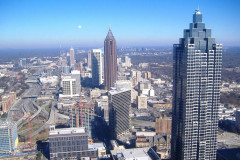
Atlanta, located in north-central Georgia at the Eastern Continental Divide, has been Georgia's capital city since 1868. It is the most populous city in Georgia, with just over 420,000 residents in 2010.
The Atlanta metropolitan area is the cultural and economic center of the Southeast, and its population in 2010 was 5,268,860, or 53.6% of Georgia's total. Atlanta is the nation's ninth largest metropolitan area.
The state has fourteen other cities with populations above 50,000 (based on 2012 census estimates). In descending order of size they are Columbus, Augusta, Macon, Savannah, Athens, Sandy Springs, Roswell, Albany, Johns Creek, Warner Robins, Alpharetta, Marietta, Valdosta and Smyrna.
Along with the rest of the Southeast, Georgia's population continues to grow rapidly, with primary gains concentrated in urban areas. The population of the Atlanta metropolitan area added 1.23 million people (24 percent) between 2000 and 2010, and Atlanta rose in rank from the eleventh largest metropolitan area in the United States to the ninth largest.