Savannah

Description

Savannah is the oldest city in the U.S. state of Georgia and is the county seat of Chatham County. Established in 1733 on the Savannah River, the city of Savannah became the British colonial capital of the Province of Georgia and later the first state capital of Georgia. A strategic port city in the American Revolution and during the American Civil War, Savannah is today an industrial center and an important Atlantic seaport. It is Georgia's fifth-largest city and third-largest metropolitan area.

Each year Savannah attracts millions of visitors to its cobblestone streets, parks, and notable historic buildings: the birthplace of Juliette Gordon Low (founder of the Girl Scouts of the USA), the Georgia Historical Society (the oldest continually operating historical society in the South), the Telfair Academy of Arts and Sciences (one of the South's first public museums), the First African Baptist Church (one of the oldest African-American Baptist congregations in the United States), Temple Mickve Israel (the third oldest synagogue in America), and the Central of Georgia Railway roundhouse complex (the oldest standing antebellum rail facility in America).

Savannah's downtown area, which includes the Savannah Historic District, the Savannah Victorian Historic District, and 22 parklike squares, is one of the largest National Historic Landmark Districts in the United States (designated by the U.S. government in 1966). Downtown Savannah largely retains the original town plan prescribed by founder James Oglethorpe (a design now known as the Oglethorpe Plan). Savannah was the host city for the sailing competitions during the 1996 Summer Olympics held in Atlanta.

History

On February 12, 1733, General James Oglethorpe and settlers from the ship Anne landed at Yamacraw Bluff and were greeted by Tomochichi, the Yamacraws, and Indian traders John and Mary Musgrove. Mary Musgrove often served as an interpreter. The city of Savannah was founded on that date, along with the colony of Georgia. In 1751, Savannah and the rest of Georgia became a Royal Colony and Savannah was made the colonial capital of Georgia. By the outbreak of the American Revolutionary War, Savannah had become the southernmost commercial port of the Thirteen Colonies. British troops took the city in 1778, and the following year a combined force of American and French soldiers failed to rout the British at the Siege of Savannah. The British did not leave the city until July 1782. Savannah, a prosperous seaport throughout the nineteenth century, was the Confederacy's sixth most populous city and the prime objective of General William T. Sherman's March to the Sea. Early on December 21, 1864, local authorities negotiated a peaceful surrender to save Savannah from destruction, and Union troops marched into the city at dawn.

Savannah was named for the Savannah River, which probably derives from variant names for the Shawnee, a Native American people who migrated to the river in the 1680s. The Shawnee destroyed another Native people, the Westo, and occupied their lands at the head of the Savannah River's navigation on the fall line, near present-day Augusta. These Shawnee, whose Native name was Ša·wano·ki (literally, "southerners"), were known by several local variants, including Shawano, Savano, Savana and Savannah. Another theory is that the name Savannah refers to the extensive marshlands surrounding the river for miles inland, and is derived from the English term "savanna", a kind of tropical grassland, which was borrowed by the English from Spanish sabana and used in the Southern Colonies. (The Spanish word comes from the Taino word zabana.) Still other theories suggest that the name Savannah originates from Algonquian terms meaning not only "southerners" but perhaps "salt".

Geography

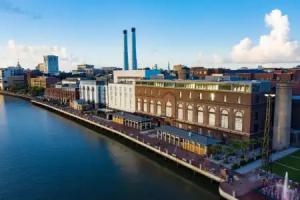
Savannah lies on the Savannah River, approximately 20 mi (32 km) upriver from the Atlantic Ocean. According to the United States Census Bureau (2011), the city has a total area of 108.7 square miles (281.5 km2), of which 103.1 square miles (267.0 km2) is land and 5.6 square miles (15 km2) is water (5.15%). Savannah is the primary port on the Savannah River and the largest port in the state of Georgia. It is also located near the U.S. Intracoastal Waterway. Georgia's Ogeechee River flows toward the Atlantic Ocean some 16 miles (26 km) south of downtown Savannah.

Savannah is prone to flooding. Five canals and several pumping stations have been built to help reduce the effects: Fell Street Canal, Pipe Makers Canal, Kayton Canal, Springfield Canal and Casey Canal, the first four draining north into the Savannah River and the last, the Casey, draining south into the Vernon River.

Urban

Neighborhoods

Savannah is a city of diverse neighborhoods. More than 100 distinct neighborhoods can be identified in six principal areas of the city: Downtown (Landmark Historic District and Victorian District), Midtown, Southside, Eastside, Westside, and Southwest/West Chatham (recently annexed suburban neighborhoods).

Historic districts

Besides the Savannah Historic District, one of the nation's largest, four other historic districts have been formally demarcated:

  • Victorian District
  • Cuyler-Brownsville District
  • Mid-City (Thomas Square) District
  • Pin Point Historic District

Arts and culture

Beyond its architectural significance as being the nation's largest, historically restored urban area, the city of Savannah has a rich and growing performing arts scene, offering cultural events throughout the year.

Books and literature

  • The Savannah Book Festival – an annual book fair held on Presidents' Day weekend in the vicinity of historic Telfair and Wright squares, includes free presentations by more than 35 contemporary authors. Special events with featured writers are offered at nominal cost throughout the year.
  • Flannery O'Connor Childhood Home – a museum house dedicated to the work and life of the acclaimed fiction writer Flannery O'Connor, who was born in Savannah. In addition to its museum, the house offers literary programming, including the annual Ursrey Lecture honoring American fiction writers.

Dance

Savannah Ballet Theatre – established in 1998 as a nonprofit organization, it has grown to become the city's largest dance company.

Music

  • The Coastal Jazz Association – presents a variety of jazz performances throughout the year in addition to hosting the annual Savannah Jazz Festival.
  • Savannah Children's Choir – non-profit, auditioned choir for children in 2nd through 8th grades that performs throughout the community and in annual holiday and spring concerts.
  • Savannah Concert Association – presents a variety of guest artists for chamber music performances each season. Performances are generally held in the Lucas Theatre For The Arts.
  • Savannah Music Festival – an annual music festival of diverse artists which is Georgia's largest musical arts festival and is nationally recognized as one of the best music festivals in the world.
  • The Savannah Orchestra – Savannah's professional orchestra, which presents an annual season of classical and popular concert performances.
  • The Savannah Philharmonic – professional orchestral and choral organization presenting year round concerts (classical, pops, education).
  • The Savannah Winds – amateur concert band hosted by the music department of Armstrong Atlantic State University.
  • The Armstrong Youth Orchestra – Savannah's professional orchestra for elementary, middle school, high school and some college students.
Rock music

Several sludge metal groups have emerged from Savannah. Included in these are Baroness, Kylesa, Black Tusk and Circle Takes the Square.

Theater and performance

  • Muse Arts Warehouse – founded in 2010, Muse Arts Warehouse is a nonprofit organization committed to community-building through the arts by providing a venue that is available, affordable, and accessible to Savannah's individual artists, arts organizations and the public.
  • Savannah Children's Theatre – a non-profit, year-round drama theater company geared toward offering elementary through high school students (and adults) opportunities for participation in dramatic and musical productions.
  • Savannah Community Theatre – a full theater season with a diverse programming schedule, featuring some of Savannah's finest actors in an intimate, three-quarter-round space.
  • Little Theatre of Savannah – founded in 1950, The Little Theatre of Savannah, Inc., is a nonprofit, volunteer-based community organization dedicated to the celebration of the theater arts. Recognizing the unique social value, expressive fulfillment and opportunity for personal growth that theater provides its participants, the Little Theatre of Savannah invites all members of the community to participate both on- and off-stage.
  • The Savannah Theatre – Savannah's only fully professional resident theater, producing music revues with live singers, dancers and the most rockin' band in town. Performances happen year-round, with several different titles and a holiday show.
  • Lucas Theatre for the Arts – founded in December 1921, the Lucas Theatre is one of several theaters owned by the Savannah College of Art and Design. It hosts the annual Savannah Film Festival.
  • Trustees Theater – once known as the Weis Theater, which opened February 14, 1946, this theater reopened as the Trustees Theater on May 9, 1998, and hosts a variety of performances and concerts sponsored by the Savannah College of Art and Design. SCAD also owns the building.
  • Odd Lot Improv – founded in 2010, a family-friendly improv comedy troupe performing weekly shows on Mondays and Fridays.

Points of interest

Savannah's architecture, history, and reputation for Southern charm and hospitality are internationally known. The city's former promotional name was "Hostess City of the South," a phrase still used by the city government. An earlier nickname was "the Forest City", in reference to the large population and species of oak trees that flourish in the Savannah area. These trees were especially valuable in shipbuilding during the 19th century. In 2014, Savannah attracted 13.5 million visitors from across the country and around the world. Savannah's downtown area is one of the largest National Historic Landmark Districts in the United States.

The city's location offers visitors access to the coastal islands and the Savannah Riverfront, both popular tourist destinations. Tybee Island, formerly known as "Savannah Beach", is the site of the Tybee Island Light Station, the first lighthouse on the southern Atlantic coast. Other picturesque towns adjacent to Savannah include the shrimping village of Thunderbolt and three residential areas that began as summer resort communities for Savannahians: Beaulieu, Vernonburg, and the Isle of Hope.

The Savannah International Trade & Convention Center is located on Hutchinson Island, across from downtown Savannah and surrounded by the Savannah River. The Belles Ferry connects the island with the mainland, as does the Eugene Talmadge Memorial Bridge.

The Savannah Civic Center on Montgomery Street is host to more than nine hundred events each year.

Savannah has consistently been named one of "America's Favorite Cities" by Travel + Leisure. In 2012, the magazine rated Savannah highest in "Quality of Life and Visitor Experience." Savannah was also ranked first for "Public Parks and Outdoor Access," visiting in the Fall, and as a romantic escape. Savannah was also named as America's second-best city for "Cool Buildings and Architecture," behind only Chicago.

Squares

Savannah's historic district has 22 squares (Ellis Square, demolished in 1954, was fully restored in early 2010). The squares vary in size and character, from the formal fountain and monuments of the largest, Johnson, to the playgrounds of the smallest, Crawford. Elbert, Ellis, and Liberty Squares are classified as the three "lost squares," destroyed in the course of urban development during the 1950s. Elbert and Liberty Squares were paved over to make way for a realignment of U.S. highway 17, while Ellis Square was demolished to build the City Market parking garage. The city restored Ellis Square after razing the City Market parking garage. The garage has been rebuilt as an underground facility, the Whitaker Street Parking Garage, and it opened in January 2009. The newly restored Ellis Square opened in March 2010. Separate efforts are now under way to revive Elbert and Liberty Squares.

Historic churches and synagogues

Savannah has numerous historic houses of worship.

Founded in 1733, with the establishment of the Georgia colony, Christ Church (Episcopal) is the longest continuous Christian congregation in Georgia. Early rectors include the Methodist evangelists John Wesley and George Whitefield. Located on the original site on Johnson Square, Christ Church continues as an active congregation.

The Independent Presbyterian Church (Savannah, Georgia), which was founded in 1755, is located near Chippewa Square. The church's current sanctuary (its third) dates from the early 1890s.

The First Bryan Baptist Church is an African-American church that was organized by Andrew Bryan in 1788. The site was purchased in 1793 by Bryan, a former slave who had also purchased his freedom. The first structure was erected there in 1794. By 1800, the congregation was large enough to split: those at Bryan Street took the name of First African Baptist Church, and Second and Third African Baptist churches were also established. The current sanctuary of First Bryan Baptist Church was constructed in 1873.

In 1832, a controversy over doctrine caused the First African Baptist congregation at Bryan Street to split. Some members left, taking with them the name of First African Baptist Church. In 1859, the members of this new congregation (most of whom were slaves) built their current church building on Franklin Square.

In 1874, the St. Benedict the Moor Church was founded in Savannah, the first African-American Catholic church in Georgia, and one of the oldest in the Southeast.

The oldest standing house of worship is First Baptist Church, Savannah (1833), located on Chippewa Square. Other historic houses of worship in Savannah include: Cathedral of St. John the Baptist (Roman Catholic), Temple Mickve Israel (the third oldest synagogue in the U.S.), and St. John's Church (Episcopal).

Historic homes

Among the historic homes that have been preserved are: the Pink House, the Sorrel-Weed House, Juliette Gordon Low's birthplace, the Davenport House Museum, the Green-Meldrim House, the Owens-Thomas House, the William Scarbrough House, and the Wormsloe plantation of Noble Jones. The Mercer-Williams House, the former home of Jim Williams, is the main location of Midnight in the Garden of Good and Evil

Historic cemeteries

Colonial Park Cemetery (an early graveyard dating back to the English colony of Georgia), Laurel Grove Cemetery (with the graves of many Confederate soldiers and African American slaves) and Bonaventure Cemetery (a former plantation and the final resting place for some illustrious Savannahians).

Historic forts

Fort Jackson, not associated with Andrew Jackson, one mile east of Savannah's Historic District, was originally built between 1808 and 1812 to protect the city from attack by sea. During the Civil War, it became one of three Confederate forts defending Savannah from Union forces. Fort Pulaski National Monument, located 17 miles (27 km) east of Savannah, preserves the largest fort protecting Savannah during the Civil War. The Union Army attacked Fort Pulaski in 1862, with the aid of a new rifled cannon that effectively rendered brick fortifications obsolete.

Other registered historic sites

  • Savannah Historic District and the Savannah Victorian Historic District
  • Forsyth Park
  • Juliette Gordon Low Historic District
  • Central of Georgia Railroad: Savannah Shops and Terminal Facilities and Central of Georgia Depot and Trainshed – a 33.2-acre (134,000 m2) historic district that was listed on the National Register of Historic Places in 1978.
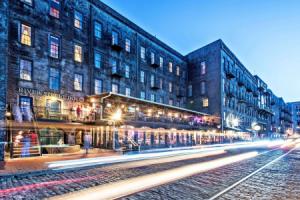
  • Riverfront Plaza and Factors' Walk – River Street's restored nineteenth-century cotton warehouses and passageways include shops, bars and restaurants
  • City Market – Savannah's restored central market features antiques, souvenirs, small eateries, as well as two large outdoor plazas
  • Savannah State University campus and Walter Bernard Hill Hall – The Georgia Historical Commission and the Georgia Department of Natural Resources have recognized both the Savannah State campus and Hill Hall as a part of the Georgia Historical Marker Program. Hill Hall, which was built in 1901, was added to the National Register of Historic Places in 1981.
  • Telfair Museum of Art and Telfair Academy of Arts of Sciences – the South's first public art museum.
  • Wormsloe Plantation – the partially restored house and grounds of an 18th-century Georgia plantation.

Shopping

Various centers for shopping exist about the city including Abercorn Common, Savannah Historic District, Oglethorpe Mall, Savannah Mall and Abercorn Walk.

Other attractions

  • Club One – home of The Lady Chablis and made famous in the book and movie Midnight in the Garden of Good and Evil.
  • Coastal Georgia Botanical Gardens – a developing botanical garden located at Bamboo Farm, a former USDA plant-introduction station south of Savannah that began operations in 1919.
  • Oatland Island Wildlife Center – located east of Savannah, a facility owned and operated by the Savannah-Chatham County Board of Education and featuring wildlife from surrounding coastal Georgia and South Carolina.
  • Ossabaw Island – an environmentally protected and commercially undeveloped barrier island south of Savannah.
  • Pinkie Masters Bar – a popular Savannah watering hole and the site of presidential visits and political campaigns. Pinkie Masters was a local political figure and a friend of President Jimmy Carter, who made several visits to the bar and the city.
  • Pirates' House – historic restaurant and tavern located in downtown Savannah.
  • Saint Patrick's Day Celebrations – Savannah holds annual celebrations in honor of Saint Patrick's Day. The actual parade route changes from year to year but usually travels through the Savannah Historic District and along Bay Street. The Savannah Waterfront Association has an annual celebration on River Street that is reminiscent of Mardi Gras on Bourbon Street in New Orleans.
  • Skidaway Island – an affluent suburban community south of Savannah that hosts Skidaway Island State Park, the University of Georgia Aquarium and the Skidaway Institute of Oceanography.
  • Tybee Island – popular Atlantic resort town 17 mi (27 km) east of Savannah, with public beaches, a lighthouse, and other attractions.

Street view

Hotels

2 guests
Adults2+
Children under 170+
Age7+
Age7+
Age7+
Age7+
Age7+
Age7+
Age7+
Age7+
Age7+
Age7+
Search hotel

Reviews

Share your experiences, help others make the right choice!
Think about what you would like to know if you were looking for a review about a place to relax. Please describe in detail what you liked and what you didn't. What would you advise to other guests and to the hotel owner. The more fully you tell about the hotel, the easier it will be for other people to make a choice and they will be very grateful to you!

Map

X