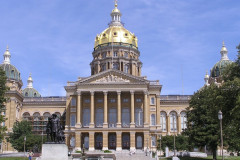
Iowa
Description
Iowa is a U.S. state in the Midwestern United States, bordered by the Mississippi River on the east and the Missouri River and the Big Sioux River on the west. Surrounding states include Wisconsin and Illinois to the east, Missouri to the south, Nebraska and South Dakota to the west, and Minnesota to the north.
In colonial times, Iowa was a part of French Louisiana and Spanish Louisiana; its state flag is patterned after the flag of France. After the Louisiana Purchase, people laid the foundation for an agriculture-based economy in the heart of the Corn Belt.
In the latter half of the 20th century, Iowa's agricultural economy made the transition to a diversified economy of advanced manufacturing, processing, financial services, information technology, biotechnology, and green energy production. Iowa is the 26th most extensive in land area and the 30th most populous of the 50 United States. Its capital and largest city by population is Des Moines. Iowa has been listed as one of the safest states in which to live. Its nickname is the Hawkeye State.
Etymology
Iowa derives its name from the Ioway people, one of the many Native American tribes that occupied the state at the time of European exploration.
Geography
Boundaries
Iowa is bordered by the Mississippi River on the east; the Missouri River and the Big Sioux River on the west; the northern boundary is a line along 43 degrees, 30 minutes north latitude. The southern border is the Des Moines River and a not-quite-straight line along approximately 40 degrees 35 minutes north, as decided by the U.S. Supreme Court in Missouri v. Iowa (1849) after a standoff between Missouri and Iowa known as the Honey War.
Iowa is the only state whose east and west borders are formed entirely by rivers.
Iowa has 99 counties, but 100 county seats because Lee County has two. The state capital, Des Moines, is located in Polk County.
Geology and terrain
Iowa's bedrock geology generally increases in age from west to east. In northwest Iowa, Cretaceous bedrock can be 74 million years old, in eastern Iowa Cambrian bedrock dates to c. 500 million years ago.
Iowa is generally not flat; most of the state consists of rolling hills. Iowa can be divided into eight landforms based on glaciation, soils, topography, and river drainage. Loess hills lie along the western border of the state, some of which are several hundred feet thick. Northeast Iowa along the Mississippi River is part of the Driftless Zone, consisting of steep hills and valleys which appear almost mountainous.
Several natural lakes exist, most notably Spirit Lake, West Okoboji Lake, and East Okoboji Lake in northwest Iowa (see Iowa Great Lakes). To the east lies Clear Lake. Man-made lakes include Lake Odessa, Saylorville Lake, Lake Red Rock, Coralville Lake, Lake MacBride, and Rathbun Lake. The northwest part of the state contains a considerable number of remnants of the once common wetlands, such as Barringer Slough.
Ecology and environment
Iowa's natural vegetation is tallgrass prairie and savanna in upland areas, with dense forest and wetlands in flood plains and protected river valleys, and pothole wetlands in northern prairie areas. Most of Iowa is used for agriculture; crops cover 60% of the state, grasslands (mostly pasture and hay with some prairie and wetland) cover 30%, and forests cover 7%; urban areas and water cover another 1% each.
There is a dearth of natural areas in Iowa; less than 1% of the tallgrass prairie that once covered most of Iowa remains intact; only about 5% of the state's prairie pothole wetlands remain, and most of the original forest has been lost. As of 2005 Iowa ranked 49th of U.S. states in public land holdings. Threatened or endangered animals in Iowa include the interior least tern, piping plover, Indiana bat, pallid sturgeon, the Iowa Pleistocene land snail, Higgins' eye pearly mussel, and the Topeka shiner. Endangered or threatened plants include western prairie fringed orchid, eastern prairie fringed orchid, Mead's milkweed, prairie bush clover, and northern wild monkshood.
The explosion in the number of high-density livestock facilities in Iowa has led to increased rural water contamination and a decline in air quality. Other factors negatively affecting Iowa's environment include the extensive use of older coal-fired power plants, fertilizer and pesticide runoff from crop production, and diminishment of the Jordan Aquifer.
Prehistory
When American Indians first arrived in what is now Iowa more than 13,000 years ago, they were hunters and gatherers living in a Pleistocene glacial landscape. By the time European explorers visited Iowa, American Indians were largely settled farmers with complex economic, social, and political systems. This transformation happened gradually. During the Archaic period (10,500–2,800 years ago), American Indians adapted to local environments and ecosystems, slowly becoming more sedentary as populations increased.
More than 3,000 years ago, during the Late Archaic period, American Indians in Iowa began utilizing domesticated plants. The subsequent Woodland period saw an increased reliance on agriculture and social complexity, with increased use of mounds, ceramics, and specialized subsistence. During the Late Prehistoric period (beginning about AD 900) increased use of maize and social changes led to social flourishing and nucleated settlements.
The arrival of European trade goods and diseases in the Protohistoric period led to dramatic population shifts and economic and social upheaval, with the arrival of new tribes and early European explorers and traders. There were numerous Indian tribes living in Iowa at the time of early European exploration. Tribes which were probably descendants of the prehistoric Oneota include the Dakota, Ho-Chunk, Ioway, and Otoe. Tribes which arrived in Iowa in the late prehistoric or protohistoric periods include the Illiniwek, Meskwaki, Omaha, and Sauk.
History
Early exploration and trade, 1673–1808
The first known European explorers to document Iowa were Jacques Marquette and Louis Jolliet who traveled the Mississippi River in 1673 documenting several Indian villages on the Iowa side. The area of Iowa was claimed for France and remained a French territory until 1763. The French, before their impending defeat in the French and Indian War, transferred ownership to their ally, Spain. Spain practiced very loose control over the Iowa region, granting trading licenses to French and British traders, who established trading posts along the Mississippi and Des Moines Rivers.
Iowa was part of a territory known as La Louisiane or Louisiana, and European traders were interested in lead and furs obtained by Indians. The Sauk and Meskwaki effectively controlled trade on the Mississippi in the late 18th century and early 19th century. Among the early traders on the Mississippi were Julien Dubuque, Robert La Salle, and Paul Marin. Along the Missouri River at least five French and English trading houses were built before 1808. In 1800, Napoleon Bonaparte took control of Louisiana from Spain in a treaty.
After the 1803 Louisiana Purchase, Iowa was placed under United States control. Much of Iowa was mapped by Zebulon Pike in 1805, but it was not until the construction of Fort Madison in 1808 that the U.S. established tenuous military control over the region.
War of 1812 and unstable U.S. control
Fort Madison was built to control trade and establish U.S. dominance over the Upper Mississippi, but it was poorly designed and disliked by the Sauk and Ho-Chunk, many of whom allied with the British, who had not abandoned claims to the territory. Fort Madison was defeated by British-supported Indians in 1813 during the War of 1812, and Fort Shelby in Prairie du Chien, Wisconsin, also fell to the British. Black Hawk took part in the siege of Fort Madison.
After the war, the U.S. reestablished control of the region through the construction of Fort Armstrong, Fort Snelling in Minnesota, and Fort Atkinson in Nebraska.
Trade and Indian removal, 1814–1832
The U.S. encouraged settlement of the east side of the Mississippi and removal of Indians to the west. Trade continued in furs and lead, but disease and forced population movement decimated Indian cultures and economies. A disputed 1804 treaty between Quashquame and William Henry Harrison that surrendered much of Illinois to the U.S. enraged many Sauk and led to the 1832 Black Hawk War. As punishment for the uprising, and as part of a larger settlement strategy, treaties were subsequently designed to remove all Indians from Iowa.
The Sauk and Meskwaki were pushed out of the Mississippi valley in 1832, out of the Iowa River valley in 1843, and out of Iowa altogether in 1846. Many Meskwaki later returned to Iowa and settled near Tama, Iowa; the Meskwaki Settlement remains to this day. In 1856 the Iowa Legislature passed an unprecedented act allowing the Meskawki to purchase the land; Indians were not usually permitted to do so. The Ho-Chunk were removed from Iowa in 1850, and the Dakota were removed by the late 1850s. Western Iowa around modern Council Bluffs was used as a way station for other tribes being moved west, including the Potawatomi.
U.S. settlement and statehood, 1832–1860
The first American settlers officially moved to Iowa in June 1833. Primarily, they were families from Ohio, Pennsylvania, New York, Indiana, Kentucky, and Virginia. On July 4, 1838, the U.S. Congress established the Territory of Iowa. President Martin Van Buren appointed Robert Lucas governor of the territory, which at the time had 22 counties and a population of 23,242.
Almost immediately after achieving territorial status, a clamor arose for statehood. On December 28, 1846, Iowa became the 29th state in the Union when President James K. Polk signed Iowa's admission bill into law. Once admitted to the Union, the state's boundary issues resolved, and most of its land purchased from the Indians, Iowa set its direction to development and organized campaigns for settlers and investors, boasting the young frontier state's rich farmlands, fine citizens, free and open society, and good government.
Iowa has a long tradition of state and county fairs. The first and second Iowa State Fairs were held in the more developed eastern part of the state at Fairfield. The first fair was held October 25–27, 1854, at a cost of around $323. Thereafter, the fair moved to locations closer to the center of the state and in 1886 found a permanent home in Des Moines. The State Fair has been held every year since except for the year 1898 due to the Spanish–American War and the World's Fair being held in nearby Omaha, Nebraska. The fair was also a World War II wartime casualty from 1942–1945.
Civil War, 1861–1865
Iowa supported the Union during the Civil War, voting heavily for Abraham Lincoln, though there was a strong antiwar "Copperhead" movement among settlers of southern origins and among Catholics. There were no battles in the state, although the battle of Athens, Missouri, 1861, was fought just across the Des Moines River from Croton, Iowa, and shots from the battle landed in Iowa. Iowa sent large supplies of food to the armies and the eastern cities.
Much of Iowa's support for the Union can be attributed to Samuel J. Kirkwood, its first wartime governor. Of a total population of 675,000, about 116,000 men were subjected to military duty. Iowa contributed proportionately more men to Civil War military service than did any other state, north or south, sending more than 75,000 volunteers to the armed forces, over one-sixth of whom were killed before the Confederates surrendered at Appomattox.
Most fought in the great campaigns in the Mississippi Valley and in the South. Iowa troops fought at Wilson's Creek in Missouri, Pea Ridge in Arkansas, Forts Henry and Donelson, Shiloh, Chattanooga, Chickamauga, Missionary Ridge, and Rossville Gap as well as Vicksburg, Iuka, and Corinth. They served with the Army of the Potomoc in Virginia and fought under Union General Philip Sheridan in the Shenandoah Valley. Many died and were buried at Andersonville. They marched on General Nathaniel Banks' ill-starred expedition to the Red River. Twenty-seven Iowans have been awarded the Medal of Honor, the highest military decoration awarded by the United States government, which was first awarded in the Civil War.
Iowa had several brigadier generals and four major generals—Grenville Mellen Dodge, Samuel R. Curtis, Francis J. Herron, and Frederick Steele—and saw many of its generals go on to state and national prominence following the war.
Agricultural expansion, 1865–1930
Following the Civil War, Iowa's population continued to grow dramatically, from 674,913 people in 1860 to 1,194,020 in 1870. The introduction of railroads in the 1850s and 1860s transformed Iowa into a major agricultural producer.
In 1917, the United States entered World War I and farmers as well as all Iowans experienced a wartime economy. For farmers, the change was significant. Since the beginning of the war in 1914, Iowa farmers had experienced economic prosperity. In the economic sector, Iowa also has undergone considerable change. Beginning with the first farm-related industries developed in the 1870s, Iowa has experienced a gradual increase in the number of business and manufacturing operations.
Depression, World War II, and the rise of manufacturing, 1930–1985
The transition from an agricultural economy to a mixed economy happened slowly. The Great Depression and World War II accelerated the shift away from smallholder farming to larger farms, and began a trend of urbanization that continues. The period since World War II has witnessed a particular increase in manufacturing operations. While agriculture continued to be the state's dominant industry, Iowans also produce a wide variety of products including refrigerators, washing machines, fountain pens, farm implements, and food products.
The Farm Crisis of the 1980s caused a major recession in Iowa, causing poverty not seen since the Depression. The crisis spurred a major population decline in Iowa that lasted a decade.
Reemergence as a mixed economy, 1985–present
After bottoming out in the 1980s, Iowa's economy began to become increasingly less dependent on agriculture, and by the early 21st century was characterized by a mix of manufacturing, biotechnology, finance and insurance services, and government services. The population of Iowa has increased at a faster rate than the U.S. as a whole, and Iowa now has a predominantly urban population. The Iowa Economic Development Authority, created in 2011 has replaced the Iowa Department of Economic Development and its annual reports are a source of economic information.
Attractions
Central Iowa
Des Moines is the largest city in Iowa and the state's political and economic center. It is home to the Iowa State Capitol, the State Historical Society of Iowa Museum, Drake University, Des Moines Art Center, Greater Des Moines Botanical Garden, Principal Riverwalk, the Iowa State Fair, Terrace Hill, and the World Food Prize. Nearby attractions include Adventureland and Prairie Meadows Racetrack Casino in Altoona, Living History Farms in Urbandale, Trainland USA in Colfax, and the Iowa Speedway and Valle Drive-In in Newton.
Ames is the home of Iowa State University, the Iowa State Center, and Reiman Gardens.
Boone hosts the biennial Farm Progress Show and is home to the Mamie Doud Eisenhower museum, the Boone & Scenic Valley Railroad, and Ledges State Park.
The Meskwaki Settlement west of Tama is the only American Indian settlement in Iowa and is host to a large annual Pow-wow.
The Clint Eastwood movie The Bridges of Madison County, based on the popular novel of the same name, took place and was filmed in Madison County. Also in Madison County is the John Wayne Birthplace Museum in Winterset.
Other communities with vibrant historic downtown areas include Newton, Indianola, Pella, Knoxville, Marshalltown, Perry, and Story City.
Eastern Iowa
Iowa City is home to the University of Iowa, which includes the Iowa Writers' Workshop, and the Old Capitol building. Because of the extraordinary history in the teaching and sponsoring of creative writing that emanated from the Iowa Writers' Workshop and related programs, Iowa City was the first American city designated by the United Nations as a "City of Literature" in the UNESCO Creative Cities Network.
The Herbert Hoover National Historic Site and Herbert Hoover Presidential Library and Museum are located in West Branch.
The Amana Colonies are a group of settlements of German Pietists comprising seven villages listed as National Historic Landmarks.
The Cedar Rapids Museum of Art has collections of paintings by Grant Wood and Marvin Cone. Cedar Rapids is also home to the National Czech & Slovak Museum & Library and Iowa's only National Trust for Historic Preservation Site, Brucemore mansion.
Davenport boasts the Figge Art Museum, River Music Experience, Putnam Museum, Davenport Skybridge, Quad City Symphony Orchestra, Ballet Quad Cities, and plays host to the annual Bix Beiderbecke Memorial Jazz Festival, and the Quad City Air Show, which is the largest airshow in the state.
Other communities with vibrant historic downtown areas include West Liberty, Fairfield, Burlington, Mount Pleasant, Fort Madison, LeClaire, Mount Vernon, Ottumwa, Washington, and Wilton.
Western Iowa
Some of the most dramatic scenery in Iowa is found in the unique Loess Hills. The Iowa Great Lakes include several resort areas such as Spirit Lake, Arnolds Park, and the Okoboji Lakes. The Sanford Museum and Planetarium in Cherokee, Grotto of the Redemption in West Bend, Arnolds Park Amusement Park (one of the oldest amusement parks in the country) in Arnolds Park, The Danish Immigrant Museum in Elk Horn, and the Fort Museum and Frontier Village in Fort Dodge are regional destinations.
Sioux City boasts a revitalized downtown, attractions include the Sergeant Floyd Monument, Sergeant Floyd River Museum, and the Orpheum Theater.
Council Bluffs, the major city of southwest Iowa, sits at the base of the Loess Hills National Scenic Byway. With three casino resorts, the city also includes such cultural attractions as the Western Hills Trails Center, Union Pacific Railroad Museum, the Grenville M. Dodge House, and the Lewis and Clark Monument.
Northwest Iowa is home to some of the largest concentrations of wind turbine farms in the world. Other western communities with vibrant historic downtown areas include Storm Lake, Spencer, Le Mars, Glenwood, Carroll, Atlantic, Red Oak, Denison, Creston, Mount Ayr, Sac City, and Walnut.
Northeast and Northern Iowa
The Driftless Area of northeast Iowa has many steep hills and deep valleys, checkered with forest and terraced fields. Effigy Mounds National Monument in Allamakee and Clayton Counties has the largest assemblage of animal-shaped prehistoric mounds in the world.
Waterloo is home of the Grout Museum and is headquarters of the Silos & Smokestacks National Heritage Area. Cedar Falls is home of the University of Northern Iowa.
Dubuque is a regional tourist destination with attractions such as the National Mississippi River Museum and Aquarium and the Port of Dubuque.
Dyersville is home to the famed Field of Dreams baseball diamond. Maquoketa Caves State Park, near Maquoketa, contains more caves than any other state park.
Fort Atkinson State Preserve in Fort Atkinson has the remains of an original 1840s Dragoon fortification.
Other communities with vibrant historic downtown areas include Decorah, McGregor, Mason City, Elkader, Guttenberg, Algona, Spillville, Charles City, and Independence.
Statewide
RAGBRAI – the Register's Annual Great Bike Ride Across Iowa – attracts thousands of bicyclists and support personnel. It has crossed the state on various routes each year since 1973. Iowa is home to more than 70 wineries, and hosts five regional wine tasting trails. Many Iowa communities hold farmers' markets during warmer months; these are typically weekly events, but larger cities can host multiple markets.
Transportation
Interstate highways
Iowa has four primary interstate highways. Interstate 29 (I-29) travels along the western edge of the state through Council Bluffs and Sioux City. I-35 travels from the Missouri state line to the Minnesota state line through the center of the state, including Des Moines. I-74 begins at I-80 just northeast of Davenport. I-80 travels from the Nebraska state line to the Illinois state line through the center of the state, including Council Bluffs, Des Moines, Iowa City, and the Quad Cities. I-380 is an auxiliary Interstate Highway, which travels from I-80 near Iowa City through Cedar Rapids ending in Waterloo and is part of the Avenue of the Saints highway.
Airports with scheduled flights
Iowa is served by several regional airports including the Des Moines International Airport, the Eastern Iowa Airport, in Cedar Rapids, Quad City International Airport, which is located in Moline, Illinois, and Eppley Airfield, located in Omaha, Nebraska. Smaller airports in the state include the Davenport Municipal Airport (Iowa), Dubuque Regional Airport, Fort Dodge Regional Airport, Mason City Municipal Airport, Sioux Gateway Airport, Southeast Iowa Regional Airport, and Waterloo Regional Airport.
Railroads
Amtrak's California Zephyr serves the south of Iowa with stops at Burlington, Mount Pleasant, Ottumwa, Osceola, and Creston on its daily route between Chicago and Emeryville, California (across the bay from San Francisco). Fort Madison is served by Amtrak's Southwest Chief, running daily between Chicago and Los Angeles.