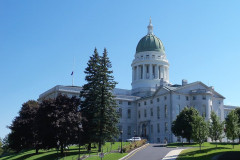
Maine
Description
Maine is a state in New England, in the United States. Maine is the 39th most extensive and the 42nd most populous of the 50 U.S. states. It is bordered by New Hampshire to the west, the Atlantic Ocean to the east, and the Canadian provinces of New Brunswick and Quebec to the east and north, respectively. Maine is the easternmost state in the contiguous United States, and the northernmost east of the Great Lakes. It is known for its jagged, rocky coastline; low, rolling mountains; heavily forested interior, and picturesque waterways; and also its seafood cuisine, especially clams and lobster. There is a continental climate throughout the state, even in coastal areas such as its most populous city of Portland. The capital is Augusta.
For thousands of years, indigenous peoples were the only inhabitants of the territory that is now Maine. At the time of European arrival in what is now Maine, several Algonquian-speaking peoples inhabited the area. The first European settlement in the area was by the French in 1604 on Saint Croix Island, by Pierre Dugua, Sieur de Mons. The first English settlement was the short-lived Popham Colony, established by the Plymouth Company in 1607. A number of English settlements were established along the coast of Maine in the 1620s, although the rugged climate, deprivations, and conflict with the local peoples caused many to fail over the years.
As Maine entered the 18th century, only a half dozen European settlements had survived. Loyalist and Patriot forces contended for Maine's territory during the American Revolution and the War of 1812. Maine was part of the Commonwealth of Massachusetts until 1820 when it voted to secede from Massachusetts. On March 15, 1820, it was admitted to the Union as the 23rd state under the Missouri Compromise.
Geography
To the south and east is the Atlantic Ocean and to the north and northeast is New Brunswick, a province of Canada. The Canadian province of Quebec is to the northwest. Maine is both the northernmost state in New England and the largest, accounting for almost half the region's entire land area. Maine is the only state to border only one other state (New Hampshire to the west).
Maine is the easternmost state in the United States in both its extreme points and its geographic center. The municipalities of Eastport and Lubec are, respectively, the easternmost city and town in the United States. Estcourt Station is Maine's northernmost point, as well as the northernmost point in New England. (For more information see extreme points of the United States.)
Maine's Moosehead Lake is the largest lake wholly in New England, as Lake Champlain is located between Vermont, New York and Quebec. A number of other Maine lakes, such as South Twin Lake, are described by Thoreau in The Maine Woods (1864). Mount Katahdin is both the northern terminus of the Appalachian Trail, which extends southerly to Springer Mountain, Georgia, and the southern terminus of the new International Appalachian Trail which, when complete, will run to Belle Isle, Newfoundland and Labrador.
Maine has several unique geographical features. Machias Seal Island and North Rock, off its easternmost point, are claimed by both the U.S. and Canada and are within one of four areas between the two countries whose sovereignty is still in dispute, but it is the only one of the disputed areas containing land. Also in this easternmost area in the Bay of Fundy is the Old Sow, the largest tidal whirlpool in the Western Hemisphere.
Maine is the least densely populated U.S. state east of the Mississippi River. It is called the Pine Tree State; about 83% of its land is forested. In the forested areas of the interior lies much uninhabited land, some of which does not have formal political organization into local units (a rarity in New England). The Northwest Aroostook, Maine unorganized territory in the northern part of the state, for example, has an area of 2,668 square miles (6,910 km2) and a population of 10, or one person for every 267 square miles (690 km2).
Maine is in the temperate broadleaf and mixed forests biome. The land near the southern and central Atlantic coast is covered by the mixed oaks of the Northeastern coastal forests. The remainder of the state, including the North Woods, is covered by the New England-Acadian forests.
Maine has almost 230 miles (400 km) of coastline (and 3,500 miles (5,600 km) of tidal coastline). West Quoddy Head, in Lubec, Maine, is the easternmost point of land in the 48 contiguous states. Along the famous rock-bound coast of Maine are lighthouses, beaches, fishing villages, and thousands of offshore islands, including the Isles of Shoals which straddle the New Hampshire border. There are jagged rocks and cliffs and many bays and inlets. Inland are lakes, rivers, forests, and mountains. This visual contrast of forested slopes sweeping down to the sea has been summed up by American poet Edna St. Vincent Millay of Rockland and Camden, Maine, in "Renascence":
"All I could see from where I stood Was three long mountains and a wood; I turned and looked the other way, And saw three islands in a bay."Geologists describe this type of landscape as a "drowned coast", where a rising sea level has invaded former land features, creating bays out of valleys and islands out of mountain tops. A rise in the elevation of the land due to the melting of heavy glacier ice caused a slight rebounding effect of underlying rock; this land rise, however, was not enough to eliminate all the effect of the rising sea level and its invasion of former land features.
Much of Maine's geomorphology was created by heavy glacial activity at the end of the last ice age. Prominent glacial features include Somes Sound and Bubble Rock, both part of Acadia National Park on Mount Desert Island. Carved by glaciers, Somes Sound is considered to be the only fjord on the eastern seaboard and reaches depths of 175 feet (50 m). The extreme depth and steep drop-off allow large ships to navigate almost the entire length of the sound. These features also have made it attractive for boat builders, such as the prestigious Hinckley Yachts. Bubble Rock, a glacial erratic, is a large boulder perched on the edge of Bubble Mountain in Acadia National Park. By analyzing the type of granite, geologists were able to discover that glaciers carried Bubble Rock to its present location from the town of Lucerne, Maine — 30 miles (48 km) away. The Iapetus Suture runs through the north and west of the state being underlain by the ancient Laurentian terrane and the south and east underlain by the Avalonian terrane.
Acadia National Park is the only national park in New England. Areas under the protection and management of the National Park Service include:
- Acadia National Park near Bar Harbor
- Appalachian National Scenic Trail
- Maine Acadian Culture in St. John Valley
- Roosevelt Campobello International Park near Lubec
- Saint Croix Island International Historic Site at Calais
History
The original inhabitants of the territory that is now Maine were Algonquian-speaking Wabanaki peoples including the Abenaki, Passamaquoddy, Maliseet and Penobscot. European contact with what is now called Maine starts around year 1200 when Norwegians interacted with the native Penobscot in present-day Hancock County, most likely through trade. About 200 years earlier, from the settlements of Iceland and Greenland, Norwegians had discovered America and attempted to settle areas such as Newfoundland, but failed to establish a permanent settlement there. However, evidence suggests that Norwegians in Greenland returned to North America for several centuries after the initial discovery to collect timber and to trade, with the most relevant evidence being the Maine Penny, a 10th century Norwegian coin found at a Native American dig site in 1954. The first European settlement in Maine was in 1604 on Saint Croix Island, by Pierre Dugua, Sieur de Mons, including Samuel de Champlain, the noted explorer. The French named the entire area Acadia, including the portion that later became the state of Maine. The first English settlement in Maine was established by the Plymouth Company at Popham in 1607, the same year as the settlement at Jamestown, Virginia. The Popham colonists returned to England after 14 months.
Two Jesuit missions were established by the French: one on Penobscot Bay in 1609, and the other on Mount Desert Island in 1613. The same year, Castine was established by Claude de La Tour. In 1625, Charles de Saint-Étienne de la Tour erected Fort Pentagouet to protect Castine. The coastal areas of western Maine first became the Province of Maine in a 1622 land patent. Eastern Maine north of the Kennebec River was more sparsely settled and was known in the 17th century as the Territory of Sagadahock. A second settlement was attempted at a place called York, in 1623 by English explorer and naval Captain Christopher Levett, granted 6,000 acres (24 km2) by King Charles I of England. That settlement also failed.
Central Maine was formerly inhabited by people of the Androscoggin tribe, also known as Arosaguntacook. The Androscoggin were a tribe in the Abenaki nation. They were driven out of the area in 1690 during King William's War. They were relocated at St. Francis, Canada, which was destroyed by Rogers' Rangers in 1759, and is now Odanak. The other Abenaki tribes suffered several severe defeats, particularly during Dummer's War, with the capture of Norridgewock in 1724 and the defeat of the Pequawket in 1725, which greatly reduced their numbers. They finally withdrew to Canada, where they were settled at Bécancour and Sillery, and later at St. Francis, along with other refugee tribes from the south.
The province within its current boundaries became part of Massachusetts Bay Colony in 1652. Maine was much fought over by the French, English and allied natives during the 17th and early 18th centuries, who conducted raids against each other, taking captives for ransom or, in some cases, adoption by Native American tribes. For instance, in early 1692, the Abenaki raided York, killing about 100 of the English settlers and taking another estimated 80 villagers hostage. The Abenaki took captives taken during raids of Massachusetts in Queen Anne's War of the early 1700s to Kahnewake, a Catholic Mohawk village near Montreal, where some were adopted and others ransomed.
After the British defeated the French in Acadia in the 1740s, the territory from the Penobscot River east fell under the nominal authority of the Province of Nova Scotia, and together with present-day New Brunswick formed the Nova Scotia county of Sunbury, with its court of general sessions at Campobello. American and British forces contended for Maine's territory during the American Revolution and the War of 1812, and British forces occupied eastern Maine in both conflicts. The treaty concluding revolution was ambiguous about Maine's boundary with British North America. The territory of Maine was confirmed as part of Massachusetts when the United States was formed, although the final border with British territory was not established until the Webster–Ashburton Treaty of 1842.
Maine was physically separate from the rest of Massachusetts. Long-standing disagreements over land speculation and settlements led to Maine residents and their allies in Massachusetts proper forcing an 1807 vote in the Massachusetts Assembly on permitting Maine to secede; the vote failed. Secessionist sentiment in Maine was stoked during the War of 1812 when Massachusetts pro-British merchants opposed the war and refused to defend Maine from British invaders. In 1819, Massachusetts agreed to permit secession if voters in Maine approved. Due to these considerations and rapid population growth, in 1820 Maine voted to secede from Massachusetts. The secession and formation of the state of Maine as the 23rd state occurred on March 15, 1820, as part of the Missouri Compromise, which geographically limited the spread of slavery and enabled the admission to statehood of Missouri the following year, keeping a balance between slave and free states.
Maine's original capital was Portland, Maine's largest city, until it was moved to Augusta in 1832 to make it more central within the state. The principal office of the Maine Supreme Judicial Court remains in Portland.
The 20th Maine, under the command of Colonel Joshua Lawrence Chamberlain, defended Little Round Top at the Battle of Gettysburg. Its soldiers prevented the Union Army from being flanked by the Confederate Army.
Four U.S. Navy ships have been named USS Maine in honor of the state.
Etymology
There is no definitive explanation for the origin of the name "Maine". The state legislature in 2001 adopted a resolution establishing Franco-American Day, which stated that the state was named after the former French province of Maine. Other theories mention earlier places with similar names, or claim it is a nautical reference to the mainland. The history of the name of Maine began with James Sullivan's 1795 "History of the District of Maine". He made the unsubstantiated allegation that the Province of Maine was a compliment to the queen of Charles I, Henrietta Maria, who once "owned" the Province of Maine in France. This was quoted by almost all Maine historians until the 1845 Agnes Strickland biography established that she had no connection to the Province of Maine in France. King Charles I married Henrietta Maria in 1625, three years after the name Maine first appeared on the charter. A new theory, set forth by Carol B. Smith Fisher, is that The Province of MAINE was first chosen by Sir Ferdinando Gorges in 1622 to honor the village where his ancestral roots first took hold on English soil. "MAINE" appears in the Domesday Book of 1086 in reference to the county of Dorset, that is today Broadmayne, just southeast of Dorchester. The generally held view amongst British place name scholars is that Mayne in Dorset is Brythonic, corresponding to modern Welsh "maen", plural "main" or "meini". Some early spellings are: MAINE 1086, MEINE 1200, MEINES 1204, MAYNE 1236. Today the actual village is known as BROADMAYNE, which is primitive Welsh or Brythonic, "main" meaning rock or stone, considered to be a reference to the many large sarsens still present around Little Mayne farm, half a mile northeast of Broadmayne village.
The first known record of the name appears in an August 10, 1622, land charter to Sir Ferdinando Gorges and Captain John Mason, English Royal Navy veterans, who were granted a large tract in present-day Maine that Mason and Gorges "intend to name the Province of Maine". Mason had served in the Royal Navy in the Orkney Islands where the chief island is called Mainland, a more likely name derivation for these English sailors than the French province. A year later, in 1623, the English naval captain Christopher Levett, exploring the New England coast, wrote: "The first place I set my foote upon in New England was the Isle of Shoals, being Ilands [sic] in the sea, above two Leagues from the Mayne." Initially, several coastal tracts along the coast of New England were referred to as Main or Maine (cf. the Spanish Main). A reconfirmed and enhanced April 3, 1639, charter from England's King Charles I gave Sir Ferdinando Gorges increased powers over his new province and stated that it "shall forever hereafter, be called and named the PROVINCE OR COUNTIE OF MAINE, and not by any other name or names whatsoever..." Whatever the origin, the name was fixed in 1665 when the King's Commissioners ordered that the "Province of Maine" be entered from then on in official records. Maine is the only state whose name has exactly one syllable, and is the only state to border only one other.
Transportation
Airports
Maine receives passenger jet service at its two largest airports, the Portland International Jetport in Portland, and the Bangor International Airport in Bangor. Both are served daily by many major airlines to destinations such as New York, Atlanta, and Orlando. Essential Air Service also subsidizes service to a number of smaller airports in Maine, bringing small turboprop aircraft to regional airports such as the Augusta State Airport, Hancock County-Bar Harbor Airport, Knox County Regional Airport, and the Northern Maine Regional Airport at Presque Isle. These airports are served by Cape Air with Cessna 402s and Penair with Saab 340s.
Many smaller airports are scattered throughout Maine, only serving general aviation traffic. The Eastport Municipal Airport, for example, is a city-owned public-use airport with 1,200 general aviation aircraft operations each year from single-engine and ultralight aircraft.
Rail
PassengerThe Downeaster passenger train, operated by Amtrak, provides passenger service between Brunswick and Boston's North Station, with stops in Freeport, Portland, Old Orchard Beach, Saco, and Wells. The Downeaster makes five daily trips, two of which continue past Portland to Brunswick.
Seasonal passenger excursions between Brunswick and Rockland are operated by the Maine Eastern Railroad, which leases the state-owned Rockland Branch rail corridor.
FreightFreight service throughout the state is provided by a handful of regional and shortline carriers: Pan Am Railways (formerly known as Guilford Rail System), which operates the former Boston & Maine and Maine Central railroads; St. Lawrence and Atlantic Railroad; Maine Eastern Railroad; Central Maine and Quebec Railway; and New Brunswick Southern Railway.
Culture
Maine in fiction
Literature- Charlotte Agell lives in Maine and has written several books set in Maine.
- Richard Blanco, the poet who read at President Barack Obama's second inauguration, lives in Bethel.
- Gerald Warner Brace (1901–1978) lived in Deer Isle. All of his novels are set in New England, some in Maine.
- John Cariani is an actor and playwright whose play "Almost, Maine" is set in a fictional town.
- Janet Chapman writes several series of paranormal romance and contemporary romance novels set in Maine.
- Carolyn Chute (1947–) lives in Maine and set several novels in the fictional town of Egypt, Maine.
- John Connolly's Charlie Parker mystery series is based in and around Maine.
- Robert P. T. Coffin (1892–1955) — iconic Maine writer
- Thomas A. Desjardin (1964–) — a Maine native and resident, he has written several books on Maine history and the Civil War.
- Terry Goodkind's The Law of Nines takes place in Maine.
- John Irving wrote The Cider House Rules, a novel (and later a motion picture), set in several fictional Maine towns.
- Sarah Orne Jewett (1849–1909) lived in South Berwick, Maine. Many of her novels and short stories were set in Maine.
- Carrie Jones set a series of best-selling books in Maine, the 'Need Pixies Series'.
- Elijah Kellogg Jr. (1813–1901) — popular author of Horatio Alger, Jr.-style boy's books. Many of these out-of-copyright books are available online at books.google.com.
- Stephen King, a Maine native and resident of Bangor, sets much of his fiction in Maine.
- Dean Koontz wrote Night Chills, a horror/suspense novel, which takes place in the fictional town of Black River, Maine.
- H. P. Lovecraft, who set almost all of his stories in New England, occasionally mentions Maine.
- Robert McCloskey (1914–2003) authored several beloved children's books, including "Make Way for Ducklings" and "Blueberries for Sal".
- Leslie Meier authors the Lucy Stone mystery series that takes place in the fictional town of Tinker's Cove, Maine.
- Ruth Moore's novels were based almost entirely in Maine, although she rejected the label of "regional writer".
- Elisabeth Ogilvie was born in Massachusetts, but spent summers in Maine; wrote High Tide at Noon and others about lobster families of Maine's Islands.
- Lauren Oliver's book Delirium is set in Portland.
- Van Reid wrote The Moosepath League series of books, which are humorous adventures set in 19th-century Maine.
- Kenneth Roberts (1885–1957) was a novelist of the Regionalist school, who wrote about Maine in works such as Arundel (novel)|Arundel, Northwest Passage (novel), Rabble in Arms and Boon Island (novel).
- Lewis Robinson's novel Water Dogs and many of his short stories in Officer Friendly and Other Stories are set in Maine.
- Harriet Beecher Stowe composed Uncle Tom's Cabin almost entirely in Brunswick.
- Henry David Thoreau wrote The Maine Woods, which he visited during his stay at Walden Pond.
- E. B. White lived in Brooklin, Maine and used Maine as the setting of Charlotte's Web. He also wrote many essays about his experiences in Maine including "Once More to the Lake."
- 40 West (2011) a drama filmed and produced in Maine.
- Belfast, Maine (1999) a documentary film on the quotidian life in Belfast, Maine by Frederick Wiseman.
- The Beans of Egypt, Maine is a 1994 film directed by Jennifer Warren and is based on the 1985 novel by Carolyn Chute.
- Carrie, based on the Stephen King novel, is set in Maine.
- Casper, a 1995 children's film, is set in the town of Friendship, Maine.
- The Cider House Rules, based on the John Irving novel, is set in several fictional Maine towns.
- Dark Harbor, a 1998 mystery/suspense film is set on an island off the coast of Maine.
- Darkness Falls, a 2003 horror film, is set in the fictional Maine town of Darkness Falls, but was filmed mostly in Australia.
- Dreamcatcher, 2003 film adaptation of the Stephen King novel, is set in and around the fictional town of Derry, Maine.
- Empire Falls, a motion picture based on Richard Russo's Pulitzer Prize-winning novel of the same name, was filmed almost entirely in Waterville and Skowhegan.
- Graveyard Shift, a 1990 film adaptation of the Steven King novel, was filmed in Harmony, Maine but set in the fictional Gates Falls, Maine.
- Home Alone 5 takes place in Rockland, Maine.
- Todd Field's 2001 Academy Award–nominated film for Best Picture, In the Bedroom, is set in many towns throughout Maine including Rockland, Owls Head, Rockport, Camden, Thomaston, Trevette and Old Orchard Beach.
- The Iron Giant, based on the novel The Iron Man by Ted Hughes, is an award-winning animated film that takes place in the fictional town of Rockwell, Maine, in the 1950s.
- It Happened to Jane, a 1959 romantic comedy, is set in the fictional town of Cape Anne, Maine and prominently features the fictional Eastern & Portland Railroad, which was based loosely on the Boston & Maine Railroad and the New Haven Railroad.
- Jumanji, starring Robin Williams, was filmed partially in North Berwick, Maine
- Lake Placid, a 1999 comedy-horror film, is set by a fictional lake in Maine, starring Bridget Fonda and a large man-eating crocodile.
- The Man Without a Face, a 1993 film starring Mel Gibson, was shot throughout Mid Coast Maine.
- The Mist, a Stephen King novel, is set in Maine.
- Pete's Dragon, a 1977 Walt Disney live-action/animated musical is set in Passamaquoddy, Maine
- Peyton Place, filmed in 1957, was set in New Hampshire but filmed in Camden region of Maine.
- Red vs. Blue, a comic science fiction video series, features a character named Maine.
- The Shawshank Redemption, an award-winning 1994 movie, was set in Maine.
- Storm of the Century, a miniseries based on the Stephen King novel, takes place in Maine, along with many other adaptations of his books.
- Thinner, based on a novel by Stephen King, took place partly in Maine.
- Welcome to Mooseport was a 2004 movie set in the fictional city of Mooseport, Maine.
- Wet Hot American Summer is set near Waterville, Maine.
- The Whales of August, a 1987 film based on a play by David Berry, was shot on location on Maine's Cliff Island.
- North Woods Law is a reality television series on the Animal Planet cable channel which follows Maine game wardens as they perform their duties; it premiered in March 2012.
- "Augusta, Gone" (2001), a television drama about a teenager's descent into drug use, is set on Mount Desert Island, Maine.
- Dark Shadows is set in the fictional coastal town of Collinsport, Maine.
- Hawkeye Pierce, a central character of the television sitcom M*A*S*H, is a resident of the fictional town of Crabapple Cove, Maine. The role of Pierce was played by Alan Alda. The series was based upon the writings of Dr. H. Richard Hornberger (writing as Richard Hooker), who following the war resided in Pittsfield.
- Murder, She Wrote, a detective series starring Angela Lansbury, is set in the fictional Maine village of Cabot Cove, but filmed in Mendocino, California.
- Kingdom Hospital, Stephen King's 2004 ABC mini-series, was set in Lewiston
- Haven, a science fiction series, is set in the fictional coastal town of Haven, Maine. It is based on Stephen King's book "The Colorado Kid."
- Passions, a daytime soap opera is set in the fictional supernatural town of Harmony. The first two months and opening credits were filmed in Camden and Belfast, Maine.
- Once Upon a Time a series starring Lana Parrilla, Jennifer Morrison, Ginnifer Goodwin and Robert Carlyle is set in the fictional town of Storybrooke in Maine.
- The Dead Zone, a science fiction series starring Anthony Michael Hall, is set in the fictional small town of Cleaves Mills. Based on the novel by Stephen King.
- Under the Dome, a science fiction series set in the fictional Maine town of Chester's Mill, based on the novel by Stephen King.
- Down East Dickering, a reality-television show, is filmed entirely in Maine.
- The titular town of the video game series Silent Hill (series) is located in Maine.
- Maine is featured in Bioshock: Infinite by Irrational Games.
- The web series Ragged Isle tells the story of a small island lobstering community located twenty-one miles off the coast of Maine. The island in the show is a fictionalized version of the real-life Maine island of Criehaven.