Reno
Description
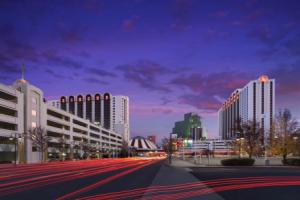
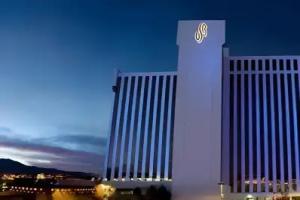
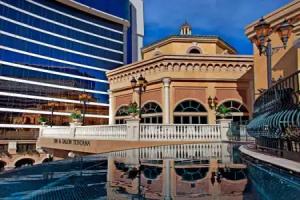
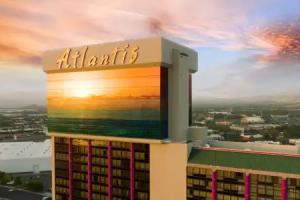
Reno is a city in the U.S. state of Nevada. It is located in Northern Nevada, approximately 22 miles (35 km) from Lake Tahoe. Known as "The Biggest Little City in the World", Reno is famous for its casinos and as the birthplace of Caesars Entertainment Corporation. It is the county seat of Washoe County, located in the northwestern part of the state. The city sits in a high desert at the foot of the Sierra Nevada and its downtown area (along with Sparks) occupies a valley informally known as the Truckee Meadows.
Reno is the most populous Nevada city outside of the Las Vegas–Paradise, NV MSA, with an estimated population of 233,294 in 2013, and is the third most populous city in the state after Las Vegas and Henderson.
Reno is part of the Reno–Sparks metropolitan area, which consists of all of both Washoe and Storey counties, and has a 2013 estimated population of 420,000, making it the second largest metropolitan area in Nevada.
History
Archaeological finds place the eastern border for the prehistoric Martis people in the Reno area.
As early as the mid 1850s a few pioneers settled in the Truckee Meadows, a relatively fertile valley through which the Truckee River made its way from Lake Tahoe to Pyramid Lake. In addition to subsistence farming, these early residents could pick up business from travelers along the California Trail, which followed the Truckee westward, before branching off towards Donner Lake, where the formidable obstacle of the Sierra Nevada began.
Gold was discovered in the vicinity of Virginia City in 1850, and a modest mining community developed, but the discovery of silver in 1859 at the Comstock Lode led to a mining rush.
To provide the necessary connection between Virginia City and the California Trail, Charles W. Fuller built a log toll bridge across the Truckee River in 1859. A small community that would service travelers soon grew up near the bridge. After two years, Fuller sold the bridge to Myron C. Lake, who continued to develop the community with the addition of a grist mill, kiln, and livery stable to the hotel and eating house. He renamed it "Lake's Crossing". In 1864, Washoe County was consolidated with Roop County, and Lake's Crossing became the largest town in the county. Lake had earned himself the title "founder of Reno".
By January 1863, the Central Pacific Railroad (CPRR) had begun laying tracks east from Sacramento, California, eventually connecting with the Union Pacific Railroad at Promontory, Utah, to form the First Transcontinental Railroad. Lake deeded land to the CPRR in exchange for its promise to build a depot at Lake's Crossing. Once the railroad station was established, the town of Reno officially came into being on May 9, 1868. CPRR construction superintendent Charles Crocker named the community after Major General Jesse Lee Reno, a Union officer killed in the American Civil War at the Battle of South Mountain.
In 1871, Reno became the county seat of the newly expanded Washoe County, replacing the previous county seat, located in Washoe City. However, political power in Nevada remained with the mining communities, first Virginia City and later Tonopah and Goldfield.
The extension of the Virginia and Truckee Railroad to Reno in 1872 provided a boost to the new city's economy. In the following decades, Reno continued to grow and prosper as a business and agricultural center and became the principal settlement on the transcontinental railroad between Sacramento and Salt Lake City.
As the mining boom waned early in the 20th century, Nevada's centers of political and business activity shifted to the non-mining communities, especially Reno and Las Vegas, and today the former mining metropolises stand as little more than ghost towns. Despite this, Nevada is still the third-largest gold producer in the world, after South Africa and Australia; the state yielded 6.9 percent of the world's supply in 2005 world gold production.
The "Reno Arch" was erected on Virginia Street in 1926 to promote the upcoming Transcontinental Highways Exposition of 1927. The arch included the words "Nevada's Transcontinental Highways Exposition" and the dates of the exposition. After the exposition, the Reno City Council decided to keep the arch as a permanent downtown gateway, and Mayor E.E. Roberts asked the citizens of Reno to suggest a slogan for the arch. No acceptable slogan was received until a $100 prize was offered, and G.A. Burns of Sacramento was declared the winner on March 14, 1929, with "Reno, The Biggest Little City in the World".
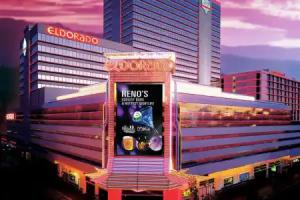
Reno took a leap when the state of Nevada legalized open-gambling on March 19, 1931, along with the passage of even more liberal divorce laws than places like Hot Springs, Arkansas, offered. No other state offered what Nevada did in the 1930s, and casinos like the Bank Club and Palace were popular.
Within a few years, the Bank Club, owned by George Wingfield, Bill Graham, and Jim McKay, was the state's largest employer and the largest casino in the world. Wingfield owned most of the buildings in town that housed gaming and took a percentage of the profits, along with his rent.
Ernie Pyle once wrote in one of his columns, "All the people you saw on the streets in Reno were obviously there to get divorces." In Ayn Rand's novel The Fountainhead, published in 1943, the New York-based female protagonist tells a friend, "I am going to Reno," which is taken as a different way of saying "I am going to divorce my husband." Among others, the Belgian-French writer Georges Simenon, at the time living in the U.S., came to Reno in 1950 in order to divorce his first wife.
Play mediaThe divorce business eventually died as the other states fell in line by passing their own laws easing the requirements for divorce, but gambling continued as a major Reno industry. While gaming pioneers like "Pappy" and Harold Smith of Harold's Club and Bill Harrah of the soon-to-dominate Harrah's casino set up shop in the 1930s, the war years of the 1940s cemented Reno as the place to play for two decades. Beginning in the 1950s, the need for economic diversification beyond gaming fueled a movement for more lenient business taxation.
A disaster occurred on the afternoon of February 5, 1957, when an explosion ripped through the heart of downtown. At 1:03 pm, two explosions, caused by natural gas leaking into the maze of pipes and ditches under the city, and an ensuing fire destroyed five buildings in the vicinity of Sierra and First streets along the Truckee River. Forty-nine people were injured in the disaster, and two were killed. The first explosion hit under the block of shops on the west side of Sierra Street (now the site of the Century Riverside), the second, across Sierra Street, now the site of the Palladio.
The presence of a main east-west rail line, the emerging interstate highway system, favorable state tax climate, and relatively inexpensive land created good conditions for warehousing and distribution of goods.
In the 1980s, Indian gaming rules were relaxed, and starting in 2000, Californian Native casinos began to cut into casino revenues. Major new construction projects have been completed in the Reno and Sparks areas. A few new luxury communities were recently built in Truckee, California, approximately 28 miles (45 km) west of Reno on Interstate 80. Reno also is an outdoor recreation destination, due to its close proximity to the Sierra Nevada, Lake Tahoe, and numerous ski resorts in the region.
In more recent years, the city has gained some notoriety as the subject of the comedy series Reno 911! (the main scenes of which, however, are filmed in the city of Carson, California).
On May 9, 2014, the Reno Historical App was released in conjunction with the city's celebration of its 111th birthday as an incorporated city. The free app puts Reno's history at users' fingertips, allowing them to explore the people, places and moments that have shaped both the city's and the university's history.
Geography
Environmental factors
Wetlands are an important part of the Reno/Tahoe area. They act as a natural filter for the solids that come out of the water treatment plant. Plant roots absorb nutrients from the water and naturally filter it. Wetlands are home to over 75% of the species in the Great Basin. However, the area's wetlands are at risk of being destroyed due to development around the city. While developers build on top of the wetlands they fill them with dirt, destroying the habitat they create for the plants and animals. Washoe County has devised a plan that will help protect these ecosystems: mitigation. In the future, when developers try to build over a wetland, they will be responsible for creating another wetland near Washoe Lake.
The Truckee River serves as Reno's primary source of drinking water. It supplies Reno with 80 million U.S. gallons (300 Ml) of water a day during the summer, and 40 million U.S. gallons (150 Ml) of water per day in the winter. Before the water goes to the homes around the Reno area, it must go to one of two water treatment plants, Chalk Bluff or Glendale Water Treatment Plant. As an attempt to save water, golf courses in Reno have been using treated effluent water instead of treated water from one of Reno's water plants.
The Reno-Sparks wastewater treatment plant discharges tertiary treated effluent to the Truckee River. In the 1990s this capacity was increased from 20 to 30 million U.S. gallons (70 to 110 million liters) per day. While treated, the effluent contains suspended solids, nitrogen, and phosphorus, aggravating water quality concerns of the river and its receiving waters of Pyramid Lake. Local agencies working with the Environmental Protection Agency have developed a number of watershed management strategies to accommodate this expanded effluent discharge; to accomplish this successful outcome, the DSSAM Model was developed and calibrated for the Truckee River in order to analyze the most cost-effective available management strategy set. The resulting management strategies included a package of measures such as land use controls in the Lake Tahoe basin, urban runoff controls in Reno and Sparks, and best management practices for wastewater discharge.
The Reno area is frequently subject to wildfires, causing property damage and sometimes loss of life. In August 1960, the Donner Ridge fire resulted in a loss of electricity to the city for four days. In November 2011, arcing from powerlines caused a fire in Caughlin in southwest Reno that destroyed 26 homes and killed one older man, and only two months later in January 2012 another fire in Washoe Drive sparked by fireplace ashes destroyed 29 homes and killed one older woman. Around 10,000 residents were evacuated, and a state of emergency was declared. The fires came at the end of Reno's longest recorded dry spell.
Geology
Reno is situated just east of the Sierra Nevada on the western edge of the Great Basin at an elevation of about 4,400 feet (1,300 m) above sea level. Numerous faults exist throughout the region. Most of these are normal (vertical motion) faults associated with the uplift of the various mountain ranges, including the Sierra Nevada.
In February 2008, an earthquake swarm began to occur, lasting for several months, and with the largest quake registering at 4.9 on the Richter scale, although some geologic estimates put it at 5.0. The earthquakes were centered on the Somersett community in western Reno near the areas of Mogul and Verdi. Many homes in these areas were damaged.
Culture
- Artown
- National Automobile Museum
- Nevada Museum of Art,the only American Alliance of Museums (AAM) accredited art museum in the state of Nevada.
- Nevada Opera
- Pioneer Center for the Performing Arts
- Reno Philharmonic Orchestra
- Reno Pops Orchestra
- University of Nevada, Reno Arboretum
- Wilbur D. May Center, an arboretum and botanical garden
- Hot August Nights
- Burning Man
Libraries
Washoe County Library System has locations throughout Reno and its surrounding communities.
Reno in media
Movies filmed in Reno include:
- The Cooler
- Magnolia
- Hard Eight
- Charley Varrick
- Into the Wild
- Desert Hearts
- The Wizard
- Jinxed!
- The Misfits
- Kingpin
- ...All the Marbles
- Pink Cadillac
- Diamonds
- Sister Act
- Father's Day
- Waking Up in Reno
- Austin Powers in Goldmember
- Jane Austen's Mafia!
- 40 Pounds of Trouble
- California Split
- Up Close & Personal
- The Pledge
- Kill Me Again
- The Last Don
- Ocean's Eleven (1960 film)
- Andy Hardy's Blonde Trouble
- Blind Fury
- Melvin and Howard
- Mr. Belvedere Goes to College
- Scarecrow
- Wild Is the Wind
- Born to Kill (1947 film)
- The Muppets
- Promised Land (1987 film)
- The Motel Life (film)
- 5 Against the House
Music videos filmed in Reno include:
- "Drive Slow" – Kanye West
- "Little Motel" – Modest Mouse
- "Take Me Home Tonight" – Eddie Money
- "Send The Pain Below" - Chevelle
The young adult author Ellen Hopkins has written a series of novels called Crank set in Reno. Also, many of the short stories included in Claire Vaye Watkins' collection Battleborn are set in the city.
American songwriter Richard Fariña composed a song named Reno Nevada; it was first released on Richard & Mimi Fariña's debut album Celebrations For A Grey Day in 1965. The song was famously covered by Fairport Convention in 1968 and by Iain Matthews in 1971.
Thomas Dolby composed a song named "Road to Reno" as part of his A Map of the Floating City album, released in 2011.
Recreation
Reno is home to a variety of recreation activities including both seasonal and year-round. In the summer, Reno locals can be found near three major bodies of water: Lake Tahoe, the Truckee River, and Pyramid Lake. The Truckee River originates at Lake Tahoe and flows west to east through the center of downtown Reno before terminating at Pyramid Lake to the north. The river is a major part of Artown, held in the summer at Wingfield Park. Washoe Lake is a popular kite and windsurfing location because of its high wind speeds during the summer.
Skiing and snowboarding are among the most popular winter sports and draw in many tourists. There are 18 ski resorts (8 major resorts) located as close as 11 miles (18 km) and as far as 98 miles (158 km) from the Reno–Tahoe International Airport, including Northstar California, Sierra-at-Tahoe, Alpine Meadows, Squaw Valley, Sugar Bowl, Diamond Peak, Heavenly Mountain, and Mount Rose. Other popular Reno winter activities include snowshoeing, ice skating, and snowmobiling. There are many bike paths to ride in the summer time. International bike competitions are held in Lake Tahoe over the summer time.
Air races
The Reno Air Races, also known as the National Championship Air Races, are held each September at the Reno Stead Airport.
