Ohio
Description
Ohio i/oʊˈhaɪ.oʊ/ is an Eastern state in the Great Lakes region of the United States. Ohio is the 34th largest by area, the 7th most populous, and the 10th most densely populated of the 50 United States. The state's capital and largest city is Columbus.
The state takes its name from the Ohio River. The name originated from the Iroquois word ohi-yo’, meaning "great river" or "large creek". Partitioned from the Northwest Territory, the state was admitted to the Union as the 17th state (and the first under the Northwest Ordinance) on March 1, 1803. Ohio is historically known as the "Buckeye State" after its Ohio buckeye trees, and Ohioans are also known as "Buckeyes".
The government of Ohio is composed of the executive branch, led by the Governor; the legislative branch, which comprises the Ohio General Assembly; and the judicial branch, which is led by the state Supreme Court. Ohio occupies 16 seats in the United States House of Representatives. Ohio is known for its status as both a swing state and a bellwether in national elections. Six Presidents of the United States have been elected who had Ohio as their home state.
Geography
Further information: List of Ohio counties, List of cities in Ohio, List of villages in Ohio, List of Ohio townships, Ohio public lands, and List of lakes in OhioOhio's geographic location has proven to be an asset for economic growth and expansion. Because Ohio links the Northeast to the Midwest, much cargo and business traffic passes through its borders along its well-developed highways. Ohio has the nation's 10th largest highway network, and is within a one-day drive of 50% of North America's population and 70% of North America's manufacturing capacity. To the north, Lake Erie gives Ohio 312 miles (502 km) of coastline, which allows for numerous cargo ports. Ohio's southern border is defined by the Ohio River (with the border being at the 1793 low-water mark on the north side of the river), and much of the northern border is defined by Lake Erie. Ohio's neighbors are Pennsylvania to the east, Michigan to the northwest, Ontario Canada, to the north, Indiana to the west, Kentucky on the south, and West Virginia on the southeast. Ohio's borders were defined by metes and bounds in the Enabling Act of 1802 as follows:
Bounded on the east by the Pennsylvania line, on the south by the Ohio River, to the mouth of the Great Miami River, on the west by the line drawn due north from the mouth of the Great Miami aforesaid, and on the north by an east and west line drawn through the southerly extreme of Lake Michigan, running east after intersecting the due north line aforesaid, from the mouth of the Great Miami until it shall intersect Lake Erie or the territorial line, and thence with the same through Lake Erie to the Pennsylvania line aforesaid.
Ohio is bounded by the Ohio River, but nearly all of the river itself belongs to Kentucky and West Virginia. In 1980, the U.S. Supreme Court held that, based on the wording of the cessation of territory by Virginia (which at that time included what is now Kentucky and West Virginia), the boundary between Ohio and Kentucky (and, by implication, West Virginia) is the northern low-water mark of the river as it existed in 1792. Ohio has only that portion of the river between the river's 1792 low-water mark and the present high-water mark.
The border with Michigan has also changed, as a result of the Toledo War, to angle slightly northeast to the north shore of the mouth of the Maumee River.
Much of Ohio features glaciated plains, with an exceptionally flat area in the northwest being known as the Great Black Swamp. This glaciated region in the northwest and central state is bordered to the east and southeast first by a belt known as the glaciated Allegheny Plateau, and then by another belt known as the unglaciated Allegheny Plateau. Most of Ohio is of low relief, but the unglaciated Allegheny Plateau features rugged hills and forests.
The rugged southeastern quadrant of Ohio, stretching in an outward bow-like arc along the Ohio River from the West Virginia Panhandle to the outskirts of Cincinnati, forms a distinct socio-economic unit. Geologically similar to parts of West Virginia and southwestern Pennsylvania, this area's coal mining legacy, dependence on small pockets of old manufacturing establishments, and distinctive regional dialect set this section off from the rest of the state. In 1965 the United States Congress passed the Appalachian Regional Development Act, at attempt to "address the persistent poverty and growing economic despair of the Appalachian Region." This act defines 29 Ohio counties as part of Appalachia. While 1/3 of Ohio's land mass is part of the federally defined Appalachian region, only 12.8% of Ohioans live there (1.476 million people.)
Significant rivers within the state include the Cuyahoga River, Great Miami River, Maumee River, Muskingum River, and Scioto River. The rivers in the northern part of the state drain into the northern Atlantic Ocean via Lake Erie and the St. Lawrence River, and the rivers in the southern part of the state drain into the Gulf of Mexico via the Ohio River and then the Mississippi.
The worst weather disaster in Ohio history occurred along the Great Miami River in 1913. Known as the Great Dayton Flood, the entire Miami River watershed flooded, including the downtown business district of Dayton. As a result, the Miami Conservancy District was created as the first major flood plain engineering project in Ohio and the United States.
Grand Lake St. Marys in the west central part of the state was constructed as a supply of water for canals in the canal-building era of 1820–1850. For many years this body of water, over 20 square miles (52 km2), was the largest artificial lake in the world. It should be noted that Ohio's canal-building projects were not the economic fiasco that similar efforts were in other states. Some cities, such as Dayton, owe their industrial emergence to location on canals, and as late as 1910 interior canals carried much of the bulk freight of the state.
Earthquakes
Although few have registered as noticeable to the average resident, more than 30 earthquakes occurred in Ohio between 2002 and 2007, and more than 200 quakes with a magnitude of 2.0 or higher have occurred since 1776.
The most substantial known earthquake in Ohio history was the Anna (Shelby County) earthquake, which occurred on March 9, 1937. It was centered in western Ohio, and had a magnitude of 5.4, and was of intensity VIII.
Other significant earthquakes in Ohio include: one of magnitude 4.8 near Lima on September 19, 1884; one of magnitude 4.2 near Portsmouth on May 17, 1901; and one of 5.0 in LeRoy Township in Lake County on January 31, 1986, which continued to trigger 13 aftershocks of magnitude 0.5 to 2.4 for two months.
The most recent earthquake in Ohio of any appreciable magnitude occurred on December 31, 2011, at 3:05pm EST. It had a magnitude of 4.0, and its epicenter was located approximately 4 kilometres northwest of Youngstown (41°7′19.1994″N 80°41′2.3994″W / 41.121999833°N 80.683999833°W / 41.121999833; -80.683999833), near the Trumbull/Mahoning county border.
The Ohio Seismic Network (OhioSeis), a group of seismograph stations at several colleges, universities, and other institutions, and coordinated by the Division of Geological Survey of the Ohio Department of Natural Resources, maintains an extensive catalog of Ohio earthquakes from 1776 to the present day, as well as earthquakes located in other states whose effects were felt in Ohio.
Major cities
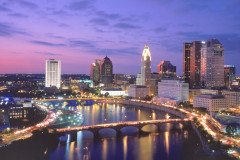
Columbus (home of The Ohio State University, Franklin University, Capital University, and Ohio Dominican University) is the capital of Ohio, near the geographic center of the state.
Other Ohio cities functioning as centers of United States metropolitan areas include:
- Akron (home of University of Akron and Goodyear Tire and Rubber Company)
- Canton (home of Pro Football Hall of Fame, Malone University, and The Timken Company)
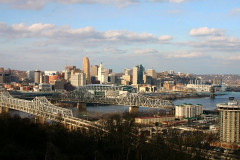
- Cincinnati (home of University of Cincinnati, Xavier University, Cincinnati Museum Center, Cincinnati Symphony Orchestra, Procter & Gamble, Kroger, Macy's Inc., and Fifth Third Bank)
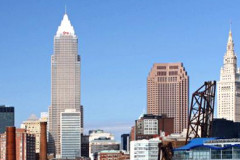
- Cleveland (home of Cleveland State University, Playhouse Square Center, The Cleveland Museum of Art, The Cleveland Orchestra, Case Western Reserve University, The Cleveland Clinic, Rock and Roll Hall of Fame, Forest City Enterprises, and University Hospitals)
- Dayton (home of University of Dayton, Dayton Ballet, Wright State University, Premier Health Partners, and National Museum of the United States Air Force)
- Lima (home of University of Northwestern Ohio)
- Mansfield (home of North Central State College and Mansfield Motorsports Park)
- Sandusky (home of Cedar Point, and Kalahari Resort and Convention Center)
- Springfield (home of Wittenberg University)
- Steubenville (home of Franciscan University of Steubenville)
- Toledo (home of The University of Toledo, The Toledo Museum of Art, Owens Corning, and Owens-Illinois)
- Youngstown (home of Youngstown State University and Butler Institute of American Art).
Note: The Cincinnati metropolitan area extends into Kentucky and Indiana, the Steubenville metropolitan area extends into West Virginia, and the Youngstown metropolitan area extends into Pennsylvania.
Ohio cities that function as centers of United States micropolitan areas include:
- Ashland (home of Ashland University)
- Ashtabula
- Athens (home of Ohio University)
- Bellefontaine
- Bucyrus
- Cambridge
- Celina
- Chillicothe (home of Ohio University-Chillicothe)
- Coshocton
- Defiance (home of Defiance College)
- Findlay (home of The University of Findlay)
- Fremont
- Greenville
- Marion (home of Marion Popcorn Festival)
- Mount Vernon (home of Mount Vernon Nazarene University)
- New Philadelphia-Dover
- Norwalk (home of the NHRA venue Summit Motorsports Park, headquarters of the International Hot Rod Association, and pioneer automobile company Fisher Body)
- Oxford (home of Miami University)
- Portsmouth (home of Shawnee State University)
- Salem
- Sidney
- Tiffin (home of Heidelberg College and Tiffin University)
- Urbana (home of Urbana University)
- Van Wert
- Wapakoneta (birthplace of Apollo 11 astronaut Neil Armstrong)
- Washington Court House
- Wilmington (home of Wilmington College)
- Wooster (home of The College of Wooster)
- Zanesville (home of Zane State College).
History
Native Americans
Archeological evidence suggests that the Ohio Valley was inhabited by nomadic people as early as 13,000 BC. These early nomads disappeared from Ohio by 1,000 BC, "but their material culture provided a base for those who followed them". Between 1,000 and 800 BC, the sedentary Adena culture emerged. As Ohio historian George W. Knepper notes, this sophisticated culture was "so named because evidences of their culture were excavated in 1902 on the grounds of Adena, Thomas Worthington's estate located near Chillicothe". The Adena were able to establish "semi-permanent" villages because they domesticated plants, which included squash, sunflowers, and perhaps corn. Cultivation of these in addition to hunting and gathering supported more settled, complex villages. The most spectacular remnant of the Adena culture is the Great Serpent Mound, located in Adams County, Ohio.
Around 100 BC, the Adena were joined in Ohio Country by the Hopewell people, who were named for the farm owned by Captain M. C. Hopewell, where evidence of their unique culture was discovered. Like the Adena, the Hopewell people participated in a mound-building culture. Their complex, large and technologically sophisticated earthworks can be found in modern-day Marietta, Newark, and Circleville. The Hopewell, however, disappeared from the Ohio Valley in about 600 AD. Little is known about the people who replaced them. Researchers have identified two additional, distinct prehistoric cultures: the Fort Ancient people and the Whittlesey Focus people. Both cultures apparently disappeared in the 17th century, perhaps decimated by infectious diseases spread in epidemics from early European contact. The Native Americans had no immunity to common European diseases. Some scholars believe that the Fort Ancient people "were ancestors of the historic Shawnee people, or that, at the very least, the historic Shawnees absorbed remnants of these older peoples."
American Indians in the Ohio Valley were greatly affected by the aggressive tactics of the Iroquois Confederation, based in central and western New York. After the so-called Beaver Wars in the mid-17th century, the Iroquois claimed much of the Ohio country as hunting and, more importantly, beaver-trapping ground. After the devastation of epidemics and war in the mid-17th century, which largely emptied the Ohio country of indigenous people by the mid-to-late 17th century, the land gradually became repopulated by the mostly Algonquian-speaking descendants of its ancient inhabitants, that is, descendants of the Adena, Hopewell, and Mississippian cultures. Many of these Ohio-country nations were multi-ethnic (sometimes multi-linguistic) societies born out of the earlier devastation brought about by disease, war, and subsequent social instability. They subsisted on agriculture (corn, sunflowers, beans, etc.) supplemented by seasonal hunts. By the 18th century, they were part of a larger global economy brought about by European entry into the fur trade.
The indigenous nations to inhabit Ohio in the historical period included the Miamis (a large confederation); Wyandots (made up of refugees, especially from the fractured Huron confederacy); Delawares (pushed west from their historic homeland in New Jersey); Shawnees (also pushed west, although they may have been descended from the Fort Ancient people of Ohio); Ottawas (more commonly associated with the upper Great Lakes region); Mingos (like the Wyandot, a group recently formed of refugees from Iroquois); and Eries (gradually absorbed into the new, multi-ethnic "republics," namely the Wyandot). Ohio country was also the site of Indian massacres, such as the Yellow Creek Massacre, Gnadenhutten and Pontiac's Rebellion school massacre.
Colonial and Revolutionary eras
During the 18th century, the French set up a system of trading posts to control the fur trade in the region. Beginning in 1754, France and Great Britain fought a war that was known in North America as the French and Indian War and in Europe as the Seven Years' War. As a result of the Treaty of Paris, the French ceded control of Ohio and the remainder of the Old Northwest to Great Britain.
Pontiac's Rebellion in the 1760s, however, posed a challenge to British military control. This came to an end with the colonists' victory in the American Revolution. In the Treaty of Paris in 1783, Britain ceded all claims to Ohio country to the United States.
Northwest Territory: 1787–1803
The United States created the Northwest Territory under the Northwest Ordinance of 1787. Slavery was not permitted in the new territory. Settlement began with the founding of Marietta by the Ohio Company of Associates, which had been formed by a group of American Revolutionary War veterans. Following the Ohio Company, the Miami Company (also referred to as the "Symmes Purchase") claimed the southwestern section, and the Connecticut Land Company surveyed and settled the Connecticut Western Reserve in present-day Northeast Ohio.
The old Northwest Territory originally included areas previously known as Ohio Country and Illinois Country. As Ohio prepared for statehood, the Indiana Territory was created, reducing the Northwest Territory to approximately the size of present-day Ohio plus the eastern half of the Lower Peninsula of Michigan and the eastern tip of the Upper Peninsula.
Under the Northwest Ordinance, areas of the territory could be defined and admitted as states once their population reached 60,000. Although Ohio's population numbered only 45,000 in December 1801, Congress determined that the population was growing rapidly and Ohio could begin the path to statehood. The assumption was that it would exceed 60,000 residents by the time it was admitted as a state. Furthermore, in regards to the Leni Lenape Native Americans living in the region, Congress decided that 10,000 acres on the Muskingum River in the present state of Ohio would "be set apart and the property thereof be vested in the Moravian Brethren . . . or a society of the said Brethren for civilizing the Indians and promoting Christianity."
Statehood: 1803–present
On February 19, 1803, US President Thomas Jefferson signed an act of Congress that approved Ohio's boundaries and constitution. However, Congress had never passed a resolution formally admitting Ohio as the 17th state. The current custom of Congress declaring an official date of statehood did not begin until 1812, with Louisiana's admission as the 18th state. Although no formal resolution of admission was required, when the oversight was discovered in 1953, Ohio congressman George H. Bender introduced a bill in Congress to admit Ohio to the Union retroactive to March 1, 1803, the date on which the Ohio General Assembly first convened. At a special session at the old state capital in Chillicothe, the Ohio state legislature approved a new petition for statehood that was delivered to Washington, D.C. on horseback. On August 7, 1953 (the year of Ohio's 150th anniversary), President Eisenhower signed a congressional joint resolution that officially declared March 1, 1803 the date of Ohio's admittance into the Union.
Ohio has had three capital cities: Chillicothe, Zanesville, and Columbus. Chillicothe was the capital from 1803 to 1810. The capital was then moved to Zanesville for two years, as part of a state legislative compromise, in order to get a bill passed. The capital was then moved back to Chillicothe, which was the capital from 1812 to 1816. Finally, the capital was moved to Columbus, in order to have it near the geographic center of the state, where it would be more accessible to most citizens.
Although many Native Americans had migrated west to evade American encroachment, others remained settled in the state, sometimes assimilating in part. In 1830 under President Andrew Jackson, the US government forced Indian Removal of most tribes to the Indian Territory west of the Mississippi River.
In 1835, Ohio fought with Michigan in the Toledo War, a mostly bloodless boundary war over the Toledo Strip. Congress intervened, making Michigan's admittance as a state conditional on ending the conflict. In exchange for giving up its claim to the Toledo Strip, Michigan was given the western two-thirds of the Upper Peninsula, in addition to the eastern third that was already considered part of the state.
Ohio's central position and its population gave it an important place during the Civil War. The Ohio River was a vital artery for troop and supply movements, as were Ohio's railroads. Ohio contributed more soldiers per-capita than any other state in the Union. In 1862, the state's morale was badly shaken in the aftermath of the battle of Shiloh, a costly victory in which Ohio forces suffered 2,000 casualties. Later that year, when Confederate troops under the leadership of Stonewall Jackson threatened Washington, D.C., Ohio governor David Tod still could recruit 5,000 volunteers to provide three months of service. Almost 35,000 Ohioans died in the conflict, and thirty thousand were physically wounded. By the end of the Civil War, the Union's top three generals–Ulysses S. Grant, William Tecumseh Sherman, and Philip Sheridan–were all from Ohio.
In 1912 a Constitutional Convention was held with Charles B. Galbreath as secretary. The result reflected the concerns of the Progressive Era. It introduced the initiative and the referendum. In addition, it allowed the General Assembly to put questions on the ballot for the people to ratify laws and constitutional amendments originating in the Legislature. Under the Jeffersonian principle that laws should be reviewed once a generation, the constitution provided for a recurring question to appear on Ohio's general election ballots every 20 years. The question asks whether a new convention is required. Although the question has appeared in 1932, 1952, 1972, and 1992, it has never been approved. Instead constitutional amendments have been proposed by petition to the legislature hundreds of times and adopted in a majority of cases.
Eight US Presidents hailed from Ohio at the time of their elections, giving rise to its nickname "Mother of Presidents", a sobriquet it shares with Virginia. It is also termed "Modern Mother of Presidents," in contrast to Virginia's status as the origin of presidents earlier in American history. Seven Presidents were born in Ohio, making it second to Virginia's eight. Virginia-born William Henry Harrison lived most of his life in Ohio and is also buried there. Harrison conducted his political career while living on the family compound, founded by his father-in-law, John Cleves Symmes, in North Bend, Ohio. The seven presidents born in Ohio were Ulysses S. Grant, Rutherford B. Hayes, James A. Garfield, Benjamin Harrison (grandson of William Henry Harrison), William McKinley, William Howard Taft and Warren G. Harding.
Transportation
Ground travel
Many major east-west transportation corridors go through Ohio. One of those pioneer routes, known in the early 20th century as "Main Market Route 3", was chosen in 1913 to become part of the historic Lincoln Highway which was the first road across America, connecting New York City to San Francisco. In Ohio, the Lincoln Highway linked many towns and cities together, including Canton, Mansfield, Wooster, Lima, and Van Wert. The arrival of the Lincoln Highway to Ohio was a major influence on the development of the state. Upon the advent of the federal numbered highway system in 1926, the Lincoln Highway through Ohio became U.S. Route 30.
Ohio also is home to 228 miles (367 km) of the Historic National Road, now U.S. Route 40.
Ohio has a highly developed network of roads and interstate highways. Major east-west through routes include the Ohio Turnpike (I-80/I-90) in the north, I-76 through Akron to Pennsylvania, I-70 through Columbus and Dayton, and the Appalachian Highway (State Route 32) running from West Virginia to Cincinnati. Major north-south routes include I-75 in the west through Toledo, Dayton, and Cincinnati, I-71 through the middle of the state from Cleveland through Columbus and Cincinnati into Kentucky, and I-77 in the eastern part of the state from Cleveland through Akron, Canton, New Philadelphia and Marietta down into West Virginia. Interstate 75 between Cincinnati and Dayton is one of the heaviest traveled sections of interstate in Ohio.
Ohio also has a highly developed network of signed state bicycle routes. Many of them follow rail trails, with conversion ongoing. The Ohio to Erie Trail (route 1) connects Cincinnati, Columbus, and Cleveland. U.S. Bicycle Route 50 traverses Ohio from Steubenville to the Indiana state line outside Richmond.
Air travel
Ohio has 5 international airports, 4 commercial and 2 military. The 5 international includes Cleveland Hopkins International Airport, Port Columbus International Airport, and Dayton International Airport, Ohio's third largest airport. Akron Fulton International Airport handles cargo and for private use. Rickenbacker International Airport is one of two military airfields which is also home to the 7th largest FedEx building in America. The other military airfield is Wright Patterson Air Force Base which is one of the largest Air Force bases in the United States. Other major airports are located in Toledo and Akron.
Cincinnati/Northern Kentucky International Airport is in Hebron, Kentucky and therefore is not listed above.
Transportation lists
- List of Ohio state highways
- List of Ohio train stations
- List of Ohio railroads
- List of Ohio rivers
- Historic Ohio Canals