Pennsylvania
Description
Pennsylvania i/ˌpɛnsᵻlˈveɪnjə/ , officially the Commonwealth of Pennsylvania, is a state located in the northern and Mid-Atlantic regions of the United States. The Appalachian Mountains run through its middle. The commonwealth borders Delaware to the southeast, Maryland to the south, West Virginia to the southwest, Ohio to the west, Lake Erie and the Canadian province of Ontario to the northwest, New York to the north, and New Jersey to the east.
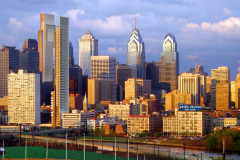
Pennsylvania is the 33rd largest, the 6th most populous, and the 9th most densely populated of the 50 United States. The state's five most populous cities are Philadelphia (1,560,297), Pittsburgh (305,801), Allentown (118,577), Erie (100,671), and Reading (89,893). The state capital is Harrisburg. Pennsylvania has 51 miles (82 km) of coastline along Lake Erie and 57 miles (92 km) of shoreline along the Delaware Estuary.
The state is one of the 13 original founding states of the United States; it was originally founded in 1681 as a result of a royal land grant to William Penn, the son of the state's namesake. It was the second state to ratify the United States Constitution, on December 12, 1787. Independence Hall, where the United States Declaration of Independence and United States Constitution were drafted, is located in the state's largest city of Philadelphia. During the American Civil War, the Battle of Gettysburg, which turned the tide of the war, was fought in the south central region of the state.
Geography
Further information: Geography of Pennsylvania and List of counties in PennsylvaniaPennsylvania is 170 miles (274 km) north to south and 283 miles (455 km) east to west. Of a total 46,055 square miles (119,282 km2), 44,817 square miles (116,075 km2) are land, 490 square miles (1,269 km2) are inland waters, and 749 square miles (1,940 km2) are waters in Lake Erie. It is the 33rd largest state in the United States. Pennsylvania has 51 miles (82 km) of coastline along Lake Erie and 57 miles (92 km) of shoreline along the Delaware Estuary.
The boundaries of the state are the Mason–Dixon line (39° 43' N) to the south, the Twelve-Mile Circle on the Pennsylvania-Delaware border, the Delaware River to the east, 80° 31' W to the west and the 42° N to the north, with the exception of a short segment on the western end, where a triangle extends north to Lake Erie.
Pennsylvania borders six other states: New York to the north; New Jersey to the east; Delaware to the southeast; Maryland to the south; West Virginia to the southwest, and Ohio to the west. Pennsylvania also shares a water border with the Canadian province of Ontario to the northwest across Lake Erie. Of the original Thirteen Colonies, Pennsylvania is the only state that does not border the Atlantic Ocean.
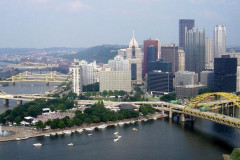
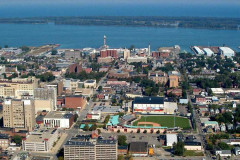
It has the cities of Philadelphia, Reading, Lebanon and Lancaster in the southeast, Pittsburgh in the southwest, the tri-cities of Allentown, Bethlehem, and Easton in the central east (known as the Lehigh Valley), the tri-cities of Scranton, Wilkes-Barre, and Hazleton in the northeast, and Erie in the northwest. Williamsport serves as the commonwealth's north-central region, with York and the state capital Harrisburg on the Susquehanna River in the central region of the commonwealth.
The state has 5 regions, namely the Allegheny Plateau, Ridge and Valley, Atlantic Coastal Plain, Piedmont, and the Erie Plain.
History
Before the Commonwealth was settled by Europeans, the area was home to the Delaware (also known as Lenni Lenape), Susquehannock, Iroquois, Eriez, Shawnee, and other American Indian Nations.
17th century
Both the Dutch and the English claimed both sides of the Delaware River as part of their colonial lands in America. The Dutch were the first to take possession.
By June 3, 1631, the Dutch had begun settling the Delmarva Peninsula by establishing the Zwaanendael Colony on the site of present-day Lewes, Delaware. In 1638, Sweden established the New Sweden Colony, in the region of Fort Christina, on the site of present-day Wilmington, Delaware. New Sweden claimed and, for the most part, controlled the lower Delaware River region (parts of present-day Delaware, New Jersey, and Pennsylvania) but settled few colonists there.
On March 12, 1664, King Charles II of England gave James, Duke of York a grant that incorporated all lands included in the original Virginia Company of Plymouth Grant plus other lands. This grant was in conflict with the Dutch claim for New Netherland, which included parts of today's Pennsylvania.
On June 24, 1664, The Duke of York sold the portion of his large grant that included present-day New Jersey to John Berkeley and George Carteret for a proprietary colony. The land was not yet in British possession, but the sale boxed in the portion of New Netherland on the West side of the Delaware River. The British conquest of New Netherland began on August 29, 1664, when New Amsterdam was coerced to surrender while facing cannons on British ships in New York Harbor. This conquest continued, and was completed in October 1664, when the British captured Fort Casimir in what today is New Castle, Delaware.
The Peace of Breda between England, France and the Netherlands confirmed the English conquest on July 21, 1667, although there were temporary reversions.
On September 12, 1672, as part of the Third Anglo-Dutch War, the Dutch re-conquered New York Colony/New Amsterdam, the Dutch established three County Courts which went on to become original Counties in present-day Delaware and Pennsylvania. The one that later transferred to Pennsylvania was Upland. This was partially reversed on February 9, 1674, when the Treaty of Westminster ended the Third Anglo-Dutch War, and reverted all political situations to the status quo ante bellum. The British retained the Dutch Counties with their Dutch names. By June 11, 1674, New York reasserted control over the outlying colonies, including Upland, but the names started to be changed to British names by November 11, 1674. Upland was partitioned on November 12, 1674, producing the general outline of the current border between Pennsylvania and Delaware.
On February 28, 1681, Charles II granted a land charter to William Penn to repay a debt of £16,000 (around £2,100,000 in 2008, adjusting for retail inflation) owed to William's father, Admiral William Penn. This was one of the largest land grants to an individual in history. The King named it Pennsylvania in honor of William Penn. Penn, who originally called it New Wales, then Sylvania, was embarrassed at the change, fearing that people would think he had named it after himself, but King Charles would not rename the grant. Penn established a government with two innovations that were much copied in the New World: the county commission and freedom of religious conviction.
What had been Upland on what became the Pennsylvania side of the Pennsylvania-Delaware Border was renamed as Chester County when Pennsylvania instituted their colonial governments on March 4, 1681. The Quaker leader William Penn had signed a peace treaty with Tammany, leader of the Delaware tribe, beginning a long period of friendly relations between the Quakers and the Indians. Additional treaties between Quakers and other tribes followed. The treaty of William Penn was never violated.
18th century
Between 1730 and when it was shut down by Parliament with the Currency Act of 1764, the Pennsylvania Colony made its own paper money to account for the shortage of actual gold and silver. The paper money was called Colonial Scrip. The Colony issued "bills of credit", which were as good as gold or silver coins because of their legal tender status. Since they were issued by the government and not a banking institution, it was an interest-free proposition, largely defraying the expense of the government and therefore taxation of the people. It also promoted general employment and prosperity, since the Government used discretion and did not issue too much to inflate the currency. Benjamin Franklin had a hand in creating this currency, of which he said its utility was never to be disputed, and it also met with the "cautious approval" of Adam Smith.
James Smith wrote that in 1763, "the Indians again commenced hostilities, and were busily engaged in killing and scalping the frontier inhabitants in various parts of Pennsylvania." Further, "This state was then a Quaker government, and at the first of this war the frontiers received no assistance from the state." The ensuing hostilities became known as Pontiac's War.
After the Stamp Act Congress of 1765, Delegate John Dickinson of Philadelphia wrote the Declaration of Rights and Grievances. The Congress was the first meeting of the Thirteen Colonies, called at the request of the Massachusetts Assembly, but only nine colonies sent delegates. Dickinson then wrote Letters from a Farmer in Pennsylvania, To the Inhabitants of the British Colonies, which were published in the Pennsylvania Chronicle between December 2, 1767, and February 15, 1768.
When the Founding Fathers of the United States convened in Philadelphia in 1774, 12 colonies sent representatives to the First Continental Congress. The Second Continental Congress, which also met in Philadelphia (in May 1775), drew up and signed the Declaration of Independence in Philadelphia, but when that city was captured by the British, the Continental Congress escaped westward, meeting at the Lancaster courthouse on Saturday, September 27, 1777, and then to York. There they and its primary author, John Dickinson, drew up the Articles of Confederation that formed 13 independent colonies into a new nation. Later, the Constitution was written, and Philadelphia was once again chosen to be cradle to the new American Nation. The Constitution was drafted and signed at the Pennsylvania State House, now known as Independence Hall, and the same building where the Declaration of Independence was signed.
Pennsylvania became the second state to ratify the U.S. Constitution on December 12, 1787, five days after Delaware became the first.
Dickinson College of Carlisle was the first college founded in the United States. Established in 1773, the college was ratified five days after the Treaty of Paris on September 9, 1783. The school was founded by Benjamin Rush and named after John Dickinson.
For half a century, the Commonwealth's General Assembly (legislature) met at various places in the general Philadelphia area before starting to meet regularly in Independence Hall in Philadelphia for 63 years. But it needed a more central location, as for example the Paxton Boys massacres of 1763 had made the legislature aware. So, in 1799 the General Assembly moved to the Lancaster Courthouse, and finally in 1812 to Harrisburg.
19th century
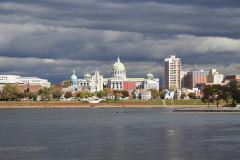
The General Assembly met in the old Dauphin County Court House until December 1821, when the Federal-style "Hills Capitol" (named for its builder, Stephen Hills, a Lancaster architect) was constructed on a hilltop land grant of four acres set aside for a seat of state government by the prescient, entrepreneurial son and namesake of John Harris, Sr., a Yorkshire native who had founded a trading post in 1705 and ferry (1733) on the east shore of the Susquehanna River. The Hills Capitol burned down on February 2, 1897, during a heavy snowstorm, presumably because of a faulty flue. The General Assembly met at Grace Methodist Church on State Street (still standing) until a new capitol could be built. Following an architectural selection contest that many alleged had been "rigged", Chicago architect Henry Ives Cobb was charged with designing and building a replacement building; however, the legislature had little money to allocate to the project, and a roughly finished, somewhat industrial building (the Cobb Capitol) was completed. The General Assembly refused to occupy the building. Political and popular indignation in 1901 prompted a second contest that was restricted to Pennsylvania architects, and Joseph Miller Huston of Philadelphia was chosen to design the present Pennsylvania State Capitol that incorporated Cobb's building into magnificent public work finished and dedicated in 1907.
The new state Capitol drew rave reviews. Its dome was inspired by the domes of St. Peter's Basilica in Rome and the United States Capitol. President Theodore Roosevelt called it "the most beautiful state Capital in the nation" and said, "It's the handsomest building I ever saw" at the dedication. In 1989, The New York Times praised it as "grand, even awesome at moments, but it is also a working building, accessible to citizens ... a building that connects with the reality of daily life".
James Buchanan, of Franklin County, the only bachelor President of the United States, was the only one to be born in Pennsylvania. The Battle of Gettysburg—the major turning point of the Civil War—took place near Gettysburg. An estimated 350,000 Pennsylvanians served in the Union Army forces including 8,600 African American military volunteers.
Pennsylvania was also the home of the first commercially drilled oil well. In 1859, near Titusville, Pennsylvania, Edwin Drake successfully drilled the well, which led to the first major oil boom in United States history.
20th century
At the beginning of the 20th century Pennsylvania's economy was centered around steel production, logging, coal mining, textile production and other forms of industrial manufacturing. A surge in immigration to the U.S. during the late 19th and early 20th centuries provided a steady flow of cheap labor for these industries which often employed children and persons who could not speak English.
In 1923 President Calvin Coolidge established the Allegheny National Forest under the authority of the Weeks Act of 1911 in the northwest part of the state in Elk, Forest, McKean, and Warren Counties for the purposes of timber production and watershed protection in the Allegheny River basin. The Allegheny is the state's only national forest.
21st century
Health
Pennsylvania has a mixed health record, and is ranked as the 29th overall healthiest state according to the 2013 United Health Foundation's Health Rankings.
Recreation
Pennsylvania is home to the nation's first zoo, the Philadelphia Zoo. Other long-accredited AZA zoos include the Erie Zoo and the Pittsburgh Zoo & PPG Aquarium. The Lehigh Valley Zoo and ZOOAMERICA are other notable zoos. The Commonwealth boasts some of the finest museums in the country, including the Carnegie Museums in Pittsburgh, the Philadelphia Museum of Art, and several others. One unique museum is the Houdini Museum in Scranton, the only building in the world devoted to the legendary magician. Pennsylvania is also home to the National Aviary, located in Pittsburgh.
All 121 state parks in Pennsylvania feature free admission.
Pennsylvania offers a number of notable amusement parks, including Camel Beach, Conneaut Lake Park, Dorney Park & Wildwater Kingdom, Dutch Wonderland, DelGrosso Amusement Park, Hersheypark, Idlewild Park, Kennywood, Knoebels, Lakemont Park, Sandcastle Waterpark, Sesame Place, Great Wolf Lodge and Waldameer Park. Pennsylvania also is home to the largest indoor waterpark resort on the East Coast, Splash Lagoon in Erie.
There are also notable music festivals that take place in Pennsylvania. These include Musikfest and NEARfest in Bethlehem, the Philadelphia Folk Festival, Creation Festival, the Great Allentown Fair, and Purple Door.
There are nearly one million licensed hunters in Pennsylvania. Whitetail deer, black bear, cottontail rabbits, squirrel, turkey, and grouse are common game species. Pennsylvania is considered one of the finest wild turkey hunting states in the Union, alongside Texas and Alabama. Sport hunting in Pennsylvania provides a massive boost for the Commonwealth's economy. A report from The Center for Rural Pennsylvania (a Legislative Agency of the Pennsylvania General Assembly) reported that hunting, fishing, and furtaking generated a total of $9.6 billion statewide.
The Boone and Crockett Club shows that five of the ten largest (skull size) black bear entries came from the state. The state also has a tied record for the largest hunter shot black bear in the Boone & Crockett books at 733 lb (332 kg) and a skull of 23 3/16 tied with a bear shot in California in 1993. The largest bear ever found dead was in Utah in 1975, and the second largest was shot by a poacher in the state in 1987. Pennsylvania holds the second highest number of Boone & Crockett-recorded record black bears at 183, second only to Wisconsin's 299.
Transportation
Exterior Interior The Allegheny Mountain Tunnel is the longest of the five tunnels on the Pennsylvania Turnpike.The Pennsylvania Department of Transportation, abbreviated as PennDOT, owns 39,861 miles (64,150 km) of the 121,770 miles (195,970 km) of roadway in the state, making it the fifth largest state highway system in the United States. The Pennsylvania Turnpike system is 535 miles (861 km) long, with the mainline portion stretching from Ohio to Philadelphia and New Jersey. It is overseen by the Pennsylvania Turnpike Commission. Another major east–west route is Interstate 80, which runs primarily in the northern tier of the state from Ohio to New Jersey at the Delaware Water Gap. Interstate 90 travels the relatively short distance between Ohio and New York through Erie County, in the extreme northwestern part of the state.
Primary north–south highways are Interstate 79 from its terminus in Erie through Pittsburgh to West Virginia, Interstate 81 from New York through Scranton, Lackawanna County and Harrisburg to Maryland and Interstate 476, which begins 7 miles (11 km) north of the Delaware border, in Chester, Delaware County and travels 132 miles (212 km) to Clarks Summit, Lackawanna County, where it joins I-81. All but 20 miles (32 km) of I-476 is the Northeast Extension of the Pennsylvania Turnpike, while the highway south of the main line of the Pennsylvania Turnpike is officially called the "Veterans Memorial Highway", but is commonly referred to by locals as the "Blue Route".
The Southeastern Pennsylvania Transportation Authority (SEPTA) is the sixth largest transit agency in the United States and operates the commuter, heavy and light rail transit, and transit bus service in the Philadelphia metropolitan area. The Port Authority of Allegheny County is the 25th largest transit agency and provides transit bus and light rail service in and around Pittsburgh.
Intercity passenger rail transit is provided by Amtrak, with the majority of traffic occurring on the Keystone Service in the high-speed Keystone Corridor between Harrisburg and Philadelphia's 30th Street Station before heading north to New York City; the Pennsylvanian follows the same route from New York City to Harrisburg, but extends out to Pittsburgh. The Capitol Limited also passes through Pittsburgh, as well as Connellsville, on its way from Chicago to Washington, D.C. Traveling between Chicago and New York City, the Lake Shore Limited passes through Erie once in each direction. There are 67 short-line, freight railroads operating in Pennsylvania, the highest number in any U.S. state.
Pennsylvania has seven major airports: Philadelphia International, Pittsburgh International, Lehigh Valley International, Harrisburg International, Erie International, University Park Airport and Wilkes-Barre/Scranton International. A total of 134 public-use airports are located in the state. The port of Pittsburgh is the second largest inland port in the United States and the 18th largest port overall; the Port of Philadelphia is the 24th largest port in the United States. Pennsylvania's only port on the Great Lakes is located in Erie.
The Allegheny River Lock and Dam Two is the most-used lock operated by the United States Army Corps of Engineers of its 255 nationwide. The dam impounds the Allegheny River near Downtown Pittsburgh.
Food
In his book Yo Mama Cooks Like a Yankee, author Sharon Hernes Silverman calls Pennsylvania the snack food capital of the world. It leads all other states in the manufacture of pretzels and potato chips. The Sturgis Pretzel House introduced the pretzel to America, and companies like Anderson Bakery Company, Intercourse Pretzel Factory, and Snyder's of Hanover are leading manufacturers in the Commonwealth. Two of the three companies that define the U.S. potato chip industry are based in Pennsylvania: Utz Quality Foods, which started making chips in Hanover, Pennsylvania in 1921, and Wise Foods which started making chips in Berwick in 1921 (the third, Lay's Potato Chips, is a Texas company). Other companies such as Herr's Snacks, Martin's Potato Chips, Snyder's of Berlin (not associated with Snyder's of Hanover) and Troyer Farms Potato Products are popular chip manufacturers.
The U.S. chocolate industry is centered in Hershey, Pennsylvania, with Mars, Godiva, and Wilbur Chocolate Company nearby, and smaller manufacturers such as Asher's in Souderton, and Gertrude Hawk Chocolates of Dunmore. Other notable companies include Just Born in Bethlehem, Pennsylvania, makers of Hot Tamales, Mike and Ikes, the Easter favorite marshmallow Peeps, and Boyer Brothers of Altoona, Pennsylvania, which is well known for its Mallo Cups. Auntie Anne's Pretzels began as a market-stand in Downingtown, Pennsylvania, and now has corporate headquarters in Lancaster City. Traditional Pennsylvania Dutch foods include chicken potpie, ham potpie, schnitz un knepp (dried apples, ham, and dumplings), fasnachts (raised doughnuts), scrapple, pretzels, bologna, chow-chow, and Shoofly pie. Martin's Famous Pastry Shoppe, Inc., headquartered in Chambersburg, Pennsylvania, specializes in potato bread, another traditional Pennsylvania Dutch food. D.G. Yuengling & Son, America's oldest brewery, has been brewing beer in Pottsville since 1829.
Among the regional foods associated with Philadelphia are cheesesteaks, hoagie, soft pretzels, Italian water ice, Irish potato candy, scrapple, Tastykake, Wawa, and strombolis. In Pittsburgh, tomato ketchup was improved by Henry John Heinz from 1876 to the early 20th century. Famous to a lesser extent than Heinz ketchup are the Pittsburgh's Primanti Brothers Restaurant sandwiches, pierogies, and city chicken. Outside of Scranton, in Old Forge there are dozens of Italian restaurants specializing in pizza made unique by thick, light crust and American cheese. Erie also has its share of unique foods, including Greek sauce and sponge candy. Sauerkraut along with pork and mashed potatoes is a common meal on New Year's Day in Pennsylvania.