South Carolina
Description
South Carolina i/ˌsaʊθ kærəˈlaɪnə/ is a state in the southeastern region of the United States. The state is bordered to the north by North Carolina, to the south and west by Georgia across the Savannah River, and to the east by the Atlantic Ocean.
South Carolina was the first state to ratify the Articles of Confederation and the eighth state to ratify the U.S. Constitution on May 23, 1788. South Carolina became the first state to vote to secede from the Union on December 20, 1860. After the American Civil War, it was readmitted into the United States on June 25, 1868.
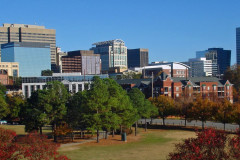
South Carolina is the 40th most extensive and the 23rd most populous U.S. state. Its GDP as of 2013 was $183.6 billion, with an annual growth rate of 3.13%. South Carolina comprises 46 counties. The capital and largest city is Columbia with a 2013 population of 133,358; the Greenville-Anderson-Mauldin metropolitan area had a 2013 population of 850,965.
Etymology
The name Carolina dates back to October 30, 1629, when King Charles I granted a patent to Sir Robert Heath for the lands south of 36 degrees and north of 31 degrees, "under the name, in honor of that king, of Carolina." Carolus is Latin for 'Charles'.
Geography
South Carolina is composed of five geographic areas, or physiographic provinces, whose boundaries roughly parallel the Atlantic coastline. South Carolina consist of the subtropical coniferous forest biome that is found through the entire state. The Atlantic Coastal Plain, which can be divided into the Outer and Inner Coastal Plains. From north to south the coast is divided into three separate areas, the Grand Strand, the Santee River Delta, and the Sea Islands. Further inland are the Sandhills, ancient dunes from what used to be South Carolina's coast millions of years ago. The Fall Line, which marks the limit of navigable rivers, runs along the boundary of the Sandhills and the Piedmont, which has rolling hills and clay soils. In the northwest corner of the state are the Blue Ridge Mountains, the smallest geographical region in the state.
The state's coastline contains many salt marshes and estuaries, as well as natural ports such as Georgetown and Charleston. An unusual feature of the coastal plain is a large number of Carolina bays, the origins of which are uncertain. The bays tend to be oval, lining up in a northwest to southeast orientation. The terrain is flat and the soil is composed entirely of recent sediments such as sand, silt, and clay. Areas with better drainage make excellent farmland, though some land is swampy. The natural areas of the coastal plain are part of the Middle Atlantic coastal forests ecoregion.
Just west of the coastal plain is the Sandhills region. The Sandhills are remnants of coastal dunes from a time when the land was sunken or the oceans were higher.
The Upstate region contains the roots of an ancient, eroded mountain chain. It is generally hilly, with thin, stony clay soils, and contains few areas suitable for farming. Much of the Piedmont was once farmed. Due to the changing economics of farming, much of the land is now reforested in Loblolly pine for the lumber industry. These forests are part of the Southeastern mixed forests ecoregion. At the southeastern edge of the Piedmont is the fall line, where rivers drop to the coastal plain. The fall line was an important early source of water power. Mills built to harness this resource encouraged the growth of several cities, including the capital, Columbia. The larger rivers are navigable up to the fall line, providing a trade route for mill towns.
The northwestern part of the Piedmont is also known as the Foothills. The Cherokee Parkway is a scenic driving route through this area. This is where Table Rock State Park is located.
Highest in elevation is the Blue Ridge Region, containing an escarpment of the Blue Ridge Mountains, which continue into North Carolina and Georgia, as part of the southern Appalachian Mountains. Sassafras Mountain, South Carolina's highest point at 3,560 feet (1,090 m), is located in this area. Also located in this area is Caesars Head State Park. The environment here is that of the Appalachian-Blue Ridge forests ecoregion. The Chattooga River, located on the border between South Carolina and Georgia, is a favorite whitewater rafting destination.
Lakes
South Carolina has several major lakes covering over 683 square miles (1,770 km2). The following are the lakes listed by size.
- Lake Marion 110,000 acres (450 km2)
- Lake Strom Thurmond (also known as Clarks Hill Lake) 71,100 acres (290 km2)
- Lake Moultrie 60,000 acres (240 km2)
- Lake Hartwell 56,000 acres (230 km2)
- Lake Murray 50,000 acres (200 km2)
- Russell Lake 26,650 acres (110 km2)
- Lake Keowee 18,372 acres (70 km2)
- Lake Wylie 13,400 acres (50 km2)
- Lake Wateree 13,250 acres (50 km2)
- Lake Greenwood 11,400 acres (50 km2)
- Lake Jocassee 7,500 acres (30 km2)
- Lake Bowen
Earthquakes
Earthquakes do occur in South Carolina. The greatest frequency is along the central coastline of the state, in the Charleston area. South Carolina averages 10–15 earthquakes a year below magnitude 3 (FEMA). The Charleston Earthquake of 1886 was the largest quake ever to hit the Southeastern United States.
This 7.2 magnitude earthquake killed 60 people and destroyed much of the city. Faults in this region are difficult to study at the surface due to thick sedimentation on top of them. Many of the ancient faults are within plates rather than along plate boundaries.
History
Discovery and exploration
About 30 Native American Tribes lived in what is now South Carolina at the time the first Europeans arrived in the region. The most important were the Catawba (Siouan language), Cherokee (Iroquoian languages), and Yamasee (Muskhogean language). It is believed that the first humans settled in the current South Carolina about 15,000 years ago. However, the Topper Site has been tentatively dated to about 30,000 years ago.
The first European to land was Francisco Gordillo in 1521, from Spain. Five years later, in 1526, another Spaniard, Lucas Vázquez de Ayllón, founded the first European settlement in the territory that now constitutes the United States. This settlement was named San Miguel de Gualdape and was founded with 600 settlers, including African slaves, but was abandoned three months later. The region would later be claimed by both the Spanish and the French. The French made several attempts at colonization which failed because of the hostility of Indian tribes and a lack of provisions.
England claimed the current South Carolina at the beginning of the seventeenth century. In 1629, King Charles I gave the southern colonies to Robert Heath. This colony included the regions that now constitute North Carolina, South Carolina, Georgia and Tennessee. Heath named this colony Carolana, a Latin word which means 'Land of Charles'.
British colony
The colony of Carolina was settled by wealthy English aristocrats, mostly migrating from Barbados, where they had already set up sugar plantations. King Charles gave eight aristocrats a royal charter to settle Carolina (Carolina is Latin for "Charlesian") because earlier they had helped him regain his throne. Parts of Carolina (mostly the coastal areas) had been colonized earlier by Spain (see Fort Caroline), but battles between the Spanish and the Native Americans resulted in the Spanish people retreating to Florida, Cuba, Mexico, and Central and South America.
Carolina was settled to make profit from trade and also by selling land. John Locke, an English philosopher, wrote a constitution for the colony that covered topics such as land divisions and social rankings. In the early years, not many people bought land there, so the proprietors lowered the price on some portions.
Carolina did not develop as planned. It split into northern and southern Carolina, creating two different colonies. It separated because of political reasons as the settlers wanted political power. In 1719 settlers in southern Carolina seized control from its proprietors. Then, in 1729, Carolina became two royal colonies- North Carolina and South Carolina. Farmers from inland Virginia settled northern Carolina. They grew tobacco, and sold timber and tar, both categories of naval stores needed by England. The northern Carolina coast lacked a good harbor, so many of the farmers used Virginia's ports to conduct their trade.
Southern Carolina prospered from the fertility of the Low Country and the harbors, such as that at Charles Town (later Charleston). It allowed religious toleration, encouraging settlement by merchants from the successful French Huguenot and Sephardic Jewish communities of London. Settlements spread, and trade in deerskin, lumber, and beef thrived. Rice cultivation was developed on a large scale with the help of skills and techniques of slaves imported from rice-growing regions of Africa. They created the large earthworks of dams and canals required to irrigate the rice fields. In addition, indigo became a commodity crop, also developed with the skills of African slaves.
The cultivation and processing of Indigo plant, a plant source of blue dye, was developed here by a young English woman, Eliza Lucas, a planter's daughter who had come with her father, also a military officer, from the Caribbean. She took over managing the plantation when he was assigned elsewhere. Indigo became an important commodity crop for the dyeing of textiles. Slave labor was integral to the economic success of rice and indigo as commodity crops. In South Carolina, slaves made up a majority of the population after 1708, and the demand for labor was so high that many were imported from Africa.
After the Stono Rebellion of 1739, the colony prohibited importing African slaves through Charleston for ten years, having observed they were more likely to cause rebellions than slaves from the Caribbean, who were already "seasoned" or those born in the colony. Slaves and their descendants comprised a majority of the population of the state through the American Civil War and to the turn of the 20th century.
The American Revolution
On March 26, 1776, the colony adopted the Constitution of South Carolina becoming the first republic in America.[not in citation given] John Rutledge was elected as the state's first president. He was succeeded by Rawlins Lowndes who served March 6, 1778 – January 9, 1779. On February 5, 1778, South Carolina became the first state to ratify the Articles of Confederation, the initial governing document of the United States.
In 1780, South Carolinian loyalists to the British crown helped British troops recapture South Carolina from the previously successful rebels. On January 17, 1781, the Battle of Cowpens won by the American forces, marked the beginning of the decline in British fortunes. In 1782 they decided to evacuate their troops by the end of the year. Thousands of Loyalists and slaves left with them.
The American Revolution caused a shock to slavery in the South. Many thousands of slaves fled to British authorities to obtain freedom; and many of those left with the British in the last days of the war. Others secured their freedom by escaping to perceived friendlier locations during the turmoil. Estimates are that 25,000 slaves (30% of those in South Carolina) fled, migrated or died during the disruption of the war.
The current United States Constitution was proposed for adoption by the states on September 17, 1787, and South Carolina was the 8th state to ratify it, on May 23, 1788.
Federal period
South Carolina politics between 1783 and 1795 were marred by rivalry between a Federalist elite supporting Alexander Hamilton and the central government in Philadelphia and a large proportion of common people. The latter were often members of 'Republican Societies', and they supported the Republican-Democrats, headed by Thomas Jefferson and James Madison. This party wanted more democracy in the US, especially in South Carolina. Sephardic Jews had prospered in contributing to the state and by 1800, South Carolina had the largest population of Jews in the United States.
Most people supported the French Revolution (1789–1795), as the French had been allies and they were proud of their own revolution. In addition, due to substantial French Huguenot immigration during the colonial years, Charleston was one of the most French-influenced cities in the USA. Leading South Carolina figures, such as governors Charles Pinckney and William Moultrie, backed with money and actions the French plans to further their political, strategic, and commercial goals in North America. This pro-French stance and attitude of South Carolina ended soon because of the XYZ Affair, a diplomatic affair that resulted in quasi-war between France and the US.
Antebellum
Antebellum South Carolina did more to advance nullification and secession than any other Southern state. Its first attempt at nullification was in 1822, following discovery of a conspiracy for a slave rebellion led by Denmark Vesey, a freed slave. As part of its response, the state passed a Negro Seamen Act, requiring foreign and northern black sailors to be prohibited from interacting with people in South Carolina ports. As it violated international treaties, this law was declared unconstitutional by Supreme Court Justice William Johnson. His ruling was not enforced.
In 1832, a South Carolina state convention passed the Ordinance of Nullification, declaring the federal tariff laws of 1828 and 1832 unconstitutional, null and not to be enforced in the state of South Carolina after February 1, 1833.
This led to the Nullification Crisis, in which U.S. President Andrew Jackson (as of 2015, the only president to have been born in South Carolina) was authorized through the Force Bill to use whatever military force necessary to enforce federal law in the state. This was the first U.S. legislation denying individual states the right to secede. As a result of Jackson's threat of force, the South Carolina state convention was re-convened and repealed the Ordinance of Nullification in March.
Anti-abolitionist feelings ran strong in South Carolina, where the economy depended on slave labor and which had a majority-slave population. In 1856, Democrat South Carolina congressman Preston Brooks entered the United States Senate chamber and, with a metal-tipped cane, beat Massachusetts Republican Senator Charles Sumner. He drew blood and injured Sumner badly enough that the latter was unable to serve for several months. Brooks was retaliating for a speech Sumner had given in which he attacked slavery and insulted South Carolinians. Brooks resigned his seat but received a hero's welcome on returning home and was promptly re-elected.
American Civil War
On December 20, 1860, when it became clear that Abraham Lincoln, an opponent of the expansion of slavery into new territories, would become the next U.S. president, South Carolina became the first U.S. state to declare its secession from the Union. On April 12, 1861, Confederate batteries began shelling Fort Sumter in Charleston Harbor, and the American Civil War began. The U.S. Navy effectively blockaded Charleston and seized the Sea Islands. Planters had taken their families (and sometimes slaves) to points inland for refuge.
The Union Army set up an experiment in freedom for the ex-slaves, in which they started education and farmed land for themselves. South Carolinian troops participated in major Confederate campaigns, but no major battles were fought inland. General William Tecumseh Sherman marched through the state in early 1865, destroying numerous plantations, and captured the state capital of Columbia on February 17. Fires began that night and by next morning, most of the central city was destroyed. South Carolina suffered 18,666 military deaths during the American Civil War, which was nearly one-third of the white male population of fighting age.
Reconstruction
After the war, South Carolina was restored to the United States during Reconstruction. Under presidential Reconstruction (1865–66), freedmen (former slaves) were given limited rights. Under Radical reconstruction (1867–1877), a Republican coalition of freedmen, carpetbaggers and scalawags was in control, supported by Union Army forces. They established public education, welfare institutions, and home rule for counties, expanding democracy.
Until the 1868 presidential election, South Carolina's legislature, not the voters, chose the state's electors for the presidential election. South Carolina was the last state to choose its electors in this manner. On October 19, 1871 President Ulysses S. Grant suspended habeas corpus in nine South Carolina counties under the authority of the Ku Klux Klan Act. Led by Grant's Attorney General Amos T. Akerman, hundreds of Klansmen were arrested while 2000 Klansmen fled the state. This was done in order to suppress Klan violence against African-American and white voters in the South. In the mid to late 1870s, white Democrats used paramilitary groups such as the Red Shirts to intimidate and terrorize black voters. They regained political control of the state under conservative white "Redeemers" and pro-business Bourbon Democrats. In 1877, the federal government withdrew its troops as part of the Compromise of 1877 that ended Reconstruction.
Populist and agrarian movements
The state became a hotbed of racial and economic tensions during the Populist and Agrarian movements of the 1890s. A Republican-Populist biracial coalition took power away from White Democrats temporarily. To prevent that from happening again, Democrats gained passage of a new constitution in 1895 that effectively disfranchised almost all blacks and many poor whites by new requirements for poll taxes, residency, and literacy tests that dramatically reduced the voter rolls. By 1896, only 5,500 black voters remained on the voter registration rolls, although they constituted a majority of the state's population. The 1900 census demonstrated the extent of disenfranchisement: the 782,509 African American citizens comprised more than 58% of the state's population, but they were essentially without any political representation in the Jim Crow society.
The 1895 constitution overturned local representative government, reducing the role of the counties to agents of state government, effectively ruled by the General Assembly, through the legislative delegations for each county. As each county had one state senator, that person had considerable power. The counties lacked representative government until home rule was passed in 1975.
Governor "Pitchfork Ben Tillman", a Populist, led the effort to disenfranchise the blacks and poor whites, although he controlled Democratic state politics from the 1890s to 1910 with a base among poor white farmers. During the constitutional convention in 1895, he supported another man's proposal that the state adopt a one-drop rule, as well as prohibit marriage between whites and anyone with any known African ancestry.
Some members of the convention realized that prominent white families with some African ancestry could be affected by such legislation. In terms similar to a debate in Virginia in 1853 on a similar proposal (which was dropped), George Dionysius Tillman said the following in opposition:
If the law is made as it now stands respectable families in Aiken, Barnwell, Colleton, and Orangeburg will be denied the right to intermarry among people with whom they are now associated and identified. At least one hundred families would be affected to my knowledge. They have sent good soldiers to the Confederate Army, and are now landowners and taxpayers. Those men served creditably, and it would be unjust and disgraceful to embarrass them in this way. It is a scientific fact that there is not one full-blooded Caucasian on the floor of this convention. Every member has in him a certain mixture of… colored blood. The pure-blooded white has needed and received a certain infusion of darker blood to give him readiness and purpose. It would be a cruel injustice and the source of endless litigation, of scandal, horror, feud, and bloodshed to undertake to annul or forbid marriage for a remote, perhaps obsolete trace of Negro blood. The doors would be open to scandal, malice and greed; to statements on the witness stand that the father or grandfather or grandmother had said that A or B had Negro blood in their veins. Any man who is half a man would be ready to blow up half the world with dynamite to prevent or avenge attacks upon the honor of his mother in the legitimacy or purity of the blood of his father.
The state postponed such a one-drop law for years. Virginian legislators adopted a one-drop law in 1924, forgetting that their state had many people of mixed ancestry among those who identified as white.
20th century
Early in the 20th century, South Carolina developed a thriving textile industry. The state also converted its agricultural base from cotton to more profitable crops; attracted large military bases through its powerful Democratic congressional delegation, part of the one-party South following disfranchisement of blacks at the turn of the century; and created tourism industries. During the early part of the 20th century, thousands of African Americans left South Carolina and other southern states for jobs and better opportunities in northern, Midwestern and western cities. In total from 1910 to 1970, 6.5 million blacks left the South in the Great Migration. By 1930 South Carolina had a white majority for the first time since 1708.
The struggle of the Civil Rights Movement took place in South Carolina as well as other places in the South.
South Carolina was one of several states that initially rejected the Nineteenth Amendment (1920) giving women the right to vote. The South Carolina legislature later ratified the amendment on July 1, 1969.
21st century
As of 2015, South Carolina had one of the lowest percentages among all states of women in state legislature, at 13.5% (only Louisiana, Oklahoma, and Wyoming had a lower percentage; the national average is 24.3%; with the highest percentage being in Colorado at 41%). In 2011, South Carolina ranked first in the country in the rate of women killed by men.
As the 21st century progresses, South Carolina attracts new business by having a 5% corporate income tax rate, no state property tax, no local income tax, no inventory tax, no sales tax on manufacturing equipment, industrial power or materials for finished products; no wholesale tax, no unitary tax on worldwide profits.
Starting January 1, 2013, South Carolina was one of the first states that no longer pays for 'early elective' deliveries of babies, under either Medicaid and private insurance. The term early elective is defined as a labor induction or Cesarean section between 37–39 weeks that is not medically based. This change is intended to result in healthier babies and fewer unnecessary costs for South Carolina.
On November 20, 2014, South Carolina became the 35th state to legalize same-sex marriages.
The arts
South Carolina has many venues for visual and performing arts. The Gibbes Museum of Art in Charleston, the Greenville County Museum of Art, the Columbia Museum of Art, Spartanburg Art Museum, and the South Carolina State Museum in Columbia among others provide access to visual arts to the state. There are also numerous historic sites and museums scattered throughout the state paying homage to many events and periods in the state's history from Native American inhabitation to the present day.
South Carolina also has performing art venues including the Peace Center in Greenville, the Koger Center for the Arts in Columbia, and the Newberry Opera House, among others to bring local, national, and international talent to the stages of South Carolina. There are several large venues in the state that can house major events, such as Colonial Life Arena in Columbia, Bon Secours Wellness Arena in Greenville, and North Charleston Coliseum.
One of the nation's major performing arts festivals, Spoleto Festival USA, is held annually in Charleston. There are also countless local festivals throughout the state highlighting many cultural traditions, historical events, and folklore.
According to the South Carolina Arts Commission, creative industries generate $9.2 billion annually and support over 78,000 jobs in the state. A 2009 statewide poll by the University of South Carolina Institute for Public Service and Policy Research found that 67% of residents had participated in the arts in some form during the past year and on average citizens had participated in the arts 14 times in the previous year.
Transportation
Major highways
Major interstate highways passing through include: I-20 which runs from Florence in the east through Columbia to the southwestern border near Aiken; I-26 which runs from Charleston in the southeast through Columbia to Spartanburg and the northern border in Spartanburg County; I-77 which runs from York County in the north to Columbia; I-85 which runs from Cherokee County in the north through Spartanburg and Greenville to the southwestern border in Oconee County; I-385 which runs from Greenville and intersects with I-26 near Clinton; and I-95 which runs from the northeastern border in Dillon County to Florence and on to the southern border in Jasper County.
- I-20
- I-26
- Future I-73
- Future I-74
- I-77
- I-85
- I-95
- I‑126
- I-185
- I‑385
- I-520
- I‑526
- I‑585
- US 1
- US 15
- US 17
- US 21
- US 25
- US 29
- US 52
- US 76
- US 78
- US 176
- US 178
- US 221
- US 276
- US 278
- US 301
- US 321
- US 378
- US 401
- US 501
- US 521
- US 601
- US 701
Rail
PassengerAmtrak operates four passenger routes in South Carolina: the Crescent, the Palmetto, the Silver Meteor, and the Silver Star. The Crescent route serves the Upstate cities, the Silver Star serves the Midlands cities, and the Palmetto and Silver Meteor routes serve the low country cities.
Station stops Station Connections Camden Silver Star North Charleston Palmetto Silver Meteor Columbia Silver Star Clemson Crescent Denmark Silver Star Dillon Palmetto Florence Palmetto Silver Meteor Greenville Crescent Kingstree Palmetto Silver Meteor Spartanburg Crescent Yemassee Palmetto Silver Meteor FreightCSX Transportation and Norfolk Southern are the only Class I railroad companies in South Carolina, as other freight companies in the state are short lines.
Major and regional airports
There are seven significant airports in South Carolina, all of which act as regional airport hubs. The busiest by passenger volume is Charleston International Airport. Just across the border in North Carolina is Charlotte/Douglas International Airport, the 30th busiest airport in the world, in terms of passengers.
- Columbia Metropolitan Airport – Columbia
- Charleston International Airport – North Charleston
- Greenville-Spartanburg International Airport – Greenville/Spartanburg
- Florence Regional Airport – Florence
- Myrtle Beach International Airport – Myrtle Beach
- Hilton Head Airport – Hilton Head Island/Beaufort
- Rock Hill/York County Airport – Rock Hill
Federal lands in South Carolina
- Charles Pinckney National Historic Site at Mt. Pleasant
- Congaree National Park in Hopkins
- Cowpens National Battlefield near Chesnee
- Fort Moultrie National Monument at Sullivan's Island
- Fort Sumter National Monument in Charleston Harbor
- Kings Mountain National Military Park at Blacksburg
- Ninety Six National Historic Site in Ninety Six
- Overmountain Victory National Historic Trail
- Fort Jackson near Columbia
- Joint Base Charleston near Charleston
- Shaw Air Force Base near Sumter