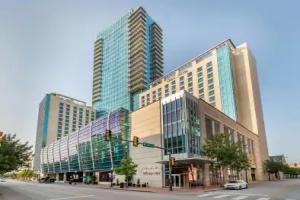
Fort Worth

Description

Fort Worth is the 16th-largest city in the United States and the fifth-largest city in the state of Texas. The city is located in North Central Texas and covers nearly 350 square miles (910 km2) in Tarrant, Denton, Parker, and Wise Counties; it is the seat of Tarrant County. According to the 2015 census estimates, Fort Worth has a population of 833,319. The city is the second-largest in the Dallas–Fort Worth–Arlington metropolitan area (the "DFW Metroplex").

The city was established in 1849 as an Army outpost on a bluff overlooking the Trinity River. Today, Fort Worth still embraces its Western heritage and traditional architecture and design. USS Fort Worth (LCS-3) is the first ship of the United States Navy named after the city.

Fort Worth is home to the Van Cliburn International Piano Competition and several world-class museums designed by internationally known contemporary architects. The Kimbell Art Museum, considered to have one of the best collections in Texas, is housed in what is widely regarded as one of Texas' foremost works of modern architecture, designed by Louis Kahn with an addition by Renzo Piano. Also of note is the Modern Art Museum of Fort Worth, designed by Tadao Ando. The Amon Carter Museum of American Art, designed by Philip Johnson, houses one of the most extensive collections of American art in the world in a building. The city is stimulated by several university communities: Texas Christian, Texas Wesleyan, University of North Texas Health Science Center, and Texas A&M University School of Law, and is the location of many multinational corporations, including Bell Helicopter, Lockheed Martin, American Airlines, BNSF Railway, Pier 1 Imports, and Radio Shack.

History

Treaty of Bird's Fort

The Treaty of Bird's Fort between the Republic of Texas and several Indian tribes was signed in 1843 at Bird's Fort in present-day Arlington, Texas. Article XI of the treaty provided that no one may "pass the line of trading houses" (at the border of the Indians' territory) without permission of the President of Texas, and may not reside or remain in the Indians' territory. These "trading houses" were later established at the junction of the Clear Fork and West Fork of the Trinity River in present-day Fort Worth. At this river junction, the U.S. War Department established Fort Worth in 1849 as the northernmost of a system of 10 forts for protecting the American Frontier following the end of the Mexican–American War. The City of Fort Worth continues to be known as "where the West begins."

The Mexican–American War

A line of seven army posts were established in 1848–49 after the Mexican War to protect the settlers of Texas along the western American Frontier and included Fort Worth, Fort Graham, Fort Gates, Fort Croghan, Fort Martin Scott, Fort Lincoln, and Fort Duncan. Originally 10 forts had been proposed by Major General William Jenkins Worth (1794–1849), who commanded the Department of Texas in 1849. In January 1849, Worth proposed a line of 10 forts to mark the western Texas frontier from Eagle Pass to the confluence of the West Fork and Clear Fork of the Trinity River. One month later, Worth died from cholera in South Texas.

General William S. Harney assumed command of the Department of Texas and ordered Major Ripley A. Arnold (Company F, Second United States Dragoons) to find a new fort site near the West Fork and Clear Fork. On June 6, 1849, Arnold, advised by Middleton Tate Johnson, established a camp on the bank of the Trinity River and named the post Camp Worth in honor of the late General Worth. In August 1849, Arnold moved the camp to the north-facing bluff, which overlooked the mouth of the Clear Fork of the Trinity River. The United States War Department officially named the post Fort Worth on November 14, 1849.

Native American attacks were still a threat in the area, as this was their traditional territory and they resented encroachment by European-American settlers, but people from the United States set up homesteads near the fort. E. S. Terrell (1812–1905) from Tennessee claimed to be the first resident of Fort Worth. The fort was flooded the first year and moved to the top of the bluff; the current courthouse was built on this site. The fort was abandoned September 17, 1853. No trace of it remains.

Town development

As a stop on the legendary Chisholm Trail, Fort Worth was stimulated by the business of the cattle drives and became a brawling, bustling town. Millions of head of cattle were driven north to market along this trail. Fort Worth became the center of the cattle drives, and later, the ranching industry. It was given the nickname of "Cowtown".

During Civil War, Fort Worth suffered from shortages of money, food, and supplies. the population dropped as low a 175, but began to recover during Reconstruction. By 1872, Jacob Samuels, William Jesse Boaz, and William Henry Davis had opened general stores. The next year, Khleber M. Van Zandt established Tidball, Van Zandt, and Company, which became Fort Worth National Bank in 1884.

Panther City and "Hell's Half-Acre"

In 1875, the Dallas Herald published an article by a former Fort Worth lawyer, Robert E. Cowart, who wrote that the decimation of Fort Worth's population, caused by the economic disaster and hard winter of 1873, had dealt a severe blow to the cattle industry. Added to the slowdown due to the railroad's stopping the laying of track 30 miles (48 km) outside of Fort Worth, Cowart said that Fort Worth was so slow that he saw a panther asleep in the street by the courthouse. Although an intended insult, the name Panther City was enthusiastically embraced when in 1876 Fort Worth recovered economically. Many businesses and organizations continue to use Panther in their name. A panther is set at the top of the police department badges.

The "Panther City" tradition is also preserved in the names and design of some of the city's geographical/architectural features, such as Panther Island (in the Trinity River), the Flat Iron Building, the Intermodal Transportation Center, and in two or three "Sleeping Panther" statues. In 1876, the Texas and Pacific Railway finally was completed to Fort Worth, stimulating a boom and transforming the Fort Worth Stockyards into a premier center for the cattle wholesale trade. Migrants from the devastated war-torn South continued to swell the population, and small, community factories and mills yielded to larger businesses. Newly dubbed the "Queen City of the Prairies", Fort Worth supplied a regional market via the growing transportation network.

Fort Worth became the westernmost railhead and a transit point for cattle shipment. With the city's main focus on cattle and the railroads, local businessman, Louville Niles, formed the Fort Worth Stockyards Company in 1893. Shortly thereafter, the two biggest cattle-slaughtering firms at the time, Armour and Swift, both established operations in the new stockyards.

With the boom times came a variety of entertainments and related problems. Fort Worth had a knack for separating cattlemen from their money. Cowboys took full advantage of their last brush with civilization before the long drive on the Chisholm Trail from Fort Worth up north to Kansas. They stocked up on provisions from local merchants, visited the colorful saloons for a bit of gambling and carousing, then galloped northward with their cattle only to whoop it up again on their way back. The town soon became home to "Hell's Half-Acre", the biggest collection of saloons, dance halls, and bawdy houses south of Dodge City (the northern terminus of the Chisholm Trail), giving Fort Worth the nickname of "The Paris of the Plains".Template:Page 2016

Certain sections of town were off-limits for proper citizens. Shootings, knifings, muggings, and brawls became a nightly occurrence. Cowboys were joined by a motley assortment of buffalo hunters, gunmen, adventurers, and crooks. Hell's Half Acre (the Acre) expanded as more people were drawn to the town. Occasionally, the Acre was referred to as "the bloody Third Ward" after it was designated one of the city's three political wards in 1876. By 1900, the Acre covered four of the city's main north-south thoroughfares. Local citizens became alarmed about the activities, electing Timothy Isaiah "Longhair Jim" Courtright in 1876 as city marshal with a mandate to tame it.

Courtright sometimes collected and jailed 30 people on a Saturday night, but allowed the gamblers to operate, as they attracted money to the city. After learning that train and stagecoach robbers, such as the Sam Bass gang, were using the area as a hideout, he intensified law enforcement, but certain businessmen advertised against too many restriction in the area as having bad effects on the legitimate businesses. Gradually, the cowboys began to avoid the area; as businesses suffered, the city moderated its opposition. Courtright lost his office in 1879.

Despite crusading mayors such as H. S. Broiles and newspaper editors such as B. B. Paddock, the Acre survived because it generated income for the city (all of it illegal) and excitement for visitors. Longtime Fort Worth residents claimed the place was never as wild as its reputation, but during the 1880s, Fort Worth was a regular stop on the "gambler's circuit" by such gambler/gunmen as Bat Masterson, Doc Holliday, and the Earp brothers (Wyatt, Morgan, and Virgil). James Earp, the eldest of his brothers, lived with his wife in Fort Worth during this period; their house was at the edge of Hell's Half Acre, at 9th and Calhoun. He often tended bar at the Cattlemen's Exchange saloon in the "uptown" part of the city.

Reforming citizens objected to the dance halls, where men and women mingled; by contrast, the saloons or gambling parlors had primarily male customers.

In the late 1880s, Mayor Broiles and County Attorney R. L. Carlock initiated a reform campaign. In a public shootout on February 8, 1887, Jim Courtright was killed on Main Street by Short, who claimed he was "King of Fort Worth Gamblers." As Courtright had been popular, when Short was jailed for his murder, rumors floated of lynching him. Short's good friend Bat Masterson came armed and spent the night in his cell to protect him.

The first prohibition campaign in Texas was mounted in Fort Worth in 1889, helping to shut down the Acre's worst excesses. Other business development began in the area, as well as residential.

Another change was the influx of black residents. Excluded by state segregation from the business end of town and the more costly residential areas, the city's black citizens, who numbered some 7,000 of a total population of 50,000 around 1900, settled into the southern portion of the city. Though some joined in the profitable vice trade (to run, for instance, the Black Elephant Saloon), many others found legitimate work and bought homes.

The popularity and profitability of the Acre declined and more derelicts and the homeless were seen on the streets. By 1900, most of the dance halls and gamblers were gone. Cheap variety shows and prostitution became the chief forms of entertainment. Some politicians sought reforms under the Progressive Era.

In 1911, the Reverend J. Frank Norris launched an offensive against racetrack gambling in the Baptist Standard and used the pulpit of the First Baptist Church of Fort Worth to attack vice and prostitution. Norris used the Acre to scourge the leadership of Fort Worth. When he began to link certain Fort Worth businessmen with property in the Acre and announce their names from his pulpit, the battle heated up. On February 4, 1912, Norris's church was burned to the ground; that evening, his enemies tossed a bundle of burning oiled rags onto his porch, but the fire was extinguished and caused minimal damage. A month later, the arsonists succeeded in burning down the parsonage.

In a sensational trial lasting a month, Norris was charged with perjury and arson in connection with the two fires. He was acquitted, but his continued attacks on the Acre accomplished little until 1917. A new city administration and the federal government, which was eyeing Fort Worth as a potential site for a major military training camp, joined forces with the Baptist preacher to bring down the final curtain on the Acre.

The police department compiled statistics showing that 50% of the violent crime in Fort Worth occurred in the Acre, which confirmed respectable citizens' opinion of the area. After Camp Bowie (a World War I Army training installation) was located on the outskirts of Fort Worth in 1917, the military used martial law to regulate prostitutes and barkeepers of the Acre. Fines and stiff jail sentences curtailed their activities. By the time Norris held a mock funeral parade to "bury John Barleycorn" in 1919, the Acre had become a part of Fort Worth history. The name continues to be associated with the southern end of Fort Worth.

Late 20th and early 21st centuries

1920 panorama

On March 28, 2000, at 6:15 pm, an F3 (some estimates claim an F4) tornado smashed through downtown, tearing many buildings into shreds and scrap metal. One of the hardest-hit structures was the Bank One Tower, which was one of the dominant features of the Fort Worth skyline and which had Reata, a popular restaurant, on its top floor. It has since been converted to upscale condominiums and officially renamed "The Tower". This was the first major tornado to strike Fort Worth proper since the early 1940s.

When oil began to gush in West Texas in the early 20th century, and again in the late 1970s, Fort Worth was at the center of the wheeling and dealing. In July 2007, advances in horizontal drilling technology made vast natural gas reserves in the Barnett Shale available directly under the city, helping many residents receive royalty checks for their mineral rights. Today, the city of Fort Worth and many residents are dealing with the benefits and issues associated with the natural gas reserves under ground.

Fort Worth was the fastest-growing large city in the United States from 2000 to 2006 and was voted one of "America's Most Livable Communities."

View of downtown from the West 7th district, June 2010

Geography and climate

Fort Worth is located in North Texas, and has a generally humid subtropical climate. It is part of the Cross Timbers region; this region is a boundary between the more heavily forested eastern parts and the rolling hills and prairies of the central part. Specifically, the city is part of the Grand Prairie ecoregion within the Cross Timbers.

The Dallas–Fort Worth metroplex is the hub of the North Texas region. According to the United States Census Bureau, the city has a total area of 298.9 square miles (774 km2), of which 292.5 square miles (758 km2) is land and 6.3 square miles (16 km2) (2.12%) is covered by water.

A large storage dam was built in 1913 on the West Fork of the Trinity River, 7 miles (11 km) from the city, with a storage capacity of 30 billion US gallons (110,000,000 m³) of water. The lake formed by this dam is known as Lake Worth. The cost of the dam was nearly US$1,500,000.

The city is not entirely contiguous and has several enclaves, practical enclaves, semi-enclaves and cities that are otherwise completely or nearly surrounded by it, including: Westworth Village, Texas, River Oaks, Texas, Saginaw, Texas, Blue Mound, Texas, Benbrook, Texas, Everman, Texas, Forest Hill, Texas, Edgecliff Village, Texas, Westover Hills, Texas, White Settlement, Texas, Sansom Park, Texas, Lake Worth, Texas, and Haslet, Texas.

Surrounding municipalities

Culture

Building on its frontier western heritage and a history of strong local arts patronage, Fort Worth, in recent years, has begun promoting itself as the "City of Cowboys and Culture". Fort Worth has the world's first and largest indoor rodeo.

Arts and sciences

Theatre

Bass Performance Hall, Casa Mañana, Stage West Theatre, Kids Who Care Inc., Jubilee Theater, Circle Theatre, Amphibian Stage Productions

Museums

Kimbell Art Museum, Amon Carter Museum of American Art, Modern Art Museum of Fort Worth, Sid Richardson Museum, Fort Worth Museum of Science and History, National Cowgirl Museum and Hall of Fame, Military Museum of Fort Worth, Texas Civil War Museum, Texas Cowboy Hall of Fame, Fort Worth Stockyards Museum, Al and Ann Stohlman Museum, Lenora Rolla Heritage Center Museum, National Multicultural Western Heritage Museum

Music

Fort Worth Symphony Orchestra, Billy Bob's, Texas Ballet Theater, Van Cliburn International Piano Competition, Fort Worth Opera, Live Eclectic Music (Ridglea Theater)

The Academy of Western Artists, based in Gene Autry, Oklahoma presents its annual awards in Fort Worth in fields related to the American cowboy, including music, literature, and even chuckwagon cooking.

Nature

The Fort Worth Zoo is home to over 5000 animals and has been named as a top zoo in the nation by Family Life magazine, the Los Angeles Times, and USA Today and one of the top zoos in the South by Southern Living Reader's Choice Awards; it has been ranked in the top 10 zoos in the United States.

The Fort Worth Botanic Garden and the Botanical Research Institute of Texas are also in the city. For those interested in hiking, birding, or canoeing, the Fort Worth Nature Center and Refuge in northwest Fort Worth is a 3621-acre preserved natural area designated by the Department of the Interior as a National Natural Landmark Site in 1980. Established in 1964 as the Greer Island Nature Center and Refuge, it celebrated its 50th anniversary in 2014. The Nature Center has small, genetically pure bison herd, a resident prairie dog town, and the prairie upon which they live. It is one of the largest urban parks of its type in the U.S.

Transportation

Like most cities that grew quickly after World War II, Fort Worth's main mode of transportation is the automobile, but bus transportation via The T is available, as well as an interurban train service to Dallas via the Trinity Railway Express.

History

Electric streetcars

The first streetcar company in Fort Worth was the Fort Worth Street Railway Company. Its first line began operating in December 1876, and traveled from the courthouse down Main Street to the T&P Depot. By 1890, more than 20 private companies were operating streetcar lines in Fort Worth. The Fort Worth Street Railway Company bought out many of its competitors, and was eventually itself bought out by the Bishop & Sherwin Syndicate in 1901. The new ownership changed the company's name to the Northern Texas Traction Company, which operated 84 miles of streetcar railways in 1925, and their lines connected downtown Fort Worth to TCU, the Near Southside, Arlington Heights, Lake Como, and the Stockyards.

Electric interurban railways

At its peak, the electric interurban industry in Texas consisted of almost 500 miles of track, making Texas the second in interurban mileage in all states west of the Mississippi River. Electric interurban railways were prominent in the early 1900s, peaking in the 1910s and fading until all electric interurban railways were abandoned by 1948. Close to three-fourths of the mileage was in the Dallas-Fort Worth area, running between Fort Worth and Dallas and to other area cities including Cleburne, Denison, Corsicana, and Waco. The line depicted in the associated image was the second to be constructed in Texas and ran 35 miles between Fort Worth and Dallas. Northern Texas Traction Company built the railway, which was operational from 1902 to 1934.

Current transport

Roads

Fort Worth is served by four interstates and two US highways. It also contains a number of arterial streets in a grid formation.

Interstate highways 30, 20, 35W, and 820 all pass through the city limits.

Interstate 820 is a spur of Interstate 20 and serves as a beltway for the city. Interstate 30 and Interstate 20 connect Fort Worth to Arlington, Grand Prairie, and Dallas. Interstate 35W connects Fort Worth with Hillsboro to the south and the cities of Denton and Gainesville to the north.

U.S. Route 287 runs southeast through the city connecting Wichita Falls to the north and Mansfield to the south. U.S. Route 377 runs south through the northern suburbs of Haltom City and Keller through the central business district.

Notable state highways:

  • Texas State Highway 114 (east-west)
  • Texas State Highway 183 (east-west)
  • Texas State Highway 121 (north-south)

(List of Dallas-Fort Worth area freeways)

Public transportation

The Fort Worth Transportation Authority, better known as The T, serves Fort Worth with dozens of different bus routes throughout the city, including a downtown bus circulator known as Molly the Trolley. The T operates buses in the suburbs of Richland Hills (route 41) and Arlington (MAX).

In 2010, Fort Worth won a $25 million Federal Urban Circulator grant to build a streetcar system. In December 2010, though, the city council forfeited the grant by voting to end the streetcar study.

Rail transportation
  • The Trinity Railway Express is a commuter rail line that connects downtown Fort Worth with downtown Dallas and several suburban stations between the two major cities.
  • Two Amtrak routes stop at the Fort Worth Intermodal Transportation Center: The Heartland Flyer and Texas Eagle.
Airports
  • Dallas/Fort Worth International Airport is a major commercial airport located between the major cities of Fort Worth and Dallas. DFW Airport is the world's third-busiest airport based on operations and tenth-busiest airport based on passengers.

Prior to the construction of DFW, the city was served by Greater Southwest International Airport, which was located just to the south of the new airport. Originally named Amon Carter Field after one of the city's influential mayors, Greater Southwest opened in 1953 and operated as the primary airport for Fort Worth until 1974. It was then abandoned until the terminal was torn down in 1980. The site of the former airport is now a mixed-use development straddled by Texas State Highway 183 and 360. One small section of runway remains north of Highway 183, and serves as the only reminder that a major commercial airport once occupied the site.

Fort Worth is home to these four airports within city limits:

  • Fort Worth Alliance Airport
  • Fort Worth Meacham International Airport
  • Fort Worth Spinks Airport
  • Naval Air Station Joint Reserve Base Fort Worth
Walkability

A 2011 study by Walk Score ranked Fort Worth 47th-most walkable of 50 largest U.S. cities.

Street view

Hotels

2 guests
Adults2+
Children under 170+
Age7+
Age7+
Age7+
Age7+
Age7+
Age7+
Age7+
Age7+
Age7+
Age7+
Search hotel

Reviews

Share your experiences, help others make the right choice!
Think about what you would like to know if you were looking for a review about a place to relax. Please describe in detail what you liked and what you didn't. What would you advise to other guests and to the hotel owner. The more fully you tell about the hotel, the easier it will be for other people to make a choice and they will be very grateful to you!

Map

X