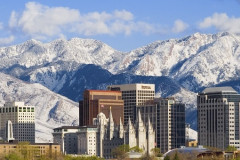
Utah
Description
Utah is a state in the western United States. It became the 45th state admitted to the U.S. on January 4, 1896. Utah is the 13th-largest by area, 31st-most-populous, and 10th-least-densely populated of the 50 United States. Utah has a population of nearly 3 million (Census estimate for July 1, 2015), approximately 80% of whom live along the Wasatch Front, centering on the state capital Salt Lake City. Utah is bordered by Colorado to the east, Wyoming to the northeast, Idaho to the north, Arizona to the south, and Nevada to the west. It also touches a corner of New Mexico in the southeast.
Approximately 62% of Utahns are reported to be members of The Church of Jesus Christ of Latter-day Saints or LDS (Mormons), which greatly influences Utahn culture and daily life (although only 41.6% are active members of the faith). The LDS Church's world headquarters is located in Salt Lake City. Utah is the only state with a majority population belonging to a single church.
The state is a center of transportation, education, information technology and research, government services, mining, and a major tourist destination for outdoor recreation. In 2013, the U.S. Census Bureau estimated that Utah had the second fastest-growing population of any state. St. George was the fastest–growing metropolitan area in the United States from 2000 to 2005. Utah also has the 14th highest median average income and the least income inequality of any U.S. state. A 2012 Gallup national survey found Utah overall to be the "best state to live in" based on 13 forward-looking measurements including various economic, lifestyle, and health-related outlook metrics.
Etymology
The name "Utah" is derived from the name of the Ute tribe. It means "people of the mountains" in the Ute language. According to other sources "Utah" is derived from the Apache name "Yudah" which means "Tall". In the Spanish language it was said as "Yuta", subsequently the English-speaking people adapted the word "Utah"
History
Pre-Columbian
Thousands of years before the arrival of European explorers, the Ancestral Puebloans and the Fremont people lived in what is now known as Utah. These Native American tribes are subgroups of the Ute-Aztec Native American ethnicity and were sedentary. The Ancestral Pueblo people built their homes through excavations in mountains, and the Fremont people built houses of straw before disappearing from the region around the 15th century.
Another group of Native Americans, the Navajo, settled in the region around the 18th century. In the mid-18th century, other Uto-Aztecan tribes, including the Goshute, the Paiute, the Shoshone, and the Ute people, also settled in the region. These five groups were present when the first European explorers arrived.
Spanish exploration (1540)
The southern Utah region was explored by the Spanish in 1540, led by Francisco Vásquez de Coronado, while looking for the legendary Cíbola. A group led by two Catholic priests—sometimes called the Dominguez-Escalante Expedition—left Santa Fe in 1776, hoping to find a route to the coast of California. The expedition traveled as far north as Utah Lake and encountered the native residents. The Spanish made further explorations in the region, but were not interested in colonizing the area because of its desert nature. In 1821, the year Mexico achieved its independence from Spain, the region became known as part of its territory of Alta California.
European trappers and fur traders explored some areas of Utah in the early 19th century from Canada and the United States. The city of Provo, Utah was named for one, Étienne Provost, who visited the area in 1825. The city of Ogden, Utah was named after Peter Skene Ogden, a Canadian explorer who traded furs in the Weber Valley.
In late 1824, Jim Bridger became the first known English-speaking person to sight the Great Salt Lake. Due to the high salinity of its waters, Bridger thought he had found the Pacific Ocean; he subsequently found that this body of water was a giant salt lake. After the discovery of the lake, hundreds of American and Canadian traders and trappers established trading posts in the region. In the 1830s, thousands of migrants traveling from the Eastern United States to the American West began to make stops in the region of the Great Salt Lake, then known as Lake Youta.
LDS settlement (1847)
Following the death of Joseph Smith in 1844, Brigham Young as president of the Quorum of the Twelve became the effective leader of the Latter Day Saints in Nauvoo, Illinois. To address the growing conflicts between his people and their neighbors, Young agreed with Illinois Governor Thomas Ford in October 1845 that the Mormons would leave by the following year.
Brigham Young and the first band of Mormon pioneers reached the Salt Lake Valley on July 24, 1847. Over the next 22 years, more than 70,000 pioneers crossed the plains and settled in Utah. For the first few years, Brigham Young and the thousands of early settlers of Salt Lake City struggled to survive. The arid desert land was deemed by the Mormons as desirable as a place where they could practice their religion without harassment.
The Mormon settlements provided pioneers for other settlements in the West. Salt Lake City became the hub of a "far-flung commonwealth" of Mormon settlements. With new church converts coming from the East and around the world, Church leaders often assigned groups of church members as missionaries to establish other settlements throughout the West. They developed irrigation to support fairly large pioneer populations along Utah's Wasatch front (Salt Lake City, Bountiful and Weber Valley, and Provo and Utah Valley). Throughout the remainder of the 19th century, Mormon pioneers established hundreds of other settlements in Utah, Idaho, Nevada, Arizona, Wyoming, California, Canada, and Mexico – including in Las Vegas, Nevada; Franklin, Idaho (the first European settlement in Idaho); San Bernardino, California; Mesa, Arizona; Star Valley, Wyoming; and Carson Valley, Nevada.
Prominent settlements in Utah included St. George, Logan, and Manti (where settlers completed the first three temples in Utah, each started after but finished many years before the larger and better known temple built in Salt Lake City was completed in 1893), as well as Parowan, Cedar City, Bluff, Moab, Vernal, Fillmore (which served as the territorial capital between 1850 and 1856), Nephi, Levan, Spanish Fork, Springville, Provo Bench (now Orem), Pleasant Grove, American Fork, Lehi, Sandy, Murray, Jordan, Centerville, Farmington, Huntsville, Kaysville, Grantsville, Tooele, Roy, Brigham City, and many other smaller towns and settlements. Young had an expansionist's view of the territory that he and the Mormon pioneers were settling, calling it Deseret – which according to the Book of Mormon was an ancient word for "honeybee". This is symbolized by the beehive on the Utah flag, and the state's motto, "Industry".
Utah was Mexican territory when the first pioneers arrived in 1847. Early in the Mexican–American War in late 1846, the United States had taken control of New Mexico and California. The entire Southwest became U.S. territory upon the signing of the Treaty of Guadalupe Hidalgo, February 2, 1848. The treaty was ratified by the United States Senate on March 11. Learning that California and New Mexico were applying for statehood, the settlers of the Utah area (originally having planned to petition for territorial status) applied for statehood with an ambitious plan for a State of Deseret.
Utah Territory (1850–1896)
The Utah Territory was much smaller than the proposed state of Deseret, but it still contained all of the present states of Nevada and Utah as well as pieces of modern Wyoming and Colorado. It was created with the Compromise of 1850, and Fillmore, named after President Millard Fillmore, was designated the capital. The territory was given the name Utah after the Ute tribe of Native Americans. Salt Lake City replaced Fillmore as the territorial capital in 1856.
Disputes between the Mormon inhabitants and the U.S. government intensified due to the practice of plural marriage, or polygamy, among members of The Church of Jesus Christ of Latter-day Saints. The Mormons were still pushing for the establishment of a State of Deseret with the new borders of the Utah Territory. Most, if not all, of the members of the U.S. government opposed the polygamous practices of the Mormons.
Members of the LDS Church were viewed as un-American and rebellious when news of their polygamous practices spread. In 1857, particularly heinous accusations of abdication of government and general immorality were stated by former associate justice William W. Drummond, among others. The detailed reports of life in Utah caused the administration of James Buchanan to send a secret military "expedition" to Utah. When the supposed rebellion should be quelled, Alfred Cumming would take the place of Brigham Young as territorial governor. The resulting conflict is known as the Utah War, nicknamed "Buchanan's Blunder" by the Mormon leaders.
In September 1857, about 120 American settlers of the Baker–Fancher wagon train, en route to California from Arkansas, were murdered by Utah Territorial Militia and some Paiute Native Americans in the Mountain Meadows massacre.
Before troops led by Albert Sidney Johnston entered the territory, Brigham Young ordered all residents of Salt Lake City to evacuate southward to Utah Valley and sent out a force, known as the Nauvoo Legion, to delay the government's advance. Although wagons and supplies were burned, eventually the troops arrived in 1858, and Young surrendered official control to Cumming, although most subsequent commentators claim that Young retained true power in the territory. A steady stream of governors appointed by the president quit the position, often citing the traditions of their supposed territorial government. By agreement with Young, Johnston established Camp Floyd, 40 miles (60 km) away from Salt Lake City, to the southwest.
Salt Lake City was the last link of the First Transcontinental Telegraph, completed in October 1861. Brigham Young was among the first to send a message, along with Abraham Lincoln and other officials.
Because of the American Civil War, federal troops were pulled out of Utah Territory in 1861. This was a boon to the local economy as the army sold everything in camp for pennies on the dollar before marching back east to join the war. The territory was then left in LDS hands until Patrick E. Connor arrived with a regiment of California volunteers in 1862. Connor established Fort Douglas just 3 miles (4.8 km) east of Salt Lake City and encouraged his people to discover mineral deposits to bring more non-Mormons into the territory. Minerals were discovered in Tooele County and miners began to flock to the territory.
Beginning in 1865, Utah's Black Hawk War developed into the deadliest conflict in the territory's history. Chief Antonga Black Hawk died in 1870, but fights continued to break out until additional federal troops were sent in to suppress the Ghost Dance of 1872. The war is unique among Indian Wars because it was a three-way conflict, with mounted Timpanogos Utes led by Antonga Black Hawk fighting federal and LDS authorities.
On May 10, 1869, the First Transcontinental Railroad was completed at Promontory Summit, north of the Great Salt Lake. The railroad brought increasing numbers of people into the territory and several influential businesspeople made fortunes there.
During the 1870s and 1880s laws were passed to punish polygamists due, in part, to the stories coming forth regarding Utah. Notably, Ann Eliza Young—tenth wife to divorce Brigham Young, women's advocate, national lecturer and author of Wife No. 19 or My Life of Bondage and Mr. and Mrs. Fanny Stenhouse, authors of The Rocky Mountain Saints (T. B. H. Stenhouse, 1873) and Tell It All: My Life in Mormonism (Fanny Stenhouse, 1875) . Both of these women, Ann Eliza and Fanny, testify to the happiness of the very early Church members before polygamy began to be practiced. They independently published their books in 1875. These books and the lectures of Ann Eliza Young have been credited with the United States Congress passage of anti-polygamy laws by newspapers throughout the United States as recorded in "The Ann Eliza Young Vindicator", a pamphlet which detailed Ms Young's travels and warm reception throughout her lecture tour.
T. B. H. Stenhouse, former Utah Mormon polygamist, Mormon missionary for thirteen years and a Salt Lake City newspaper owner, finally left Utah and wrote The Rocky Mountain Saints. His book gives a witnessed account of his life in Utah, both the good and the bad. He finally left Utah and Mormonism after financial ruin occurred when Brigham Young sent Stenhouse to relocate to Ogden, Utah, according to Stenhouse, to take over his thriving pro-Mormon Salt Lake Telegraph newspaper. In addition to these testimonies, The Confessions of John D. Lee, written by John D. Lee—alleged "Scape goat" for the Mountain Meadow Massacre—also came out in 1877. The corroborative testimonies coming out of Utah from Mormons and former Mormons had an impact on Congress and the people of the United States.
In the 1890 Manifesto, the LDS Church banned polygamy. When Utah applied for statehood again, it was accepted. One of the conditions for granting Utah statehood was that a ban on polygamy be written into the state constitution. This was a condition required of other western states that were admitted into the Union later. Statehood was officially granted on January 4, 1896.
20th century
Beginning in the early 20th century, with the establishment of such national parks as Bryce Canyon National Park and Zion National Park, Utah became known for its natural beauty. Southern Utah became a popular filming spot for arid, rugged scenes featured in the popular mid-century western film genre. From such films, most US residents recognize such natural landmarks as Delicate Arch and "the Mittens" of Monument Valley. During the 1950s, 1960s, and 1970s, with the construction of the Interstate highway system, accessibility to the southern scenic areas was made easier.
Since the establishment of Alta Ski Area in 1939 and the subsequent development of several ski resorts in the state's mountains, Utah's skiing has become world-renowned. The dry, powdery snow of the Wasatch Range is considered some of the best skiing in the world (the state license plate claims "the Greatest Snow on Earth"). Salt Lake City won the bid for the 2002 Winter Olympic Games, and this served as a great boost to the economy. The ski resorts have increased in popularity, and many of the Olympic venues built along the Wasatch Front continue to be used for sporting events. Preparation for the Olympics spurred the development of the light-rail system in the Salt Lake Valley, known as TRAX, and the re-construction of the freeway system around the city.
In 1957, Utah created the Utah State Parks Commission with four parks. Today, Utah State Parks manages 43 parks and several undeveloped areas totaling over 95,000 acres (380 km2) of land and more than 1,000,000 acres (4,000 km2) of water. Utah's state parks are scattered throughout Utah; from Bear Lake State Park at the Utah/Idaho border to Edge of the Cedars State Park Museum deep in the Four Corners region, and everywhere in between. Utah State Parks is also home to the state's off highway vehicle office, state boating office and the trails program.
During the late 20th century, the state grew quickly. In the 1970s growth was phenomenal in the suburbs of the Wasatch Front. Sandy was one of the fastest-growing cities in the country at that time. Today, many areas of Utah continue to see boom-time growth. Northern Davis, southern and western Salt Lake, Summit, eastern Tooele, Utah, Wasatch, and Washington counties are all growing very quickly. Management of transportation and urbanization are major issues in politics, as development consumes agricultural land and wilderness areas, with density of uses creating air pollution.
Geography
Utah is known for its natural diversity and is home to features ranging from arid deserts with sand dunes to thriving pine forests in mountain valleys. It is a rugged and geographically diverse state that is located at the convergence of three distinct geological regions: the Rocky Mountains, the Great Basin, and the Colorado Plateau.
Utah is one of the Four Corners states, and is bordered by Idaho in the north, Wyoming in the north and east; by Colorado in the east; at a single point by New Mexico to the southeast; by Arizona in the south; and by Nevada in the west. It covers an area of 84,899 sq mi (219,890 km2). The state is one of only three U.S. states (with Colorado and Wyoming) that have only lines of latitude and longitude for boundaries.
One of Utah's defining characteristics is the variety of its terrain. Running down the middle of the northern third of the state is the Wasatch Range, which rises to heights of almost 12,000 ft (3,700 m) above sea level. Utah is home to world-renowned ski resorts, made popular by the light, fluffy snow, and winter storms which regularly dump 1 to 3 feet of overnight snow accumulation. In the northeastern section of the state, running east to west, are the Uinta Mountains, which rise to heights of over 13,000 feet (4,000 m). The highest point in the state, Kings Peak, at 13,528 feet (4,123 m), lies within the Uinta Mountains.
At the western base of the Wasatch Range is the Wasatch Front, a series of valleys and basins that are home to the most populous parts of the state. It stretches approximately from Brigham City at the north end to Nephi at the south end. Approximately 75 percent of the population of the state live in this corridor, and population growth is rapid.
Western Utah is mostly arid desert with a basin and range topography. Small mountain ranges and rugged terrain punctuate the landscape. The Bonneville Salt Flats are an exception, being comparatively flat as a result of once forming the bed of ancient Lake Bonneville. Great Salt Lake, Utah Lake, Sevier Lake, and Rush Lake are all remnants of this ancient freshwater lake, which once covered most of the eastern Great Basin. West of the Great Salt Lake, stretching to the Nevada border, lies the arid Great Salt Lake Desert. One exception to this aridity is Snake Valley, which is (relatively) lush due to large springs and wetlands fed from groundwater derived from snow melt in the Snake Range, Deep Creek Range, and other tall mountains to the west of Snake Valley. Great Basin National Park is just over the Nevada state line in the southern Snake Range. One of western Utah's most impressive, but least visited attractions is Notch Peak, the tallest limestone cliff in North America, located west of Delta.
Much of the scenic southern and southeastern landscape (specifically the Colorado Plateau region) is sandstone, specifically Kayenta sandstone and Navajo sandstone. The Colorado River and its tributaries wind their way through the sandstone, creating some of the world's most striking and wild terrain (the area around the confluence of the Colorado and Green Rivers was the last to be mapped in the lower 48 United States). Wind and rain have also sculpted the soft sandstone over millions of years. Canyons, gullies, arches, pinnacles, buttes, bluffs, and mesas are the common sight throughout south-central and southeast Utah.
This terrain is the central feature of protected state and federal parks such as Arches, Bryce Canyon, Canyonlands, Capitol Reef, and Zion national parks, Cedar Breaks, Grand Staircase-Escalante, Hovenweep, and Natural Bridges national monuments, Glen Canyon National Recreation Area (site of the popular tourist destination, Lake Powell), Dead Horse Point and Goblin Valley state parks, and Monument Valley. The Navajo Nation also extends into southeastern Utah. Southeastern Utah is also punctuated by the remote, but lofty La Sal, Abajo, and Henry mountain ranges.
Eastern (northern quarter) Utah is a high-elevation area covered mostly by plateaus and basins, particularly the Tavaputs Plateau and San Rafael Swell, which remain mostly inaccessible, and the Uinta Basin, where the majority of eastern Utah's population lives. Economies are dominated by mining, oil shale, oil, and natural gas-drilling, ranching, and recreation. Much of eastern Utah is part of the Uintah and Ouray Indian Reservation. The most popular destination within northeastern Utah is Dinosaur National Monument near Vernal.
Southwestern Utah is the lowest and hottest spot in Utah. It is known as Utah's Dixie because early settlers were able to grow some cotton there. Beaverdam Wash in far southwestern Utah is the lowest point in the state, at 2,000 feet (610 m). The northernmost portion of the Mojave Desert is also located in this area. Dixie is quickly becoming a popular recreational and retirement destination, and the population is growing rapidly. Although the Wasatch Mountains end at Mount Nebo near Nephi, a complex series of mountain ranges extends south from the southern end of the range down the spine of Utah. Just north of Dixie and east of Cedar City is the state's highest ski resort, Brian Head.
Like most of the western and southwestern states, the federal government owns much of the land in Utah. Over 70 percent of the land is either BLM land, Utah State Trustland, or U.S. National Forest, U.S. National Park, U.S. National Monument, National Recreation Area or U.S. Wilderness Area. Utah is the only state where every county contains some national forest.
Transportation
Further information: List of state highways in Utah and Utah Transit AuthorityI-15 and I-80 are the main interstate highways in the state, where they intersect and briefly merge near downtown Salt Lake City. I-15 traverses the state north-to-south, entering from Arizona near St. George, paralleling the Wasatch Front, and crossing into Idaho near Portage. I-80 spans northern Utah east-to-west, entering from Nevada at Wendover, crossing the Wasatch Mountains east of Salt Lake City, and entering Wyoming near Evanston. I-84 West enters from Idaho near Snowville (from Boise) and merges with I-15 from Tremonton to Ogden, then heads southeast through the Wasatch Mountains before terminating at I-80 near Echo Junction.
I-70 splits from I-15 at Cove Fort in central Utah and heads east through mountains and rugged desert terrain, providing quick access to the many national parks and national monuments of southern Utah, and has been noted for its beauty. The 103-mile (163 km) stretch from Salina to Green River is the longest stretch of interstate in the country without services and, when completed in 1970, was the longest stretch of entirely new highway constructed in the U.S. since the Alaska Highway was completed in 1943.
TRAX, a light rail system in the Salt Lake Valley, consists of three lines. The Blue Line (formerly Salt Lake/Sandy Line) begins in the suburb of Draper and ends in Downtown Salt Lake City. The Red Line (Mid-Jordan/University Line) begins in the Daybreak Community of South Jordan, a southwestern valley suburb, and ends at the University of Utah. The Green Line begins in West Valley City, passes through downtown Salt Lake City, and ends at Salt Lake City International Airport.
The Utah Transit Authority (UTA), which operates TRAX, also operates a bus system that stretches across the Wasatch Front, west into Grantsville, and east into Park City. In addition, UTA provides winter service to the ski resorts east of Salt Lake City, Ogden, and Provo. Several bus companies also provide access to the ski resorts in winter, and local bus companies also serve the cities of Cedar City, Logan, Park City, and St. George. A commuter rail line known as FrontRunner, also operated by UTA, runs between Pleasant View and Provo via Salt Lake City. Amtrak's California Zephyr, with one train in each direction daily, runs east-west through Utah with stops in Green River, Helper, Provo, and Salt Lake City.
Salt Lake City International Airport is the only international airport in the state and serves as one of the hubs for Delta Air Lines. The airport has consistently ranked first in on-time departures and had the fewest cancellations among U.S. airports. The airport has non-stop service to over 100 destinations throughout the United States, Canada, and Mexico, as well as to Paris. Canyonlands Field (near Moab), Cedar City Regional Airport, Ogden-Hinckley Airport, Provo Municipal Airport, St. George Regional Airport, and Vernal Regional Airport all provide limited commercial air service. An entirely new regional airport at St. George opened on January 12, 2011. SkyWest Airlines is also headquartered in St. George and maintains a hub at Salt Lake City.
Major cities and towns
Utah's population is concentrated in two areas, the Wasatch Front in the north-central part of the state, with a population of over 2 million; and Washington County, in southwestern Utah, locally known as "Dixie", with over 150,000 residents in the metropolitan area.
According to the 2010 Census, Utah was the second fastest-growing state (at 23.8 percent) in the United States between 2000 and 2010 (behind Nevada). St. George, in the southwest, is the second fastest-growing metropolitan area in the United States, trailing Greeley, Colorado.
The three fastest-growing counties from 2000 to 2010 were Wasatch County (54.7%), Washington County (52.9%), and Tooele County (42.9%). However, Utah County added the most people (148,028). Between 2000 and 2010, Saratoga Springs (1,673%), Herriman (1,330%), Eagle Mountain (893%), Cedar Hills (217%), South Willard (168%), Nibley (166%), Syracuse (159%), West Haven (158%), Lehi (149%), Washington (129%), and Stansbury Park (116%) all at least doubled in population. West Jordan (35,376), Lehi (28,379), St. George (23,234), South Jordan (20,981), West Valley City (20,584), and Herriman (20,262) all added at least 20,000 people.
UtahRank City Population
(2010)
within
city limits Land
area Population
density
(/mi²) Population
density
(/km²) County 1 Salt Lake City 186,440 109.1 sq mi (283 km2) 1,666.1 630 Salt Lake 2 West Valley City 129,480 35.4 sq mi (92 km2) 3,076.3 1236 Salt Lake 3 Provo 112,488 39.6 sq mi (103 km2) 2,653.2 1106 Utah County 4 West Jordan 103,712 30.9 sq mi (80 km2) 2,211.3 1143 Salt Lake 5 Orem 88,328 18.4 sq mi (48 km2) 4,572.6 1881 Utah County 6 Sandy 87,461 22.3 sq mi (58 km2) 3,960.5 1551 Salt Lake 7 Ogden 82,825 26.6 sq mi (69 km2) 2,899.2 1137 Weber 8 St. George 72,897 64.4 sq mi (167 km2) 771.2 385 Washington 9 Layton 67,311 20.7 sq mi (54 km2) 2,823.9 1153 Davis 10 Taylorsville 58,652 10.7 sq mi (28 km2) 5,376.1 2094 Salt Lake Combined statistical area Population
(2010) Salt Lake City-Ogden-Clearfield
comprises:
Salt Lake City and Ogden-Clearfield Metropolitan Areas and
Brigham City and Heber Micropolitan Areas (as listed below) 1,744,886 Utah
Rank Metropolitan area Population
(2010) Counties 1 Salt Lake City* 1,124,197 Salt Lake, Tooele, Summit 2 Ogden-Clearfield* 547,184 Weber, Davis, Morgan 3 Provo-Orem 526,810 Utah 4 St. George 138,115 Washington 5 Logan 125,442 Cache, Franklin (Idaho)
- Until 2003, the Salt Lake City and Ogden-Clearfield metropolitan areas were considered as a single metropolitan area.
Rank Micropolitan area Population
(2010) 1 Brigham City 49,015 2 Cedar City 44,540 3 Vernal 29,885 4 Heber 21,066 5 Price 19,549 6 Richfield 18,382
Colleges and universities
- The Art Institute of Salt Lake City in Draper
- Broadview University in Salt Lake City, Layton, Orem, West Jordan
- Brigham Young University in Provo (satellite campus in Salt Lake City)
- Certified Career Institute in Salt Lake City and Clearfield
- Davis Applied Technology College Kaysville, UT
- Dixie State University in St. George
- Eagle Gate College in Murray and Layton
- ITT Technical Institute in Murray
- LDS Business College in Salt Lake City
- Neumont University in South Jordan
- Provo College in Provo
- Roseman University in South Jordan, Utah
- Salt Lake Community College in Taylorsville
- Snow College in Ephraim and Richfield
- Southern Utah University (formerly Southern Utah State College) in Cedar City
- Stevens-Henager College at various locations statewide
- University of Phoenix at various locations statewide
- University of Utah in Salt Lake City
- Utah College of Applied Technology
- Utah State University in Logan (satellite campuses at various state locations)
- Utah State University Eastern in Price (formerly the College of Eastern Utah until 2010)
- Utah Valley University (formerly Utah Valley State College) in Orem
- Weber State University in Ogden
- Western Governors University an online university, begun by former Utah Governor, Michael O. Leavitt
- Westminster College in Salt Lake City
- George Wythe University in Salt Lake City
Branding
The state of Utah relies heavily on income from tourists and travelers visiting the state's parks and ski resorts, and thus the need to "brand" Utah and create an impression of the state throughout the world has led to several state slogans, the most famous of which being "The Greatest Snow on Earth", which has been in use in Utah officially since 1975 (although the slogan was in unofficial use as early as 1962) and now adorns nearly 50 percent of the state's license plates. In 2001, Utah Governor Mike Leavitt approved a new state slogan, "Utah! Where Ideas Connect", which lasted until March 10, 2006, when the Utah Travel Council and the office of Governor Jon Huntsman announced that "Life Elevated" would be the new state slogan.
Entertainment
Utah is the setting of or the filming location for many books, films, television series, music videos, and video games. A selective list of each appears below.
Books
- Harry Turtledove's Southern Victory Series, which is set in a North America where the South won the Civil War, mentions Utah several times. The state's Mormon population rebels against the United States in an attempt to create the Nation of Deseret throughout the series, which results in battles in and around Salt Lake City, Provo, and other locations.
- In Around the World in Eighty Days, the characters pass through Utah by train.
- The children's series The Great Brain is set in a fictional town that is based on Price.
- Edward Abbey's The Monkey Wrench Gang is set in Southern Utah and Northern Arizona. The characters' ultimate goal is the destruction of the Glen Canyon Dam.
- Much of Walter M. Miller, Jr.'s post-apocalyptic novel A Canticle for Leibowitz is set near or directly within Utah. The "hero" of the first part of the novel, the novice Brother Francis Gerard, is from Utah.
- In the second of four books based on the video game Doom much of the story takes place in Salt Lake City.
- Jack Kerouac's semi-autobiographical novel On the Road (arguably the most defining work of the post-WWII Beat Generation) describes traveling through Utah as part of a number of spontaneous road trips taken by the book's main characters. Additionally, the character of Dean Moriarty (like his real life counterpart Neal Cassady) was born in Salt Lake City. While many of the names and details of Kerouac's experiences are changed, the characters and road trips in the novel are based heavily on road trips taken by Kerouac and his friends across mid-20th century America.
- Will Hobbs' 1999 young adult novel, The Maze, takes place in Canyonlands National Park in Southern Utah.
- Mark Twain's book Roughing It (describes meeting with Brigham Young.)
- In Dean Koontz's book Dark Rivers of the Heart the two main characters travel through Utah while being sought after by a secret government agency. One scene takes place in Cedar City.
Television
- The Donny & Marie Show and The Osmond Family Show were primarily filmed at the former Osmond Studios in Orem.
- In the Doctor Who episode "Dalek", Utah was the base of operations for the character Henry van Statten. In the episode "The Impossible Astronaut," the Doctor mysteriously summons his former companions Amy Pond and Rory Williams to Monument Valley.
- In Blood & Oil, a young couple move to the fictional oil boomtown, Rock Springs, ND. The entire series is filmed in and around Park City.
- In Prison Break, D. B. Cooper buried his money under a silo in the Utah desert somewhere near Tooele. Much of the first half of the second season involves the characters attempting to reach Utah and recovering the money.
- In The Visitor, the main character's spaceship was shot down and crash-landed in the mountains east of Salt Lake City.
- Everwood was filmed in Park City, Ogden, and South Salt Lake.
- Regular production for Touched by an Angel was based in Salt Lake City, but it was filmed in many Utah locations, including some scenes in Ogden.
- The CBS series Promised Land was filmed in a closed set in Salt Lake City.
- Big Love, an HBO television drama about a polygamous family, was set in Sandy.
- In an episode of The Simpsons, Bart and his girlfriend drive to Utah to get married because of the state's marriage laws. In another episode, the Simpsons attend the Sundance Film Festival in Park City.
- In an episode of the Nickelodeon sitcom Drake & Josh, after accidentally killing his sister Megan's rare Cuban hamster, Josh Peck's character packs to move to Utah because "Nothing bad ever happens in Utah."
- "The Stand", a 1994 TV mini-series, was filmed at multiple locations in Weber, Salt Lake and Tooele counties. The scene where the deaf character (Nick) meets the slow-witted character (Tom Cullen) was filmed on Historic 25th Street in Ogden.
- Hannah Montana & Miley Cyrus: Best of Both Worlds Concert was filmed in Salt Lake City at EnergySolutions Arena on October 26 and 27, 2007.
- Top Gear Series 12, episode 2 features hosts Jeremy Clarkson, Richard Hammond, and James May driving to Utah's Bonneville Salt Flats in a Chevrolet Corvette ZR-1, a Dodge Challenger SRT-8, and a Cadillac CTS-V.
- In the Futurama episode "Mars University", the Professor mentions Utah while describing the colonization of Mars: "In those days Mars was a dreary, uninhabitable wasteland, much like Utah. But unlike Utah, Mars was eventually made liveable..."
- The TLC reality series Sister Wives, which made its debut in 2010, documents the life of a polygamous family in Lehi.
- In 2011 an episode of Travel Channel's television series Ghost Adventures was aired that took place at the Tooele Hospital.
- An episode of The Aquabats Super Show was filmed in Lagoon Amusement Park in Farmington.
- An episode of "I Love Jenni" was filmed in Utah for the Sundance Film Festival in Park City.
Music videos
- Jon Bon Jovi – "Blaze of Glory" was shot in or around Moab.
- Metallica – "King Nothing" and parts of "I Disappear" were filmed in Monument Valley.
- The Killers – "Human" was shot in Goblin Valley.
- The Offspring – "Gotta Get Away" was filmed at the Fairgrounds Coliseum.
- Tiffany – "I Think We're Alone Now" was filmed at the Ogden Mall.
- Chelsea Grin – "Don't Ask, Don't Tell" was filmed in the Bonneville Salt Flats.
- Demi Lovato – "Skyscraper" was filmed in the Bonneville Salt Flats.
- Paramore – "Daydreaming" beginning scenes were filmed in Spanish Fork and Benjamin, Utah County.
Video games
- Splinter Cell: Conviction's Insurgency Pack features a level that takes place at a fictional experimental pharmaceutical company in Salt Lake City.
- Resistance 2 features a level in Bryce Canyon.
- Amped 3 features a level at the Snowbird Ski Resort.
- Downhill Domination has six bike racing courses in Moab and Salt Lake City.
- Shaun White Snowboarding features Park City Mountain Resort.
- Command & Conquer: Tiberian Sun features a level in Provo (NOD campaign).
- EA Sports BIG's Freekstyle game has a level called "Monumental Motoplex" in Monument Valley.
- Test Drive Off-Road Wide Open features a level in Moab.
- Sly Cooper and the Thievius Raccoonus features a level in a fictional Utah town called "Mesa City".
- Fallout: New Vegas features a downloadable add-on, titled Honest Hearts, which takes place in Utah's Zion National Park.
- The Last of Us shows the central area of Salt Lake City (Interstate highway, Salt Lake Temple, and the fictional Saint Mary's Hospital).