
Andorra
Hotels
Regions (1)
Towns (15)





Description
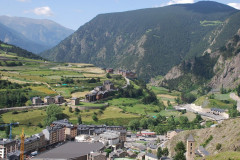
Andorra , officially the Principality of Andorra (Catalan: Principat d'Andorra), also called the Principality of the Valleys of Andorra (Catalan: Principat de les Valls d'Andorra), is a sovereign landlocked microstate in Southwestern Europe, located in the eastern Pyrenees mountains and bordered by Spain and France. Created under a charter in 988, the present principality was formed in 1278. It is known as a principality as it is a monarchy headed by two Co-Princes – the Roman Catholic Bishop of Urgell in Spain, and the President of France.
Andorra is the sixth-smallest nation in Europe, having an area of 468 km2 (181 sq mi) and a population of approximately 85,000. Its capital Andorra la Vella is the highest capital city in Europe, at an elevation of 1,023 metres (3,356 ft) above sea level. The official language is Catalan, although Spanish, Portuguese, and French are also commonly spoken.
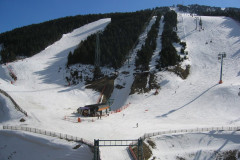
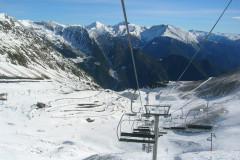
Andorra's tourism services an estimated 10.2 million visitors annually. It is not a member of the European Union, but the euro is the official currency. It has been a member of the United Nations since 1993. In 2013, the people of Andorra had the highest life expectancy in the world at 81 years, according to The Lancet.
Etymology
The origin of the word Andorra is unknown, although several hypotheses have been formulated. The oldest derivation of the word Andorra is from the Greek historian Polybius (The Histories III, 35, 1) who describes the Andosins, an Iberian Pre-Roman tribe, as historically located in the valleys of Andorra and facing the Carthaginian army in its passage through the Pyrenees during the Punic Wars. The word Andosini or Andosins (Ἀνδοσίνους) may derive from the Basque handia whose meaning is "big" or "giant". The Andorran toponymy shows evidence of Basque language in the area. Another theory suggests that the word Andorra may derive from the old word Anorra that contains the Basque word ur (water).
Another theory suggests that Andorra may derive from Arabic al-durra, meaning "The pearl" (الدرة). When the Moors invaded the Iberian Peninsula, the valleys of the Pyrenees were covered by large tracts of forest, and other regions and towns, also dominated by Muslims, received this designation.
Other theories suggest that the term derives from the Navarro-Aragonese andurrial, which means "land covered with bushes" or "scrubland".
The folk etymology holds that Charlemagne had named the region as a reference to the Biblical Canaanite valley of Endor or Andor (where the Midianites had been defeated), a name also bestowed by his heir and son Louis le Debonnaire after defeating the Moors in the "wild valleys of Hell".
History
Tradition holds that Charles the Great (Charlemagne) granted a charter to the Andorran people in return for fighting against the Moors. Overlordship of the territory was by the Count of Urgell and eventually by the bishop of the Diocese of Urgell. In 988, Borrell II, Count of Urgell, gave the Andorran valleys to the Diocese of Urgell in exchange for land in Cerdanya. Since then the Bishop of Urgell, based in Seu d'Urgell, has owned Andorra.
Before 1095, Andorra did not have any type of military protection and the Bishop of Urgell, who knew that the Count of Urgell wanted to reclaim the Andorran valleys, asked the Lord of Caboet for help and protection. In 1095 the Lord of Caboet and the Bishop of Urgell signed under oath a declaration of their co-sovereignty over Andorra. Arnalda, daughter of Arnau of Caboet, married the Viscount of Castellbò and both became Viscounts of Castellbò and Cerdanya. Years later their daughter, Ermessenda, married Roger Bernat II, the French Count of Foix. They became Roger Bernat II and Ermessenda I, Counts of Foix, Viscounts of Castellbò and Cerdanya, and co-sovereigns of Andorra (shared with the Bishop of Urgell).
In the 13th century, a dispute arose between the Bishop of Urgell and the Count of Foix. The conflict was resolved in 1278 with the mediation of Aragon by the signing of the first paréage which provided that Andorra's sovereignty be shared between the count of Foix (whose title would ultimately transfer to the French head of state) and the Bishop of Urgell, in Catalonia. This gave the principality its territory and political form.
With the passage of time, the co-title to Andorra passed to the kings of Navarre. After Henry of Navarre became King Henry IV of France, he issued an edict in 1607, that established the head of the French state and the Bishop of Urgell as Co-Princes of Andorra. In 1812–13, the First French Empire annexed Catalonia and divided it in four départements, with Andorra being made part of the district of Puigcerdà (département of Sègre).
17th to 19th centuries
Andorra retained its medieval institutions and rural culture largely unchanged during this period. In 1866, a Council General of 24 members elected by suffrage limited to heads of family, replaced the aristocratic oligarchy previously ruling the state.
20th century
Andorra declared war on Imperial Germany during World War I, but did not actually take part in the fighting. It remained in an official state of belligerency until 1958 as it was not included in the Treaty of Versailles.
In 1933, France occupied Andorra following social unrest which occurred before elections. On 12 July 1934, adventurer Boris Skossyreff issued a proclamation in Urgell, declaring himself "Boris I, King of Andorra", simultaneously declaring war on the Bishop of Urgell. He was arrested by the Spanish authorities on 20 July and ultimately expelled from Spain. From 1936 until 1940, a French military detachment was garrisoned in Andorra to secure the principality against disruption from the Spanish Civil War and Francoist Spain. Francoist troops reached the Andorran border in the later stages of the war. During World War II, Andorra remained neutral and was an important smuggling route between Vichy France and Spain.
Given its relative isolation, Andorra has existed outside the mainstream of European history, with few ties to countries other than France, Spain and Portugal. In recent times, however, its thriving tourist industry along with developments in transport and communications have removed the country from its isolation. Its political system was modernised in 1993, when it became a member of the United Nations and the Council of Europe.
Law and criminal justice
The judiciary is composed of the Magistrates Court, the Criminal Law Court, the High Court of Andorra, and the Constitutional Court. The High Court of Justice is composed of five judges: one appointed by the Head of Government, one each by the Co-Princes, one by the Syndic General, and one by the Judges and Magistrates. It is presided over by the member appointed by the Syndic General and the judges hold office for six-year terms.
The Magistrates and Judges are appointed by the High Court, as is the President of the Criminal Law Court. The High Court also appoints members of the Office of the Attorney General. The Constitutional Court is responsible for interpreting the Constitution and reviewing all appeals of unconstitutionality against laws and treaties. It is composed of four judges, one appointed by each of the Co-Princes and two by the General Council. They serve eight-year terms. The Court is presided over by one of the Judges on a two-year rotation so that each judge at one point will preside over the Court.
Foreign relations, defence, and security
Andorra does not have its own armed forces, although there is a small ceremonial army. Responsibility for defending the nation rests primarily with France and Spain. However, in case of emergencies or natural disasters, the Sometent (an alarm) is called and all able-bodied men between 21 and 60 of Andorran nationality must serve. This is why all Andorrans, and especially the head of each house (usually the eldest able-bodied man of a house) should, by law, keep a rifle, even though the law also states that the police will offer a firearm in case of need. Andorra is a full member of the United Nations (UN), the Organization for Security and Co-operation in Europe (OSCE), and has a special agreement with the European Union (EU).
Police Corps
Andorra maintains a small but modern and well-equipped internal police force, with around 240 police officers supported by civilian assistants. The principal services supplied by the corps are uniformed community policing, criminal detection, border control, and traffic policing. There are also small specialist units including police dogs, mountain rescue, and a bomb disposal team.
GIPAThe Grup d'Intervenció Policia d'Andorra (GIPA) is a small special forces unit trained in counter-terrorism, and hostage recovery tasks. Although it is the closest in style to an active military force, it is part of the Police Corps, and not the army. As terrorist and hostage situations are a rare threat to the nation, the GIPA is commonly assigned to prisoner escort duties, and at other times to routine policing.
Fire brigade
The Andorran Fire Brigade, with headquarters at Santa Coloma, operates from four modern fire stations, and has a staff of around 120 firefighters. The service is equipped with 16 heavy appliances (fire tenders, turntable ladders, and specialist four-wheel drive vehicles), four light support vehicles (cars and vans) and four ambulances.
Historically, the families of the six ancient parishes of Andorra maintained local arrangements to assist each other in fighting fires. The first fire pump purchased by the government was acquired in 1943. Serious fires which lasted for two days in December 1959 led to calls for a permanent fire service, and the Andorran Fire Brigade was formed on 21 April 1961.
The fire service maintains full-time cover with five fire crews on duty at any time – two at the brigade's headquarters in Santa Coloma, and one crew at each of the other three fire stations.
Geography
Parishes
Andorra consists of seven parishes:
- Andorra la Vella
- Canillo
- Encamp
- Escaldes-Engordany
- La Massana
- Ordino
- Sant Julià de Lòria
Physical geography
Due to its location in the eastern Pyrenees mountain range, Andorra consists predominantly of rugged mountains, the highest being the Coma Pedrosa at 2,942 metres (9,652 ft), and the average elevation of Andorra is 1,996 metres (6,549 ft). These are dissected by three narrow valleys in a Y shape that combine into one as the main stream, the Gran Valira river, leaves the country for Spain (at Andorra's lowest point of 840 m or 2,756 ft). Andorra's land area is 468 km2 (181 sq mi).
Phytogeographically, Andorra belongs to the Atlantic European province of the Circumboreal Region within the Boreal Kingdom. According to the WWF, the territory of Andorra belongs to the ecoregion of Pyrenees conifer and mixed forests.
Statistics
Largest cities
Healthcare
Healthcare in Andorra is provided to all employed persons and their families by the government-run social security system, Caixa Andorrana de Seguretat Social (CASS), which is funded by employer and employee contributions in respect of salaries. The cost of healthcare is covered by CASS at rates of 75% for out-patient expenses such as medicines and hospital visits, 90% for hospitalisation, and 100% for work-related accidents. The remainder of the costs may be covered by private health insurance. Other residents and tourists require full private health insurance.
The main hospital, Meritxell, is in Escaldes-Engordany. There are also 12 primary health care centres in various locations around the principality.
Transport
Until the 20th century, Andorra had very limited transport links to the outside world, and development of the country was affected by its physical isolation. Even now, the nearest major airports at Toulouse and Barcelona are both three hours' drive from Andorra.
Andorra has a road network of 279 km (173 mi), of which 76 km (47 mi) is unpaved. The two main roads out of Andorra la Vella are the CG-1 to the Spanish border, and the CG-2 to the French border via the Envalira Tunnel near El Pas de la Casa. Bus services cover all metropolitan areas and many rural communities, with services on most major routes running half-hourly or more frequently during peak travel times. There are frequent long-distance bus services from Andorra to Barcelona and Toulouse, plus a daily tour from the former city. Bus services are mostly run by private companies, but some local ones are operated by the government.
There are no airports for fixed-wing aircraft within Andorra's borders but there are, however, heliports in La Massana (Camí Heliport), Arinsal and Escaldes-Engordany with commercial helicopter services and an airport located in the neighbouring Spanish comarca of Alt Urgell, 12 kilometres (7.5 miles) south of the Andorran-Spanish border. Since July 2015, Andorra–La Seu d'Urgell Airport has operated commercial flights to Madrid and Palma de Mallorca, and is the main hub for Air Andorra and Andorra Airlines.
Nearby airports located in Spain and France provide access to international flights for the principality. The nearest airports are at Perpignan, France (156 km from Andorra) and Lleida, Spain (160 km from Andorra). The largest nearby airports are at Toulouse, France (165 km from Andorra) and Barcelona, Spain (215 km from Andorra). There are hourly bus services from both Barcelona and Toulouse airports to Andorra.
The nearest railway station is L'Hospitalet-près-l'Andorre 10 km (6 mi) east of Andorra which is on the 1,435 mm (4 ft 8 1⁄2 in)-gauge line from Latour-de-Carol, (25 km or 16 mi) southeast of Andorra, to Toulouse and on to Paris by the French high-speed trains. This line is operated by the SNCF. Latour-de-Carol has a scenic 1,000 mm (3 ft 3 3⁄8 in) metre gauge trainline to Villefranche-de-Conflent, as well as the SNCF's 1,435 mm gauge line connecting to Perpignan, and the RENFE's 1,668 mm (5 ft 5 21⁄32 in) -gauge line to Barcelona. There are also direct Intercités de Nuit trains between L'Hospitalet-près-l'Andorre and Paris on certain dates.
Culture
The official and historic language is Catalan. Thus the culture is Catalan, with its own specificity.
Andorra is home to folk dances like the contrapàs and marratxa, which survive in Sant Julià de Lòria especially. Andorran folk music has similarities to the music of its neighbours, but is especially Catalan in character, especially in the presence of dances such as the sardana. Other Andorran folk dances include contrapàs in Andorra la Vella and Saint Anne's dance in Escaldes-Engordany. Andorra's national holiday is Our Lady of Meritxell Day, 8 September. American folk artist Malvina Reynolds, intrigued by its defence budget of $4.90, wrote a song "Andorra". Pete Seeger added verses, and sang "Andorra" on his 1962 album The Bitter and the Sweet.