
Cambodia
Hotels
Regions (7)
Towns (6)


Places




Description
Cambodia (i/kæmˈboʊdiə/; Khmer: កម្ពុជា, or Kampuchea IPA: [kɑmpuˈciə]), officially known as the Kingdom of Cambodia (Khmer: ព្រះរាជាណាចក្រកម្ពុជា, Preăh Réachéanachâk Kâmpŭchéa, IPA: [ˈprĕəh riəciənaːˈcɑk kɑmpuˈciə]), is a country located in the southern portion of the Indochina Peninsula in Southeast Asia. It is 181,035 square kilometres (69,898 square miles) in area, bordered by Thailand to the northwest, Laos to the northeast, Vietnam to the east, and the Gulf of Thailand to the southwest.
Cambodia has a population of over 15 million. The official religion is Theravada Buddhism, practised by approximately 95 percent of the population. The country's minority groups include Vietnamese, Chinese, Chams, and 30 hill tribes. The capital and largest city is Phnom Penh, the political, economic, and cultural centre of Cambodia. The kingdom is a constitutional monarchy with Norodom Sihamoni, a monarch chosen by the Royal Throne Council, as head of state. The head of government is Hun Sen, who is currently the longest serving non-royal leader in South East Asia and has ruled Cambodia for over 25 years.
In 802 AD, Jayavarman II declared himself king, uniting the warring Khmer princes of Chenla under the name "Kambuja". This marked the beginning of the Khmer Empire which flourished for over 600 years, allowing successive kings to control and exert influence over much of Southeast Asia and accumulate immense power and wealth. The Indianized kingdom built monumental temples including Angkor Wat, now a World Heritage Site, and facilitated the spread of first Hinduism, then Buddhism to much of Southeast Asia. After the fall of Angkor to Ayutthaya in the 15th century, a reduced and weakened Cambodia was then ruled as a vassal state by its neighbours. In 1863 Cambodia became a protectorate of France which doubled the size of the country by reclaiming the north and west from Thailand.
Cambodia gained independence in 1953. The Vietnam War extended into the country with the US bombing of Cambodia from 1969 until 1973. Following the Cambodian coup of 1970, the deposed king gave his support to his former enemies, the Khmer Rouge. The Khmer Rouge emerged as a major power, taking Phnom Penh in 1975 and later carrying out the Cambodian Genocide from 1975 until 1979, when they were ousted by Vietnam and the Vietnamese-backed People's Republic of Kampuchea in the Cambodian–Vietnamese War (1979–91). Following the 1991 Paris Peace Accords, Cambodia was governed briefly by a United Nations mission (1992–93). The UN withdrew after holding elections in which around 90 percent of the registered voters cast ballots. The 1997 coup placed power solely in the hands of Prime Minister Hun Sen and the Cambodian People's Party, who remain in power as of 2017.
The country faces numerous challenges. Important sociopolitical issues includes widespread poverty, pervasive corruption, lack of political freedoms, low human development, and a high rate of hunger. Cambodia has been described by Human Rights Watch's Southeast Asian Director, David Roberts, as a "vaguely communist free-market state with a relatively authoritarian coalition ruling over a superficial democracy." While per capita income remains low compared to most neighbouring countries, Cambodia has one of the fastest growing economies in Asia with growth averaging 6 percent over the last decade. Agriculture remains the dominant economic sector, with strong growth in textiles, construction, garments, and tourism leading to increased foreign investment and international trade. Cambodia scored dismally in an annual index (2015) ranking the rule of law in 102 countries, placing 99th overall and the worst in the region.
Cambodia also faces environmental destruction as an imminent problem. The most severe activity in this regard is considered to be the countrywide deforestation, which also involves national parks and wildlife sanctuaries. Overall, environmental destruction in Cambodia comprise many different activities, including illegal loggings, poaching of endangered and endemic species, and destruction of important wildlife habitats from large scale construction projects and agricultural businesses. The degrading activities involve the local population, Cambodian businesses and political authorities, as well as foreign criminal syndicates and many transnational corporations from all over the world.
Name
The "Kingdom of Cambodia" is the official English name of the country. The English "Cambodia" is an anglicisation of the French "Cambodge", which in turn is the French transliteration of the Khmer Kampuchea. Kampuchea is the shortened alternative to the country's official name in Khmer, Preah Reacheanachak Kampuchea (Khmer: ព្រះរាជាណាចក្រកម្ពុជា). The Khmer endonym Kampuchea derives from the Sanskrit name Kambujadeśa (कम्बोजदेश), composed of देश, desa ("land of" or "country of") and कम्बोज, Kambujas, which alludes to the foundation myths of the first ancient Khmer kingdom.
Colloquially, Cambodians refer to their country as either Srok Khmer (Khmer pronunciation: [srok kʰmae]), meaning "Khmer's Land", or the slightly more formal Prateh Kampuchea (ប្រទេសកម្ពុជា), literally "Country of Kampuchea". The name "Cambodia" is used most often in the Western world while "Kampuchea" is more widely used in the East.
Official names Date Name Notes 802–1431 Khmer Empire 1431–1863 Cambodia 1863–1941, 1945–1953 Kingdom of Cambodia (French Protectorate) 1941–1945 Under Japanese occupation 1953–1970 Kingdom of Cambodia 1970–1975 Khmer Republic 1975–1976 Kampuchea 1976–1982 Democratic Kampuchea (removed from power in 1979) 1982–1993 Coalition Government of Democratic Kampuchea (internationally recognized until 1993, renamed to the National Government of Cambodia in 1990) 1979–1989 People's Republic of Kampuchea 1989–1992 State of Cambodia 1992–1993 United Nations Transitional Authority in Cambodia 1993–present Kingdom of CambodiaHistory
Pre-history
There exists sparse evidence for a Pleistocene human occupation of present-day Cambodia, which includes quartz and quartzite pebble tools found in terraces along the Mekong River, in Stung Treng and Kratié provinces, and in Kampot Province, although their dating is unreliable. Some slight archaeological evidence shows communities of hunter-gatherers inhabited the region during Holocene: the most ancient archaeological discovery site in Cambodia is considered to be the cave of L'aang Spean, in Battambang Province, which belongs to the Hoabinhian period. Excavations in its lower layers produced a series of radiocarbon dates as of 6000 BC. Upper layers in the same site gave evidence of transition to Neolithic, containing the earliest dated earthenware ceramics in Cambodia
Archaeological records for the period between Holocene and Iron Age remain equally limited. A pivotal event in Cambodian prehistory was the slow penetration of the first rice farmers from the north, which began in the late 3rd millennium BC. The most curious prehistoric evidence in Cambodia are the various "circular earthworks" discovered in the red soils near Memot and in the adjacent region of Vietnam in the latter 1950s. Their function and age are still debated, but some of them possibly date from 2nd millennium BC.
Other prehistoric sites of somewhat uncertain date are Samrong Sen (not far from the ancient capital of Oudong), where the first investigations began in 1875, and Phum Snay, in the northern province of Banteay Meanchey. An excavation at Phum Snay revealed 21 graves with iron weapons and cranial trauma which could point to conflicts in the past, possible with larger cities in Angkor. Prehistoric artefacts are often found during mining activities in Ratanakiri.
Iron was worked by about 500 BC, with supporting evidence coming from the Khorat Plateau, in modern-day Thailand. In Cambodia, some Iron Age settlements were found beneath Baksei Chamkrong and other Angkorian temples while circular earthworks were found beneath Lovea a few kilometres north-west of Angkor. Burials, much richer than other types of finds, testify to improvement of food availability and trade (even on long distances: in the 4th century BC trade relations with India were already opened) and the existence of a social structure and labour organisation. Also, among the artefacts from the Iron Age, glass beads are important evidence. Different kinds of glass beads recovered from several sites across Cambodia, such as the Phum Snay site in northwest and the Prohear site in southeast, show that there were two main trading networks at the time. The two networks were separated by time and space, which indicate that there was a shift from one network to the other at about 2nd–4th century AD, probably with changes in socio-political powers.
Pre-Angkorian and Angkorian era
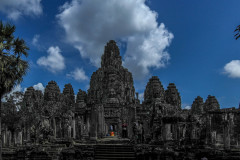
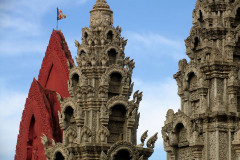
Angkor Wat. Faces of Bodhisattva Avalokiteshvara at Prasat Bayon.During the 3rd, 4th, and 5th centuries, the Indianised states of Funan and its successor, Chenla, coalesced in present-day Cambodia and southwestern Vietnam. For more than 2,000 years, what was to become Cambodia absorbed influences from India, passing them on to other Southeast Asian civilisations that are now Thailand and Laos. Little else is known for certain of these polities, however Chinese chronicles and tribute records do make mention of them. It is believed that the territory of Funan may have held the port known to Alexandrian geographer Claudius Ptolemy as "Kattigara". The Chinese chronicles suggest that after Jayavarman I of Chenla died around 690, turmoil ensued which resulted in division of the kingdom into Land Chenla and Water Chenla which was loosely ruled by weak princes under the dominion of Java.
The Khmer Empire grew out of these remnants of Chenla becoming firmly established in 802 when Jayavarman II (reigned c790-850) declared independence from Java and proclaimed himself a Devaraja. He and his followers instituted the cult of the God-king and began a series of conquests that formed an empire which flourished in the area from the 9th to the 15th centuries. During the rule of Jayavarman VIII the Angkor empire was attacked by the Mongol army of Kublai Khan, however the king was able to buy peace. Around the 13th century, monks from Sri Lanka introduced Theravada Buddhism to Southeast Asia. The religion spread and eventually displaced Hinduism and Mahayana Buddhism as the popular religion of Angkor; however it was not the official state religion until 1295; when Indravarman III took power.
The Khmer Empire was Southeast Asia's largest empire during the 12th century. The empire's centre of power was Angkor, where a series of capitals were constructed during the empire's zenith. In 2007 an international team of researchers using satellite photographs and other modern techniques concluded that Angkor had been the largest pre-industrial city in the world with an urban sprawl of 1,150 square miles (2,978 square kilometres). The city, which could have supported a population of up to one million people and Angkor Wat, the best known and best-preserved religious temple at the site, still serve as reminders of Cambodia's past as a major regional power. The empire, though in decline, remained a significant force in the region until its fall in the 15th century.
Dark ages of Cambodia
After a long series of wars with neighbouring kingdoms, Angkor was sacked by the Ayutthaya Kingdom and abandoned in 1432 because of ecological failure and infrastructure breakdown. This led to a period of economic, social, and cultural stagnation when the kingdom's internal affairs came increasingly under the control of its neighbours. By this time, the Khmer penchant for monument building had ceased. Older faiths such as Mahayana Buddhism and the Hindu cult of the god-king had been supplanted by Theravada Buddhism.
The court moved the capital to Longvek where the kingdom sought to regain its glory through maritime trade. The first mention of Cambodia in European documents was in 1511 by the Portuguese. Portuguese travellers described the city as a place of flourishing wealth and foreign trade. The attempt was short-lived however, as continued wars with Ayutthaya and the Vietnamese resulted in the loss of more territory and Longvek being conquered and destroyed by King Naresuan the Great of Ayutthaya in 1594. A new Khmer capital was established at Oudong south of Longvek in 1618, but its monarchs could survive only by entering into what amounted to alternating vassal relationships with the Siamese and Vietnamese for the next three centuries with only a few short-lived periods of relative independence.
The hill tribe people in Cambodia were "hunted incessantly and carried off as slaves by the Siamese (Thai), the Annamites (Vietnamese), and the Cambodians."
In the nineteenth century a renewed struggle between Siam and Vietnam for control of Cambodia resulted in a period when Vietnamese officials attempted to force the Khmers to adopt Vietnamese customs. This led to several rebellions against the Vietnamese and appeals to Thailand for assistance. The Siamese–Vietnamese War (1841–1845) ended with an agreement to place the country under joint suzerainty. This later led to the signing of a treaty for French Protection of Cambodia by King Norodom Prohmborirak.
French colonisation
In 1863, King Norodom, who had been installed by Thailand, sought the protection of France from the Thai rule. In 1867, the Thai king signed a treaty with France, renouncing suzerainty over Cambodia in exchange for the control of Battambang and Siem Reap provinces which officially became part of Thailand. The provinces were ceded back to Cambodia by a border treaty between France and Thailand in 1907.
Cambodia continued as a protectorate of France from 1867 to 1953, administered as part of the colony of French Indochina, though occupied by the Japanese empire from 1941 to 1945. Between 1874 and 1962, the total population increased from about 946,000 to 5.7 million. After King Norodom's death in 1904, France manipulated the choice of king, and Sisowath, Norodom's brother, was placed on the throne. The throne became vacant in 1941 with the death of Monivong, Sisowath's son, and France passed over Monivong's son, Monireth, feeling he was too independently minded. Instead, Norodom Sihanouk, a maternal grandson of King Sisowath was enthroned. The French thought young Sihanouk would be easy to control. They were wrong, however, and under the reign of King Norodom Sihanouk, Cambodia gained independence from France on 9 November 1953.
Independence and Vietnam War
Cambodia became a constitutional monarchy under King Norodom Sihanouk. When French Indochina was given independence, Cambodia lost hope of regaining control over the Mekong Delta as it was awarded to Vietnam. Formerly part of the Khmer Empire, the area had been controlled by the Vietnamese since 1698, with King Chey Chettha II granting Vietnamese permission to settle in the area decades before. This remains a diplomatic sticking point with over one million ethnic Khmers (the Khmer Krom) still living in this region. The Khmer Rouge attempted invasions to recover the territory which, in part, led to Vietnam's invasion of Cambodia and deposition of the Khmer Rouge.
In 1955, Sihanouk abdicated in favour of his father to participate in politics and was elected prime minister. Upon his father's death in 1960, Sihanouk again became head of state, taking the title of prince. As the Vietnam War progressed, Sihanouk adopted an official policy of neutrality in the Cold War. Sihanouk allowed the Vietnamese communists to use Cambodia as a sanctuary and a supply route for their arms and other aid to their armed forces fighting in South Vietnam. This policy was perceived as humiliating by many Cambodians. In December 1967 Washington Post journalist Stanley Karnow was told by Sihanouk that if the US wanted to bomb the Vietnamese communist sanctuaries, he would not object, unless Cambodians were killed.
The same message was conveyed to US President Johnson's emissary Chester Bowles in January 1968. However, in public Sihanouk refuted the US' right to use air strikes in Cambodia and on 26 March Prince Sihanouk said "these criminal attacks must immediately and definitively stop..." and on 28 March a press conference was held and Sihanouk appealed to the international media "I appeal to you to publicise abroad this very clear stand of Cambodia—that is, I will in any case oppose all bombings on Cambodian territory under whatever pretext." Nevertheless, the public pleas of Sihanouk were ignored and the bombing continued.
Members of the government and army became resentful of Sihanouk's ruling style as well as his tilt away from the United States.
Khmer Republic (1970–75)
While visiting Beijing in 1970 Sihanouk was ousted by a military coup led by Prime Minister General Lon Nol and Prince Sisowath Sirik Matak. US support for the coup remains unproven. However, once the coup was completed, the new regime, which immediately demanded that the Vietnamese communists leave Cambodia, gained the political support of the United States. The North Vietnamese and Viet Cong forces, desperate to retain their sanctuaries and supply lines from North Vietnam, immediately launched armed attacks on the new government. The king urged his followers to help in overthrowing this government, hastening the onset of civil war.
Soon Khmer Rouge rebels began using him to gain support. However, from 1970 until early 1972, the Cambodian conflict was largely one between the government and army of Cambodia, and the armed forces of North Vietnam. As they gained control of Cambodian territory, the Vietnamese communists imposed a new political infrastructure, which was eventually dominated by the Cambodian communists now referred to as the Khmer Rouge. Between 1969 and 1973, Republic of Vietnam and US forces bombed Cambodia in an effort to disrupt the Viet Cong and Khmer Rouge.
Documents uncovered from the Soviet archives after 1991 reveal that the North Vietnamese attempt to overrun Cambodia in 1970 was launched at the explicit request of the Khmer Rouge and negotiated by Pol Pot's then second in command, Nuon Chea. NVA units overran many Cambodian army positions while the Communist Party of Kampuchea (CPK) expanded their small-scale attacks on lines of communication. In response to the North Vietnamese invasion, US President Richard Nixon announced that US and South Vietnamese ground forces had entered Cambodia in a campaign aimed at destroying NVA base areas in Cambodia (see Cambodian Incursion). Although a considerable quantity of equipment was seized or destroyed by US and South Vietnamese forces, containment of North Vietnamese forces proved elusive.
The Khmer Republic's leadership was plagued by disunity among its three principal figures: Lon Nol, Sihanouk's cousin Sirik Matak, and National Assembly leader In Tam. Lon Nol remained in power in part because neither of the others was prepared to take his place. In 1972, a constitution was adopted, a parliament elected, and Lon Nol became president. But disunity, the problems of transforming a 30,000-man army into a national combat force of more than 200,000 men, and spreading corruption weakened the civilian administration and army.
The Communist insurgency inside Cambodia continued to grow, aided by supplies and military support from North Vietnam. Pol Pot and Ieng Sary asserted their dominance over the Vietnamese-trained communists, many of whom were purged. At the same time, the CPK forces became stronger and more independent of their Vietnamese patrons. By 1973, the CPK were fighting battles against government forces with little or no North Vietnamese troop support, and they controlled nearly 60% of Cambodia's territory and 25% of its population. The government made three unsuccessful attempts to enter into negotiations with the insurgents, but by 1974, the CPK were operating openly as divisions, and some of the NVA combat forces had moved into South Vietnam. Lon Nol's control was reduced to small enclaves around the cities and main transportation routes. More than 2 million refugees from the war lived in Phnom Penh and other cities.
On New Year's Day 1975, Communist troops launched an offensive which, in 117 days of the hardest fighting of the war, collapsed the Khmer Republic. Simultaneous attacks around the perimeter of Phnom Penh pinned down Republican forces, while other CPK units overran fire bases controlling the vital lower Mekong resupply route. A US-funded airlift of ammunition and rice ended when Congress refused additional aid for Cambodia. The Lon Nol government in Phnom Penh surrendered on 17 April 1975, just five (5) days after the US mission evacuated Cambodia.
Khmer Rouge regime
The Khmer Rouge reached Phnom Penh and took power in 1975. Led by Pol Pot, they changed the official name of the country to Democratic Kampuchea. The new regime modelled itself on Maoist China during the Great Leap Forward, immediately evacuated the cities, and sent the entire population on forced marches to rural work projects. They attempted to rebuild the country's agriculture on the model of the 11th century, discarded Western medicine and destroyed temples, libraries, and anything considered Western.
Estimates as to how many people were killed by the Khmer Rouge regime range from approximately one to three million; the most commonly cited figure is two million (about a quarter of the population). This era gave rise to the term Killing Fields, and the prison Tuol Sleng became notorious for its history of mass killing. Hundreds of thousands fled across the border into neighbouring Thailand. The regime disproportionately targeted ethnic minority groups. The Cham Muslims suffered serious purges with as much as half of their population exterminated. Pol Pot was determined to keep his power and disenfranchise any enemies or potential threats, and thus increased his violent and aggressive actions against his people.
Forced repatriation in 1970 and deaths during the Khmer Rouge era reduced the Vietnamese population in Cambodia from between 250,000 and 300,000 in 1969 to a reported 56,000 in 1984. However, most of the victims of the Khmer Rouge regime were not ethnic minorities but ethnic Khmer. Professionals, such as doctors, lawyers and teachers, were also targeted. According to Robert D. Kaplan, "eyeglasses were as deadly as the yellow star" as they were seen as a sign of intellectualism.
Vietnamese occupation and transition
In November 1978, Vietnamese troops invaded Cambodia in response to border raids by the Khmer Rouge. The People's Republic of Kampuchea (PRK), a pro-Soviet state led by the Kampuchean People's Revolutionary Party, a party created by the Vietnamese in 1951, and led by a group of Khmer Rouge who had fled Cambodia to avoid being purged by Pol Pot and Ta Mok, was established.[clarification needed] It was fully beholden to the occupying Vietnamese army and under direction of the Vietnamese ambassador to Phnom Penh. Its arms came from Vietnam and the Soviet Union.
In opposition to the newly created state, a government-in-exile referred to as the Coalition Government of Democratic Kampuchea (CGDK) was formed in 1981 from three factions. This consisted of the Khmer Rouge, a royalist faction led by Sihanouk, and the Khmer People's National Liberation Front. Its credentials were recognised by the United Nations. The Khmer Rouge representative to the UN, Thiounn Prasith, was retained, but he had to work in consultation with representatives of the noncommunist Cambodian parties. The refusal of Vietnam to withdraw from Cambodia led to economic sanctions by the US and its allies.[specify]
Peace efforts began in Paris in 1989 under the State of Cambodia, culminating two years later in October 1991 in a Paris Comprehensive Peace Settlement. The UN was given a mandate to enforce a ceasefire and deal with refugees and disarmament known as the United Nations Transitional Authority in Cambodia (UNTAC).
Restoration of the monarchy
In 1993, Norodom Sihanouk was restored as King of Cambodia, but all power was in the hands of the government established after the UNTAC sponsored elections. The stability established following the conflict was shaken in 1997 by a coup d'état led by the co-Prime Minister Hun Sen against the non-communist parties in the government. In recent years, reconstruction efforts have progressed and led to some political stability through a multiparty democracy under a constitutional monarchy.
In July 2010, Kang Kek Iew was the first Khmer Rouge member found guilty of war crimes and crimes against humanity in his role as the former commandant of the S21 extermination camp and he was sentenced to life in prison. However, Hun Sen has opposed extensive trials of former Khmer Rouge mass murderers.
In August 2014, a U.N.-backed war crimes tribunal, the Extraordinary Chambers in the Courts of Cambodia (also known as the Khmer Rouge Tribunal), sentenced Khieu Samphan, the regime's 83-year-old former head of state, and Nuon Chea, its 88-year-old chief ideologue to life in prison on war crimes charges for their role in the country's terror period in the 1970s. The trial began in November 2011. Former Foreign Minister Ieng Sary died in 2013, while his wife, Social Affairs Minister Ieng Thirith, was deemed unfit to stand trial due to dementia in 2012. The group's top leader, Pol Pot, died in 1998.
Geography
Cambodia has an area of 181,035 square kilometres (69,898 square miles) and lies entirely within the tropics, between latitudes 10° and 15°N, and longitudes 102° and 108°E. It borders Thailand to the north and west, Laos to the northeast, and Vietnam to the east and southeast. It has a 443-kilometre (275-mile) coastline along the Gulf of Thailand.
Cambodia's landscape is characterised by a low-lying central plain that is surrounded by uplands and low mountains and includes the Tonle Sap (Great Lake) and the upper reaches of the Mekong River delta. Extending outward from this central region are transitional plains, thinly forested and rising to elevations of about 650 feet (200 metres) above sea level.
To the north the Cambodian plain abuts a sandstone escarpment, which forms a southward-facing cliff stretching more than 200 miles (320 kilometres) from west to east and rising abruptly above the plain to heights of 600 to 1,800 feet (180–550 metres). This cliff marks the southern limit of the Dângrêk Mountains.
Flowing south through the country's eastern regions is the Mekong River. East of the Mekong the transitional plains gradually merge with the eastern highlands, a region of forested mountains and high plateaus that extend into Laos and Vietnam. In southwestern Cambodia two distinct upland blocks, the Krâvanh Mountains and the Dâmrei Mountains, form another highland region that covers much of the land area between the Tonle Sap and the Gulf of Thailand.
In this remote and largely uninhabited area, Phnom Aural, Cambodia's highest peak rises to an elevation of 5,949 feet (1,813 metres). The southern coastal region adjoining the Gulf of Thailand is a narrow lowland strip, heavily wooded and sparsely populated, which is isolated from the central plain by the southwestern highlands.
The most distinctive geographical feature is the inundations of the Tonle Sap (Great Lake), measuring about 2,590 square kilometres (1,000 square miles) during the dry season and expanding to about 24,605 square kilometres (9,500 square miles) during the rainy season. This densely populated plain, which is devoted to wet rice cultivation, is the heartland of Cambodia. Much of this area has been designated as a biosphere reserve.
Ecology
Cambodia's biodiversity is largely founded on its seasonal tropical forests, containing some 180 recorded tree species, and riparian ecosystems. There are 212 mammal species, 536 bird species, 240 reptile species, 850 freshwater fish species (Tonle Sap Lake area), and 435 marine fish species recorded by science. Much of this biodiversity is contained around the Tonle Sap Lake and the surrounding biosphere.
The Tonle Sap Biosphere Reserve is a reserve surrounding the Tonle Sap lake. It encompasses the lake and nine provinces: Kampong Thom, Siem Reap, Battambang, Pursat, Kampong Chhnang, Banteay Meanchey, Pailin, Oddar Meanchey and Preah Vihear. In 1997, it was successfully nominated as a UNESCO Biosphere Reserve. Other key habitats include the dry forest of Mondolkiri and Ratanakiri provinces and the Cardamom Mountains ecosystem, including Bokor National Park, Botum-Sakor National Park, and the Phnom Aural and Phnom Samkos wildlife sanctuaries.
The Worldwide Fund for Nature recognises six distinct terrestrial ecoregions in Cambodia – the Cardamom Mountains rain forests, Central Indochina dry forest, Southeast Indochina dry evergreen forest, Southern Annamite Range rain forest, Tonle Sap freshwater swamp forest, and Tonle Sap-Mekong peat swamp forest.
Environment
Cambodia has a bad but improving performance in the global Environmental Performance Index (EPI) with an overall ranking of 146 out of 180 countries in 2016. This is among the worst in the Southeast Asian region, only ahead of Laos and Myanmar. The EPI was established in 2001 by the World Economic Forum as a global gauge to measure how well individual countries perform in implementing the United Nations' Sustainable Development Goals. The environmental areas where Cambodia performs worst (i.e. highest ranking) are air quality (148), water resource management (140) and health impacts of environmental issues (137), with the areas of sanitation, environmental impacts of fisheries and forest management following closely. Cambodia performs best when it comes to handling the nitrogen balance in the agricultural industry specifically, an area where Cambodia excels and are among the best in the world. In addition, Cambodia has an unusually large area of wildlife protections, both on land and at sea, with the land-based protections covering about 20% of the country. This secures Cambodia a better than average ranking of 61 in relation to biodiversity and habitat, even though illegal logging, construction and poaching are heavily deteriorating these protections and habitats in reality.
The rate of deforestation in Cambodia is one of the highest in the world and it is often perceived as the most destructive, singular environmental issue in the country. Cambodia's primary forest cover fell from over 70% in 1969 to just 3.1% in 2007. In total, Cambodia lost 25,000 km2 (9,700 sq mi) of forest between 1990 and 2005 – 3,340 km2 (1,290 sq mi) of which was primary forest. Since 2007, less than 3,220 km2 (1,243 sq mi) of primary forest remain with the result that the future sustainability of the forest reserves of Cambodia is under severe threat. In 2010–2015, the annual rate of deforestation was 1.3%. The environmental degradation also includes national parks and wildlife sanctuaries on a large scale and many endangered and endemic species are now threatened with extinction due to loss of habitats. There are many reasons for the deforestation in Cambodia, which range from opportunistic illegal loggings to large scale clearings from big construction projects and agricultural activities. The global issue of land grabbing is particularly rampant in Cambodia. The deforestation involves the local population, Cambodian businesses and authorities as well as transnational corporations from all over the world.
Plans for hydroelectric development in the region, by Laos in particular, pose a "real danger to the food supply of Vietnam and Cambodia. Upstream dams will imperil the fish stocks that provide the vast majority of Cambodia's protein and could also denude the Mekong River of the silt Vietnam needs for its rice basket." The rich fisheries of Tonle Sap, the largest freshwater lake in Southeast Asia, largely supply the impoverished country's protein. The lake is unusual: It all but disappears in the dry season and then expands massively as water flow from the Mekong backs up when the rains come. "Those fish are so important for their livelihoods, both economically and nutritionally," said Gordon Holtgrieve, a professor at the University of Washington who researches Cambodia's freshwater fish and he points out that none of the dams that are either built or being built on the Mekong river "are pointing at good outcomes for the fisheries."
In the 2010s, the Cambodian government and educational system has increased its involvement and co-operation with both national and international environmental groups. A new National Environmental Strategy and Action Plan (NESAP) for Cambodia is to be implemented from late 2016 to 2023 and contains new ideas for how to incite a green and environmentally sustainable growth for the country.
Society
Ethnic groups
Ninety percent of Cambodia's population is of Khmer origin and speak the Khmer language, the country's official language. Cambodia's population is relatively homogeneous. Its minority groups include Vietnamese (5%) and Chinese (1%).
The largest ethnic group in Cambodia are the Khmers, who comprise around 90% of the total population in Cambodia, and are indigenous to the lowland Mekong subregion in which they inhabit. The Khmers historically have lived near the lower Mekong River in a contiguous diagonal arc, from where modern-day Thailand, Laos and Cambodia meet in the northwest, all the way to the mouth of the Mekong River in southeastern Vietnam.
The Vietnamese are the largest (or second largest) ethnic minority in Cambodia, with an estimated 400,000 – 700,000 living in provinces concentrated in the southeast of the country adjacent to the Mekong Delta. Although the Vietnamese language has been determined to be a Mon–Khmer language, there are very few cultural connections between the two peoples because the early Khmers were influenced by the Indian cultural sphere while the Vietnamese are part of the Chinese cultural sphere. Ethnic tensions between the Khmer and the Vietnamese can be traced to the Dark Ages of Cambodia (from the 16th to 19th centuries), during which time a nascent Vietnam and Thailand each attempted to vassalise a weakened post-Angkor Cambodia, and effectively dominate all of Indochina.
Chinese Cambodians are approximately 1% of the population. Most Chinese are descended from 19th–20th century settlers who came in search of trade and commerce opportunities during the time of the French protectorate. Most are urban dwellers, engaged primarily in commerce.
The indigenous ethnic groups of the mountains are known collectively as Montagnards or Khmer Loeu, a term meaning "Highland Khmer". They are descended from neolithic migrations of Mon–Khmer speakers via southern China and Austronesian speakers from insular Southeast Asia. Being isolated in the highlands, the various Khmer Loeu groups were not Indianized like their Khmer cousins and consequently are culturally distant from modern Khmers and often from each other, observing many pre-Indian-contact customs and beliefs.
The Cham are descended from the Austronesian people of Champa, a former kingdom on the coast of central and southern present-day Vietnam and former rival to the Khmer Empire. The Cham in Cambodia number under a million and often maintain separate villages in the southeast of the country. Almost all Cham in Cambodia are Muslims.
Population centres
Languages
The Khmer language is a member of the Mon–Khmer subfamily of the Austroasiatic language group. French, once the language of government in Indochina, is still spoken by many older Cambodians, and is also the language of instruction in some schools and universities that are funded by the government of France. There is also a French-language newspaper and some TV channels are available in French. Cambodia is a member of La Francophonie. Cambodian French, a remnant of the country's colonial past, is a dialect found in Cambodia and is sometimes used in government, particularly in court. However, since 1993, there has been a growing use of English, that has been replacing French as the main foreign language. English is widely taught in several universities and there is also a significant press in that language, while street signs are now bilingual in Khmer and English. Due to this shift, English is now mostly used in Cambodia's international relationships and has replaced French both in Cambodia's stamps, since 2002, and currency.
Religion
Theravada Buddhism is the official religion of Cambodia, practised by more than 95 percent of the population with an estimated 4,392 monastery temples throughout the country. Cambodian Buddhism is deeply pervaded by Hinduism, Tantrism, and native animism. Key concepts in Cambodian Buddhism include reincarnation, and religious activities are focused on acquiring bonn (Pali punna, merit), and erasing kamm (Pali kamma, karma), which, for Khmers, means the negative results accrued from past actions.
Key concepts deriving from animism include the close interrelationship between spirits and the community, the efficacy of apotropaic and luck-attracting actions and charms, and the possibility of manipulating one's life through contact with spiritual entities such as the "baromey" spirits. Hinduism has left little trace beyond the magical practices of Tantricism and a host of Hindu gods now assimilated into the spirit world (for example, the important neak ta spirit called Yeay Mao is the modern avatar of the Hindu goddess Kali).
Mahayana Buddhism is the religion of the majority of Chinese and Vietnamese in Cambodia. Elements of other religious practices, such as the veneration of folk heroes and ancestors, Confucianism, and Taoism mix with Chinese Buddhism are also practised.
Islam is followed by about 2% of the population and comes in three varieties, two practised by the Cham people and a third by the descendants of Malays resident in the country for generations. Cambodia's Muslim population is reported to be 80% ethnic Cham.
Health
Cambodian life expectancy was 72 years in 2014, a major improvement since 1999 when the average life expectancy was 49.8 and 46.8[clarification needed]. Health care is offered by both public and private practitioners and research has found that trust in health providers is a key factor in improving the uptake of health care services in rural Cambodia. The government plans to increase the quality of healthcare in the country by raising awareness of HIV/AIDS, malaria, and other diseases.
Cambodia's infant mortality rate has decreased from 115 per 1,000 live births in 1993 to 54 in 2009. In the same period, the under-five mortality rate decreased from 181 to 115 per 1,000 live births. In the province with worst health indicators, Ratanakiri, 22.9% of children die before age five.
Cambodia was once one of the most landmined countries in the world. According to some estimates, unexploded land mines have been responsible for over 60,000 civilian deaths and thousands more maimed or injured since 1970. The number of reported landmine casualties has sharply decreased, from 800 in 2005 to 111 in 2013 (22 dead and 89 injured). Adults that survive landmines often require amputation of one or more limbs and have to resort to begging for survival. Cambodia is expected to be free of land mines by 2020 but the social and economic legacy, including orphans and one in 290 people being an amputee, is expected to affect Cambodia for years to come.
"In Cambodia, landmines and exploded ordnance alone have caused 44,630 injuries between 1979 and 2013, according to the Cambodia Mine/UXO Victim Information System"
Culture
Various factors contribute to the Cambodian culture including Theravada Buddhism, Hinduism, French colonialism, Angkorian culture, and modern globalisation. The Cambodian Ministry of Culture and Fine Arts is responsible for promoting and developing Cambodian culture. Cambodian culture not only includes the culture of the lowland ethnic majority, but also some 20 culturally distinct hill tribes colloquially known as the Khmer Loeu, a term coined by Norodom Sihanouk to encourage unity between the highlanders and lowlanders.
Rural Cambodians wear a krama scarf which is a unique aspect of Cambodian clothing. The sampeah is a traditional Cambodian greeting or a way of showing respect to others. Khmer culture, as developed and spread by the Khmer empire, has distinctive styles of dance, architecture and sculpture, which have been exchanged with neighbouring Laos and Thailand throughout history. Angkor Wat (Angkor means "city" and Wat "temple") is the best preserved example of Khmer architecture from the Angkorian era along with hundreds of other temples that have been discovered in and around the region.
Traditionally, the Khmer people have a recorded information on Tra leaves. Tra leaf books record legends of the Khmer people, the Ramayana, the origin of Buddhism and other prayer books. They are taken care of by wrapping in cloth to protect from moisture and the climate.
Bon Om Tuuk (Festival of Boat Racing), the annual boat rowing contest, is the most attended Cambodian national festival. Held at the end of the rainy season when the Mekong river begins to sink back to its normal levels allowing the Tonle Sap River to reverse flow, approximately 10% of Cambodia's population attends this event each year to play games, give thanks to the moon, watch fireworks, dine, and attend the boat race in a carnival-type atmosphere.
Popular games include cockfighting, soccer, and kicking a sey, which is similar to a footbag. Based on the classical Indian solar calendar and Theravada Buddhism, the Cambodian New Year is a major holiday that takes place in April. Recent artistic figures include singers Sinn Sisamouth and Ros Serey Sothea (and later Meng Keo Pichenda), who introduced new musical styles to the country.
Cuisine
Rice is the staple grain, as in other Southeast Asian countries. Fish from the Mekong and Tonle Sap rivers is also an important part of the diet. The supply of fish and fish products for food and trade as of 2000 was 20 kilograms (44 pounds) per person or 2 ounces per day per person. Some of the fish can be made into prahok for longer storage.
The cuisine of Cambodia contains tropical fruits, soups and noodles. Key ingredients are kaffir lime, lemon grass, garlic, fish sauce, soy sauce, curry, tamarind, ginger, oyster sauce, coconut milk and black pepper. Some delicacies are នំបញ្ចុក (Num Banh chok), អាម៉ុក (Amok), អាពីង (Ah Ping). The country also boasts various distinct local street foods, such as fried spiders. Kampot pepper is reputed to be the best in the world and accompanies crab at the Kep crab shacks and squid in the restaurants on the Ou Trojak Jet river.
French influence on Cambodian cuisine includes the Cambodian red curry with toasted baguette bread. The toasted baguette pieces are dipped in the curry and eaten. Cambodian red curry is also eaten with rice and rice vermicelli noodles. Probably the most popular dine out dish, kuy teav, is a pork broth rice noodle soup with fried garlic, scallions, green onions that may also contain various toppings such as beef balls, shrimp, pork liver or lettuce. Kampot pepper is reputed to be the best in the world and accompanies crab at the Kep crab shacks and squid in the restaurants on the Ou Trojak Jet river.The cuisine is relatively unknown to the world compared to that of its neighbours Thailand and Vietnam.
Women
Khmer women are traditionally supposed to be modest, soft-spoken, "light" walkers, well-mannered, industrious, belong to the household, act as the family's caregivers and caretakers and financial controllers, perform as the "preserver of the home", maintain their virginity until marriage, become faithful wives, and act as advisors and servants to their husbands. The "light" walking and refinement of Cambodian women is further described as being "quiet in […] movements that one cannot hear the sound of their silk skirt rustling". As financial controllers, the women of Cambodia can be identified as having real household authority at the familial level.
Dance
Cambodian dance can be divided into three main categories: Khmer classical dance, folk dance, and social dances. The exact origins of Khmer classical dance are disputed. Most native Khmer scholars trace modern dance forms back to the time of Angkor, seeing similarities in the temple engravings of the period, while others hold that modern Khmer dance styles were learned (or re-learned) from Siamese court dancers in the 1800s.
Khmer classical dance is the form of stylised performance art established in the royal courts of Cambodia exhibited for both entertainment and ceremonial purposes. The dances are performed by intricately costumed, highly trained men and women on public occasions for tribute, invocation or to enact traditional stories and epic poems such as Reamker, the Khmer version of the Ramayana. Known formally as Robam Preah Reach Trop (របាំព្រះរាជទ្រព្យ "theater of royal wealth") it is set to the music of a pinpeat ensemble accompanied by a vocal chorus.
Cambodian folk dance, often performed to mahori music, celebrates the various cultural and ethnic groups of Cambodia. Folk dances originated in the villages and are performed, for the most part, by the villagers for the villagers. The movements are less stylised and the clothing worn is that of the people the dancers are portraying, such as hill tribes, Chams or farmers. Typically faster-paced than classical dance, folk dances display themes of the "common person" such as love, comedy or warding off evil spirits.
Social dances are those performed by guests at banquets, parties or other informal social gatherings. Khmer traditional social dances are analogous to those of other Southeast Asian nations. Examples include the circle dances Romvong and Romkbach as well as Saravan and Lam Leav. Modern western popular dances including Cha-cha, Bolero, and the Madison, have also influenced Cambodian social dance.
Music
Traditional Cambodian music dates back as far as the Khmer Empire. Royal dances like the Apsara Dance are icons of the Cambodian culture as are the Mahori ensembles that accompany them. More rural forms of music include Chapei and A Yai. The former is popular among the older generation and is most often a solo performance of a man plucking a Cambodian guitar (chapei) in between a cappella verses. The lyrics usually have moral or religious theme.
A Yai can be performed solo or by a man and woman and is often comedic in nature. It is a form of lyrical poetry, often full of double entendres, that can be either scripted or completely impromptu and ad-libbed. When sung by a duo, the man and women take turns, "answering" the other's verse or posing riddles for the other to solve, with short instrumental breaks in between verses. Pleng kaah (lit. "wedding music") is a set of traditional music and songs played both for entertainment and as accompaniment for the various ceremonial parts of a traditional, days-long Khmer wedding.
Cambodian popular music is performed with western style instruments or a mixture of traditional and western instruments. Dance music is composed in particular styles for social dances. The music of crooner Sinn Sisamouth and Ros Sereysothea from the 1960s to the 1970s is considered to be the classic pop music of Cambodia. During the Khmer Rouge Revolution, many classic and popular singers of the 1960s and 1970s were murdered, starved to death, or overwork to death by the Khmer Rouge. and many original master tapes from the period were lost or destroyed.
In the 1980s, Keo Surath, (a refugee resettled in the United States) and others carried on the legacy of the classic singers, often remaking their popular songs. The 1980s and 1990s also saw the rise in popularity of kantrum, a music style of the Khmer Surin set to modern instrumentation.
The Australian hip hop group Astronomy Class has recorded with Cambodian singer Kak Channthy a native born Cambodian female singer.
The Dengue Fever rock and roll band features a Cambodian female singer and back-up band from California. It is classified as "world music" and combines Cambodian music with Western style rock.
Internet
As Cambodia continues to grow, so does its connection to the world. In most cities, restaurants and hotels offer WiFi connections for guests, and there are numerous places where internet access is available for public use, such as coffee shops, bars, restaurants and petrol stations.
Recent advances in mobile phone connectivity have expanded internet access to about one-third of Cambodians.
Internet service in metropolitan areas is less expensive than in rural areas. Basic service with 3 Mbit/s speed costs $12 per month plus the price of modem rental. Installation and delivery fees in rural areas may add to the cost. Recent improvements to internet connection technology and competition have resulted in lower prices.