
Georgia
Hotels
Regions (11)
Towns (15)





Places




Description
Georgia ) is a country in the Caucasus region of Eurasia. Located at the crossroads of Western Asia and Eastern Europe, it is bounded to the west by the Black Sea, to the north by Russia, to the south by Turkey and Armenia, and to the southeast by Azerbaijan. The capital and largest city is Tbilisi. Georgia covers a territory of 69,700 square kilometres (26,911 sq mi), and its 2015 population is about 3.75 million. Georgia is a unitary, semi-presidential republic, with the government elected through a representative democracy.
During the classical era, several independent kingdoms became established in what is now Georgia. The kingdoms of Colchis and Iberia adopted Christianity in the early 4th century. A unified Kingdom of Georgia reached the peak of its political and economic strength during the reign of King David IV and Queen Tamar in the 11th–12th centuries. Thereafter the area was dominated by various large empires for centuries, including the Mongols, the Ottoman Empire, and successive dynasties of Iran. In the late 18th century, the kingdom of Kartli-Kakheti forged an alliance with the Russian Empire, and the area was annexed by Russia in 1801. The latter's rule over Georgia was confirmed in 1813 through the Treaty of Gulistan with Qajar Iran. Following the Russian Revolution in 1917, Georgia obtained independence, though only briefly, and established its first-ever republic under German and British protection, only to be invaded by Soviet Russia in 1921 and subsequently absorbed into the Soviet Union as the Georgian Soviet Socialist Republic.
After restoring its independence once again in 1991, post-communist Georgia suffered from civil and economic crisis for most of the 1990s. This lasted until the peaceful Rose Revolution, when Georgia pursued a strongly pro-Western foreign policy, introducing a series of democratic and economic reforms aimed at NATO and European integration. The country's Western orientation soon led to the worsening of relations with Russia, culminating in the brief Russo-Georgian War.
Georgia is a member of the Council of Europe and the GUAM Organization for Democracy and Economic Development. It contains two de facto independent regions, Abkhazia and South Ossetia, which gained limited international recognition after the 2008 Russo-Georgian War. Georgia and a major part of the international community consider the regions to be part of Georgia's sovereign territory under Russian military occupation.
Etymology
"Georgia" probably stems from the Persian designation of the Georgians – gurğān, in the 11th and 12th centuries adapted via Syriac gurz-ān/gurz-iyān and Arabic ĵurĵan/ĵurzan. Lore based theories were given by he traveller Jacques de Vitry, who explained the name's origin by the popularity of St. George amongst Georgians, while traveller Jean Chardin thought that "Georgia" came from Greek γεωργός ("tiller of the land"). As Prof. Alexander Mikaberidze adds, these century-old explanations for the word Georgia/Georgians are rejected by the scholarly community, who point to the Persian word gurğ/gurğān ("wolf") as the root of the word. Starting with the Persian word gurğ/gurğān, the word was later adopted in numerous other languages, including Slavic and West European languages. This term itself might have been established through the ancient Iranian appellation of the near-Caspian region, which was referred to as Gorgan ("land of the wolves").
The native name is Sakartvelo (საქართველო; "land of Kartvelians"), derived from the core central Georgian region of Kartli, recorded from the 9th century, and in extended usage referring to the entire medieval Kingdom of Georgia by the 13th century. The self-designation used by ethnic Georgians is Kartvelebi (ქართველები, i.e. "Kartvelians")
The medieval Georgian Chronicles present an eponymous ancestor of the Kartvelians, Kartlos, a great-grandson of Japheth. However, scholars agree that the word is derived from the Karts, the latter being one of the proto-Georgian tribes that emerged as a dominant group in ancient times. The name Sakartvelo (საქართველო) consists of two parts. Its root, kartvel-i (ქართველ-ი), specifies an inhabitant of the core central-eastern Georgian region of Kartli, or Iberia as it is known in sources of the Eastern Roman Empire. Ancient Greeks (Strabo, Herodotus, Plutarch, Homer, etc.) and Romans (Titus Livius, Tacitus, etc.) referred to early western Georgians as Colchians and eastern Georgians as Iberians (Iberoi in some Greek sources).
History
Prehistory
The territory of modern-day Georgia was inhabited by Homo erectus since the Paleolithic Era. The proto-Georgian tribes first appear in written history in the 12th century BC.
Archaeological finds and references in ancient sources reveal elements of early political and state formations characterized by advanced metallurgy and goldsmith techniques that date back to the 7th century BC and beyond. In fact, early metallurgy started in Georgia during the 6th millennium BC, associated with the Shulaveri-Shomu culture.
The earliest evidence of wine to date has been found in Georgia, where 8000-year old wine jars were uncovered. Archaeological finds and references in ancient sources also reveal elements of early political and state formations characterized by advanced metallurgy and goldsmith techniques that date back to the 7th century BC and beyond. In fact, early metallurgy started in Georgia during the 6th millennium BC, associated with the Shulaveri-Shomu culture.
Antiquity
The classical period saw the rise of a number of early Georgian states, the principal of which was Colchis in the west and Iberia in the east. In the 4th century BC, a unified kingdom of Georgia – an early example of advanced state organization under one king and an aristocratic hierarchy – was established.
In Greek mythology, Colchis was the location of the Golden Fleece sought by Jason and the Argonauts in Apollonius Rhodius' epic tale Argonautica. The incorporation of the Golden Fleece into the myth may have derived from the local practice of using fleeces to sift gold dust from rivers. Known to its natives as Egrisi or Lazica, Colchis was also the battlefield of the Lazic War fought between the Byzantine Empire and Sassanid Persia.
After the Roman Republic completed its brief conquest of what is now Georgia in 66 BC, what is now Georgia became a primary objective of what would eventually turn out to be over 700 years of protracted Irano-Roman geo-political rivalry and warfare.
From the first centuries A.D, the cult of Mithras, pagan beliefs, and Zoroastrianism were commonly practised in Georgia. In 337 AD King Mirian III declared Christianity as the state religion, giving a great stimulus to the development of literature, arts, and ultimately playing a key role in the formation of the unified Georgian nation, The acceptance led to the slow but sure decline of Zoroastrianism, which until the 5th century AD, appeared to have become something like a second established religion in Iberia (eastern Georgia), and was widely practised there. In the ensuing period, until the course of the 7th century, what is now Georgia remained dominated by the Romans and Sasanians.
Middle Ages up to Early Modern Period
Located on the crossroads of protracted Roman-Persian Wars, the early Georgian kingdoms disintegrated into various feudal regions by the early Middle Ages. This made it easy for the remaining Georgian realms to fall prey to the early Muslim conquests in the 7th century. Despite the capture of Tbilisi in 645 AD by Muslims, Kartli-Iberia retained considerable independence under local rulers.
The Kingdom of Georgia reached its zenith in the 12th to early 13th centuries. This period during the reigns of David IV (called David the Builder, r. 1089–1125) and his granddaughter Tamar (r. 1184–1213) has been widely termed as Georgia's Golden Age or the Georgian Renaissance. This early Georgian renaissance, which preceded its Western European analogue, was characterized by impressive military victories, territorial expansion, and a cultural renaissance in architecture, literature, philosophy and the sciences. The Golden age of Georgia left a legacy of great cathedrals, romantic poetry and literature, and the epic poem "The Knight in the Panther's Skin", the latter which is considered a national epic.
David suppressed dissent of feudal lords and centralized the power in his hands to effectively deal with foreign threats. In 1121, he decisively defeated much larger Turkish armies during the Battle of Didgori and liberated Tbilisi. At the height of its dominance, the Kingdom's influence spanned from the south of modern-day Ukraine, to the northern provinces of Persia, while also maintaining religious possessions in the Holy Land and Greece.
The 29-year reign of Tamar, the first female ruler of Georgia, is considered the most successful in Georgian history. Tamar was given the title "king of kings" (mepe mepeta). She succeeded in neutralizing opposition and embarked on an energetic foreign policy aided by the downfall of the rival powers of the Seljuks and Byzantium. Supported by a powerful military élite, Tamar was able to build on the successes of her predecessors to consolidate an empire which dominated the Caucasus, and extended over large parts of present-day Azerbaijan, Armenia, and eastern Turkey as well as parts of northern Iran, until its collapse under the Mongol attacks within two decades after Tamar's death in 1213.
The revival of the Kingdom of Georgia was set back after Tbilisi was captured and destroyed by the Khwarezmian leader Jalal ad-Din in 1226. The Mongols were expelled by George V of Georgia, son of Demetrius II of Georgia, who was named "Brilliant" for his role in restoring the country's previous strength and Christian culture. George V was the last great king of the unified Georgian state. After his death, different local rulers fought for their independence from central Georgian rule, until the total disintegration of the Kingdom in the 15th century. Georgia was further weakened by several disastrous invasions by Tamerlane. Invasions continued, giving the kingdom no time for restoration, with both Black and White sheep Turkomans constantly raiding its southern provinces. As a result, the Kingdom of Georgia collapsed into anarchy by 1466 and fragmented into three independent kingdoms and five semi-independent principalities. Neighboring large empires subsequently exploited the internal division of the weakened country, and beginning in the 16th century up to the late 18th century, Safavid Iran (and successive Iranian Afsharid and Qajar dynasties) and Ottoman Turkey subjugated the eastern and western regions of Georgia, respectively.
The rulers of regions that remained partly autonomous organized rebellions on various occasions. However, subsequent Iranian and Ottoman invasions further weakened local kingdoms and regions. As a result of incessant wars and deportations, the population of Georgia dwindled to 250,000 inhabitants at the end of the 18th century. Eastern Georgia (the larger part of Georgia), composed of the regions of Kartli and Kakheti, had been under Iranian suzerainty since 1555 following the Peace of Amasya signed with neighbouring rivalling Ottoman Turkey. With the death of Nader Shah in 1747, both kingdoms broke free of Iranian control and were reunified through a personal union under the energetic king Heraclius (Erekle) II in 1762. Erekle, who had risen to prominence through the Iranian ranks, was awarded the crown of Kartli by Nader himself in 1744 for his loyal service to him. Erekle nevertheless stabilized Eastern Georgia to a degree in the ensuing period and was able to guarantee its autonomy throughout the Iranian Zand period.
In 1783, Russia and the eastern Georgian Kingdom of Kartli-Kakheti signed the Treaty of Georgievsk, by which Georgia abjured any dependence on Persia or another power, and made the kingdom a protectorate of Russia, which guaranteed Georgia's territorial integrity and the continuation of its reigning Bagrationi dynasty in return for prerogatives in the conduct of Georgian foreign affairs.
However, despite this commitment to defend Georgia, Russia rendered no assistance when the Iranians invaded in 1795, capturing and sacking Tbilisi while massacring its inhabitants, as the new heir to the throne sought to reassert Iranian hegemony over Georgia. Despite a punitive campaign subsequently launched against Qajar Iran in 1796, this period culminated in the 1801 Russian violation of the Treaty of Georgievsk and annexation of eastern Georgia, followed by the abolition of the royal Bagrationi dynasty, as well as the autocephaly of the Georgian Orthodox Church. Pyotr Bagration, one of the descendants of the abolished house of Bagrationi, would later join the Russian army and rise to be a prominent general in the Napoleonic wars.
Georgia in the Russian Empire
On 22 December 1800, Tsar Paul I of Russia, at the alleged request of the Georgian King George XII, signed the proclamation on the incorporation of Georgia (Kartli-Kakheti) within the Russian Empire, which was finalized by a decree on 8 January 1801, and confirmed by Tsar Alexander I on 12 September 1801. The Georgian envoy in Saint Petersburg reacted with a note of protest that was presented to the Russian vice-chancellor Prince Kurakin. In May 1801, under the oversight of General Carl Heinrich von Knorring, Imperial Russia transferred power in eastern Georgia to the government headed by General Ivan Petrovich Lazarev. The Georgian nobility did not accept the decree until, on 12 April 1802, when Knorring assembled the nobility at the Sioni Cathedral and forced them to take an oath on the Imperial Crown of Russia. Those who disagreed were temporarily arrested.
In the summer of 1805, Russian troops on the Askerani River near Zagam defeated the Iranian army during the Russo-Persian War (1804-1813) and saved Tbilisi from reconquest now that it was officially part of the Imperial territories. Russian suzerainty over eastern Georgia was officially finalized with Iran in 1813 following the Treaty of Gulistan. Following the annexation of eastern Georgia, the western Georgian kingdom of Imereti was annexed by Tsar Alexander I. The last Imeretian king and the last Georgian Bagrationi ruler, Solomon II, died in exile in 1815, after attempts to rally people against Russia and to enlist foreign support against the latter, had been in vain. From 1803 to 1878, as a result of numerous Russian wars now against Ottoman Turkey, several of Georgia's previously lost territories – such as Adjara – were recovered, and also incorporated into the empire. The principality of Guria was abolished and incorporated into the Empire in 1829, while Svaneti was gradually annexed in 1858. Mingrelia, although a Russian protectorate since 1803, was not absorbed until 1867.
Declaration of independence
After the Russian Revolution of 1917, Georgia declared independence on 26 May 1918, in the midst of the Russian Civil War. The Menshevik Georgian Social-Democratic Party won the parliamentary election. Its leader, Noe Zhordania, became prime minister.
The 1918 Georgian–Armenian War, which erupted over parts of Georgian provinces populated mostly by Armenians, ended because of British intervention. In 1918–1919, Georgian general Giorgi Mazniashvili led an attack against the White Army led by Moiseev and Denikin in order to claim the Black Sea coastline from Tuapse to Sochi and Adler for independent Georgia. The country's independence did not last long. Georgia was under British protection from 1918–1920.
Georgia in the Soviet Union
In February 1921, Georgia was attacked by the Red Army. The Georgian army was defeated and the Social-Democratic government fled the country. On 25 February 1921, the Red Army entered Tbilisi and installed a communist government loyal to Moscow, led by Georgian Bolshevik Filipp Makharadze.
Nevertheless, there remained significant opposition to the Bolsheviks, and this culminated in the August Uprising of 1924. Soviet rule was firmly established only after this uprising was suppressed. Georgia was incorporated into the Transcaucasian SFSR, which united Georgia, Armenia and Azerbaijan. Later, in 1936, the TSFSR was disaggregated into its component elements and Georgia became the Georgian SSR.
Joseph Stalin, an ethnic Georgian born Ioseb Besarionis Dze Jugashvili (იოსებ ბესარიონის ძე ჯუღაშვილი) in Gori, was prominent among the Bolsheviks. Stalin was to rise to the highest position, leading the Soviet Union from 3 April 1922 until his death on 5 March 1953.
Georgia after restoration of independence
On 9 April 1991, shortly before the collapse of the Soviet Union, Georgia declared independence. On 26 May 1991, Gamsakhurdia was elected as the first President of independent Georgia. Gamsakhurdia stoked Georgian nationalism and vowed to assert Tbilisi's authority over regions such as Abkhazia and South Ossetia that had been classified as autonomous oblasts under the Soviet Union.
He was soon deposed in a bloody coup d'état, from 22 December 1991 to 6 January 1992. The coup was instigated by part of the National Guards and a paramilitary organization called "Mkhedrioni" ("horsemen"). The country became embroiled in a bitter civil war, which lasted until nearly 1995. Eduard Shevardnadze (Soviet Minister of Foreign Affairs from 1985 to 1991) returned to Georgia in 1992 and joined the leaders of the coup — Tengiz Kitovani and Jaba Ioseliani — to head a triumvirate called "The State Council".
Simmering disputes within two regions of Georgia, Abkhazia and South Ossetia, between local separatists and the majority Georgian populations, erupted into widespread inter-ethnic violence and wars. Supported by Russia, Abkhazia, and South Ossetia achieved de facto independence from Georgia, with Georgia retaining control only in small areas of the disputed territories. In 1995, Shevardnadze was officially elected as president of Georgia.
Roughly 230,000 to 250,000 Georgians were massacred or expelled from Abkhazia by Abkhaz separatists and North Caucasian volunteers (including Chechens) in 1992–1993. Around 23,000 Georgians fled South Ossetia as well, and many Ossetian families were forced to abandon their homes in the Borjomi region and moved to Russia.
In 2003, Shevardnadze (who won re-election in 2000) was deposed by the Rose Revolution, after Georgian opposition and international monitors asserted that the November 2 parliamentary elections were marred by fraud. The revolution was led by Mikheil Saakashvili, Zurab Zhvania and Nino Burjanadze, former members and leaders of Shevardnadze's ruling party. Mikheil Saakashvili was elected as President of Georgia in 2004.
Following the Rose Revolution, a series of reforms were launched to strengthen the country's military and economic capabilities. The new government's efforts to reassert Georgian authority in the southwestern autonomous republic of Ajaria led to a major crisis early in 2004. Success in Ajaria encouraged Saakashvili to intensify his efforts, but without success, in breakaway South Ossetia.
These events, along with accusations of Georgian involvement in the Second Chechen War, resulted in a severe deterioration of relations with Russia, fuelled also by Russia's open assistance and support to the two secessionist areas. Despite these increasingly difficult relations, in May 2005 Georgia and Russia reached a bilateral agreement by which Russian military bases (dating back to the Soviet era) in Batumi and Akhalkalaki were withdrawn. Russia withdrew all personnel and equipment from these sites by December 2007 while failing to withdraw from the Gudauta base in Abkhazia, which it was required to vacate after the adoption of the Adapted Conventional Armed Forces in Europe Treaty during the 1999 Istanbul summit.
Russo-Georgian War and since
Political tensions between Georgia and Russia began escalating in April 2008. On 1 August 2008 South Ossetian separatists blew up a Georgian military vehicle injuring five Georgian peacekeepers, which Georgian snipers responded to by killing six South Ossetian militiamen. Low-level skirmishes followed, with South Ossetian forces shelling some villages under Georgian control, eliciting responses from Georgian peacekeepers.
On 7 August 2008, Georgian forces began shelling the South Ossetian capital, Tskhinvali; this was followed, on 8 August 2008, by an advance of Georgian Army infantry, tanks, and police commandos into South Ossetia; the action was supported by artillery and air support, leading to the capture of a number of key South Ossetian towns and retreat of Russian peacekeepers and South Ossetian forces. However, after a Russian peacekeepers' base was shelled and personnel killed, units of the Russian 58th Army, supported by irregular forces, entered South Ossetia through the Roki Tunnel, thus leading to a three-day battle which left the city of Tskhinvali in ruins. Georgian forces were subsequently forced to retreat and the Russian Air Force began launching airstrikes against Georgian forces in South Ossetia, and multiple targets inside Georgia proper. The Georgian Air Force resisted and later continued to carry out air strikes against Russian troops. A second front was opened when the separatist Republic of Abkhazia, with Russian support, launched an offensive against Georgian troops in the Kodori Valley. Georgian troops offered minimal resistance and soon withdrew. Russian paratroopers launched raids against military bases in Senaki, Georgia, from Abkhazia, whilst the Russian Navy stationed a task force off the coast of Abkhazia, and sank a Georgian Coast Guard cutter.
Russian forces, upon crossing into Georgia proper, soon entered Gori where Georgian forces had earlier regrouped before retreating to Tbilisi. Irregulars such as Ossetians, Chechens and Cossacks followed; looting, killing, and arson was reported. Russian troops removed military equipment abandoned by retreating Georgian troops in Gori and the port of Poti, where several naval and coast guard vessels moored in the harbour were scuttled.
On August 12, 2008, President Medvedev announced a halt to further Russian military operations in Georgia and ordered a gradual withdrawal from Gori, Poti and other established checkpoints. Despite this Russian forces remained in South Ossetia and Abkhazia, the independence of which it soon recognized.
Because of the intensive fighting in South Ossetia, there were many disputed reports about the number of casualties on both sides, which targets had fallen under aerial attacks, the status of troop movements, and the most current location of the front line between the Georgian and Russian-Ossetian units. Since the war, South Ossetian and Russian officials have made a number of claims that the Georgian Army was responsible for killing 1,400–2,000 South Ossetian civilians. Human Rights Watch and European Union investigators in South Ossetia have subsequently accused Russia of exaggerating the scale of such casualties. All sides sustained casualties, with Georgia accounting for the greatest number of military casualties with 170 confirmed dead or missing.
Since the war, Georgia has maintained that Abkhazia and South Ossetia are under Russian occupation and remain, legally, part of Georgia. Georgia has gained much international support for this position although attempts at limiting international access to and enforcing an economic embargo of the two break-away regions have produced mixed results.
Geography and climate
Georgia is situated in the South Caucasus, between latitudes 41° and 44° N, and longitudes 40° and 47° E, with an area of 67,900 km2 (26,216 sq mi). It is a very mountainous country. The Likhi Range divides the country into eastern and western halves. Historically, the western portion of Georgia was known as Colchis while the eastern plateau was called Iberia. Because of a complex geographic setting, mountains also isolate the northern region of Svaneti from the rest of Georgia.
The Greater Caucasus Mountain Range forms the northern border of Georgia. The main roads through the mountain range into Russian territory lead through the Roki Tunnel between Shida Kartli and North Ossetia and the Darial Gorge (in the Georgian region of Khevi). The Roki Tunnel was vital for the Russian military in the 2008 South Ossetia war because it is the only direct route through the Caucasus Mountains. The southern portion of the country is bounded by the Lesser Caucasus Mountains. The Greater Caucasus Mountain Range is much higher in elevation than the Lesser Caucasus Mountains, with the highest peaks rising more than 5,000 meters (16,404 ft) above sea level.
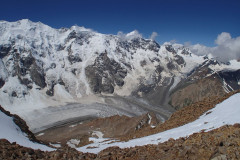
The highest mountain in Georgia is Mount Shkhara at 5,068 meters (16,627 ft), and the second highest is Mount Janga (Dzhangi-Tau) at 5,059 m (16,598 ft) above sea level. Other prominent peaks include Mount Kazbek at 5,047 m (16,558 ft), Shota Rustaveli 4,860 m (15,945 ft), Tetnuldi 4,858 m (15,938 ft), Mt. Ushba 4,700 m (15,420 ft), and Ailama 4,547 m (14,918 ft). Out of the abovementioned peaks, only Kazbek is of volcanic origin. The region between Kazbek and Shkhara (a distance of about 200 km (124 mi) along the Main Caucasus Range) is dominated by numerous glaciers. Out of the 2,100 glaciers that exist in the Caucasus today, approximately 30% are located within Georgia.
The term Lesser Caucasus Mountains is often used to describe the mountainous (highland) areas of southern Georgia that are connected to the Greater Caucasus Mountain Range by the Likhi Range. The area can be split into two separate sub-regions; the Lesser Caucasus Mountains, which run parallel to the Greater Caucasus Range, and the Southern Georgia Volcanic Highland, which lies immediately to the south of the Lesser Caucasus Mountains.
The overall region can be characterized as being made up of various, interconnected mountain ranges (largely of volcanic origin) and plateaus that do not exceed 3,400 meters (11,155 ft) in elevation. Prominent features of the area include the Javakheti Volcanic Plateau, lakes, including Tabatskuri and Paravani, as well as mineral water and hot springs. Two major rivers in Georgia are the Rioni and the Mtkvari. The Southern Georgia Volcanic Highland is a young and unstable geologic region with high seismic activity and has experienced some of the most significant earthquakes that have been recorded in Georgia.
The Krubera Cave is the deepest known cave in the world. It is located in the Arabika Massif of the Gagra Range, in Abkhazia. In 2001, a Russian–Ukrainian team had set the world depth record for a cave at 1,710 meters (5,610 ft). In 2004, the penetrated depth was increased on each of three expeditions, when a Ukrainian team crossed the 2,000-meter (6,562 ft) mark for the first time in the history of speleology. In October 2005, an unexplored part was found by the CAVEX team, further increasing the known depth of the cave. This expedition confirmed the known depth of the cave at 2,140 meters (7,021 ft).
Topography
The landscape within the nation's boundaries is quite varied. Western Georgia's landscape ranges from low-land marsh-forests, swamps, and temperate rainforests to eternal snows and glaciers, while the eastern part of the country even contains a small segment of semi-arid plains. Forests cover around 40% of Georgia's territory while the alpine/subalpine zone accounts for roughly around 10 percent of the land.
Much of the natural habitat in the low-lying areas of western Georgia has disappeared during the past 100 years because of the agricultural development of the land and urbanization. The large majority of the forests that covered the Colchis plain are now virtually non-existent with the exception of the regions that are included in the national parks and reserves (e.g. Lake Paliastomi area). At present, the forest cover generally remains outside of the low-lying areas and is mainly located along the foothills and the mountains. Western Georgia's forests consist mainly of deciduous trees below 600 meters (1,969 ft) above sea level and contain species such as oak, hornbeam, beech, elm, ash, and chestnut. Evergreen species such as box may also be found in many areas. Ca. 1000 of all 4000 higher plants of Georgia are endemic in this country.
The west-central slopes of the Meskheti Range in Ajaria as well as several locations in Samegrelo and Abkhazia are covered by temperate rain forests. Between 600–1,000 metres (1,969–3,281 ft) above sea level, the deciduous forest becomes mixed with both broad-leaf and coniferous species making up the plant life. The zone is made up mainly of beech, spruce, and fir forests. From 1,500–1,800 metres (4,921–5,906 ft), the forest becomes largely coniferous. The tree line generally ends at around 1,800 metres (5,906 ft) and the alpine zone takes over, which in most areas, extends up to an elevation of 3,000 metres (9,843 ft) above sea level. The eternal snow and glacier zone lies above the 3,000 metre line.
Eastern Georgia's landscape (referring to the territory east of the Likhi Range) is considerably different from that of the west, although, much like the Colchis plain in the west, nearly all of the low-lying areas of eastern Georgia including the Mtkvari and Alazani River plains have been deforested for agricultural purposes. In addition, because of the region's relatively drier climate, some of the low-lying plains (especially in Kartli and south-eastern Kakheti) were never covered by forests in the first place.
The general landscape of eastern Georgia comprises numerous valleys and gorges that are separated by mountains. In contrast with western Georgia, nearly 85 percent of the forests of the region are deciduous. Coniferous forests only dominate in the Borjomi Gorge and in the extreme western areas. Out of the deciduous species of trees, beech, oak, and hornbeam dominate. Other deciduous species include several varieties of maple, aspen, ash, and hazelnut. The Upper Alazani River Valley contains yew forests.
At higher elevations above 1,000 metres (3,281 ft) above sea level (particularly in the Tusheti, Khevsureti, and Khevi regions), pine and birch forests dominate. In general, the forests in eastern Georgia occur between 500–2,000 metres (1,640–6,562 ft) above sea level, with the alpine zone extending from 2,000–2,300 to 3,000–3,500 metres (6,562–7,546 to 9,843–11,483 ft). The only remaining large, low-land forests remain in the Alazani Valley of Kakheti. The eternal snow and glacier zone lies above the 3,500-metre (11,483 ft) line in most areas of eastern Georgia.
Biodiversity
Because of its high landscape diversity and low latitude, Georgia is home to about 5,601 species of animals, including 648 species of vertebrates (more than 1% of the species found worldwide) and many of these species are endemics. A number of large carnivores live in the forests, namely Brown bears, wolves, lynxes and Caucasian Leopards. The common pheasant (also known as the Colchian Pheasant) is an endemic bird of Georgia which has been widely introduced throughout the rest of the world as an important game bird. The species number of invertebrates is considered to be very high but data is distributed across a high number of publications. The spider checklist of Georgia, for example, includes 501 species.
Slightly more than 6,500 species of fungi, including lichen-forming species, have been recorded from Georgia, but this number is far from complete. The true total number of fungal species occurring in Georgia, including species not yet recorded, is likely to be far higher, given the generally accepted estimate that only about 7 percent of all fungi worldwide have so far been discovered. Although the amount of available information is still very small, a first effort has been made to estimate the number of fungal species endemic to Georgia, and 2595 species have been tentatively identified as possible endemics of the country. 1729 species of plants have been recorded from Georgia in association with fungi. The true number of plant species occurring in Georgia is likely to be substantially higher.
Culture
Georgian culture evolved over thousands of years with its foundations in the Iberian and Colchian civilizations, continuing with the rise of the unified Georgian Kingdom under the single monarchy of the Bagrationi. Georgian culture enjoyed a golden age and renaissance of classical literature, arts, philosophy, architecture and science in the 11th century.
The Georgian language, and the Classical Georgian literature of the poet Shota Rustaveli, were revived in the 19th century after a long period of turmoil, laying the foundations of the romantics and novelists of the modern era such as Grigol Orbeliani, Nikoloz Baratashvili, Ilia Chavchavadze, Akaki Tsereteli, Vazha Pshavela, and many others. Georgian culture was influenced by Classical Greece, the Roman Empire, the Byzantine Empire, the various Iranian empires (notably the Achaemenid, Parthian, Sassanian, Safavid and Qajar empires), and later, from the 19th century, by the Russian Empire.
Georgians have their own unique three alphabets which according to traditional accounts were invented by King Pharnavaz I of Iberia in the 3rd century BC.
Georgia is known for its rich folklore, unique traditional music, theatre, cinema, and art. Georgians are renowned for their love of music, dance, theatre and cinema. In the 20th century there have been notable Georgian painters such as Niko Pirosmani, Lado Gudiashvili, Elene Akhvlediani; ballet choreographers such as George Balanchine, Vakhtang Chabukiani, and Nino Ananiashvili; poets such as Galaktion Tabidze, Lado Asatiani, and Mukhran Machavariani; and theatre and film directors such as Robert Sturua, Tengiz Abuladze, Giorgi Danelia and Otar Ioseliani.
Architecture and arts
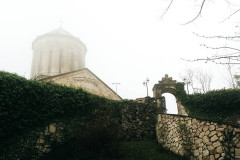
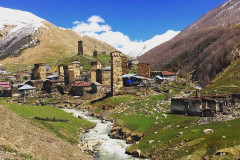
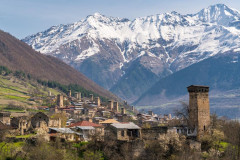
Georgian architecture has been influenced by many civilizations. There are several different architectural styles for castles, towers, fortifications and churches. The Upper Svaneti fortifications, and the castle town of Shatili in Khevsureti, are some of the finest examples of medieval Georgian castle architecture. Other architectural aspects of Georgia include Rustaveli avenue in Tbilisi in the Hausmann style, and the Old Town District.
Georgian ecclesiastic art is one of the most notable aspects of Georgian Christian architecture, which combines the classical dome style with the original basilica style, forming what is known as the Georgian cross-dome style. Cross-dome architecture developed in Georgia during the 9th century; before that, most Georgian churches were basilicas. Other examples of Georgian ecclesiastic architecture can be found outside Georgia: Bachkovo Monastery in Bulgaria (built in 1083 by the Georgian military commander Grigorii Bakuriani), Iviron monastery in Greece (built by Georgians in the 10th century), and the Monastery of the Cross in Jerusalem (built by Georgians in the 9th century). One of the most famous late 19th/early 20th century Georgian artists was primitivist painter Niko Pirosmani.
Music
Georgia has a rich and vibrant musical tradition, primarily known for its early development of polyphony. Georgian polyphony is based on three vocal parts, a unique tuning system based on perfect fifths, and a harmonic structure rich in parallel fifths and dissonances. Each region in Georgia has its own traditional music; polyphonic dialogue over a bass background and ostinato-like soloists in the east, complex improvised harmonies in the west, and solid moving chords in Svaneti.
In 1970s, Georgian folk song Chakrulo (Georgian: ჩაკრულო) was chosen for Voyager Golden Record as one of 27 musical compositions and on August 20, 1977, on Voyager 2 that contained a lot of information regarding Earth and its inhabitants was sent in space.
Georgian Polyphonic Singing is a subject of the UNESCO Intangible Heritage List.
Cuisine
Georgian cuisine and wine have evolved through the centuries, adapting traditions in each era. One of the most unusual traditions of dining is supra, or Georgian table, which is also a way of socialising with friends and family. The head of supra is known as tamada. He also conducts the highly philosophical toasts, and makes sure that everyone is enjoying themselves. Various historical regions of Georgia are known for their particular dishes: for example, khinkali (meat dumplings), from eastern mountainous Georgia, and khachapuri, mainly from Imereti, Samegrelo and Adjara. In addition to traditional Georgian dishes, the foods of other countries have been brought to Georgia by immigrants from Russia, Greece, and recently China.