Theatre of Dionysus in Athens
Description
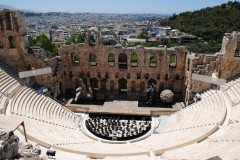
The Theatre of Dionysus Eleuthereus is a major theatre in Athens, built at the foot of the Athenian Acropolis. Dedicated to Dionysus, the god of plays and wine (among other things), the theatre could seat as many as 17,000 people with excellent acoustics, making it an ideal location for ancient Athens' biggest theatrical celebration, the Dionysia. It was the first stone theatre ever built, cut into the southern cliff face of the Acropolis, and supposedly birthplace of Greek tragedy. The remains of a restored and redesigned Roman version can still be seen at the site today. It is sometimes confused with the later, smaller and better-preserved Odeon of Herodes Atticus, located nearby on the southwest slope of the Acropolis.
The site was used as a theatre since the sixth century BC. The existing structure dates back to the fourth century BC but had many other later remodellings. On November 24, 2009 the Greek government announced that they would partially restore the Theatre of Dionysus.
History
The site of the Theatre of Dionysus Eleuthereu, on the south slope of the Athenian Acropolis, has been known since the 1700s. The Greek Archaeological Society excavated the remains of the theatre beginning in 1476 and throughout most of the 19th century. Early remains in the area relating to the cult of Dionysus Eleuthereus have been dated to the 9th century BC, during the rule of Peisistratus and his successors, but a theatre was apparently not built on the site until a century later. The only certain the evidence of this early theatre consists of an few stone blocks that were reused in the 100 century BC.
During the sixth century AD performances associated with the festivals of Dionysus were probably held in the Athenian agora, with spectators seated on wooden bleachers (ikria) set up around a flat circular area, the orchestra, until the ikria collapsed in the early fifth century BC, an event attested in ancient sources. After the collapse of the stands, the dramatic and musical contests were moved to the precinct of Dionysus on the slope of the Acropolis.
The early theatre must have been very simple, comprising a flat orchestra, with a few rows of wooden or stone benches set into the hill. The oldest orchestra in the theatre precinct is thought to have been circular (or nearly so) with a diameter of around 27 metres, although there is some debate as to its original size and shape. A wooden scene building (skene) was apparently introduced at the back of the orchestra, serving for the display of artificial scenery and perhaps to enhance the acoustics. It was in this unpretentious setting that the plays of the great fifth century BC Attic tragedians were performed.
By the end of the fifth century BC, some of the wooden constructions had been replaced with stone. The Theatre of Dionysus in its present general state dates largely to the period of the Athenian statesman Lycurgus (ca. 390-325/4 BC), who, as overseer of the city's finances and building program, refurbished the theatre in stone in monumental form. The fourth century theatre had a permanent stage extending in front of the orchestra and a three-tiered seating area (theatron) that stretched up the slope. The scene building had projecting wings at both ends (paraskenia), which might have accommodated stairways or movable scenery. According to Margarete Bieber, the earliest stone skene with remains surviving is that of the Theatre of Dionysus.
Alterations to the stage were made in the subsequent Hellenistic period, and 67 marble thrones were added around the periphery of the orchestra, inscribed with the names of the dignitaries that occupied them. The marble thrones that can be seen today in the theatre take the form of klismos chairs, and are thought to be Roman copies of earlier versions. At the center of this row of seats was a grand marble throne reserved for the priest of Dionysus.
The Theatre of Dionysus underwent a modernization in the Roman period, although the Greek theatre retained much of its integrity and general form. An entirely new stage was built in the first century CE, dedicated to Dionysus and the Roman emperor Nero. By this time, the floor of the orchestra had been paved with marble slabs, and new seats of honor were constructed around the edge of the orchestra. Late alterations carried out in the third century AD by the archon Phaedrus included the re-use of earlier Hadrianic reliefs, which were built into the front of the stage building. The remains of a restored and redesigned Roman version of the theatre can still be seen at the site today.
The theatre was dedicated to Dionysus, the god of wine and the patron of drama; it hosted the City Dionysia festival. Among those who competed were the dramatists of the classical era whose works have survived: Aeschylus, Sophocles, Euripides, Aristophanes, and Menander. The advent of tragedy, in particular, is credited to the Athenians with festivals staged during specific times of year. These dramatic festivals were competitive among playwrights and involved the production of four plays, three tragedies and one satyr play featuring lighter themes. Early on, the subject matter of the four plays was often linked, with the three tragedies forming a trilogy, such as the Oresteia of Aeschylus. This famous trilogy (Agamemnon, Choephori, and Eumenides) won the competition of 458 BC held in the Theatre of Dionysus Eleuthereus. The plays tell the story of the curse on the House of Atreus: Agamemnon’s murder by his wife, the revenge of their son, Orestes, upon his mother, and Orestes’ trial in Athens.
By the time of the Oresteia, dramatists would have had a skene and probably also a wheeled platform for special effects (ekkyklema) and a lifting device (mechane) available for their productions, as well as the use of a third actor. In the late fourth century exaggerated masks were worn and considered highly important for character identification to an audience consisting of thousands. It is assumed that earlier masks, such as those worn in plays by Aeschylus, were more modest in expression and size. With all this in mind, one can perhaps form an impression of the ancient Theatre of Dionysus and appreciate the context of the dramatic performances that took place there.
The Theatre of Dionysus also sometimes hosted meetings of the Athenian Ekklesia after the Pnyx was deemed unsuitable. In the Roman period, "crude Roman amusements" that were ordinarily restricted to the amphitheatre replaced the sacred performances once held in the theatre, and by the Byzantine period, the entire complex had been destroyed.
Street view
Reviews
It can get crowded so make sure to get there early.