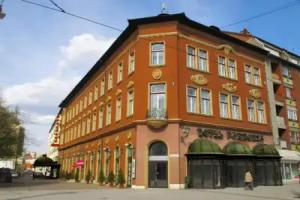
Miskolc
Description
Miskolc , Slovak: Miškovec, German: Mischkolz) is a city in northeastern Hungary, known for its heavy industry. With a population of 161,265 (1st Jan 2014) Miskolc is the fourth largest city in Hungary (behind Budapest, Debrecen, and Szeged, the second-largest with agglomeration). It is also the county capital of Borsod-Abaúj-Zemplén and the regional centre of Northern Hungary.
Geography
Trams 1 & 2 on Széchenyi streetMiskolc is located at 48°6′15″N 20°47′30″E / 48.10417°N 20.79167°E / 48.10417; 20.79167.
The city lies at the meeting point of different geographical regions – east from the Bükk mountains, in the valley of the river Sajó and the streams Hejő and Szinva. According to the 2001 Census the city has a total area of 236.68 km2 (91.38 sq mi). The ground level slopes gradually; the difference between the highest and lowest area is about 800 m (2,600 ft).
The lowest areas are the banks of the river Sajó, with an altitude of 110–120 m (360–390 ft). The area belongs to the Great Plain region and is made up of sedimentary rocks. Between the Avas hill and Diósgyőr lies the hilly area of the Lower Bükk (250–300 m or 820–980 ft) consisting of sandstone, marl, clay, layers of coal, from the tertiary period, and volcanic rocks from the Miocene.
The Central Bükk, a gently sloping mountainous area with an altitude between 400 and 600 m (1,300 and 2,000 ft), is situated between Diósgyőr and Lillafüred; the area is made up of limestone, slate, dolomite and other rocks from the Triassic period. The surface was formed mostly by karstic erosions.
The highest area, the 600–900 m (2,000–3,000 ft) high Higher Bükk bore Bükk Highlands begin at Lillafüred. This mostly consists of sea sediments (limestone, slate, dolomite) from the Paleozoic and Mesozoic, and volcanic rocks like diabase and porphyry. Several caves can be found in the area. The city is also known for lowest measured temperature ever in Hungary with −35 °C (−31 °F).
History
The area has been inhabited since ancient times – archaeological findings date back to the Paleolithic, proving human presence for over 70,000 years. Its first known dwellers were the Cotini, one of the Celt tribes. The area has been occupied by Hungarians since the "Conquest" in the late 9th century. It was named after the Miskóc clan and was first mentioned by this name around 1210 AD. The Miskóc clan lost their power when King Charles I centralized his power by curbing the power of the oligarchs.
Miskolc was elevated to the rank of oppidum (market town) in 1365 by King Louis I. He also had the castle of the nearby town Diósgyőr (now a district of Miskolc) transformed into a Gothic fortress. The city developed in a dynamic way, but during the Ottoman occupation of most of Hungary the development of Miskolc was brought to a standstill. The Turks burnt Miskolc in 1544 and the city had to pay heavy taxes until 1687. It was also ruled by Ottomans after Battle of Mezőkeresztes in 1596 as part of Eyalet of Egir until 1687. It was during these years that Miskolc became an important centre of wine-growing. By the end of the 17th century the population of the city was as large as that of Kassa, and 13 guilds had been founded.
During the war of independence against Habsburg rule in the early 18th century, Prince Francis II Rákóczi, the leader of the Hungarians put his headquarters in Miskolc. The imperial forces sacked and burnt the city in 1707. Four years later half of the population fell victim of a cholera epidemic. Miskolc recovered quickly, and another age of prosperity began again. In 1724, Miskolc was chosen to be the city where the county hall of Borsod county would be built. Many other significant buildings were built in the 18th and 19th centuries, including the city hall, schools, churches, the synagogue, and the theatre. The theatre is commonly regarded as the first stone-built theatre of Hungary, although the first one was actually built in Kolozsvár (then a part of Hungary, now Cluj-Napoca, Romania). According to the first nationally held census (1786) the city had a population of 14,719, and 2,414 houses.
Elizabeth SquareThese years brought prosperity, but the cholera epidemic of 1873 and the flood of 1878 took many lives. Several buildings were destroyed by the flood, but bigger and more beautiful buildings were built in their places. World War I did not affect the city directly, but many people died, either from warfare or from the cholera epidemic. She was occupied by Czechoslovak troops between 1918 and 1919 after the First World War.
After the Treaty of Trianon, Hungary lost Kassa (today Košice, Slovakia) and Miskolc became the sole regional center of northern Hungary. This was one of the reasons for the enormous growth of the city during the 1930s and 1940s. The preparation for World War II established Miskolc as the national centre of heavy industry, a position the city maintained until the 1990s. Although Miskolc suffered a lot during the last year of the war, it recovered quickly, and by absorbing the surrounding villages, it became the second-largest city of Hungary with more than 200,000 inhabitants.
In July 30 and August 1, 1946, the Miskolc pogrom led to death of one accused Jewish black marketeer, the wounding of another, and subsequently the death of a Jewish policeman. Economic hardship and anti-Semitism motivated the riots.
In 1949, the University of Miskolc was founded (as a successor of the Academy of Mining, formerly in Selmecbánya, which is now Banská Štiavnica, Slovakia).
During its long history Miskolc survived fires, floods, plagues and foreign invasions, but maintained its position as the centre of northeastern Hungary. The 1990s brought a crisis in the iron industry with a decline in the population.
Miskolc is now trying to become known as a cultural – instead of merely an industrial – city. Among the various cultural events, one of the most important festivities is the International Opera Festival, held in every summer.
The most popular tourist destinations in Miskolc are Tapolca, Lillafüred and Felsőhámor. Tapolca has a beautiful park with a boating pond and the famous and unique Cave Bath. Lillafüred and Felsőhámor are pretty villages in a valley surrounded by mountains and forests; their most famous sights are the Hotel Palace on the shore of the Lake Hámori, the Szinva waterfall (the highest waterfall of the country), the Anna Cave and the István Cave.
Historical population
Historical population Year Pop. ±% 1870 21,199 — 1890 30,408 +43.4% 1900 61,160 +101.1% 1910 76,207 +24.6% 1920 85,151 +11.7% 1930 93,877 +10.2% 1941 114,674 +22.2% 1949 109,124 −4.8% 1960 143,903 +31.9% 1970 180,581 +25.5% 1980 207,303 +14.8% 1990 196,442 −5.2% 2001 185,567 −5.5% 2011 167,754 −9.6% 2013 162,905 −2.9% 2014 161,265 −1.0%City parts of Miskolc
Avas
The Avas is a hill (234 m or 768 ft) in the heart of Miskolc. On the hilltop stands the Avas lookout tower, the symbol of the city. On the northern part of the hill, close to downtown Erzsébet Square, is the Gothic Protestant Church of Avas, one of the two oldest buildings of Miskolc (the other is the Castle of Diósgyőr.) The limestone caves of Avas are used as wine cellars; the narrow, winding streets give a Mediterranean atmosphere to this part of Avas Hill. The southern part of Avas, also called Avas-South, is where the largest housing estate of the city stands, with 10-story Socialist-style concrete buildings providing homes for about one-third of the city's population.
Belváros (City centre)
Miskolc's city centre is not as rich in monuments as that of other cities; only the Main Street (Széchenyi St.), Városház tér (City Hall Square) and Erzsébet tér (Elizabeth Square) have preserved the 19th-century style of the town. There are not only historical buildings but also modern shopping malls and offices in the city centre.
Diósgyőr
The other town forming today's Greater Miskolc is mostly famous for its medieval castle. Miskolc's football team also got its name from Diósgyőr, since their stadium stands there. Historical Diósgyőr is connected to Historical Miskolc by a district called Új(diós)győr (Újgyőr); its main square is an important traffic hub. Also in Új(diós)győr (Diósgyőr-Vasgyár) stands the steel factory that made Miskolc the most important heavy industrial city of Hungary (and earned it the nickname "Steel City").
Egyetemváros (University Town)
The University of Miskolc is among the newer ones. It was founded in the 1950s, so its buildings are not old, historical ones. University Town is one of the newer parts of the city and can be found between Miskolc and the holiday resort Miskolctapolca. The university, the campus, and the sport facilities are surrounded by a large park.
Hejőcsaba and Görömböly
Two former villages that were annexed to the city in 1945 and 1950. Görömböly still looks like a small town of its own.
Lillafüred
The other famous holiday resort, Miskolc-Lillafüred is a picturesque village surrounded by the Bükk mountains. Its most famous building is the beautiful Palace Hotel (Palotaszálló).
Martin-Kertváros
Martin-Kertváros (in Slovak: Martinská osada) is a suburban area.
Miskolctapolca
One of the most well-known holiday resorts in the country, Tapolca (officially Miskolctapolca or Miskolc-Tapolca to avoid confusion with the Transdanubian town of the same name) is the home of the unique Cave Bath, a natural cave with thermal water. Tapolca is quite far from the city centre and counts as one of the posh areas of Miskolc. It is a popular tourist attraction.
Alsóhámor, Bükkszentlászló, Felsőhámor, Ómassa, Szirma
These former villages were annexed to the city in 1950 (Bükkszentlászló in 1981) and are still separated villages, connected to the city only by its public transport system.
Main sights
Downtown
- Main street and City Hall Square with the atmosphere of Hungarian towns of the 19th century
- Gothic Protestant Church of the Avas Hill
- Greek Orthodox Church with the largest iconostasis in Central Europe
- House of Arts with two art cinemas
- Kós House (designed by Károly Kós in Art Nouveau and folk style, 1931)
- Mindszent Church
- Minorite Church and Heroes' Square
- Miskolc-Avas TV Tower
- National Theatre of Miskolc
- Csodamalom Puppet Theatre
- Ottó Herman Museum
- Palace of Music
- Wooden Church
Diósgyőr
- Castle of Diósgyőr (built in the 13th century, had its prime during the reign of Louis the Great; medieval castle plays are held in every August)
- Lutheran church of Diósgyőr
- Protestant church of Diósgyőr (Baroque, built on the ruins of a mediaeval monastery)
Lillafüred
- Anna Cave, István Cave, Szeleta Cave
- Hotel Palace
- Lake Hámori
- Trout Farm
- Waterfalls (the highest one in Hungary)
There is a narrow-gauge railway that connects Lillafüred to Miskolc known as the Lillafüredi Állami Erdei Vasút (Lillafüred Forest State Railway). It winds through scenic forests, and takes between a half hour and 45 minutes for the train to go between the two major stops. The Miskolc stop is located in Diósgyőr.
Miskolctapolca
- Cave Bath of Miskolctapolca
Near to the city
- Bánkút ski resort
- Bükk Mountains
- Miskolc Zoo
- Ruins of the monastery at Szentlélek
* Castell Earl Andrassy Tiszadob
Festivals
- Diósgyőr Castle Plays (every May and August)
- International Soldiers and Military Bands Festival (every two years in August)
- Jelly festival (February)
- Miskolc Opera Festival (every summer)
- CineFest – International Festival of Young Filmmakers (every September)
Public transport
Public transport in Miskolc is provided by the company MVK Zrt., owned by the local government. There are 36 bus lines and 2 tram lines. The first tram entered service on July 10, 1897 (making Miskolc the third city in Hungary to have a tram line), the first scheduled bus line started on June 8, 1903 (first in the country as well.) Today the public transport of Miskolc is one of the best ones in Hungary. There are several taxi companies too.
The Lillafüred Forest Train connects Diósgyőr to Lillafüred. It is mainly a tourist attraction.
The city has two railway stations (Tiszai and Gömöri) and a small unpaved airport, which is not open to the public, used mainly as a sports facility and has no role in public transport since 1963.
Notable individuals
Including people born in Miskolc as well as in Diósgyőr and other city parts that were independent towns at the time of their birth.
- Alan A. Brown (1928–2010) economist
- Alexander Grossmann (1909–2003) Swiss writer, journalist
- Andrei Șaguna (1809–1873) Romanian political leader, orthodox Metropolitan bishop of Transylvania
- Árpád Latabár sr. (1878–1951) actor
- Attila Pataky (1951) singer, UFO specialist, End of the World consultant
- Attila Repka (1968) wrestler, Olympic champion
- Bela Borsody Bevilaqua (1885–1962) Cultural historian
- Dániel Nyitray (1890–1971) painter, sculptor
- Dezső Dobrosi (1967) singer-songwriter, journalist, TV personality [now lives in the United States]
- Dezső Gyarmati (1927) water polo player
- Ede Reményi (1828–1898) violinist
- Emeric Pressburger (1902–1988) Academy Award–winning movie director/writer/producer
- Endre Granat (1937) violinist
- Ferenc Demjén (1941) singer
- Gábor Dayka (1769–1796) poet
- Gizella Bodnár, "Airplane Gizi" (1926–) thief
- Ilona Kállay (1930–2005) actress
- István Jónyer (1951) table tennis player
- István Prókai (1920–1983) actor
- Ladislau Raffinsky (1905–1981), Romanian football player
- Júlia Sebestyén (1981) figure skater, Europe champion
- Julius Leopold Klein (1810–1876) German writer
- Károly Grósz (1930–1996) politician, president
- László Palóczy (1783–1861) politician
- Lőrinc Szabó (1900–1957) poet
- Mária Keresztessy (1908–1977) actress
- János Nagyváthy (1755–1819) Hungarian journalist
- Máté Kamarás (1976) musical actor
- Miklos Kover (1975) controller, member of Holt Dog
- Péter Biros (1976) water polo player
- Péter Kropkó (1963) triathlonist
- Róza Laborfalvi (1817–1886) actress
- Sándor Ferenczi (1873–1933) psychoanalyst
- Sándor Lukács (1947) actor
- Sándor Rónai (1892–1965) politician, president
- Szabolcs Huszti (1983) football player
- Tamas Varro (1975) engineer, member of Miskolci Kan Korus
- Tibor Benedek (1911–1963) actor
- Vera Schmidt (1982) singer-songwriter
- Zoltán Dunai (1935)
- Zsigmond Fülöp (1935) actor
Lived in Miskolc
- Béla Kondor (Pestlőrinc, 1931 – Budapest, 1972) graphics artist
- Béni Egressy (Sajókazinc, 1814 – Budapest, 1851) composer
- Bertalan Szemere (Vatta, 1818 – Budapest, 1869) politician
- Didák Kelemen (Kézdialmás-Baksafalva, 1683 – Miskolc, 1744) Minorite monk, founder of Ferenc Földes High School
- Ferenc Bessenyei (Hódmezővásárhely, 1919 – Lajosmizse, 2004) actor
- Ferenc Pulszky (Eperjes, 1814 – Budapest, 1897) politician, archaeologist, writer
- János Lavotta (Pusztafödémes, 1764 – Tállya, 1820) composer, violinist
- József Lévay (Sajószentpéter, 1825 – Miskolc, 1918) poet, politician
- Lajos Szalay (Őrmező, 1909 – Miskolc, 1995) painter
- Leo Lánczy (Pest, 1852 – Budapest, 1921) deputy
- Margit Kaffka (Nagykároly, 1880 – Budapest, 1918) writer
- Menachem Josef Heimlich (Hajdu Bogasz, 1890 – Miskolc, 1925–1944) grand rabbi
- Ottó Herman (Breznóbánya, 1835 – Miskolc, 1914) ornithologist, polyhistor
- Pavol Országh Hviezdoslav (Felsőkubin, 1849 – Alsókubin, 1921) Slovak poet
- Robert Szucs (Toronto, 1974 – Miskolc, 1976–1989, teacher, social worker, member of Holt Dog and Miskolci Kan Korus
- Róza Széppataki-Déry (Jászberény, 1793 – Miskolc, 1872) actress
- Teréz Karacs (Budapest, 1808 – Békés, 1892) pioneer in women's education
- Zénó Terplán (Hegyeshalom, 1921 – Miskolc, 2002) fellow of the Hungarian Academy of Sciences


