Aosta Valley
Description
The Aosta Valley (Italian: Valle d'Aosta [ˈvalle daˈɔsta] (official) or Val d'Aosta (usual); French: Vallée d'Aoste [vale daɔst]/[vale dɔst] (official) or Val d'Aoste (usual); Arpitan: Val d'Outa) is a mountainous semi-autonomous region in northwestern Italy. It is bordered by Rhône-Alpes, France to the west, Valais, Switzerland to the north and the region of Piedmont to the south and east.
Covering an area of 3,263 km2 (1,260 sq mi) and with a population of about 128,000 it is the smallest, least populous, and least densely populated region of Italy. It is the only Italian region that has no provinces (the province of Aosta was dissolved in 1945). Provincial administrative functions are provided by the regional government. The region is divided into 74 comuni (communes).
Italian and French are the official languages, though much of the native population also speak Valdôtain, a dialect of Arpitan, as their home language; about half of the population can speak all three languages.
The regional capital is Aosta.
Geography
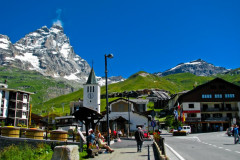
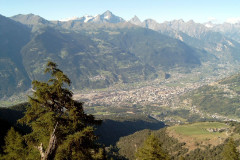
The Aosta Valley is an Alpine valley which with its tributary valleys includes the Italian slopes of Mont Blanc, Monte Rosa, Gran Paradiso and the Matterhorn; its highest peak is Mont Blanc.
History
The first inhabitants of the Aosta Valley were Celts and Ligures, whose language heritage remains in some local placenames. Rome conquered the region from the local Salassi around 25 BC and founded Augusta Prætoria Salassorum (modern-day Aosta) to secure the strategic mountain passes, and they went on to build bridges and roads through the mountains. Thus, the name Valle d'Aosta literally means "Valley of Augustus".
In 1031–1032 Humbert I of Savoy, the founder of the House of Savoy, received the title Count of Aosta from Emperor Conrad II of the Franconian line and built himself a commanding fortification at Bard. Saint Anselm of Canterbury was born in Aosta in 1033 or 1034. The region was divided among strongly fortified castles, and in 1191 Thomas I of Savoy found it necessary to grant to the communes a Charte des franchises ("Charter of Liberties") that preserved autonomy—rights that were fiercely defended until 1770, when they were revoked in order to tie Aosta more closely to Piedmont, but which were again demanded during post-Napoleonic times. In the mid-13th century Emperor Frederick II made the County of Aosta a duchy (see Duke of Aosta), and its arms charged with a lion rampant were carried in the Savoy arms until the reunification of Italy in 1870.
The region remained part of Savoy lands, with the exceptions of French occupations from 1539 to 1563, later in 1691, then between 1704 and 1706. As part of the Kingdom of Sardinia it joined the new Kingdom of Italy in 1861. It was also ruled by the First French Empire between 1800 and 1814. During French rule, it was part of Aoste arrondissement in Doire department.
Under Mussolini, a forced programme of Italianization, including the translation of all toponyms into Italian and population transfers of Italian-speaking workers from the rest of Italy into Aosta, fostered movements towards separatism. Many Valdostans chose to emigrate to France and Switzerland (where Valdostan communities are still present).
The region gained special autonomous status after the end of World War Two; the province of Aosta ceased to exist in 1945.
Culture
Cuisine
The cuisine of Aosta Valley is characterized by simplicity and revolves around "robust" ingredients such as potatoes, polenta; cheese and meat; and rye bread. Many of the dishes involve Fontina, a cheese with PDO status, made from cow's milk that originates from the valley. It is found in dishes such as the soup à la vâpeuleunèntse (Valpelline Soup). Other cheeses made in the region are Toma and Seras. Fromadzo (Valdôtain for cheese) has been produced locally since the 15th century and also has PDO status.
Regional specialities, besides Fontina, are Motzetta (dried chamois meat, prepared like prosciutto), Vallée d'Aoste Lard d'Arnad (a cured and brined fatback product with PDO designation), Vallée d’Aoste Jambon de Bosses (a kind of ham, likewise with PDO designation), and a black bread.
Notable dishes include Carbonnade, consisting of salt-cured beef cooked with onions and red wine served with polenta; breaded veal cutlets called costolette; teuteuns, salt-cured cow's udder that is cooked and sliced; and steak à la valdôtaine, a steak with croûtons, ham and melted cheese.
Wine growing
Notable wines include two white wines from Morgex (Blanc de Morgex et de La Salle and Chaudelune), a red wine blend from Arvier (Enfer d'Arvier), and a Gamay.
Languages
The Aosta Valley was the first government authority to adopt Modern French as the official language in 1536, three years before France itself. Italian and French are nowadays the region's official languages and are used for the regional government's acts and laws, though Italian is much more widely spoken in everyday life, and French is mostly spoken in cultural life. School education is delivered equally in both Italian and French so that everyone who went to school in Aosta Valley can speak French to at least a medium-high level.
The regional language is a dialect of Franco-Provençal called Valdotain (locally, patois). It is spoken as native tongue and as second language by 68,000 residents, about 58% of the population, according to a poll taken by the Fondation Émile Chanoux in 2002. The residents of the villages of Gressoney-Saint-Jean, Gressoney-La-Trinité and Issime, in the Lys Valley, speak two dialects of Walser German origin called Titsch and Töitschu respectively.
Use of languages by the population (2001) Italian 96.01% Aostan French 75.41% Valdôtain (Franco-Provençal) 55.77% All three languages 50.53%Castles
There are a number of medieval castles and fortified houses in the Aosta Valley, including Châtel-Argent and Tour de Châtelard.