
Maldives
Hotels
Regions (6)
Towns (4)

Description
The Maldives , officially the Republic of Maldives (Maldivian: ދިވެހިރާއްޖޭގެ ޖުމްހޫރިއްޔާ, Dhivehi Raa'jeyge Jumhooriyya), is a South Asian island country, located in the Indian Ocean, situated in the Arabian Sea. It lies southwest of India and Sri Lanka. The chain of twenty-six atolls stretches from Ihavandhippolhu Atoll in the north to the Addu City in the south. Comprising a territory spanning roughly 90,000 square kilometres (35,000 sq mi), the Maldives is one of the world's most geographically dispersed countries, as well as the smallest Asian country by both land area and population, with a little over 393,500 inhabitants. Malé is the capital and most populated city, traditionally called the "King's Island" for its central location.
The Maldives archipelago is located atop the Chagos-Maldives-Laccadive Ridge, a vast submarine mountain range in the Indian Ocean, which also forms a terrestrial ecoregion, together with the Chagos and the Lakshadweep. With an average ground-level elevation of 1.5 metres (4 ft 11 in) above sea level, it is the world's lowest country, with even its highest natural point being the lowest in the world, at 2.4 metres (7 ft 10 in). Due to the subsequent risks posed by rising sea-levels, the government has pledged to make the Maldives a carbon-neutral country by 2019.
The Maldives have been historically and culturally linked to the Indian subcontinent since the fourth century BCE. The Maldivian archipelago was Islamised in the 12th century and consolidated as a sultanate, developing strong commercial and cultural ties with Asia and Africa. From the mid 16th-century, the region came under the increasing influence of colonial powers, with the Maldives becoming a British protectorate in 1887. Independence from the United Kingdom was achieved in 1965 and a presidential republic was established in 1968 with an elected People's Majlis. The ensuing decades have been characterised by political instability, efforts at democratic reform, and environmental challenges posed by climate change.
The Maldives is a founding member of the South Asian Association for Regional Cooperation (SAARC). It is also a member of the United Nations, the Organization of Islamic Cooperation and the Non Aligned Movement. The World Bank classifies the Maldives as having an upper middle income economy. Fishing has historically been the dominant economic activity, and remains the largest sector by far, followed by the rapidly growing tourism industry. Along with Sri Lanka, it is one of only two South Asian countries rated "high" on the Human Development Index (HDI), with its per capita income the highest among SAARC nations.
The Maldives was a Commonwealth republic from July 1982 until its withdrawal from the Commonwealth in October 2016 in protest at international criticism of its records in relation to corruption and human rights.
Toponymy
The name Maldives may derive from the Malayalam words maala (garland) and dweepu (island) or the Tamil maalai (garland / evening) and theevu (island), or මාල දිවයින (Maala Divaina, "Necklace Islands") in Sinhala. The Maldivian people are called Dhivehin. The word theevu (archaic heevu, related to Tamil தீவு, dheevu) means "island", and Dhives (Dhivehin) means "islanders" (i.e., Maldivians).
The ancient Sri Lankan chronicle Mahawamsa refers to an island called Mahiladiva ("Island of Women", महिलादिभ) in Pali, which is probably a mistranslation of the same Sanskrit word meaning "garland".
Jan S Hogendorn, Grossman Professor of Economics, theorises that the name Maldives derives from the Sanskrit mālādvīpa (मालाद्वीप), meaning "garland of islands". In Tamil, "Garland of Islands" can be translated as Malai Theevu (மாலைத்தீவு). In Malayalam, "Garland of Islands" can be translated as Maladweepu (മാലദ്വീപ്). In Kannada, "Garland of Islands" can be translated as Maaledweepa (ಮಾಲೆದ್ವೀಪ). None of these names is mentioned in any literature, but classical Sanskrit texts dating back to the Vedic period mention the "Hundred Thousand Islands" (Lakshadweepa), a generic name which would include not only the Maldives, but also the Laccadives, Aminidivi Islands, Minicoy and the Chagos island groups.
Some medieval travellers such as Ibn Battuta called the islands Mahal Dibiyat (محل دبيأت) from the Arabic word mahal ("palace"), which must be how the Berber traveller interpreted the local name, having been through Muslim North India, where Perso-Arabic words were introduced to the local vocabulary. This is the name currently inscribed on the scroll in the Maldive state emblem. The classical Persian/Arabic name for Maldives is Dibajat. The Dutch referred to the islands as the Maldivische Eilanden (pronounced [mɑlˈdivisə ˈɛi̯lɑndə(n)]), while the British anglicised the local name for the islands first to the "Maldive Islands" and later to "Maldives."
History
Ancient history and settlement
Comparative studies of Maldivian oral, linguistic and cultural traditions and customs indicate that early settlers were Dravidian people from ancient Tamilakam in the Sangam period (300 BC–AD 300), most probably fishermen from the southwest coasts of what is now the south of the Indian Subcontinent and the western shores of Sri Lanka. One such community is the Giraavaru people descended from ancient Tamils. They are mentioned in ancient legends and local folklore about the establishment of the capital and kingly rule in Malé.
A strong underlying layer of Dravidian population and culture survives in Maldivian society, with a clear Dravidian-Malayalam substratum in the language, which also appears in place names, kinship terms, poetry, dance, and religious beliefs. Malabari seafaring culture led to Malayali settling of the Laccadives, and the Maldives were evidently viewed as an extension of that archipelago. Some argue (from the presence of Jat, Gujjar Titles and Gotra names) that Sindhis also accounted for an early layer of migration. Seafaring from Debal began during the Indus valley civilisation. The Jatakas and Puranas show abundant evidence of this maritime trade; the use of similar traditional boat building techniques in Northwestern South Asia and the Maldives, and the presence of silver punch mark coins from both regions, gives additional weight to this. There are minor signs of Southeast Asian settlers, probably some adrift from the main group of Austronesian reed boat migrants that settled Madagascar.
The earliest written history of the Maldives is marked by the arrival of Sinhalese people, who were descended from the exiled Magadha Prince Vijaya from the ancient city known as Sinhapura. He and his party of several hundred landed in Sri Lanka, and some in the Maldives circa 543 to 483 BC. According to the Mahavansa, one of the ships that sailed with Prince Vijaya, who went to Sri Lanka around 500 BC, went adrift and arrived at an island called Mahiladvipika, which is being identified with the Maldives. It is also said that at that time, the people from Mahiladvipika used to travel to Sri Lanka. Their settlement in Sri Lanka and the Maldives marks a significant change in demographics and the development of the Indo-Aryan language Dhivehi, which is most similar in grammar, phonology, and structure to Sinhala, and especially to the more ancient Elu Prakrit, which has less Pali.
Alternatively, it is believed that Vijaya and his clan came from western India – a claim supported by linguistic and cultural features, and specific descriptions in the epics themselves, e.g. that Vijaya visited Bharukaccha (Bharuch in Gujarat) in his ship on the voyage down south.
Philostorgius, a Greek historian of Late Antiquity, wrote of a hostage among the Romans, from the island called Diva, which is presumed to be the Maldives, who was baptised Theophilus. Theophilus was sent in the 350s to convert the Himyarites to Christianity, and went to his homeland from Arabia; he returned to Arabia, visited Axum, and settled in Antioch.
Buddhist period
Buddhism came to the Maldives at the time of Emperor Ashoka's expansion, and became the dominant religion of the people of the Maldives until the 12th century AD. The ancient Maldivian Kings promoted Buddhism, and the first Maldive writings and artistic achievements, in the form of highly developed sculpture and architecture, are from that period. Before embracing Buddhism as their way of life, Maldivians had practised an ancient form of Hinduism, ritualistic traditions known as Śrauta, in the form of venerating the Surya (the ancient ruling caste were of Aadheetta or Suryavanshi origins).
The first archaeological study of the remains of early cultures in the Maldives began with the work of H.C.P. Bell, a British commissioner of the Ceylon Civil Service. Bell was first ordered to the islands in late 1879 he returned twice to the Maldives to investigate ancient ruins. He studied the ancient mounds, called havitta or ustubu (these names are derived from chaitiya and stupa) (Maldivian: ހަވިއްތަ) by the Maldivians, which are found on many of the atolls. Although Bell asserted that the ancient Maldivians had followed Theravada Buddhism, many local Buddhist archaeological remains now in the Malé Museum in fact also display elements of Mahayana and Vajrayana iconography.
In the early 11th century, the Minicoy and Thiladhunmathi, and possibly other northern Atolls, were conquered by the medieval Chola Tamil emperor Raja Raja Chola I, thus becoming a part of the Chola Empire.
According to a legend from Maldivian folklore, in the early 12th century AD, a medieval prince named Koimala, a nobleman of the Lion Race from Sri Lanka, sailed to Rasgetheemu island (literally "Town of the Royal House", or figuratively "King's Town") in the North Maalhosmadulu Atoll, and from there to Malé, and established a kingdom. By then, the Aadeetta (Sun) Dynasty (the Suryavanshi ruling cast) had for some time ceased to rule in Malé, possibly because of invasions by the Cholas of Southern India in the 10th century. Koimala Kalou (Lord Koimala), who reigned as King Maanaabarana, was a king of the Homa (Lunar) Dynasty (the Chandravanshi ruling cast), which some historians call the House of Theemuge.
The Homa (Lunar) dynasty sovereigns intermarried with the Aaditta (Sun) Dynasty. This is why the formal titles of Maldive kings until 1968 contained references to "kula sudha ira", which means "descended from the Moon and the Sun". No official record exists of the Aadeetta dynasty's reign. Since Koimala's reign, the Maldive throne was also known as the Singaasana (Lion Throne). Before then, and in some situations since, it was also known as the Saridhaaleys (Ivory Throne). Some historians credit Koimala with freeing the Maldives from Chola rule.
Several foreign travellers, mainly Arabs, had written about a kingdom of the Maldives ruled over by a queen. This kingdom pre-dated Koimala's reign. al-Idrisi, referring to earlier writers, mentions the name of one of the queens, Damahaar, who was a member of the Aadeetta (Sun) dynasty.
Islamic Period
The conversion to Islam is mentioned in the edicts written in copper plates from the end of the 12th century AD.
The famous Moroccan traveller Ibn Batutta, who visited the Maldives in the 14th century, wrote how a Moroccan, one Abu Barakat the Berber, was believed to have been responsible for spreading Islam in the islands. Even though this report has been contested in later sources, it does explain some crucial aspects of Maldivian culture. For instance, historically Arabic has been the prime language of administration there, instead of the Persian and Urdu languages used in the nearby Muslim states. Another link to North Africa was the Maliki school of jurisprudence, used throughout most of North Africa, which was the official one in the Maldives until the 17th century.
Some scholars have suggested the possibility of Ibn Battuta misreading Maldive texts, and have posited another scenario where this Abu Barakat might have been a native of Berbera, a significant trading port on the north western coast of Somalia. This scenario would also help explain the usage of the Arabic language and the predominance of the Maliki school on the islands.
Another interpretation, held by some of the islanders, is that Abu Barakat was an Iranian from Tabriz. In the Arabic script the words al-Barbari and al-Tabrizi are very much alike, owing to the fact that at the time, Arabic had several consonants that looked identical and could only be differentiated by overall context (this has since changed by addition of dots above or below letters to clarify pronunciation – For example, the letter "B" in modern Arabic has a dot below, whereas the letter "T" looks identical except there are two dots above it). The first reference to an Iranian origin dates to an 18th-century Persian text.
The Maldives was the first landfall for traders from Basra, sailing to Sri Lanka or Southeast Asia. Bengal was one of the principal trading partners of the Maldives. Shell currency imported from the Maldives was used as legal tender in the Bengal Sultanate and Mughal Bengal, alongside gold and silver. The Maldives received rice in exchange for cowry shells. The Bengal-Maldives cowry shell trade was the largest shell currency trade network in history. In the Maldives, ships could take on fresh water, fruit and the delicious, basket-smoked red flesh of the black bonito, a delicacy exported to Sindh, China and Yemen. The people of the archipelago were described as gentle, civilised and hospitable. They produced brass utensils as well as fine cotton textiles, exported in the form of sarongs and turban lengths. These local industries must have depended on imported raw materials.
The other essential product of the Maldives was coir, the fibre of the dried coconut husk. Cured in pits, beaten, spun and then twisted into cordage and ropes, coir's salient quality is its resistance to saltwater. It stitched together and rigged the dhows that plied the Indian Ocean. Maldivian coir was exported to Sindh, China, Yemen, and the Persian Gulf.
"It is stronger than hemp", wrote Ibn Battuta, "and is used to sew together the planks of Sindhi and Yemeni dhows, for this sea abounds in reefs, and if the planks were fastened with iron nails, they would break into pieces when the vessel hit a rock. The coir gives the boat greater elasticity, so that it doesn't break up."
British protectorate, 1887–1965
On 16 December 1887, the Sultan of the Maldives signed a contract with the British Governor of Ceylon turning the Maldives into a British protected state, thus giving up the islands' sovereignty in matters of foreign policy, but retaining internal self-government. The British government promised military protection and non-interference in local administration in exchange for an annual tribute. The status of the islands were akin to other British protectorates in the Indian Ocean region, including Zanzibar and the Trucial States.
In 1957, the British established an air base, RAF Gan, in the strategic southernmost atoll of Addu, paying £2000 a year, employing hundreds of locals. This served as a staging post for British military flights to the Far East and Australia, replacing RAF Mauripur in Pakistan which had been relinquished in 1956. The base was closed in 1976 as part of the larger British withdrawal of permanently stationed forces 'East of Suez' initiated by Labour government of Harold Wilson.
In 1953, there was an abortive attempt to form a republic, but the sultanate survived. In 1959, objecting to Ibrahim Nasir's centralism, the inhabitants of the three southernmost atolls protested against the government. They formed the United Suvadive Republic and elected Abdullah Afeef as president and chose Hithadhoo as capital of this republic.
Independence and Republic
In line with the broader British policy of decolonisation on 26 July 1965 an agreement was signed on behalf of His Majesty the Sultan by Ibrahim Nasir Rannabandeyri Kilegefan, Prime Minister, and on behalf of Her Majesty The Queen by Sir Michael Walker, British Ambassador designate to the Maldive Islands, which ended the British responsibility for the defence and external affairs of the Maldives. The islands thus achieved full political independence, with the ceremony taking place at the British High Commissioner's Residence in Colombo. After this, the sultanate continued for another three years under Muhammad Fareed Didi, who declared himself King rather than Sultan.
On 15 November 1967, a vote was taken in parliament to decide whether the Maldives should continue as a constitutional monarchy or become a republic. Of the 44 members of parliament, forty voted in favour of a republic. On 15 March 1968, a national referendum was held on the question, and 93.34% of those taking part voted in favour of establishing a republic. The republic was declared on 11 November 1968, thus ending the 853-year-old monarchy, which was replaced by a republic under the presidency of Ibrahim Nasir. As the King had held little real power, this was seen as a cosmetic change and required few alterations in the structures of government.
Tourism began to be developed on the archipelago by the beginning of the 1970s. The first resort in the Maldives was Kurumba Maldives which welcomed the first guests on 3 October 1972. The first accurate census was held in December 1977 and showed 142,832 persons residing in Maldives. Political infighting during the '70s between Nasir's faction and other political figures led to the 1975 arrest and exile of elected prime minister Ahmed Zaki to a remote atoll. Economic decline followed the closure of the British airfield at Gan and the collapse of the market for dried fish, an important export. With support for his administration faltering, Nasir fled to Singapore in 1978, with millions of dollars from the treasury.
Maumoon Abdul Gayoom began his 30-year role as President in 1978, winning six consecutive elections without opposition. His election was seen as ushering in a period of political stability and economic development in view of Gayoom's priority to develop the poorer islands. Tourism flourished and increased foreign contact spurred development. However, Gayoom's rule was controversial, with some critics saying Gayoom was an autocrat who quelled dissent by limiting freedoms and political favouritism.
A series of coup attempts (in 1980, 1983, and 1988) by Nasir supporters and business interests tried to topple the government without success. While the first two attempts met with little success, the 1988 coup attempt involved a roughly 80-person mercenary force of the PLOTE Tamil militant group who seized the airport and caused Gayoom to flee from house to house until the intervention of 1600 Indian troops airlifted into Malé restored order.
A November 1988 coup was headed by Muhammadu Ibrahim Lutfee, a small-businessman. On the night of 3 November 1988, the Indian Air Force airlifted a parachute battalion group from Agra and flew them over 2,000 kilometres (1,200 mi) to the Maldives. The Indian paratroopers landed at Hulule and secured the airfield and restored the government rule at Malé within hours. The brief, bloodless operation, labelled Operation Cactus, also involved the Indian Navy.
21st century
On 26 December 2004, following the 2004 Indian Ocean earthquake, the Maldives were devastated by a tsunami. Only nine islands were reported to have escaped any flooding, while fifty-seven islands faced serious damage to critical infrastructure, fourteen islands had to be totally evacuated, and six islands were destroyed. A further twenty-one resort islands were forced to close because of serious damage. The total damage was estimated at more than US$400 million, or some 62% of the GDP. 102 Maldivians and 6 foreigners reportedly died in the tsunami. The destructive impact of the waves on the low-lying islands was mitigated by the fact there was no continental shelf or land mass upon which the waves could gain height. The tallest waves were reported to be 14 feet (4.3 m) high.
During the later part of Gayoom's rule, independent political movements emerged in Maldives, which challenged the then-ruling Dhivehi Rayyithunge Party (Maldivian People's Party) and demanded democratic reform.
The dissident journalist Mohamed Nasheed rose to challenge the autocratic rule of Gayoom. Nasheed was imprisoned a total of 16 times under Gayoom’s rule. Persisting in his activism, he founded the Maldivian Democratic Party (MDP) in 2003 while in exile. His activism, as well as civil unrest that year, pressured Gayoom into allowing for gradual political reforms.
These movements brought about significant change in political structure. In 2008 a new constitution was approved and the first direct presidential elections occurred, which were won by Mohamed Nasheed and Mohammed Waheed Hassan (as Vice-President) in the second round. The 2009 parliamentary election saw the Maldivian Democratic Party of President Nasheed receive the most votes with 30.81%, gaining 26 seats, although the Dhivehi Rayyithunge Party, with 24.62% of the vote, received the most seats (28).
The government of President Mohamed Nasheed faced many challenges, including the huge debts left by the previous government, the economic downturn following the 2004 tsunami, overspending (by means of overprinting of local currency rufiyaa) during his regime, unemployment, corruption, and increasing drug use.[unreliable source?]
Taxation on goods was imposed for the first time in the country, and import duties were reduced in many goods and services. Social welfare benefits were given to those above 65 years of age, single parents, and those with special needs. On 10 November 2008, Nasheed announced an intent to create a sovereign wealth fund with money earned from tourism that could be used to purchase land elsewhere for the Maldives people to relocate should rising sea levels due to climate change inundate the country. The government reportedly considered locations in Sri Lanka and India due to cultural and climate similarities, and as far away as Australia.
On 23 December 2011, the opposition held a mass symposium with as many as 20,000 people in the name of protecting Islam, which they believed Nasheed's government was unable to maintain in the country. The mass event became the foundation of a campaign that brought about social unrest within the capital city.
On 16 January 2012, the Maldives military, on orders from the interior ministry, unconstitutionally arrested Judge Abdulla Mohamed, the chief justice of the Maldives Criminal Court, on charges he was blocking the prosecution of corruption and human rights cases against allies of former President Gayoom. On 7 February, Nasheed ordered the police and army to subdue the anti-government protesters and allegedly told them to use force against the public. Police came out to protest against the government instead.
President Mohamed Nasheed resigned on 7 February 2012 by letter, and followed that with a televised public address informing Maldivians of his resignation. Later Nasheed told foreign media that he was deposed by a military coup led by President Waheed. There have been disputes over exactly what happened that day. Nasheed's vice president, Mohammed Waheed Hassan, was sworn in as President in accordance with the Constitution at the Peoples majlis in front of the Chief Justice.
Many countries, including the United States and the United Kingdom, were quick to abandon Nasheed, instead endorsing his successor. (The United States backtracked in late 2012 in response to widespread criticism.) On 23 February 2012, the Commonwealth suspended the Maldives from its democracy and human rights watchdog while the ousting was being investigated, and backed Nasheed's call for elections before the end of 2012.
On 8 October, Nasheed was arrested after failing to appear in court to face charges that he ordered the illegal arrest of a judge while in office. However, his supporters claim that this detention was politically motivated in order to prevent him from campaigning for the 2013 presidential elections.
In March 2013 the former president Nasheed was convicted under the country's terrorism laws for ordering the arrest of an allegedly corrupt judge in 2012 and jailed for 13 years.
Recently (Oct. 2015) Nasheed has appealed to Indian Prime Minister Narendra Modi, suggesting Modi has the ability to “disentangle” the Maldives from the “mess we are in”. Maldives’ international partners including the EU, US, UK and the United Nations had said his rushed trial was seriously flawed following a UN panel ruling in the former president’s favour. The UN Working Group on Arbitrary Detention has called for his immediate release.
At the time Nasheed was jailed, President Mohammed Waheed Hassan announced a presidential election would be held in 2013.
The elections in late 2013 were highly contested. Former president Mohammed Nasheed won the most votes in the first round. Contrary to the assessment of international election observers, the Supreme Court cited irregularities and annulled it. In the end, the opposition combined to gain a majority. Abdulla Yameen, half-brother of the former president Gayoom, assumed the presidency.
Yameen implemented a foreign policy shift towards increased engagement with China, establishing diplomatic relations between the two countries. Yameen employed Islam as a tool of identity politics, framing religious mobilisation as the solution to perceived Western attempts to undermine Maldivian national sovereignty. Yameen’s policy of connecting Islam with anti-Western rhetoric represented a new development.
On 28 September 2015 there was an assassination attempt on President Abdulla Yameen as he was returning from Saudi Arabia after the haj pilgrimage. As his speedboat was docking at Male there was an explosion on board. Amid screams, the right door of the boat fell on the jetty and there was heavy smoke. Three people were injured, including his wife, but the President managed to escape unhurt.
In a probe of the explosion targeting president, on 24 October 2015 Maldives vice president Ahmed Adheeb was arrested at the airport upon his return from a conference in China. 17 of Adheeb's supporters were also arrested for "public order offences". The government instituted a broader crackdown against political dissent. Though the popular image of the Maldives is that of a holiday paradise, its radicalised youths are enlisting in significant numbers to fight for Islamic State militants in the Middle East.
On 4 November 2015, President Abdulla Yameen declared a 30-day state of emergency ahead of a planned anti-government rally.
On 5 November 2015 (the next day), as per the State of Emergency bill made by the President, the people's Majlis decided to rush the process for the removal of Vice president Ahmed Adeeb by a no confidence vote that was submitted by PPM Parliament than the originally intended period. As a result, the Majlis passed the no confidence vote with a majority of 61 members favouring it, removing Adeeb from the post of Vice President in the process.
On 10 November 2015, President Yameen revoked the State of Emergency citing that no imminent threats remain in the country.
Geography
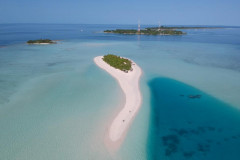
The Maldives consists of 1,192 coral islands grouped in a double chain of 26 atolls, along the north-south direction, spread over roughly 90,000 square kilometres (35,000 sq mi), making this one of the world's most dispersed countries. It lies between latitudes 1°S and 8°N, and longitudes 72° and 74°E. The atolls are composed of live coral reefs and sand bars, situated atop a submarine ridge 960 kilometres (600 mi) long that rises abruptly from the depths of the Indian Ocean and runs north to south.
Only near the southern end of this natural coral barricade do two open passages permit safe ship navigation from one side of the Indian Ocean to the other through the territorial waters of Maldives. For administrative purposes the Maldivian government organised these atolls into twenty one administrative divisions. The largest island of Maldives is Gan, which belongs to Laamu Atoll or Hahdhummathi Maldives. In Addu Atoll the westernmost islands are connected by roads over the reef (collectively called Link Road) and the total length of the road is 14 km (9 mi).
Maldives is the lowest country in the world, with maximum and average natural ground levels of only 2.4 metres (7 ft 10 in) and 1.5 metres (4 ft 11 in) above sea level, respectively. In areas where construction exists, however, this has been increased to several metres. More than 80 per cent of the country's land is composed of coral islands which rise less than one metre above sea level. As a result, the Maldives are at high risk of being submerged due to rising sea levels. The UN's environmental panel has warned that, at current rates, sea level rise would be high enough to make the Maldives uninhabitable by 2100.
Environmental issues
According to former Maldivian president Mohamed Nasheed, the Maldives are ranked the third most endangered nation due to flooding from climate change. In March and April 2012, Nasheed stated, "If carbon emissions were to stop today, the planet would not see a difference for 60 to 70 years." "If carbon emissions continue at the rate they are climbing today, my country will be under water in seven years." He called for more climate change mitigation action while on the American television shows The Daily Show and the Late Show with David Letterman.
The Intergovernmental Panel on Climate Change's 2007 report predicted the upper limit of the sea level rises will be 59 centimetres (23 in) by 2100, which means that most of the republic's 200 inhabited islands may need to be abandoned. One study appears to show that the sea level in the Maldives dropped 20–30 centimetres (8–12 in) throughout the 1970s and '80s, although later studies failed to back this up. The observed rate of sea level rise is only 1.7–1.8 millimetres per year.
In November 2008, President Mohamed Nasheed announced plans to look into purchasing new land in India, Sri Lanka, and Australia because of his concerns about global warming, and the possibility of much of the islands being inundated with water from rising sea levels. The purchase of land will be made from a fund generated by tourism. The President has explained his intentions: "We do not want to leave the Maldives, but we also do not want to be climate refugees living in tents for decades". On 22 April 2008, then President Maumoon Abdul Gayoom pleaded for a cut in global greenhouse gas emissions, warning that rising sea levels could submerge the island nation of Maldives.
By 2020, Maldives plans to eliminate or offset all of its greenhouse gas emissions. At the 2009 International Climate Talks, President Mohamed Nasheed explained that:
For us swearing off fossil fuels is not only the right thing to do, it is in our economic self-interest... Pioneering countries will free themselves from the unpredictable price of foreign oil; they will capitalise on the new green economy of the future, and they will enhance their moral standing giving them greater political influence on the world stage.
Other environmental issues include bad waste disposal and beach theft. Although the Maldives are kept relatively pristine and little litter can be found on the islands, no good waste disposal sites exist. Most trash from Male and other resorts is simply dumped at Thilafushi.
Marine ecosystem
Further information: Wildlife of MaldivesMaldivian waters are home to several ecosystems, but are most noted for their variety of colourful coral reefs, home to 1100 species of fish, 5 species of sea turtles, 21 species of whales and dolphins, 187 species of corals, 400 species of molluscs, and 83 species of echinoderms. Many crustacean species are there as well: 120 copepod, 15 amphipod as well as over 145 crab and 48 shrimp species.
Among the many marine families represented are Pufferfish, Fusiliers, Jackfish, Lionfish, Oriental Sweetlips, reef sharks, Groupers, Eels, Snappers, Bannerfish, Batfish, Humphead Wrasse, Spotted Eagle Rays, Scorpionfish, Lobsters, Nudibranches, Angelfish, Butterflyfish, Squirrelfish, Soldierfish, Glassfish, Surgeonfish, Unicornfish[disambiguation needed], Triggerfish, Napoleon wrasses, and Barracudas.
These coral reefs are home to a variety of marine ecosystems that vary from planktonic organisms to whale sharks. Sponges have gained importance as five species have displayed anti-tumor and anti-cancer properties.
In 1998, sea-temperature warming of as much as 5 °C (9.0 °F) due to a single El Niño phenomenon event caused coral bleaching, killing ⅔ of the nation's coral reefs.
In an effort to induce the regrowth of the reefs, scientists placed electrified cones anywhere from 20–60 feet (6.1–18.3 m) below the surface to provide a substrate for larval coral attachment. In 2004, scientists witnessed corals regenerating. Corals began to eject pink-orange eggs and sperm. The growth of these electrified corals was five times faster than ordinary corals. Scientist Azeez Hakim stated:
before 1998, we never thought that this reef would die. We had always taken for granted that these animals would be there, that this reef would be there forever. El Niño gave us a wake-up call that these things are not going to be there for ever. Not only this, they also act as a natural barrier against the tropical storms, floods and tsunamis. Seaweeds grow on the skeletons of dead coral.
Recent scientific studies suggest that the faunistic composition can vary greatly between neighbour atolls, especially in terms of benthic fauna. Differences in terms of fishing pressure (including poaching) could be the cause.
Culture
Since the 12th century AD there were also influences from Arabia in the language and culture of the Maldives because of the conversion to Islam and its location as a crossroads in the central Indian Ocean. This was due to the long trading history between the far east and the middle east. Somali travellers discovered the island for gold in the 13th century, before the Portuguese. Their brief stay later ended in a bloody conflict known by the Somalis as "Dagaal Diig Badaaney" in 1424.
However, unlike the Sinhalese of Sri Lanka and most of the Arabs, Africans and Europeans whose influence can be seen in borrow-words, material culture, and the diversity of Maldivian phenotype, Maldivians do not have the highly embedded patriarchal codes of honour, purity, corporate marriage, and sedentary private property that are typical of places where agriculture is the key form of subsistence and social relations have been built, historically, around tribute taking.
Reflective of this is the fact that the Maldives has had the highest national divorce rate in the world for many decades. This, it is hypothesised, is due to a combination of liberal Islamic rules about divorce and the relatively loose marital bonds that have been identified as common in non- and semi-sedentary peoples without a history of fully developed agrarian property and kinship relations.
Transportation
Velana International Airport is the principal gateway to the Maldives. International travel is available on a number of major airlines. Two Maldives based airlines also operate international flights. Privately owned MEGA Maldives Airlines has Boeing 737 and 767 aircraft and operates frequent services to Beijing, Shanghai, and Hong Kong. Government owned Island Aviation Services (branded as Maldivian) operates to nearly all of Maldives domestic airports with several Dash-8 aircraft and one A320 with international service to Chennai and Thiruvananthapuram, India, and Dhaka, Bangladesh.
In Maldives there are three main ways to move around: by domestic flight, by seaplane or by boat. For several years there were two seaplanes companies operating: TMA, Trans Maldivian Airways, and Maldivian Air Taxi, but these merged in 2013 under the name TMA. The seaplane fleet is entirely made up of DHC-6 "Twin Otters." There is also another airline, flyMe, which operates using ATRs to domestic airports, principally Maamagili and some others. The typical Maldivian boat is called dhoni. Depending on the distance of the destination island to the airport, resorts organise domestic flight plus boat transfers, seaplane flights directly to the resort island jetty, or speedboat trips for their guests. There are also locally run ferries by large dhoni boats. Speedboats and seaplanes tend to be more expensive, while travel by dhoni, although longer, is relatively cheaper and convenient.