
Norway
Hotels
Regions (5)
Towns (15)


Places




Description
Norway (i/ˈnɔːrweɪ/ NAWR-way; Norwegian: Norge (Bokmål) or Noreg (Nynorsk)), officially the Kingdom of Norway, is a sovereign and unitary monarchy whose territory comprises the western portion of the Scandinavian Peninsula plus the island Jan Mayen and the archipelago of Svalbard. The Antarctic Peter I Island and the sub-Antarctic Bouvet Island are dependent territories and thus not considered part of the Kingdom. Norway also lays claim to a section of Antarctica known as Queen Maud Land. Until 1814, the Kingdom included the Faroe Islands (since 1035), Greenland (1261), and Iceland (1262). It also included Shetland and Orkney until 1468.
Norway has a total area of 385,252 square kilometres (148,747 sq mi) and a population of 5,213,985 (May 2016). The country shares a long eastern border with Sweden (1,619 km or 1,006 mi long). Norway is bordered by Finland and Russia to the north-east, and the Skagerrak Strait to the south, with Denmark on the other side. Norway has an extensive coastline, facing the North Atlantic Ocean and the Barents Sea.
King Harald V of the German House of Glücksburg is the current King of Norway. Erna Solberg became Prime Minister in 2013, replacing Jens Stoltenberg. A constitutional monarchy, Norway divides state power between the Parliament, the Cabinet, and the Supreme Court, as determined by the 1814 Constitution. The Kingdom is established as a merger of several petty kingdoms. By the traditional count from the year 872 the Kingdom has existed continuously for 1,144 years, and the list of Norwegian monarchs includes over sixty kings and earls.
Norway has both administrative and political subdivisions on two levels: counties and municipalities. The Sámi people have a certain amount of self-determination and influence over traditional territories through the Sámi Parliament and the Finnmark Act. Norway maintains close ties with the European Union and the United States. Norway is a founding member of the United Nations, NATO, the Council of Europe, the Antarctic Treaty and the Nordic Council; a member of the European Economic Area, the WTO and the OECD; and is also a part of the Schengen Area.
The country maintains a combination of market economy and a Nordic welfare model with universal health care and a comprehensive social security system. Norway has extensive reserves of petroleum, natural gas, minerals, lumber, seafood, fresh water, and hydropower. The petroleum industry accounts for around a quarter of the country's gross domestic product (GDP). On a per-capita basis, Norway is the world's largest producer of oil and natural gas outside the Middle East.
The country has the fourth-highest per capita income in the world on the World Bank and IMF lists. On the CIA's GDP (PPP) per capita list (2015 estimate) which includes territories and some regions, Norway ranks as number eleven. From 2001 to 2006, and then again from 2009 to 2015, Norway had the highest Human Development Index ranking in the world. Norway has topped the Legatum Prosperity Index for seven years in a row as of 2015. Norway ranks also first on the OECD Better Life Index, the Index of Public Integrity, and the Democracy Index.
Etymology
Norway has two official names: Noreg in Nynorsk (Old Norse: Noregr) and Norge in Bokmål (Old Norse: Noregi, dative of Noregr).
The name Norway comes from the Old Norse word norðrvegr, "northern way" or "way leading to the north", which the Geats and the Danes named the coastline of western Norway, contrasting with suðrvegar "southern way" for Germany, and austrvegr "eastern way" for the Baltic.
Philology professor Magnus Olsen wrote that norðrvegr refers to the inner-archipelago sailing route of southwestern Norway, the home area of Harald Fairhair, the first king of Norway, and that because of him, the name was extended to the entire country. The newer interpretation of the syllable is Norvegr, where nor(ve)- means narrow (Nynorsk: norve) and -(ve)gr (Nynorsk: veg) means way that refers to the sailing routes through the straits of Norway. The old meaning of the word is interpreted as "The narrow way through the strait".
In a Latin manuscript of 849, the name Northuagia is mentioned, while a French chronicle of c. 900 uses the names Northwegia and Norwegia. When Ohthere of Hålogaland visited King Alfred the Great in England in the end of the 9th century, the land was called Norðwegr (lit. Northway) and norðmanna land (lit. Northmen's land).
Old Norse norðmaðr was Latinized as Nortmannus in the 9th century to mean "Norseman, Viking", giving rise to the name of the Normans. After Norway had become Christian, Noregr and Noregi had become the most common forms, but during the 15th century the newer forms Noreg(h) and Norg(h)e, found in medieval Icelandic manuscripts, took over and have survived until modern day.
The Old Norse name was borrowed into Old English, as Norðweg, Norweg, giving rise to modern Norway by regular development via Middle English Norwey, Norwei. The adjective Norwegian, on the other hand, recorded from c. 1600, is derived from the latinization of the name as Norwegia. In the adjective Norwegian, the Old English spelling '-weg' has survived.
History
Prehistory
The first inhabitants were the Ahrensburg culture (11th to 10th millennia BC), which was a late Upper Paleolithic culture during the Younger Dryas, the last period of cold at the end of the Weichsel glaciation. The culture is named after the village of Ahrensburg, 25 km (15.53 mi) north-east of Hamburg in the German state of Schleswig-Holstein, where wooden arrow shafts and clubs have been excavated. The earliest traces of human occupation in Norway are found along the coast, where the huge ice shelf of the last ice age first melted between 11,000 and 8,000 BC. The oldest finds are stone tools dating from 9,500 to 6,000 BC, discovered in Finnmark (Komsa culture) in the north and Rogaland (Fosna culture) in the south-west. However, theories about two altogether different cultures (the Komsa culture north of the Arctic Circle being one and the Fosna culture from Trøndelag to Oslo Fjord being the other) were rendered obsolete in the 1970s.
More recent finds along the entire coast revealed to archaeologists that the difference between the two can simply be ascribed to different types of tools and not to different cultures. Coastal fauna provided a means of livelihood for fishermen and hunters, who may have made their way along the southern coast about 10,000 BC when the interior was still covered with ice. It is now thought that these so-called "Arctic" peoples came from the south and followed the coast northward considerably later.
In the southern part of the country are dwelling sites dating from about 5,000 BC. Finds from these sites give a clearer idea of the life of the hunting and fishing peoples. The implements vary in shape and mostly are made of different kinds of stone; those of later periods are more skilfully made. Rock carvings (i.e. petroglyphs) have been found, usually near hunting and fishing grounds. They represent game such as deer, reindeer, elk, bears, birds, seals, whales, and fish (especially salmon and halibut), all of which were vital to the way of life of the coastal peoples. The carvings at Alta in Finnmark, the largest in Scandinavia, were made at sea level continuously from 4,200 to 500 BC and mark the progression of the land as it rose from the sea after the last ice age (Rock carvings at Alta).
Bronze Age
Between 3000 and 2500 BC new settlers (Corded Ware culture) arrived in eastern Norway. They were Indo-European farmers who grew grain and kept cows and sheep. The hunting-fishing population of the west coast was also gradually replaced by farmers, though hunting and fishing remained useful secondary means of livelihood.
From about 1500 BC bronze was gradually introduced, but the use of stone implements continued; Norway had few riches to barter for bronze goods, and the few finds consist mostly of elaborate weapons and brooches that only chieftains could afford. Huge burial cairns built close to the sea as far north as Harstad and also inland in the south are characteristic of this period. The motifs of the rock carvings differ from those typical of the Stone Age. Representations of the Sun, animals, trees, weapons, ships, and people are all strongly stylised.
Thousands of rock carvings from this period depict ships, and the large stone burial monuments known as stone ships, suggest that ships and seafaring played an important role in the culture at large. The depicted ships, most likely represent sewn plank built canoes used for warfare, fishing and trade. These ship types may have their origin as far back as the neolithic period and they continue into the Pre-Roman Iron Age, as exemplified by the Hjortspring boat.
Iron Age
Little has been found dating from the early Iron Age (the last 500 years BC). The dead were cremated, and their graves contain few burial goods. During the first four centuries AD the people of Norway were in contact with Roman-occupied Gaul. About 70 Roman bronze cauldrons, often used as burial urns, have been found. Contact with the civilised countries farther south brought a knowledge of runes; the oldest known Norwegian runic inscription dates from the 3rd century. At this time the amount of settled area in the country increased, a development that can be traced by coordinated studies of topography, archaeology, and place-names. The oldest root names, such as nes, vik, and bø ("cape," "bay," and "farm"), are of great antiquity, dating perhaps from the Bronze Age, whereas the earliest of the groups of compound names with the suffixes vin ("meadow") or heim ("settlement"), as in Bjorgvin (Bergen) or Saeheim (Seim), usually date from the 1st century AD.
Archaeologists first made the decision to divide the Iron Age of Northern Europe into distinct pre-Roman and Roman Iron Ages after Emil Vedel unearthed a number of Iron Age artifacts in 1866 on the island of Bornholm. They did not exhibit the same permeating Roman influence seen in most other artifacts from the early centuries AD, indicating that parts of northern Europe had not yet come into contact with the Romans at the beginning of the Iron Age.
Migration Age
The destruction of the Western Roman Empire by the Germanic tribes (5th century) is characterised by rich finds, including chieftains' graves containing magnificent weapons and gold objects. Hill forts were built on precipitous rocks for defence. Excavation has revealed stone foundations of farmhouses 18 to 27 metres (59 to 89 ft) long—one even 46 metres (151 feet) long—the roofs of which were supported on wooden posts. These houses were family homesteads where several generations lived together, with people and cattle under one roof.
These states were based on either clans or tribes (e.g., the Horder of Hordaland in western Norway). By the 9th century each of these small states had things, or tings (local or regional assemblies), for negotiating and settling disputes. The thing meeting places, each eventually with a horg (open-air sanctuary) or a hov (temple; literally "hill"), were usually situated on the oldest and best farms, which belonged to the chieftains and wealthiest farmers. The regional things united to form even larger units: assemblies of deputy yeomen from several regions. In this way, the lagting (assemblies for negotiations and lawmaking) developed. The Gulating had its meeting place by Sognefjord and may have been the centre of an aristocratic confederation along the western fjords and islands called the Gulatingslag. The Frostating was the assembly for the leaders in the Trondheimsfjord area; the earls Jarls of Lade, near Trondheim, seem to have enlarged the Frostatingslag by adding the coastland from Romsdalsfjord to the Lofoten Islands.
Viking Age
From the 8th to the 10th century, the wider Scandinavian region was the source of Vikings. The looting of the monastery at Lindisfarne in Northeast England in 793 by Norse people has long been regarded as the event which marked the beginning of the Viking Age. This age was characterised by expansion and emigration by Viking seafarers. They colonised, raided, and traded in all parts of Europe. Norwegian Viking explorers first discovered Iceland by accident in the 9th century when heading for the Faroe Islands, and eventually came across Vinland, known today as Newfoundland, in Canada. The Vikings from Norway were most active in the northern and western British Isles and eastern North America isles.
According to tradition, Harald Fairhair unified them into one in 872 after the Battle of Hafrsfjord in Stavanger, thus becoming the first king of a united Norway. Harald's realm was mainly a South Norwegian coastal state. Fairhair ruled with a strong hand and according to the sagas, many Norwegians left the country to live in Iceland, the Faroe Islands, Greenland, and parts of Britain and Ireland. The modern-day Irish cities of Dublin, Limerick and Waterford were founded by Norwegian settlers.
Norse traditions were slowly replaced by Christian ones in the late 10th and early 11th centuries. This is largely attributed to the missionary kings Olav Tryggvasson and St. Olav. Haakon the Good was Norway's first Christian king, in the mid-10th century, though his attempt to introduce the religion was rejected. Born sometime in between 963–969, Olav Tryggvasson set off raiding in England with 390 ships. He attacked London during this raiding. Arriving back in Norway in 995, Olav landed in Moster. There he built a church which became the first Christian church ever built in Norway. From Moster, Olav sailed north to Trondheim where he was proclaimed King of Norway by the Eyrathing in 995.
Feudalism never really developed in Norway or Sweden, as it did in the rest of Europe. However, the administration of government took on a very conservative feudal character. The Hanseatic League forced the royalty to cede to them greater and greater concessions over foreign trade and the economy. The League had this hold over the royalty because of the loans the Hansa had made to the royalty and the large debt the kings were carrying. The League's monopolistic control over the economy of Norway put pressure on all classes, especially the peasantry, to the degree that no real burgher class existed in Norway.
Kalmar Union
Upon the death of Haakon V, King of Norway, in 1319, Magnus Erikson, at just three years old, inherited the throne as King Magnus VII of Norway. At the same time a movement to make Magnus King of Sweden proved successful. (At this time both the kings of Sweden and of Denmark were elected to the throne by their respective nobles.) Thus, with his election to the throne of Sweden, both Sweden and Norway were united under King Magnus VII.
In 1349, the Black Death radically altered Norway, killing between 50% and 60% of its population and leaving it in a period of social and economic decline. The plague left Norway very poor. Although the death rate was comparable with the rest of Europe, economic recovery took much longer because of the small, scattered population. Before the plague, the population was only about 500,000 people. After the plague, many farms lay idle while the population slowly increased. However, the few surviving farms' tenants found their bargaining positions with their landlords greatly strengthened.
King Magnus VII ruled Norway until 1350, when his son, Haakon, was placed on the throne as Haakon VI. In 1363, Haakon VI married Margaret, the daughter of King Valdemar IV of Denmark. Upon the death of Haakon VI, in 1379, his son, Olaf IV, was only 10 years old. Olaf had already been elected to the throne of Denmark on 3 May 1376. Thus, upon Olaf's accession to the throne of Norway, Denmark and Norway entered personal union. Olaf's mother and Haakon's widow, Queen Margaret, managed the foreign affairs of Denmark and Norway during the minority of Olaf IV.
Margaret was working toward a union of Sweden with Denmark and Norway by having Olaf elected to the Swedish throne. She was on the verge of achieving this goal when Olaf IV suddenly died. However, Denmark made Margaret temporary ruler upon the death of Olaf. On 2 February 1388 Norway followed suit and crowned Margaret. Queen Margaret knew that her power would be more secure if she were able to find a king to rule in her place. She settled on Eric of Pomerania, grandson of her sister. Thus at an all-Scandinavian meeting held at Kalmar, Erik of Pomerania was crowned king of all three Scandinavian countries. Thus, royal politics resulted in personal unions between the Nordic countries, eventually bringing the thrones of Norway, Denmark, and Sweden under the control of Queen Margaret when the country entered into the Kalmar Union.
Union with Denmark
After Sweden broke out of the Kalmar Union in 1521, Norway tried to follow suit, but the ensuing rebellion was defeated, and Norway remained in a union with Denmark until 1814, a total of 434 years. During the national romanticism of the 19th century, this period was by some referred to as the "400-Year Night", since all of the kingdom's royal, intellectual, and administrative power was centred in Copenhagen in Denmark. In fact, it was a period of great prosperity and progress for Norway, especially in terms of shipping and foreign trade, and it also secured the country's revival from the demographic catastrophe it suffered in the Black Death. Based on the respective natural resources, Denmark–Norway was in fact a very good match, since Denmark supported Norway's needs for grain and food supplies, and Norway supplied Denmark with timber, metal, and fish.
With the introduction of Protestantism in 1536, the archbishopric in Trondheim was dissolved, and Norway lost its independence, and effectually became a colony of Denmark. The Church's incomes and possessions were instead redirected to the court in Copenhagen. Norway lost the steady stream of pilgrims to the relics of St. Olav at the Nidaros shrine, and with them, much of the contact with cultural and economic life in the rest of Europe.
Eventually restored as a kingdom (albeit in legislative union with Denmark) in 1661, Norway saw its land area decrease in the 17th century with the loss of the provinces Båhuslen, Jemtland, and Herjedalen to Sweden, as the result of a number of disastrous wars with Sweden. In the north, however, its territory was increased by the acquisition of the northern provinces of Troms and Finnmark, at the expense of Sweden and Russia.
The famine of 1695–96 killed roughly 10% of Norway's population. The harvest failed in Scandinavia at least nine times between 1740 and 1800, with great loss of life.
Union with Sweden
After Denmark–Norway was attacked by the United Kingdom at the Battle of Copenhagen, it entered into an alliance with Napoleon, with the war leading to dire conditions and mass starvation in 1812. As the Danish kingdom found itself on the losing side in 1814, it was forced, under terms of the Treaty of Kiel, to cede Norway to the king of Sweden, while the old Norwegian provinces of Iceland, Greenland, and the Faroe Islands remained with the Danish crown.
Norway took this opportunity to declare independence, adopted a constitution based on American and French models, and elected the Crown Prince of Denmark and Norway, Christian Frederick, as king on 17 May 1814. This is the famous Syttende Mai (Seventeenth of May) holiday celebrated by Norwegians and Norwegian-Americans alike. Syttende Mai is also called Norwegian Constitution Day.
Norwegian opposition to the great powers' decision to link Norway with Sweden caused the Norwegian-Swedish War to break out as Sweden tried to subdue Norway by military means. As Sweden's military was not strong enough to defeat the Norwegian forces outright and Norway's treasury was not large enough to support a protracted war, and as British and Russian navies blockaded the Norwegian coast, the belligerents were forced to negotiate the Convention of Moss. According to the terms of the convention, Christian Frederik abdicated the Norwegian throne and authorised the Parliament of Norway to make the necessary constitutional amendments to allow for the personal union that Norway was forced to accept. On 4 November 1814 the Parliament (Storting) elected Charles XIII of Sweden as king of Norway, thereby establishing the union with Sweden. Under this arrangement, Norway kept its liberal constitution and its own independent institutions, except for the foreign service. Following the recession caused by the Napoleonic Wars, economic development of Norway remained slow until economic growth began around 1830.
This period also saw the rise of the Norwegian romantic nationalism, as Norwegians sought to define and express a distinct national character. The movement covered all branches of culture, including literature (Henrik Wergeland [1808–1845], Bjørnstjerne Bjørnson [1832–1910], Peter Christen Asbjørnsen [1812–1845], Jørgen Moe [1813–1882]), painting (Hans Gude [1825–1903], Adolph Tidemand [1814–1876]), music (Edvard Grieg [1843–1907]), and even language policy, where attempts to define a native written language for Norway led to today's two official written forms for Norwegian: Bokmål and Nynorsk.
King Charles III John, who came to the throne of Norway and Sweden in 1818, was the second king following Norway's break from Denmark and the union with Sweden. Charles John was a complex man whose long reign extended to 1844. He protected the constitution and liberties of Norway and Sweden during the age of Metternich. As such, he was regarded as a liberal monarch for that age. However, he was ruthless in his use of paid informers, the secret police and restrictions on the freedom of the press to put down public movements for reform—especially the Norwegian national independence movement.
The Romantic Era that followed the reign of King Charles III John brought some significant social and political reforms. In 1854, women won the right to inherit property in their own right just like men. In 1863, the last trace of keeping unmarried women in the status of minors was removed. Furthermore, women were then eligible for different occupations, particularly the common school teacher. However, by mid-century, Norway was still far from a "democracy". Voting was limited to officials, property owners, leaseholders, and burghers of incorporated towns. There was some dissatisfaction with this system.
Still Norway remained a conservative society. Life in Norway (especially economic life) was "dominated by the aristocracy of professional men who filled most of the important posts in the central government." There was no strong bourgeosie class in Norway to demand a breakdown of this aristocratic control of the economy. Thus, even while revolution swept over most of the countries of Europe in 1848, Norway was largely unaffected by revolts that year.
Marcus Thrane was a Utopian socialist. He made his appeal to the labouring classes urging a change of social structure "from below upwards." In 1848, he organised a labour society in Drammen. In just a few months this society had a membership of 500 and was publishing its own newspaper. Within two years 300 societies had been organised all over Norway with a total membership of 20,000 persons. The membership was drawn from the lower classes of both urban and rural areas; for the first time these two groups felt they had a common cause. In the end, the revolt was easily crushed; Thrane was captured and in 1855, after four years in jail, was sentenced to three additional years for crimes against the safety of the state. Upon his release, Marcus Thrane attempted unsuccessfully to revitalize his movement but, after the death of his wife, migrated to the United States.
In 1898, all men were granted universal suffrage, followed by all women in 1913.
Dissolution of the union
Christian Michelsen, a shipping magnate and statesman, and Prime Minister of Norway from 1905 to 1907, played a central role in the peaceful separation of Norway from Sweden on 7 June 1905. A national referendum confirmed the people's preference for a monarchy over a republic. No Norwegian could legitimately claim the throne because none was able to prove relationship to medieval royalty and in European tradition royal or "blue" blood is a precondition for laying claim to the throne.
The government offered the throne of Norway to a prince of the German royal house of Schleswig-Holstein-Sonderburg-Glücksburg. Prince Carl of Denmark was unanimously elected king by the Norwegian Parliament, the first king of a fully independent Norway in 508 years (1397: Kalmar Union); he took the name Haakon VII. In 1905, the country welcomed the prince from neighboring Denmark, his wife Maud of Wales and their young son to re-establish Norway's royal house. Following centuries of close ties between Norway and Denmark, a prince from the latter was the obvious choice for a European prince who could best relate to the Norwegian people.
First and Second World Wars
Throughout the First World War, Norway was in principle a neutral country. In reality, however, Norway had been pressured by the British to hand over increasingly large parts of its large merchant fleet to the British at low rates, as well as to join the trade blockade against Germany. Norwegian merchant marine ships, often with Norwegian sailors still on board, were then sailing under the British flag and at risk of being sunk by German submarines. Thus, many Norwegian sailors and ships were lost. Thereafter, the world ranking of the Norwegian merchant navy fell from fourth place to sixth in the world.
Norway also proclaimed its neutrality during the Second World War, but despite this it was invaded by German forces on 9 April 1940. Although Norway was unprepared for the German surprise attack (see: Battle of Drøbak Sound, Norwegian Campaign, and Invasion of Norway), military and naval resistance lasted for two months. Norwegian armed forces in the north launched an offensive against the German forces in the Battles of Narvik, until they were forced to surrender on 10 June after losing British support which had been diverted to France during the German invasion of France.
King Haakon and the Norwegian government escaped to Rotherhithe in London. Throughout the war they sent inspirational radio speeches and supported clandestine military actions in Norway against the Germans. On the day of the invasion, the leader of the small National-Socialist party Nasjonal Samling, Vidkun Quisling, tried to seize power but was forced by the German occupiers to step aside. Real power was wielded by the leader of the German occupation authority, Reichskommissar Josef Terboven. Quisling, as minister president, later formed a collaborationist government under German control. Up to 15,000 Norwegians volunteered to fight in German units, including the Waffen-SS.
The fraction of the Norwegian population that supported Germany was traditionally smaller than in Sweden but greater than is generally appreciated today. It included a number of prominent personalities such as Knut Hamsun. The concept of a "Germanic Union" of member states fit well into their thoroughly nationalist-patriotic ideology.
Many Norwegians and persons of Norwegian descent joined the Allied forces as well as the Free Norwegian Forces. In June 1940 a small group had left Norway following their king to Britain. This group included 13 ships, five aircraft, and 500 men from the Royal Norwegian Navy. By the end of the war, the force had grown to 58 ships and 7,500 men in service in the Royal Norwegian Navy, 5 squadrons of aircraft (including Spitfires, Sunderland flying boats and Mosquitos) in the newly formed Norwegian Air Force, and land forces including the Norwegian Independent Company 1 and 5 Troop as well as No. 10 Commandos.
During the five years of German occupation, Norwegians built a resistance movement which fought the German occupation forces with both civil disobedience and armed resistance including the destruction of Norsk Hydro's heavy water plant and stockpile of heavy water at Vemork, which crippled the German nuclear programme (see: Norwegian heavy water sabotage). More important to the Allied war effort, however, was the role of the Norwegian Merchant Marine. At the time of the invasion, Norway had the 4th largest merchant marine fleet in the world. It was led by the Norwegian shipping company Nortraship under the Allies throughout the war and took part in every war operation from the evacuation of Dunkirk to the Normandy landings. Each December Norway gives a Christmas tree to the United Kingdom as thanks for the British assistance during the Second World War. A ceremony takes place to erect the tree in London's Trafalgar Square.
Post-World War II history
From 1945 to 1962, the Labour Party held an absolute majority in the parliament. The government, led by prime minister Einar Gerhardsen, embarked on a programme inspired by Keynesian economics, emphasising state financed industrialisation and co-operation between trade unions and employers' organisations. Many measures of state control of the economy imposed during the war were continued, although the rationing of dairy products was lifted in 1949, while price control and rationing of housing and cars continued as long as until 1960.
The wartime alliance with the United Kingdom and the United States was continued in the post-war years. Although pursuing the goal of a socialist economy, the Labour Party distanced itself from the Communists (especially after the Communists' seizure of power in Czechoslovakia in 1948), and strengthened its foreign policy and defence policy ties with the US. Norway received Marshall Plan aid from the United States starting in 1947, joined the OEEC one year later, and became a founding member of the North Atlantic Treaty Organization (NATO) in 1949.
In 1969, the Phillips Petroleum Company discovered petroleum resources at the Ekofisk field west of Norway. In 1973, the Norwegian government founded the State oil company, Statoil. Oil production did not provide net income until the early 1980s because of the large capital investment that was required to establish the country's petroleum industry. Around 1975, both the proportion and absolute number of workers in industry peaked. Since then labour-intensive industries and services like factory mass production and shipping have largely been outsourced.
Norway was a founding member of the European Free Trade Association (EFTA). Two referendums on joining the European Union failed by narrow margins in 1972 and 1994.
In 1981, a Conservative government led by Kåre Willoch replaced the Labour Party with a policy of stimulating the stagflated economy with tax cuts, economic liberalisation, deregulation of markets, and measures to curb record-high inflation (13.6% in 1981).
Norway's first female prime minister, Gro Harlem Brundtland of the Labour party, continued many of the reforms of her conservative predecessor, while backing traditional Labour concerns such as social security, high taxes, the industrialisation of nature, and feminism. By the late 1990s, Norway had paid off its foreign debt and had started accumulating a sovereign wealth fund. Since the 1990s, a divisive question in politics has been how much of the income from petroleum production the government should spend, and how much it should save. In 2011, Norway suffered two terrorist attacks on the same day conducted by Anders Behring Breivik which struck the government quarter in Oslo and a summer camp of the Labour party's youth movement at Utøya island, resulting in 77 deaths and 319 wounded. The 2013 Norwegian parliamentary election brought a more conservative government to power with the Conservative Party and the Progress Party, winning 43% of the electorate's votes.
Geography
Norway comprises the western part of Scandinavia in Northern Europe. The rugged coastline, broken by huge fjords and thousands of islands, stretches 25,000 kilometres (16,000 mi) and 83,000 kilometres (52,000 mi). Norway shares a 1,619-kilometre (1,006 mi) land border with Sweden, 727 kilometres (452 mi) with Finland, and 196 kilometres (122 mi) with Russia to the east. To the north, west and south, Norway is bordered by the Barents Sea, the Norwegian Sea, the North Sea, and Skagerrak. The Scandinavian Mountains form much of the border with Sweden.
At 385,252 square kilometres (148,747 sq mi) (including Svalbard and Jan Mayen) (and 323,802 square kilometres (125,021 sq mi) without), much of the country is dominated by mountainous or high terrain, with a great variety of natural features caused by prehistoric glaciers and varied topography. The most noticeable of these are the fjords: deep grooves cut into the land flooded by the sea following the end of the Ice Age. Sognefjorden is the world's second deepest fjord, and the world's longest at 204 kilometres (127 mi). Hornindalsvatnet is the deepest lake in all Europe. Permafrost can be found all year in the higher mountain areas and in the interior of Finnmark county. Numerous glaciers are found in Norway.
Norway lies between latitudes 57° and 81° N, and longitudes 4° and 32° E.
The land is mostly made of hard granite and gneiss rock, but slate, sandstone, and limestone are also common, and the lowest elevations contain marine deposits. Because of the Gulf Stream and prevailing westerlies, Norway experiences higher temperatures and more precipitation than expected at such northern latitudes, especially along the coast. The mainland experiences four distinct seasons, with colder winters and less precipitation inland. The northernmost part has a mostly maritime Subarctic climate, while Svalbard has an Arctic tundra climate.
Because of the large latitudinal range of the country and the varied topography and climate, Norway has a larger number of different habitats than almost any other European country. There are approximately 60,000 species in Norway and adjacent waters (excluding bacteria and virus). The Norwegian Shelf large marine ecosystem is considered highly productive.
Biodiversity
The total number of species include 16,000 species of insects (probably 4,000 more species yet to be described), 20,000 species of algae, 1,800 species of lichen, 1,050 species of mosses, 2,800 species of vascular plants, up to 7,000 species of fungi, 450 species of birds (250 species nesting in Norway), 90 species of mammals, 45 fresh-water species of fish, 150 salt-water species of fish, 1,000 species of fresh-water invertebrates, and 3,500 species of salt-water invertebrates. About 40,000 of these species have been described by science. The red list of 2010 encompasses 4,599 species.
Seventeen species are listed mainly because they are endangered on a global scale, such as the European beaver, even if the population in Norway is not seen as endangered. The number of threatened and near-threatened species equals to 3,682; it includes 418 fungi species, many of which are closely associated with the small remaining areas of old-growth forests, 36 bird species, and 16 species of mammals. In 2010, 2,398 species were listed as endangered or vulnerable; of these were 1250 listed as vulnerable (VU), 871 as endangered (EN), and 276 species as critically endangered (CR), among which were the grey wolf, the Arctic fox (healthy population on Svalbard) and the pool frog.
The largest predator in Norwegian waters is the sperm whale, and the largest fish is the basking shark. The largest predator on land is the polar bear, while the brown bear is the largest predator on the Norwegian mainland. The largest land animal on the mainland is the elk (American English: moose). The elk is in Norway known for its size and strength and is often called skogens konge, "king of the forest".
Environment
Stunning and dramatic scenery and landscape is found throughout Norway. The west coast of southern Norway and the coast of northern Norway present some of the most visually impressive coastal sceneries in the world. National Geographic has listed the Norwegian fjords as the world's top tourist attraction. The 2014 Environmental Performance Index put Norway in tenth place, based on the environmental performance of the country's policies.
Health
Norway was awarded first place according to the UN's Human Development Index (HDI) for 2013. Poverty and communicable diseases dominated in Norway together with famines, and epidemics in the 1800s. From the 1900s improvements in public health occurred as a result of development in several areas such as social and living conditions, changes in disease and medical outbreaks, establishment of the health care system and emphasis on public health matters. Vaccination and increased treatment opportunities with antibiotics resulted in great improvements within the Norwegian population. Improved hygiene and better nutrition were factors that contributed to improved health.
The disease pattern in Norway changed from communicable diseases to non-communicable diseases and chronic diseases as cardiovascular disease. Inequalities and social differences are still present in public health in Norway today.
In 2013 the infant mortality rate was 2.5 per 1 000 live births among children under the age of one. For girls it was 2.7 and for boys 2.3, which is the lowest infant mortality rate for boys ever recorded in Norway.
Culture
The Norwegian farm culture continues to play a role in contemporary Norwegian culture. In the 19th century, it inspired a strong romantic nationalistic movement, which is still visible in the Norwegian language and media. Norwegian culture blossomed with nationalist efforts to achieve an independent identity in the areas of literature, art and music. This continues today in the performing arts and as a result of government support for exhibitions, cultural projects and artwork.
Human rights
Norway has been a progressive country, which has adopted legislation and policies to support women's rights, minority rights, and LGBT rights. As early as 1884, 171 of the leading figures, among them five Prime Ministers for the Liberal Party and the Conservative Party, co-founded the Norwegian Association for Women's Rights. They successfully campaigned for women's right to education, women's suffrage, the right to work and other gender equality policies. From the 1970s, gender equality also came high on the state agenda with the establishment of a public body to promote gender equality, which evolved into the Gender Equality and Anti-Discrimination Ombud. Civil society organisations also continue to play an important role, and the women's rights organisations are today organised in the Norwegian Women's Lobby umbrella organisation.
In 1990 the Norwegian constitution was amended to grant absolute primogeniture to the Norwegian throne, meaning that the eldest child, regardless of gender, takes precedence in the line of succession. As it was not retroactive, the current successor to the throne is the eldest son of the King, rather than his eldest child. The Norwegian constitution Article 6 states that "For those born before the year 1990 it shall...be the case that a male shall take precedence over a female."
The Sami people have for centuries been the subject of discrimination and abuse by the dominant cultures in Scandinavia and Russia, those countries claiming possession of Sami lands. The Sami people have never been a single community in a single region of Lapland. Norway has been greatly criticized by the international community for the politics of Norwegianization of and discrimination against the indigenous population of the country. Nevertheless, Norway was, in 1990, the first country to recognise ILO-convention 169 on indigenous people recommended by the UN.
In regard to LGBT rights, Norway was the first country in the world to enact an anti-discrimination law protecting the rights of gays and lesbians. In 1993 Norway became the second country to legalise civil union partnerships for same-sex couples, and on 1 January 2009 Norway became the sixth country to grant full marriage equality to same-sex couples. As a promoter of human rights, Norway has held the annual Oslo Freedom Forum conference, a gathering described by The Economist as "on its way to becoming a human-rights equivalent of the Davos economic forum."
Religion
Separation of church and state happened significantly later in Norway than in most of Europe and is not yet complete. In 2012, the Norwegian parliament voted to grant the Church of Norway greater autonomy, a decision which was confirmed in a constitutional amendment on 21 May 2012. Until 2012 parliamentary officials were required to be members of the Lutheran Church and at least half of all ministers had to be a member of the Christian State Church. As the Church of Norway is the state church, its clergy are state employees, and the central and regional church administrations are part of the state administration. The members of the Royal family are required to be members of the Lutheran church.
Cinema
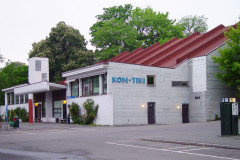
The Norwegian cinema has received international recognition. The documentary film Kon-Tiki (1950) of the expedition won an American Oscar Academy Award. In 1959, Arne Skouen's Nine Lives was nominated, but failed to win. Another notable film is Flåklypa Grand Prix (English: Pinchcliffe Grand Prix), an animated feature film directed by Ivo Caprino. The film was released in 1975 and is based on characters from Norwegian cartoonist Kjell Aukrust. It is the most widely seen Norwegian film of all time.
Nils Gaup's Pathfinder (1987), the story of the Sami, was nominated for an Oscar. Berit Nesheim's The Other Side of Sunday was nominated for an Oscar in 1997.
Since the 1990s, the film industry has thrived, producing up to 20 feature films each year. Particular successes were Kristin Lavransdatter, based on a novel by a Nobel Prize winner; The Telegraphist and Gurin with the Foxtail. Knut Erik Jensen was among the more successful new directors, together with Erik Skjoldbjærg, who is remembered for Insomnia.
The country has also been used as filming location for several Hollywood and other international productions, including The Empire Strikes Back (1980), for which the producers used Hardangerjøkulen glacier as a filming location for scenes of the ice planet Hoth. It included a memorable battle in the snow. The films Die Another Day, The Golden Compass, Spies Like Us and Heroes of Telemark, as well as the TV series Lilyhammer and Vikings also had scenes set in Norway. A short film, The Spirit of Norway was featured at Maelstrom at Norway Pavilion at Epcot located within Walt Disney World Resort in Florida in the United States. The attraction and the film ceased their operations on 5 October 2014.
Music
The classical music of the romantic composers Edvard Grieg, Rikard Nordraak and Johan Svendsen is internationally known as is the modern music of Arne Nordheim. Norway's classical performers include Leif Ove Andsnes, one of the world's more famous pianists; Truls Mørk, an outstanding cellist; and the great Wagnerian soprano Kirsten Flagstad.
Norwegian black metal has been an influence in world music since the late 20th century. Since the 1990s, Norway's export of black metal, a lo-fi, dark and raw form of heavy metal, has been developed by such bands as Emperor, Darkthrone, Gorgoroth, Mayhem, Burzum, and Immortal. More recently bands such as Enslaved, Kvelertak, Dimmu Borgir and Satyricon have evolved the genre into the present day while still garnering worldwide fans. Controversial events associated with the black metal movement in the early 1990s included several church burnings and two prominent murder cases.
The jazz scene in Norway is thriving. Jan Garbarek, Terje Rypdal, Mari Boine, Arild Andersen, and Bugge Wesseltoft are internationally recognised while Paal Nilssen-Love, Supersilent, Jaga Jazzist and Wibutee are becoming world-class artists of the younger generation.
Norway has a strong folk music tradition which remains popular to this day. Among the most prominent folk musicians are Hardanger fiddlers Andrea Een, Olav Jørgen Hegge and Annbjørg Lien, and the vocalists Agnes Buen Garnås, Kirsten Bråten Berg and Odd Nordstoga.
Other internationally recognised bands are A-ha, Röyksopp, Ylvis and Maria Mena. A-ha initially rose to global fame during the mid-1980s. In the 1990s and 2000s the group maintained its popularity domestically, and has remained successful outside Norway, especially in Germany, Switzerland, France and Brazil.
In recent years, various Norwegian songwriters and production teams have contributed to the music of other international artists. The Norwegian production team Stargate has produced songs for Rihanna, Beyoncé, Shakira, Jennifer Lopez and Lionel Richie, among others. Espen Lind has written and produced songs for Beyoncé, Lionel Richie and Leona Lewis, among others. Lene Marlin has written songs for Rihanna and Lovebugs.
Norway enjoys many music festivals throughout the year, all over the country. Norway is the host of one of the world's biggest extreme sport festivals with music, Ekstremsportveko—a festival held annually in Voss. Oslo is the host of many festivals, such as Øyafestivalen and by:Larm. Oslo used to have a summer parade similar to the German Love Parade. In 1992 the city of Oslo wanted to adopt the French music festival Fête de la Musique. Fredrik Carl Størmer established the festival. Even in its first year, "Musikkens Dag" gathered thousands of people and artists in the streets of Oslo. "Musikkens Dag" is now renamed Musikkfest Oslo.
Research
Internationally recognised Norwegian scientists include the mathematicians Niels Henrik Abel, Sophus Lie and Atle Selberg, physical chemist Lars Onsager, physicist Ivar Giaever, chemists Odd Hassel, Peter Waage, and Cato Maximilian Guldberg.
In the 20th century, Norwegian academics have been pioneering in many social sciences, including criminology, sociology and peace and conflict studies. Prominent academics include Arne Næss, a philosopher and founder of deep ecology; Johan Galtung, the founder of peace studies; Nils Christie and Thomas Mathiesen, criminologists; Fredrik Barth, a social anthropologist; Vilhelm Aubert, Harriet Holter and Erik Grønseth, sociologists; Tove Stang Dahl, a pioneer of women's law; Stein Rokkan, a political scientist; and economists Ragnar Frisch, Trygve Haavelmo, and Finn E. Kydland.
In 2014, the two Norwegian scientists May-Britt Moser and Edvard Moser won the Nobel Prize in Physiology or Medicine along with John O'Keefe. They won the prize for their groundbreaking work identifying the cells that make up a positioning system in the human brain, our "in-built GPS".
Architecture
With expansive forests, Norway has long had a tradition of building in wood. Many of today's most interesting new buildings are made of wood, reflecting the strong appeal that this material continues to hold for Norwegian designers and builders.
With Norway's conversion to Christianity some 1,000 years ago, churches were built. Stonework architecture was introduced from Europe for the most important structures, beginning with the construction of Nidaros Cathedral in Trondheim. In the early Middle Ages, wooden stave churches were constructed throughout Norway. Some of them have survived; they represent Norway's most unusual contribution to architectural history. A fine example, Urnes Stave Church in inner Sognefjord, is on UNESCO's World Heritage List. Another notable example of wooden architecture is the buildings at Bryggen Wharf in Bergen, also on the list for World Cultural Heritage sites, consisting of a row of tall, narrow wooden structures along the quayside.
In the 17th century, under the Danish monarchy, cities and villages such as Kongsberg and Røros were established. The city[which?] had a church built in the Baroque style. Traditional wooden buildings that were constructed in Røros have survived.
After Norway's union with Denmark was dissolved in 1814, Oslo became the capital. The architect Christian H. Grosch designed the earliest parts of the University of Oslo, the Oslo Stock Exchange, and many other buildings and churches constructed in that early national period.
At the beginning of the 20th century, the city of Ålesund was rebuilt in the Art Nouveau style, influenced by styles of France. The 1930s, when functionalism dominated, became a strong period for Norwegian architecture. It is only since the late 20th century that Norwegian architects have achieved international renown. One of the most striking modern buildings in Norway is the Sami Parliament in Kárášjohka, designed by Stein Halvorson and Christian Sundby. Its debating chamber, in timber, is an abstract version of a lavvo, the traditional tent used by the nomadic Sami people.
Art
For an extended period, the Norwegian art scene was dominated by artwork from Germany and Holland as well as by the influence of Copenhagen. It was in the 19th century that a truly Norwegian era began, first with portraits, later with impressive landscapes. Johan Christian Dahl (1788–1857), originally from the Dresden school, eventually returned to paint the landscapes of western Norway, defining Norwegian painting for the first time."
Norway's newly found independence from Denmark encouraged painters to develop their Norwegian identity, especially with landscape painting by artists such as Kitty Kielland, a female painter who studied under Hans Gude, and Harriet Backer, another pioneer among female artists, influenced by impressionism. Frits Thaulow, an impressionist, was influenced by the art scene in Paris as was Christian Krohg, a realist painter, famous for his paintings of prostitutes.
Of particular note is Edvard Munch, a symbolist/expressionist painter who became world-famous for The Scream which is said to represent the anxiety of modern man.
Other artists of note include Harald Sohlberg, a neo-romantic painter remembered for his paintings of Røros, and Odd Nerdrum, a figurative painter who maintains that his work is not art but kitsch.
Cuisine
Norway's culinary traditions show the influence of long seafaring and farming traditions with salmon (fresh and cured), herring (pickled or marinated), trout, codfish and other seafood balanced by cheeses, dairy products and breads (predominantly dark/darker).
Lefse is a Norwegian potato flatbread, usually topped with large amounts of butter and sugar, most common around Christmas. Some traditional Norwegian dishes include lutefisk, smalahove, pinnekjøtt, raspeball and fårikål.
International rankings
The following are international rankings of Norway, including those measuring life quality, health care quality, stability, press freedom, and income.
Index Rank Countries reviewed Human Development Index 2015 1 187 Inequality adjusted Human Development Index 2015 1 150 OECD Better Life Index 2016 1 38 Legatum Prosperity Index 2015 1 142 Index of Public Integrity 2016 1 105 Democracy Index 2015 1 167 Freedom House ranking of political rights 2016 1 195 Freedom House ranking of civil liberties 2016 1 195 Save the Children State of the World's Mothers report 2015 1 179 Total health expenditure per capita 2013 1 188 Fragile States Index 2016 2 178 Gallup gross median household income 2013 2 131 Median equivalent adult income 2009-2014 2 35 International Property Rights Index 2015 2 129 Net international investment position of creditor nations per capita 2013 2 17 Euro health consumer index 2015 3 35 Press Freedom Index 2016 3 180 Global Gender Gap Report 2015 3 144 World Happiness Report 2016 4 157 EF English Proficiency Index 2015 4 70 Corruption Perceptions Index 2015 5 175 Networked Readiness Index 2014 5 144 Household final consumption expenditure per capita 2013 5 163 Ease of doing business index 2016 9 185 Global Peace Index 2016 17 163 Globalization Index 2015 18 207 Logistics Performance Index 2016 22 160 Index of Economic Freedom 2015 27 167