
Oman
Hotels
Regions (1)
Towns (1)
Description
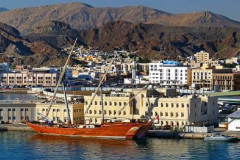
Oman is a country on the southeastern coast of the Arabian Peninsula in Western Asia and the oldest independent state in the Arab world. Located in a strategically important position at the mouth of the Persian Gulf, the country shares land borders with the United Arab Emirates to the northwest, Saudi Arabia to the west, and Yemen to the southwest, and shares marine borders with Iran and Pakistan. The coast is formed by the Arabian Sea on the southeast and the Gulf of Oman on the northeast. The Madha and Musandam exclaves are surrounded by the UAE on their land borders, with the Strait of Hormuz (which it shares with Iran) and the Gulf of Oman forming Musandam's coastal boundaries.
From the late 17th century, the Omani Sultanate was a powerful empire, vying with the Portuguese Empire and the British Empire for influence in the Persian Gulf and Indian Ocean. At its peak in the 19th century, Omani influence or control extended across the Strait of Hormuz to modern-day Iran and Pakistan, and as far south as Zanzibar. When its power declined in the 20th century, the sultanate came under the influence of the United Kingdom. For over 300 years, the relations built between the two empires were based on mutual benefits. The UK recognized Oman's geographical importance as a trading hub that secured their trading lanes in the Persian Gulf and Indian Ocean and protected their empire in the Indian sub-continent. Historically, Muscat was the principal trading port of the Persian Gulf region. Muscat was also among the most important trading ports of the Indian Ocean.
Sultan Qaboos bin Said al Said was the hereditary leader of the country, which is an absolute monarchy, from 1970 until his death on 10 January 2020. His cousin, Haitham bin Tariq, was named as the country's new ruler following his death.
Oman is a member of the United Nations, the Arab League, the Gulf Cooperation Council, the Non-Aligned Movement and the Organisation of Islamic Cooperation. It has sizeable oil reserves, ranking 25th globally. In 2010, the United Nations Development Programme ranked Oman as the most improved nation in the world in terms of development during the preceding 40 years. A significant portion of its economy involves tourism and trading fish, dates and other agricultural produce. Oman is categorized as a high-income economy and ranks as the 69th most peaceful country in the world according to the Global Peace Index.
Etymology
The origin of Oman's name is uncertain. It seems to be related to Pliny the Elder's Omana and Ptolemy's Omanon (Ὄμανον ἐμπόριον in Greek), both probably the ancient Sohar. The city or region is typically etymologized in Arabic from aamen or amoun ("settled" people, as opposed to the Bedouin), although a number of eponymous founders have been proposed (Oman bin Ibrahim al-Khalil, Oman bin Siba' bin Yaghthan bin Ibrahim, Oman bin Qahtan and the Biblical Lot) and others derive it from the name of a valley in Yemen at Ma'rib presumed to have been the origin of the city's founders, the Azd, a tribe migrating from Yemen.
History
Prehistory and ancient history
At Aybut Al Auwal, in the Dhofar Governorate of Oman, a site was discovered in 2011 containing more than 100 surface scatters of stone tools, belonging to a regionally specific African lithic industry—the late Nubian Complex—known previously only from the northeast and Horn of Africa. Two optically stimulated luminescence age estimates place the Arabian Nubian Complex at 106,000 years old. This supports the proposition that early human populations moved from Africa into Arabia during the Late Pleistocene.
In recent years surveys have uncovered Palaeolithic and Neolithic sites on the eastern coast. Main Palaeolithic sites include Saiwan-Ghunaim in the Barr al-Hikman. Archaeological remains are particularly numerous for the Bronze Age Umm an-Nar and Wadi Suq periods. Sites such as Bat show professional wheel-turned pottery, excellent hand-made stone vessels, a metals industry and monumental architecture . The Early (1300‒300 BC) and Late Iron Ages (100 BC‒300 AD) show more differences than similarities to each other. Thereafter, until the coming of Ibadi Islam, little or nothing is known.
During the 8th century BC, it is believed that the Yaarub, the descendant of Qahtan, ruled the entire region of Yemen, including Oman. Wathil bin Himyar bin Abd-Shams(Saba) bin Yashjub(Yaman) bin Yarub bin Qahtan later ruled Oman. It is thus believed that the Yaarubah were the first settlers in Oman from Yemen.
In the 1970s and 1980s scholars like John C. Wilkinson believed by virtue of oral history that in the 6th century BC, the Achaemenids exerted control over the Omani peninsula, most likely ruling from a coastal centre such as Suhar. Central Oman has its own indigenous Samad Late Iron Age cultural assemblage named eponymously from Samad al-Shan. In the northern part of the Oman Peninsula the Recent Pre-Islamic Period begins in the 3rd century BC and extends into the 3rd A.D. century. Whether or not Persians brought south-eastern Arabian under their control is a moot point, since the lack of Persian finds speak against this belief. M. Caussin de Percevel suggests that Shammir bin Wathil bin Himyar recognized the authority of Cyrus the Great over Oman in 536 B.C.
Sumerian tablets referred to Oman as "Magan" and in the Akkadian language "Makan", a name which links Oman's ancient copper resources. Mazoon, a Persian name used to refer to Oman's region, which was part of the Sasanian Empire.
Arab settlement
Over centuries tribes from western Arabia settled in Oman, making a living by fishing, farming, herding or stock breeding, and many present day Omani families trace their ancestral roots to other parts of Arabia. Arab migration to Oman started from northern-western and south-western Arabia and those who chose to settle had to compete with the indigenous population for the best arable land. When Arab tribes started to migrate to Oman, there were two distinct groups. One group, a segment of the Azd tribe migrated from the southwest of Arabia in A.D. 120/200 following the collapse of Marib Dam, while the other group migrated a few centuries before the birth of Islam from central and northern Arabia, named Nizari (Nejdi). Other historians believe that the Yaarubah from Qahtan which belong to an older branch, were the first settlers of Oman from Yemen, and then came the Azd.
The Azd settlers in Oman are descendants of Nasr bin Azd, a branch of Nabataeans, and were later known as "the Al-Azd of Oman". Seventy years after the first Azd migration, another branch of Alazdi under Malik bin Fahm, the founder of Kingdom of Tanukhites on the west of Euphrates, is believed to have settled in Oman. According to Al-Kalbi, Malik bin Fahm was the first settler of Alazd. He is said to have first settled in Qalhat. By this account, Malik, with an armed force of more than 6000 men and horses, fought against the Marzban, who served an ambiguously named Persian king in the battle of Salut in Oman and eventually defeated the Persian forces. This account is, however, semi-legendary and seems to condense multiple centuries of migration and conflict into a story of two campaigns that exaggerate the success of the Arabs. The account may also represent an amalgamation of various traditions from not only the Arab tribes but also the region's original inhabitants. Furthermore, no date can be determined for the events of this story.
In the 7th century AD, Omanis came in contact with and accepted Islam. The conversion of Omanis to Islam is ascribed to Amr ibn al-As, who was sent by the prophet Muhammad during the Expedition of Zaid ibn Haritha (Hisma). Amer was dispatched to meet with Jaifer and Abd, the sons of Julanda who ruled Oman. They appear to have readily embraced Islam.
Imamate of Oman
Omani Azd used to travel to Basra for trade, which was a centre of Islam during the Umayyad empire. Omani Azd were granted a section of Basra, where they could settle and attend their needs. Many of the Omani Azd who settled in Basra became wealthy merchants and under their leader Muhallab bin Abi Sufrah started to expand their influence of power eastwards towards Khorasan. Ibadhi Islam originated in Basra by its founder Abdullah ibn Ibada around the year 650 CE, which the Omani Azd in Iraq followed. Later, Alhajjaj, the governor of Iraq, came into conflict with the Ibadhis, which forced them out to Oman. Among those who returned to Oman was the scholar Jaber bin Zaid. His return and the return of many other scholars greatly enhanced the Ibadhi movement in Oman. Alhajjaj, also made an attempt to subjugate Oman, which was ruled by Suleiman and Said, the sons of Abbad bin Julanda. Alhajjaj dispatched Mujjaah bin Shiwah who was confronted by Said bin Abbad. The confrontation devastated Said's army. Thus, Said and his forces resorted to the Jebel Akhdar. Mujjaah and his forces went after Said and his forces and succeeded in besieging them from a position in "Wade Mastall". Mujjaah later moved towards the coast where he confronted Suleiman bin Abbad. The battle was won by Suleiman's forces. Alhajjaj, however, sent another force under Abdulrahman bin Suleiman and eventually won the war and took over the governance of Oman.
The first elective Imamate of Oman is believed to have been established shortly after the fall of the Umayyad Dynasty in 750/755 AD when Janah bin Abbada Alhinawi was elected. Other scholars claim that Janah bin Abbada served as a Wali (governor) under Umayyad dynasty and later ratified the Imamate, while Julanda bin Masud was the first elected Imam of Oman in A.D. 751. The first Imamate reached its peak power in the ninth A.D. century. The Imamate established a maritime empire whose fleet controlled the Gulf during the time when trade with the Abbasid Dynasty, the East and Africa flourished. The authority of the Imams started to decline due to power struggles, the constant interventions of Abbasid and the rise of the Seljuk Empire.
Nabhani dynasty
During the 11th and 12th centuries, Oman was controlled by the Seljuk Empire. They were expelled in 1154, when the Nabhani dynasty came to power. The Nabhanis ruled as muluk, or kings, while the Imams were reduced to largely symbolic significance. The capital of the dynasty was Bahla. The Banu Nabhan controlled the trade in frankincense on the overland route via Sohar to the Yabrin oasis, and then north to Bahrain, Baghdad and Damascus. The mango-tree was introduced to Oman during the time of Nabhani dynasty, by ElFellah bin Muhsin. The Nabhani dynasty started to deteriorate in 1507 when Portuguese colonisers captured the coastal city of Muscat, and gradually extended their control along the coast up to Sohar in the north and down to Sur in the southeast. Other historians argue that the Nabhani dynasty ended earlier in A.D. 1435 when conflicts between the dynasty and Alhinawis arose, which led to the restoration of the elective Imamate.
Portuguese occupation
A decade after Vasco da Gama's successful voyage around the Cape of Good Hope and to India in 1497–98, the Portuguese arrived in Oman and occupied Muscat for a 143-year period, from 1507 to 1650. In need of an outpost to protect their sea lanes, the Portuguese built up and fortified the city, where remnants of their Portuguese architectural style still exist. Later, several more Omani cities were colonized in the early 16th century by the Portuguese, to control the entrances of the Persian Gulf and trade in the region as part of a web of fortresses in the region, from Basra to Hormuz.
However, in 1552 an Ottoman fleet briefly captured the fort in Muscat, during their fight for control of the Persian Gulf and the Indian Ocean, but soon departed after destroying it.
Several cities were sketched in the 17th century and appear in the António Bocarro Book of fortress.
Yaruba dynasty
The Ottoman Turks temporarily captured Muscat from the Portuguese again in 1581 and held it until 1588. During the 17th century, the Omanis were reunited by the Yaruba Imams. Nasir bin Murshid became the first Yaarubah Imam in 1624, when he was elected in Rustak. Nasir's energy and perseverance is believed to have earned him the election. Imam Nasir succeeded in the 1650s to force the Portuguese colonisers out of Oman. The Omanis over time established a maritime empire that later expelled the Portuguese from East Africa, which became an Omani colony. To capture Zanzibar Saif bin Sultan, the Imam of Oman, pressed down the Swahili Coast. A major obstacle to his progress was Fort Jesus, housing the garrison of a Portuguese settlement at Mombasa. After a two-year siege, the fort fell to Saif bin Sultan in 1698. Thereafter the Omanis easily ejected the Portuguese from other African coastal regions including Kilwa and Pemba. Saif bin Sultan occupied Bahrain in 1700. Qeshm was captured in 1720. The rivalry within the house of Yaruba over power after the death of Imam Sultan in 1718 weakened the dynasty. With the power of the Yaruba Dynasty dwindling, Imam Saif bin Sultan II eventually asked for help against his rivals from Nader Shah of Persia. A Persian force arrived in March 1737 to aid Saif. From their base at Julfar, the Persian forces eventually rebelled against the Yaruba in 1743. The Persian empire then colonised Oman for a short period until 1747.
18th and 19th centuries
After the decolonization of Oman from the Persians, Ahmed bin Sa'id Albusaidi in 1749 became the elected Imam of Oman, with Rustaq serving as the capital. Since the Yaruba dynasty, the Omanis kept the elective system but, provided that the person is deemed qualified, gave preference to a member of the ruling family. Following Imam Ahmed's death in 1783, his son, Said bin Ahmed became the elected Imam. His son, Seyyid Hamed bin Said, overthrew the representative of the Imam in Muscat and obtained the possession of Muscat fortress. Hamed ruled as "Seyyid". Afterwards, Seyyid Sultan bin Ahmed, the uncle of Seyyid Hamed, took over power. Seyyid Said bin Sultan succeeded Sultan bin Ahmed. During the entire 19th century, in addition to Imam Said bin Ahmed who retained the title until he died in 1803, Azzan bin Qais was the only elected Imam of Oman. His rule started in 1868. However, the British refused to accept Imam Azzan as a ruler. The refusal played an instrumental role in deposing Imam Azzan in 1871 by a sultan who Britain deemed to be more acceptable.
Oman's Imam Sultan, defeated ruler of Muscat, was granted sovereignty over Gwadar, an area of modern-day Pakistan. This coastal city is located in the Makran region of what is now the far southwestern corner of Pakistan, near the present-day border of Iran, at the mouth of the Gulf of Oman. After regaining control of Muscat, this sovereignty was continued via an appointed wali ("governor").s
British de facto colonisation
The British empire was keen to dominate southeast Arabia to stifle the growing power of other European states and to curb the Omani maritime power that grew during the 17th century. The British empire over time, starting from the late 18th century, began to establish a series of treaties with the sultans with the objective of advancing British political and economic interest in Muscat, while granting the sultans military protection. In 1798, the first treaty between the British East India Company and Albusaidi family was signed by Sultan bin Ahmed. The treaty was to block commercial competition of the French and the Dutch as well as obtain a concession to build a British factory at Bandar Abbas. A second treaty was signed in 1800, which stipulated that a British representative shall reside at the port of Muscat and manage all external affairs with other states. The British influence that grew during the nineteenth century over Muscat weakened the Omani Empire.
In 1854, a deed of cession of the Omani Kuria Muria islands to Britain was signed by the sultan of Muscat and the British government. The British government achieved predominating control over Muscat, which, for the most part, impeded competition from other nations. Between 1862 and 1892, the Political Residents, Lewis Pelly and Edward Ross, played an instrumental role in securing British supremacy over the Persian Gulf and Muscat by a system of indirect governance. By the end of the 19th century, the British influence increased to the point that the sultans became heavily dependent on British loans and signed declarations to consult the British government on all important matters. The Sultanate thus became a de facto British colony.
Zanzibar was a valuable property as the main slave market of the Swahili Coast, and became an increasingly important part of the Omani empire, a fact reflected by the decision of the 19th century sultan of Muscat, Sa'id ibn Sultan, to make it his main place of residence in 1837. Sa'id built impressive palaces and gardens in Zanzibar. Rivalry between his two sons was resolved, with the help of forceful British diplomacy, when one of them, Majid, succeeded to Zanzibar and to the many regions claimed by the family on the Swahili Coast. The other son, Thuwaini, inherited Muscat and Oman. Zanzibar influences in the Comoros archipelago in the Indian Ocean indirectly introduced Omani customs to the Comorian culture. These influences include clothing traditions and wedding ceremonies. In 1856, under British direction, Zanzibar and Muscat became two different sultanates.
Treaty of Seeb
The Al Hajar Mountains, of which the Jebel Akhdar is a part, separate the country into two distinct regions: the interior, known as Oman, and the coastal area dominated by the capital, Muscat. The British imperial development over Muscat and Oman during the 19th century led to the renewed revival of the Imamate cause in the interior of Oman, which has appeared in cycles for more than 1,200 years in Oman. The British Political Agent, who resided in Muscat, owed the alienation of the interior of Oman to the vast influence of the British government over Muscat, which he described as being completely self-interested and without any regard to the social and political conditions of the locals. In 1913, Imam Salim Alkharusi instigated an anti-Muscat rebellion that lasted until 1920 when the Imamate established peace with the Sultanate by signing the Treaty of Seeb.The treaty was brokered by Britain, which had no economic interest in the interior of Oman during that point of time. The treaty granted autonomous rule to the Imamate in the interior of Oman and recognized the sovereignty of the coast of Oman, the Sultanate of Muscat. In 1920, Imam Salim Alkharusi died and Muhammad Alkhalili was elected.
On 10 January 1923, an agreement between the Sultanate and the British government was signed in which the Sultanate had to consult with the British political agent residing in Muscat and obtain the approval of the High Government of India to extract oil in the Sultanate. On 31 July 1928, the Red Line Agreement was signed between Anglo-Persian Company (later renamed British Petroleum), Royal Dutch/Shell, Compagnie Française des Pétroles (later renamed Total), Near East Development Corporation (later renamed ExxonMobil) and Calouste Gulbenkian (an Armenian businessman) to collectively produce oil in the post-Ottoman Empire region, which included the Arabian peninsula, with each of the four major companies holding 23.75 percent of the shares while Calouste Gulbenkian held the remaining 5 percent shares. The agreement stipulated that none of the signatories was allowed to pursue the establishment of oil concessions within the agreed on area without including all other stakeholders. In 1929, the members of the agreement established Iraq Petroleum Company (IPC). On 13 November 1931, Sultan Taimur bin Faisal abdicated.
Reign of Sultan Said (1932–1970)
Said bin Taimur became the sultan of Muscat officially on 10 February 1932. The rule of sultan Said bin Taimur, who was backed by the British government, was characterized as being feudal, reactionary and isolationist. The British government maintained vast administrative control over the Sultanate as the defence secretary and chief of intelligence, chief adviser to the sultan and all ministers except for one were British. In 1937, an agreement between the sultan and Iraq Petroleum Company (IPC), a consortium of oil companies that was 23.75% British owned, was signed to grant oil concessions to IPC. After failing to discover oil in the Sultanate, IPC was intensely interested in some promising geological formations near Fahud, an area located within the Imamate. IPC offered financial support to the sultan to raise an armed force against any potential resistance by the Imamate.
In 1955, the exclave coastal Makran strip acceded to Pakistan and was made a district of its Balochistan province, while Gwadar remained in Oman. On 8 September 1958, Pakistan purchased the Gwadar enclave from Oman for US$3 million. Gwadar then became a tehsil in the Makran district.
Jebel Akhdar War
Sultan Said bin Taimur expressed his interest to the British government in occupying the Imamate right after the death of Imam Alkhalili and take advantage of potential instability that may occur within the Imamate when elections were due. The British political agent in Muscat believed that the only method of gaining access to the oil reserves in the interior was by assisting the sultan in taking over the Imamate. In 1946, the British government offered arms and ammunition, auxiliary supplies and officers to prepare the sultan to attack the interior of Oman. In May 1954, Imam Alkhalili died and Ghalib Alhinai became the elected Imam of the Imamate of Oman. Relations between the sultan of Muscat, Said bin Taimur, and Imam Ghalib Alhinai frayed over their dispute about oil concessions. Under the terms of the 1920 treaty of Seeb, the Sultan, backed by the British government, claimed all dealings with the oil company as his prerogative. The Imam, on the other hand, claimed that since the oil was in the Imamate territory, anything concerning it was an internal matter.
In December 1955, sultan Said bin Taimur sent troops of the Muscat and Oman Field Force to occupy the main centres in Oman, including Nizwa, the capital of the Imamate of Oman, and Ibri. The Omanis in the interior led by Imam Ghalib Alhinai, Talib Alhinai, the brother of the Imam and the Wali (governor) of Rustaq, and Suleiman bin Hamyar, who was the Wali (governor) of Jebel Akhdar, defended the Imamate of Oman in the Jebel Akhdar War against British-backed attacks by the Sultanate. In July 1957, the Sultan's forces were withdrawing, but they were repeatedly ambushed, sustaining heavy casualties. Sultan Said, however, with the intervention of British infantry (two companies of the Cameronians), armoured car detachments from the British Army and RAF aircraft, was able to suppress the rebellion. The Imamate's forces retreated to the inaccessible Jebel Akhdar.
Colonel David Smiley, who had been seconded to organise the Sultan's Armed Forces, managed to isolate the mountain in autumn 1958 and found a route to the plateau from Wadi Bani Kharus. On 4 August 1957, the British Foreign Secretary gave the approval to carry out air strikes without prior warning to the locals residing in the interior of Oman. Between July and December 1958, the British RAF made 1,635 raids, dropping 1,094 tons and firing 900 rockets at the interior of Oman targeting insurgents, mountain top villages, water channels and crops. On 27 January 1959, the Sultanate's forces occupied the mountain in a surprise operation. Ghalib, Talib and Sulaiman managed to escape to Saudi Arabia, where the Imamate's cause was promoted until the 1970s. The interior of Oman presented the case of Oman to the Arab League and the United Nations. On 11 December 1963, the UN General Assembly decided to establish an Ad-Hoc Committee on Oman to study the 'Question of Oman' and report back to the General Assembly. The UN General Assembly adopted the 'Question of Oman' resolution in 1965, 1966 and again in 1967 that called upon the British government to cease all repressive action against the locals, end British control over Oman and reaffirmed the inalienable right of the Omani people to self-determination and independence.
Dhofar Rebellion
Oil reserves in Dhofar were discovered in 1964 and extraction began in 1967. In the Dhofar Rebellion, which began in 1965, pro-Soviet forces were pitted against government troops. As the rebellion threatened the Sultan's control of Dhofar, Sultan Said bin Taimur was deposed in a bloodless coup (1970) by his son Qaboos bin Said, who expanded the Sultan of Oman's Armed Forces, modernised the state's administration and introduced social reforms. The uprising was finally put down in 1975 with the help of forces from Iran, Jordan, Pakistan and the British Royal Air Force, army and Special Air Service.
Reign of Sultan Qaboos (1970–2020)
After deposing his father in 1970, Sultan Qaboos opened up the country, embarked on economic reforms, and followed a policy of modernisation marked by increased spending on health, education and welfare. Slavery, once a cornerstone of the country's trade and development, was outlawed in 1970.
In 1981, Oman became a founding member of the six-nation Gulf Cooperation Council. Political reforms were eventually introduced. Historically, voters had been chosen from among tribal leaders, intellectuals and businessmen. In 1997, Sultan Qaboos decreed that women could vote for, and stand for election to, the Majlis al-Shura, the Consultative Assembly of Oman. Two women were duly elected to the body.
In 2002, voting rights were extended to all citizens over the age of 21, and the first elections to the Consultative Assembly under the new rules were held in 2003. In 2004, the Sultan appointed Oman's first female minister with portfolio, Sheikha Aisha bint Khalfan bin Jameel al-Sayabiyah. She was appointed to the post of National Authority for Industrial Craftsmanship, an office that attempts to preserve and promote Oman's traditional crafts and stimulate industry. Despite these changes, there was little change to the actual political makeup of the government. The Sultan continued to rule by decree. Nearly 100 suspected Islamists were arrested in 2005 and 31 people were convicted of trying to overthrow the government. They were ultimately pardoned in June of the same year.
Inspired by the Arab Spring uprisings that were taking place throughout the region, protests occurred in Oman during the early months of 2011. While they did not call for the ousting of the regime, demonstrators demanded political reforms, improved living conditions and the creation of more jobs. They were dispersed by riot police in February 2011. Sultan Qaboos reacted by promising jobs and benefits. In October 2011, elections were held to the Consultative Assembly, to which Sultan Qaboos promised greater powers. The following year, the government began a crackdown on internet criticism. In September 2012, trials began of 'activists' accused of posting "abusive and provocative" criticism of the government online. Six were given jail terms of 12–18 months and fines of around $2,500 each.
Qaboos died on 10 January 2020, and the government declared three days of national mourning. He was buried the next day.
Reign of Sultan Haitham (2020–present)
On 11 January 2020, Qaboos was succeeded by his first cousin Sultan Haitham bin Tariq Al Said.
Geography
Oman lies between latitudes 16° and 28° N, and longitudes 52° and 60° E. A vast gravel desert plain covers most of central Oman, with mountain ranges along the north (Al Hajar Mountains) and southeast coast (Qara or Dhofar Mountains), where the country's main cities are located: the capital city Muscat, Sohar and Sur in the north, and Salalah in the south. Oman's climate is hot and dry in the interior and humid along the coast. During past epochs, Oman was covered by ocean, as evidenced by the large numbers of fossilized shells found in areas of the desert away from the modern coastline.
The peninsula of Musandam (Musandem) exclave, which is strategically located on the Strait of Hormuz, is separated from the rest of Oman by the United Arab Emirates. The series of small towns known collectively as Dibba are the gateway to the Musandam peninsula on land and the fishing villages of Musandam by sea, with boats available for hire at Khasab for trips into the Musandam peninsula by sea.
Oman's other exclave, inside UAE territory, known as Madha, located halfway between the Musandam Peninsula and the main body of Oman, is part of the Musandam governorate, covering approximately 75 km2 (29 sq mi). Madha's boundary was settled in 1969, with the north-east corner of Madha barely 10 m (32.8 ft) from the Fujairah road. Within the Madha exclave is a UAE enclave called Nahwa, belonging to the Emirate of Sharjah, situated about 8 km (5 mi) along a dirt track west of the town of New Madha, and consisting of about forty houses with a clinic and telephone exchange.
The central desert of Oman is an important source of meteorites for scientific analysis.
Flora and fauna
Desert shrub and desert grass, common to southern Arabia, are found in Oman, but vegetation is sparse in the interior plateau, which is largely gravel desert. The greater monsoon rainfall in Dhofar and the mountains makes the growth there more luxuriant during summer; coconut palms grow plentifully on the coastal plains of Dhofar and frankincense is produced in the hills, with abundant oleander and varieties of acacia. The Al Hajar Mountains are a distinct ecoregion, the highest points in eastern Arabia with wildlife including the Arabian tahr.
Indigenous mammals include the leopard, hyena, fox, wolf, hare, oryx and ibex. Birds include the vulture, eagle, stork, bustard, Arabian partridge, bee eater, falcon and sunbird. In 2001, Oman had nine endangered species of mammals, five endangered types of birds, and nineteen threatened plant species. Decrees have been passed to protect endangered species, including the Arabian leopard, Arabian oryx, mountain gazelle, goitered gazelle, Arabian tahr, green sea turtle, hawksbill turtle and olive ridley turtle. However, the Arabian Oryx Sanctuary is the first site ever to be deleted from UNESCO's World Heritage List, following the government's 2007 decision to reduce the site's area by 90% in order to clear the way for oil prospectors.
In recent years, Oman has become one of the newer hot spots for whale watching, highlighting the critically endangered Arabian humpback whale, the most isolated and only non-migratory population in the world, sperm whales and pygmy blue whales.
Environment
Drought and limited rainfall contribute to shortages in the nation's water supply. Maintaining an adequate supply of water for agricultural and domestic use is one of Oman's most pressing environmental problems, with limited renewable water resources. 94% of available water is used in farming and 2% for industrial activity, with the majority sourced from fossil water in the desert areas and spring water in hills and mountains.
Drinking water is available throughout Oman, either piped or delivered. The soil in coastal plains, such as Salalah, have shown increased levels of salinity, due to over exploitation of ground water and encroachment by seawater on the water table. Pollution of beaches and other coastal areas by oil tanker traffic through the Strait of Hormuz and Gulf of Oman is also a persistent concern.
Local and national entities have noted unethical treatment of animals in Oman. In particular, stray dogs (and to a lesser extent, stray cats) are often the victims of torture, abuse or neglect. The only approved method of decreasing the stray dog population is shooting by police officers. The Oman government has refused to implement a spay and neuter programme or create any animal shelters in the country. Cats, while seen as more acceptable than dogs, are viewed as pests and frequently die of starvation or illness.
In 2019, the World Health Organization (WHO) ranked Oman as the least polluted country in the Arab world, with a score of 37.7 in the pollution index. The country ranked 112th in Asia among the list of highest polluted countries.
Culture
Outwardly, Oman shares many of the cultural characteristics of its Arab neighbours, particularly those in the Gulf Cooperation Council. Despite these similarities, important factors make Oman unique in the Middle East. These result as much from geography and history as from culture and economics. The relatively recent and artificial nature of the state in Oman makes it difficult to describe a national culture; however, sufficient cultural heterogeneity exists within its national boundaries to make Oman distinct from other Arab States of the Persian Gulf. Oman's cultural diversity is greater than that of its Arab neighbours, given its historical expansion to the Swahili Coast and the Indian Ocean.
Oman has a long tradition of shipbuilding, as maritime travel played a major role in the Omanis' ability to stay in contact with the civilisations of the ancient world. Sur was one of the most famous shipbuilding cities of the Indian Ocean. The Al Ghanja ship takes one whole year to build. Other types of Omani ship include As Sunbouq and Al Badan.
In March 2016 archaeologists working off Al Hallaniyah Island identified a shipwreck believed to be that of the Esmeralda from Vasco da Gama's 1502–1503 fleet. The wreck was initially discovered in 1998. Later underwater excavations took place between 2013 and 2015 through a partnership between the Oman Ministry of Heritage and Culture and Blue Water Recoveries Ltd., a shipwreck recovery company. The vessel was identified through such artifacts as a "Portuguese coin minted for trade with India (one of only two coins of this type known to exist) and stone cannonballs engraved with what appear to be the initials of Vincente Sodré, da Gama's maternal uncle and the commander of the Esmeralda."
Dress
The male national dress in Oman consists of the dishdasha, a simple, ankle-length, collarless gown with long sleeves. Most frequently white in colour, the dishdasha may also appear in a variety of other colours. Its main adornment, a tassel (furakha) sewn into the neckline, can be impregnated with perfume. Underneath the dishdasha, men wear a plain, wide strip of cloth wrapped around the body from the waist down. The most noted regional differences in dishdasha designs are the style with which they are embroidered, which varies according to age group. On formal occasions a black or beige cloak called a bisht may cover the dishdasha. The embroidery edging the cloak is often in silver or gold thread and it is intricate in detail.
Omani men wear two types of headdress:
- the ghutra, also called "Musar" a square piece of woven wool or cotton fabric of a single colour, decorated with various embroidered patterns.
- the kummah, a cap that is the head dress worn during leisure hours.
Some men carry the assa, a stick, which can have practical uses or is simply used as an accessory during formal events. Omani men, on the whole, wear sandals on their feet.
The khanjar (dagger) forms part of the national dress and men wear the khanjar on all formal public occasions and festivals. It is traditionally worn at the waist. Sheaths may vary from simple covers to ornate silver or gold-decorated pieces. It is a symbol of a man's origin, his manhood and courage. A depiction of a khanjar appears on the national flag.
Omani women wear eye-catching national costumes, with distinctive regional variations. All costumes incorporate vivid colours and vibrant embroidery and decorations. In the past, the choice of colours reflected a tribe's tradition. The Omani women's traditional costume comprises several garments: the kandoorah, which is a long tunic whose sleeves or radoon are adorned with hand-stitched embroidery of various designs. The dishdasha is worn over a pair of loose fitting trousers, tight at the ankles, known as a sirwal. Women also wear a head shawl most commonly referred to as the lihaf.
As of 2014 women reserve wearing their traditional dress for special occasions, and instead wear a loose black cloak called an abaya over their personal choice of clothing, whilst in some regions, particularly amongst the Bedouin, the burqa is still worn. Women wear hijab, and though some women cover their faces and hands, most do not. The Sultan has forbidden the covering of faces in public office.
Music and cinema
Music of Oman is extremely diverse due to Oman's imperial legacy. There are over 130 different forms of traditional Omani songs and dances. The Oman Centre for Traditional Music was established in 1984 to preserve them. In 1985, Sultan Qaboos founded the Royal Oman Symphony Orchestra, an act attributed[by whom?] to his love for classical music. Instead of engaging foreign musicians, he decided to establish an orchestra made up of Omanis. On 1 July 1987 at the Al Bustan Palace Hotel's Oman Auditorium the Royal Oman Symphony Orchestra gave its inaugural concert.
The cinema of Oman is very small, there being only one Omani film Al-Boom (2006) as of 2007. Oman Arab Cinema Company LLC is the single largest motion picture exhibitor chain in Oman. It belongs to the Jawad Sultan Group of Companies, which has a history spanning more than 40 years in the Sultanate of Oman. In popular music, a seven-minute music video about Oman went viral, achieving 500,000 views on YouTube within 10 days of being released on YouTube in November 2015. The a cappella production features three of the region's most popular talents: Kahliji musician Al Wasmi, Omani poet Mazin Al-Haddabi and actress Buthaina Al Raisi.
Art
Traditional art in Oman stems from its long heritage of material culture. Art movements in the 20th century reveal that the art scene in Oman began with early practices that included a range of tribal handicrafts and self-portraiture in painting since the 1960s. However, since the inclusion of several Omani artists in international collections, art exhibitions, and events, such Alia Al Farsi, the first Omani artist to show at the last Venice Biennale and Radhika Khimji, the first Omani artist to exhibit at both the Marrakesh and Haiti Ghetto biennale, Oman's position as a newcomer to the contemporary art scene in recent years has been more important for Oman's international exposure.
Bait Muzna Gallery is the first art gallery in Oman. Established in 2000 by Sayyida Susan Al Said, Bait Muzna has served as a platform for emerging Omani artists to showcase their talent and place themselves on the wider art scene. In 2016, Bait Muzna opened a second space in Salalah to branch out and support art film and the digital art scene. The gallery has been primarily active as an art consultancy.
The Sultanate's flagship cultural institution, the National Museum of Oman, opened on 30 July 2016 with 14 permanent galleries. It showcases national heritage from the earliest human settlement in Oman two million years ago through to the present day. The museum takes a further step by presenting information on the material in Arabic Braille script for the visually impaired, the first museum to do this in the Gulf region.
The Omani Society for Fine Arts, established in 1993, offers educational programmes, workshops and artist grants for practitioners across varied disciplines. In 2016, the organisation opened its first exhibition on graphic design. It also hosted the "Paint for Peace" competition with 46 artists in honour of the country's 46th National Day, where Mazin al-Mamari won the top prize. The organisation has additional branches in Sohar, Buraimi and Salalah.
Bait Al- Zubair Museum is a private, family-funded museum that opened its doors to the public in 1998. In 1999, the museum received Sultan Qaboos’ Award for Architectural Excellence. Bait Al Zubair displays the family's collection of Omani artifacts that spans a number of centuries and reflect inherited skills that define Oman's society in the past and present. Located within Bait Al-Zubair, Gallery Sarah, which opened in October 2013, offers an array of paintings and photographs by established local and international artists. The gallery also occasionally holds lectures and workshops.
Food
Omani cuisine is diverse and has been influenced by many cultures. Omanis usually eat their main daily meal at midday, while the evening meal is lighter. During Ramadan, dinner is served after the Taraweeh prayers, sometimes as late as 11 pm. However, these dinner timings differ according to each family; for instance, some families would choose to eat right after maghrib prayers and have dessert after taraweeh.
Arsia, a festival meal served during celebrations, consists of mashed rice and meat (sometimes chicken). Another popular festival meal, shuwa, consists of meat cooked very slowly (sometimes for up to 2 days) in an underground clay oven. The meat becomes extremely tender and it is infused with spices and herbs before cooking to give it a very distinct taste. Fish is often used in main dishes too, and the kingfish is a popular ingredient. Mashuai is a meal consisting of a whole spit-roasted kingfish served with lemon rice.
Rukhal bread is a thin, round bread originally baked over a fire made from palm leaves. It is eaten at any meal, typically served with Omani honey for breakfast or crumbled over curry for dinner. Chicken, fish, and lamb or mutton are regularly used in dishes. The Omani halwa is a very popular sweet, basically consisting of cooked raw sugar with nuts. There are many different flavors, the most popular ones being black halwa (original) and saffron halwa. Halwa is considered as a symbol of Omani hospitality, and is traditionally served with coffee. As is the case with most Arab states of the Persian Gulf, alcohol is only available over-the-counter to non-Muslims. Muslims can still purchase alcoholic drinks. Alcohol is served in many hotels and a few restaurants.