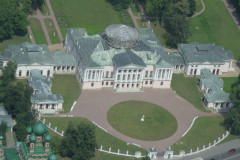
Arkhangelskoye Palace
Description
Historical estate in a neoclassical style 18th century
Arkhangelskoye is an architectural-park ensemble in the style of neoclassicism. The name of the manor owe the oldest building in the estate - the Church of Archangel Michael. Prince Odoyevsky was built a stone Church in place of wood in the late seventeenth century and the village where the temple was located, was renamed Arkhangelskoye.

In 1703, the estate passed to Prince Dmitry Mikhaylovich Golitsyn, at the time he was in disgrace and most of the time spent in Arkhangelskoye, developing the estate. But the present buildings were constructed by his grandson - Prince Nikolay Alexeyevich Galitzin.
Nikolai Golitsyn had acquired the architectural design of the manor in Paris (architector Charles Gern) and began the constructionin 1784. The Palace had been built 25 years, was laid out around a regular French Park, arranged a terrace. In 1810 Arkhangelskoye was sold for 245 thousand rubles by Prince Nikolai Borisovich Yusupov after the death of Prince Golitsyn. Prince Yusupov successfully completed the work begun by Prince Golitsyn, transforming Arkhangelskoye into a work of art. By order of the Prince were brought here valuable items from his other estates, so all sculpture were taken from Gorenki estate for park decoration at Archangelskoye. The furniture and paintings adorned the interiors of the Big house.

Arkhangelskoye has occupied an important place in the cultural life of the high society of Moscow. In 1818, Tsar Alexander I solemnly opened theatre in the Arkhangelskoye, which quickly gained popularity.
In the estate Yusupov arranged greenhouses with exotic plants and a zoo with camels and peacocks. The terraces were reconstructed, groves on the slopes of the Moskva river were extended. The Park was opened for walking to all comers. In 1827 poet Alexander Pushkin first visited Arkhangelskoye, he was delighted with the beauty and splendor of the estate and very impressed with the education of the Prince, received him in his house.
The estate was inherited by the descendants of Prince Yusupov until then, until in 1919 the Yusupovs left Russia forever. The estate was passed to the Ministry of defence, in place of the greenhouses were built two sanatorium buildings and open military sanatorium, working until now. The park and museums are open to the public.

Photo (32)


Video (1)
Street view
Info
Phone: (498) 653-86-60, (495) 363-13-75
Schedule:
in winter, November 10 - April 17:
- the park is open: Monday-Friday 10.00-18.00
- Saturday, Sunday and holidays from 10.00 to 19.00
- expositions and exhibitions are open: Wednesday-Friday 10.00-16.00
- Saturday, Sunday and holidays from 10.00 to 17.00
in summer, from April 18 to November 9:
- the Park is open daily from 10.00 to 21.00
- expositions and exhibitions are open Wednesday - Friday from 10.30 to 17.00
- on Saturdays, Sundays and holidays from 10.30 to 18.00
Weekends – Monday, Tuesday.
Sanitary day - last Wednesday of the month.
Access to the exposition ends 30 minutes before closing.
How to get there by public transport:
- By bus from Moscow. From the underground station Tushino buses 541, 549 to "Archangelskoye" bus stop or route taxi 151 up to the stop "Sanatorium";
- By train to the station from station 24 to the bus stop "Sanatorium" 49 or minibus to "Archangelskoye" bus stop;
- From Krasnogorsk town – buses 520 and 824.