
Vladimir Region
Description
Vladimir Oblast is a federal subject of Russia (an oblast). Its administrative center is the city of Vladimir, which is located 190 km east of Moscow. As of the 2010 Census, the oblast's population was 1,443,693.
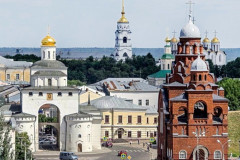
The UNESCO World Heritage List includes the 12th-century cathedrals of Vladimir, Suzdal, Bogolyubovo, and Kideksha.
Geography
Vladimir Oblast borders Moscow, Yaroslavl, Ivanovo, Ryazan, and Nizhny Novgorod Oblasts. The oblast is situated in the center of the East European Plain. The Klyazma and the Oka are the most important rivers. There are approximately three hundred lakes. The oblast is situated in a zone of mixed forests.
Fauna
The oblast's fauna currently includes more than fifty species of mammals (some examples including elk, wild boar, roe deer, red and sika deer, lynx, wolf, squirrel, rabbit, marten, fox, weasel, badger and other fur-bearing animals), five species of reptiles, and ten species of amphibians. The semiaquatic Russian desman is listed in the Russian Red Book of endangered species. The region is inhabited by 216 species of birds, among which are the capercaillie, black grouse, grouse, partridge, woodcock, goose, duck, etc. The lesser white-fronted goose is listed in the Red Book.
Hunting season runs from October to February with the following license and permit restrictions:
- Elk, wild boar, red deer, and sika deer from mid-November through mid-January
- Hare from October through January
- Grouse, black grouse, woodcock, duck and goose for 10 days in April.
Bodies of water in the region are rich in numerous species (about 40) of fresh-water fish (e.g. eel, roach, pike, perch, bream, rudd, and sturgeon in the Klyazma River), which support ice fishing in winter. Additionally, the oblast has several hunting farms.
Hydrography
The total expanse of the oblast's surface waters is 32.9 hectares.
The region has hundreds of rivers with a total length of more than 8.6 million kilometers--there are 560 rivers and streams throughout the oblast. The Klyazma River flows into the Oka River on the south-eastern edge of the oblast's border with the Nizhny Novgorod Region. The Klyazma River's major tributaries in the Vladimir Region are the Sherna (with the Molokcha flowing into it), the Kirzhach (with its own tributaries being the Big and Small Kirzhach), the Peksha, the Koloksha, the Nerl, the Sudogda, the Uvod, the Lukh and the Suvorosch. Tributaries of the Oka within Vladimir oblast are the Gus, Unzha, and Ushna rivers. The Dubna River, a tributary of the Volga River, originates near the town of Alexandrov. The Oka River is navigable throughout the region (157 km). The rivers in the region are characterized by their flat currents, broad valleys and meandering channels. Water levels are characterized by their high spring tides, low water periods over summer-autumn with occasional flooding during heavy rains, and stable/low levels throughout the winter.
There are about three hundred lakes covering an area of five thousand hectares. Most of them are small and undrained and many are overgrown with a peat layer. The origin of the lakes varies. Numerous oxbow lakes are scattered along the river valleys. The largest of them are Lake Urvanovskoe (12 km long) and Lake Visha (length about 10 km). In the Meshchera Lowlands and in the northwest of the oblast are lakes of ancient alluvial valleys: Isikhry, Svyatoe and others. Lakes of karst origin, located in the lower reaches of the Klyazma and in the center of Vyaznikovsky District (a northeastern district in the oblast), have highly mineralized water and are associated with underground watercourses. The largest and deepest of them is Lake Kshchara. In the districts of Alexandrov and Yuryev-Polsky glacial lakes are small in size.
The main masses of wetlands in the region (total area of 37.4 thousand hectares ) occur in Meshchera and Balakhna (in the northeast of the oblast) lowlands.
History
The territory of modern Vladimir Oblast has been populated since ancient times. The oldest known traces of human settlement date to the Upper Paleolithic. A settlement of Homo Sapiens dating back to 25,000 BCE was discovered in the area of Sungir. Archaeological excavations of Volga Finn settlements document the Finno-Ugric roots of this land. Merya, Muromian, and Meshchera inhabited territory of the region during this period.
Since the 10th century CE, Slavic colonization of the area began in Murom and Suzdal. The current territory of Vladimir Oblast became part of the Old Russian state. In the 11th century, the region became part of the Rostov-Suzdal principality and in the 12th century the Vladimir-Suzdal principality. In the early 12th century, Vladimir emerged as did Yaropolch-Zalessky. The Vladimir region rapidly developed in the mid-12th century during the rule of Yuri Dolgorukiy and Andrey Bogolyubsky. New townships arose--Yuriev-Polsky, Gorokhovets, Starodub-on-the-Klyazma, Mstislavl--along with the princely residences Kideksha and Bogolyubovo. The visibility of historical monuments preserves cities reminiscent of medieval Russian history and detailed documents about the history of the last hundred years records the peak of the cultural development of these places (Vladimirskaya guberniya, Vladimir Highway).
Economy and transportation
The Gusevskoye peat narrow gauge railway for hauling peat operates in the Gus-Khrustalny District.
Towns


All accomodation types
Hotels
 Staryy gorod Hotel
Hostels
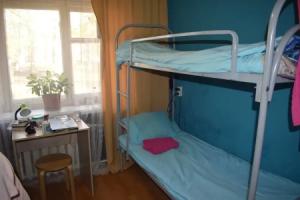 Eko Hostel
 Hostel "Hostel 67"
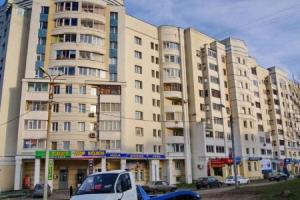 Light room
 Hostel Wow
 from 3 USDHostel Vostok
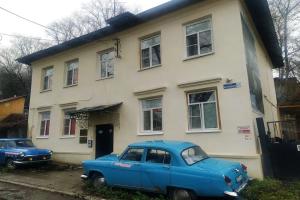 from 4 USDHostel "Narodnyy"
 from 6 USDSamovar Hostel
 from 8 USDHostel Grad
 from 8 USDGagarin Hostel
 from 8 USDPobeda Hostel
 High ratingfrom 9 USDVishnya Hostel
 from 8 USDFilm Hostel
 from 10 USDBelyij Topol Hostel
 from 12 USDSketch Mini Hotel