Montreux

Description

Montreux is a municipality in the district of Riviera-Pays-d'Enhaut in the canton of Vaud in Switzerland.

It is located on Lake Geneva at the foot of the Alps and has a population, as of December 2015, of 26,433 and nearly 90,000 in the agglomeration.

History

The earliest settlement was a Late Bronze Age village at Baugy. Montreux lies on the north east shore of Lake Geneva at the fork in the Roman road from Italy over the Simplon Pass, where the roads to the Roman capital of Aventicum and the road into Gaul through Besançon separated. This made it an important settlement in the Roman era. A Roman villa from the 2nd-4th centuries and a 6th–7th century cemetery have been discovered.

In the 12th century, viticulture was introduced to the region, and the sunny slopes of the lake from Lavaux to Montreux became an important wine-growing region. Montreux is first mentioned in 1215 as Mustruel. In 1295, the Bishop of Sion sold the parish of Montreux to Girard of Oron. In 1317, it was split between the Lords of Oron (Le Châtelard) and the Counts of Savoy (Les Planches). A Brotherhood of the Holy Spirit administered estates and a hospital in Montreux starting in about 1309.

The region was subject to various princes, most notably the princes of Savoy from the south side of the lake. They unified the territory which comprises the present canton of Vaud and were generally popular sovereigns.

After the Burgundian Wars in the 15th century, the Swiss in Bern occupied the region without resistance, an indication of the weakness of the princes of Savoy. Under Bernese rule (1536–1798) it belonged to the bailiwick of Chillon (renamed in 1735 into the bailiwick of Vevey).

The Reformation made the region around Montreux and Vevey an attractive haven for Huguenots from Italy, who brought their artisanal skills and set up workshops and businesses.

The abbey of Les Echarpes blanches was founded in 1626.

In 1798, Napoleon liberated the region from the Bernese. In the 19th century, the tourist industry became a major commercial outlet, with the grand hotels of Montreux attracting the rich and cultured from Europe and America.

Starting in the 19th Century there were three independent municipalities that shared a central authority. This county council was made up of four deputies from Le Châtelard, two from Les Planches and one from Veytaux. The church, the market hall of La Rouvenaz, the secondary school (the building was from 1872 and 1897) and the slaughter-house (1912) were all owned by the county council. Each municipality had its own taxes and a mayor. In 1962, the municipalities of Le Châtelard and Les Planches merged, while Veytaux remained independent.

Geography

Montreux has an area, as of 2009, of 33.4 square km. Of this area, 8.47 km2 (3.27 sq mi) or 25.4% is used for agricultural purposes, while 16.93 km2 (6.54 sq mi) or 50.7% is forested. Of the rest of the land, 6.37 km2 (2.46 sq mi) or 19.1% is settled (buildings or roads), 0.08 km2 (20 acres) or 0.2% is either rivers or lakes and 1.59 km2 (0.61 sq mi) or 4.8% is unproductive land.

Of the built up area, housing and buildings made up 10.9% and transportation infrastructure made up 6.3%. Out of the forested land, 47.0% of the total land area is heavily forested and 3.1% is covered with orchards or small clusters of trees. Of the agricultural land, 0.4% is used for growing crops and 8.8% is pastures, while 1.6% is used for orchards or vine crops and 14.7% is used for alpine pastures. All the water in the municipality is flowing water.

The municipality was part of the Vevey District until it was dissolved on 31 August 2006, and Montreux became part of the new district of Riviera-Pays-d'Enhaut.

The municipality stretches from Lake Geneva to the foothills of the Swiss Alps (Rochers-de-Naye). It includes the former municipalities of Montreux-Les Planches (until 1952 Les Planches) and Montreux-Le Châtelard (until 1952 Le Châtelard). It was formed in 1962 with the merger of the two former municipalities.

Heritage sites of national significance

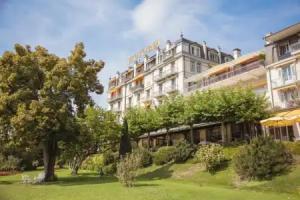
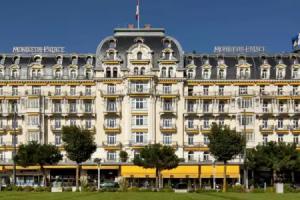
The Audiorama, the Swiss National Audiovisual Museum, Crêtes Castle, Châtelard Castle, the Train Station, the Hôtel Montreux Palace, the Caux Palace Hotel, the Ile and Villa Salagnon, the Marché couvert, the Palace-Hôtel, the Territet which was formerly the Grand-Hôtel/the Hôtel des Alpes, served as the recording studio for Deep Purple's record Machine Head, and the Villa Karma are listed as Swiss heritage site of national significance. The entire urban village of Territet / Veytaux as well as the Caux, Montreux and Villas Dubochet areas are all part of the Inventory of Swiss Heritage Sites.

  • Châtelard Castle

  • Hôtel Montreux Palace

  • Marché couvert

  • the Territet which was formerly the Grand-Hôtel/the Hôtel des Alpes

Religion

From the 2000 census, 8,557 or 38.1% were Roman Catholic, while 6,438 or 28.7% belonged to the Swiss Reformed Church. Of the rest of the population, there were 745 members of an Orthodox church (or about 3.32% of the population), there were 18 individuals (or about 0.08% of the population) who belonged to the Christian Catholic Church, and there were 925 individuals (or about 4.12% of the population) who belonged to another Christian church. There were 73 individuals (or about 0.33% of the population) who were Jewish, and 1,031 (or about 4.59% of the population) who were Muslim. There were 80 individuals who were Buddhist, 171 individuals who were Hindu and 90 individuals who belonged to another church. 2,796 (or about 12.45% of the population) belonged to no church, are agnostic or atheist, and 1,941 individuals (or about 8.64% of the population) did not answer the question.

Culture

  • It was a haven for Catherine Barkley and Lt. Frederic Henry in Ernest Hemingway's classic, A Farewell to Arms.

Montreux hosts several noteworthy festivals:

  • The Septembre musical de Montreux, founded in 1946 and held every year since then.
  • Freddie Mercury's Montreux Memorial Day, annually first week-end of September since 2003.
  • The Montreux Jazz Festival, annually in July since 1967. It is held at the Montreux Music & Convention Centre, built in 1973 and has become a global phenomenon.
  • The Golden Rose Festival, annually in spring (1961–2003), which awarded the Golden Rose of Montreux, an international award for television.
  • The Golden Award of Montreux, annually in April, is traditionally, since 1989, the first international advertising and multimedia Competition in Europe - starting the global season for awarding creative excellence.

Montreux boasts one of the most beautiful walks along the lake, stretching from Villeneuve all the way towards Vevey. The main square of the town, Place du Marché, features a statue of Freddie Mercury facing Lake Geneva. Some of the numerous small villages around Montreux include La Tour-de-Peilz, Clarens, Territet, and Villeneuve. The Château of Chillon provides a marvelous view of the entire Lake of Geneva and can be easily accessed via bus, train, walk or boat.

Deep Purple came to Montreux in December 1971 to record Machine Head. The band's famous song "Smoke on the Water" tells of the events of December 1971, when a Frank Zappa fan with a flare gun set the Montreux Casino on fire, destroying the casino where they had originally planned to record the album. Thanks to Claude Nobs who eventually arranged alternate locations, the Grand Hotel was where the album was created and recorded, except for Smoke on the Water which was recorded at La Petit Palais on Rue du Lac. Deep Purple again returned in 1973 to record Burn. The Montreux Casino was reopened in 1975 and later a monument commemorating Deep Purple and their song Smoke on the Water can be found next to the casino.

The Dubliners's song "Montreux Monto" on their album Live at Montreux was recorded live at the Montreux Jazz Festival in 1976.

Montreux is the home of Mountain Studios, the recording studio used by several artists. "Bonzo's Montreux" by Led Zeppelin is named after the city where the drums session of John Bonham was recorded in 1976. In 1978, the band Queen bought the studio. It was then sold to Queen producer David Richards. In 2002, the Mountain Studios was converted into a bar as part of a complete renovation of the studio. David Richards has left Montreux to settle down somewhere else. Queen also appeared in 1984 and in 1986 at the Golden Rose Festival and Queen guitarist Brian May appeared in 2001 at the Jazz Festival. Montreux was also the subject of the 1995 Queen single "A Winter's Tale" on the album Made in Heaven, one of Freddie's last songs before his death on November 24, 1991. The album cover features the statue of Mercury beside the lake.

In 1990, the Wakker Prize for the development and preservation of its architectural heritage was awarded to Montreux.

The Fédération Internationale de Roller Sports Federation International de Roller Skating was founded in Montreux in 1924.

Tourist attractions

Street view

Hotels

2 guests
Adults2+
Children under 170+
Age7+
Age7+
Age7+
Age7+
Age7+
Age7+
Age7+
Age7+
Age7+
Age7+
Search hotel

Reviews

Share your experiences, help others make the right choice!
Think about what you would like to know if you were looking for a review about a place to relax. Please describe in detail what you liked and what you didn't. What would you advise to other guests and to the hotel owner. The more fully you tell about the hotel, the easier it will be for other people to make a choice and they will be very grateful to you!

Map

X