Alaska
Description
Alaska is a U.S. state situated in the northwest extremity of the Americas. The Canadian administrative divisions of British Columbia and Yukon border the state to the east; it has a maritime border with Russia to the west across the Bering Strait. To the north are the Chukchi and Beaufort seas–the southern parts of the Arctic Ocean. The Pacific Ocean lies to the south and southwest. Alaska is the largest state in the United States by area, the 3rd least populous and the least densely populated of the 50 United States. Approximately half of Alaska's residents (the total estimated at 738,432 by the U.S. Census Bureau in 2015) live within the Anchorage metropolitan area. Alaska's economy is dominated by the fishing, natural gas, and oil industries, resources which it has in abundance. Military bases and tourism are also a significant part of the economy.
The United States purchased Alaska from the Russian Empire on March 30, 1867, for 7.2 million U.S. dollars at approximately two cents per acre ($4.74/km2). The actual transfer of sovereignty took place on the 6th October 1867 (Julian calendar), which was equivalent to the 18th October in the Gregorian one. To complicate matters further, the time zone changed from 14 hours ahead of Greenwich to 10 hours behind, which meant that Alaska had two Fridays in succession, the only place to have ever done so. The area went through several administrative changes before becoming organized as a territory on May 11, 1912. It was admitted as the 49th state of the U.S. on January 3, 1959.
Etymology
The name "Alaska" (Аляска) was introduced in the Russian colonial period when it was used to refer to the peninsula. It was derived from an Aleut, or Unangam idiom, which figuratively refers to the mainland of Alaska. Literally, it means object to which the action of the sea is directed. It is also known as Alyeska, the "great land", an Aleut word derived from the same root.
Geography
Alaska is the northernmost and westernmost state in the United States and has the most easterly longitude in the United States because the Aleutian Islands extend into the eastern hemisphere. Alaska is the only non-contiguous U.S. state on continental North America; about 500 miles (800 km) of British Columbia (Canada) separates Alaska from Washington. It is technically part of the continental U.S., but is sometimes not included in colloquial use; Alaska is not part of the contiguous U.S., often called "the Lower 48". The capital city, Juneau, is situated on the mainland of the North American continent but is not connected by road to the rest of the North American highway system.
The state is bordered by Yukon and British Columbia in Canada, to the east, the Gulf of Alaska and the Pacific Ocean to the south and southwest, the Bering Sea, Bering Strait, and Chukchi Sea to the west and the Arctic Ocean to the north. Alaska's territorial waters touch Russia's territorial waters in the Bering Strait, as the Russian Big Diomede Island and Alaskan Little Diomede Island are only 3 miles (4.8 km) apart. Alaska has a longer coastline than all the other U.S. states combined.
Alaska is the largest state in the United States in land area at 663,268 square miles (1,717,856 km2), over twice the size of Texas, the next largest state. Alaska is larger than all but 18 sovereign countries. Counting territorial waters, Alaska is larger than the combined area of the next three largest states: Texas, California, and Montana. It is also larger than the combined area of the 22 smallest U.S. states.
Regions
There are no officially defined borders demarcating the various regions of Alaska, but there are six widely accepted regions:
South Central
The most populous region of Alaska, containing Anchorage, the Matanuska-Susitna Valley and the Kenai Peninsula. Rural, mostly unpopulated areas south of the Alaska Range and west of the Wrangell Mountains also fall within the definition of South Central, as do the Prince William Sound area and the communities of Cordova and Valdez.
Southeast
Also referred to as the Panhandle or Inside Passage, this is the region of Alaska closest to the rest of the United States. As such, this was where most of the initial non-indigenous settlement occurred in the years following the Alaska Purchase. The region is dominated by the Alexander Archipelago as well as the Tongass National Forest, the largest national forest in the United States. It contains the state capital Juneau, the former capital Sitka, and Ketchikan, at one time Alaska's largest city. The Alaska Marine Highway provides a vital surface transportation link throughout the area, as only three communities (Haines, Hyder and Skagway) enjoy direct connections to the contiguous North American road system.
Interior
The Interior is the largest region of Alaska; much of it is uninhabited wilderness. Fairbanks is the only large city in the region. Denali National Park and Preserve is located here. Denali is the highest mountain in North America.
Southwest
Southwest Alaska is a sparsely inhabited region stretching some 500 miles (800 km) inland from the Bering Sea. Most of the population lives along the coast. Kodiak Island is also located in Southwest. The massive Yukon–Kuskokwim Delta, one of the largest river deltas in the world, is here. Portions of the Alaska Peninsula are considered part of Southwest, with the remaining portions included with the Aleutian Islands (see below).
North Slope
The North Slope is mostly tundra peppered with small villages. The area is known for its massive reserves of crude oil, and contains both the National Petroleum Reserve–Alaska and the Prudhoe Bay Oil Field. Barrow, the northernmost city in the United States, is located here. The Northwest Arctic area, anchored by Kotzebue and also containing the Kobuk River valley, is often regarded as being part of this region. However, the respective Inupiat of the North Slope and of the Northwest Arctic seldom consider themselves to be one people.
Aleutian Islands
More than 300 small volcanic islands make up this chain, which stretches over 1,200 miles (1,900 km) into the Pacific Ocean. Some of these islands fall in the Eastern Hemisphere, but the International Date Line was drawn west of 180° to keep the whole state, and thus the entire North American continent, within the same legal day. Two of the islands, Attu and Kiska, were occupied by Japanese forces during World War II.
Natural features
With its myriad islands, Alaska has nearly 34,000 miles (54,720 km) of tidal shoreline. The Aleutian Islands chain extends west from the southern tip of the Alaska Peninsula. Many active volcanoes are found in the Aleutians and in coastal regions. Unimak Island, for example, is home to Mount Shishaldin, which is an occasionally smoldering volcano that rises to 10,000 feet (3,048 m) above the North Pacific. It is the most perfect volcanic cone on Earth, even more symmetrical than Japan's Mount Fuji. The chain of volcanoes extends to Mount Spurr, west of Anchorage on the mainland. Geologists have identified Alaska as part of Wrangellia, a large region consisting of multiple states and Canadian provinces in the Pacific Northwest, which is actively undergoing continent building.
One of the world's largest tides occurs in Turnagain Arm, just south of Anchorage – tidal differences can be more than 35 feet (10.7 m).
Alaska has more than three million lakes. Marshlands and wetland permafrost cover 188,320 square miles (487,747 km2) (mostly in northern, western and southwest flatlands). Glacier ice covers some 16,000 square miles (41,440 km2) of land and 1,200 square miles (3,110 km2) of tidal zone. The Bering Glacier complex near the southeastern border with Yukon covers 2,250 square miles (5,827 km2) alone. With over 100,000 glaciers, Alaska has half of all in the world.
Land ownership
According to an October 1998 report by the United States Bureau of Land Management, approximately 65% of Alaska is owned and managed by the U.S. federal government as public lands, including a multitude of national forests, national parks, and national wildlife refuges. Of these, the Bureau of Land Management manages 87 million acres (35 million hectares), or 23.8% of the state. The Arctic National Wildlife Refuge is managed by the United States Fish and Wildlife Service. It is the world's largest wildlife refuge, comprising 16 million acres (6.5 million hectares).
Of the remaining land area, the state of Alaska owns 101 million acres (41 million hectares), its entitlement under the Alaska Statehood Act. A portion of that acreage is occasionally ceded to organized boroughs, under the statutory provisions pertaining to newly formed boroughs. Smaller portions are set aside for rural subdivisions and other homesteading-related opportunities. These are not very popular due to the often remote and roadless locations. The University of Alaska, as a land grant university, also owns substantial acreage which it manages independently.
Another 44 million acres (18 million hectares) are owned by 12 regional, and scores of local, Native corporations created under the Alaska Native Claims Settlement Act (ANCSA) of 1971. Regional Native corporation Doyon, Limited often promotes itself as the largest private landowner in Alaska in advertisements and other communications. Provisions of ANCSA allowing the corporations' land holdings to be sold on the open market starting in 1991 were repealed before they could take effect. Effectively, the corporations hold title (including subsurface title in many cases, a privilege denied to individual Alaskans) but cannot sell the land. Individual Native allotments can be and are sold on the open market, however.
Various private interests own the remaining land, totaling about one percent of the state. Alaska is, by a large margin, the state with the smallest percentage of private land ownership when Native corporation holdings are excluded.
History
Alaska Natives
Numerous indigenous peoples occupied Alaska for thousands of years before the arrival of European peoples to the area. Linguistic and DNA studies done here have provided evidence for the settlement of North America by way of the Bering land bridge. The Tlingit people developed a society with a matrilineal kinship system of property inheritance and descent in what is today Southeast Alaska, along with parts of British Columbia and the Yukon. Also in Southeast were the Haida, now well known for their unique arts. The Tsimshian people came to Alaska from British Columbia in 1887, when President Grover Cleveland, and later the U.S. Congress, granted them permission to settle on Annette Island and found the town of Metlakatla. All three of these peoples, as well as other indigenous peoples of the Pacific Northwest Coast, experienced smallpox outbreaks from the late 18th through the mid-19th century, with the most devastating epidemics occurring in the 1830s and 1860s, resulting in high fatalities and social disruption.
The Aleutian Islands are still home to the Aleut people's seafaring society, although they were the first Native Alaskans to be exploited by Russians. Western and Southwestern Alaska are home to the Yup'ik, while their cousins the Alutiiq ~ Sugpiaq lived in what is now Southcentral Alaska. The Gwich'in people of the northern Interior region are Athabaskan and primarily known today for their dependence on the caribou within the much-contested Arctic National Wildlife Refuge. The North Slope and Little Diomede Island are occupied by the widespread Inupiat people.
Colonization
Some researchers believe that the first Russian settlement in Alaska was established in the 17th century. According to this hypothesis, in 1648 several koches of Semyon Dezhnyov's expedition came ashore in Alaska by storm and founded this settlement. This hypothesis is based on the testimony of Chukchi geographer Nikolai Daurkin, who had visited Alaska in 1764–1765 and who had reported on a village on the Kheuveren River, populated by "bearded men" who "pray to the icons". Some modern researchers associate Kheuveren with Koyuk River.
The first European vessel to reach Alaska is generally held to be the St. Gabriel under the authority of the surveyor M. S. Gvozdev and assistant navigator I. Fyodorov on August 21, 1732 during an expedition of Siberian cossak A. F. Shestakov and Belorussian explorer Dmitry Pavlutsky (1729—1735).
Another European contact with Alaska occurred in 1741, when Vitus Bering led an expedition for the Russian Navy aboard the St. Peter. After his crew returned to Russia with sea otter pelts judged to be the finest fur in the world, small associations of fur traders began to sail from the shores of Siberia toward the Aleutian Islands. The first permanent European settlement was founded in 1784.
Between 1774 and 1800, Spain sent several expeditions to Alaska in order to assert its claim over the Pacific Northwest. In 1789 a Spanish settlement and fort were built in Nootka Sound. These expeditions gave names to places such as Valdez, Bucareli Sound, and Cordova. Later, the Russian-American Company carried out an expanded colonization program during the early-to-mid-19th century.
Sitka, renamed New Archangel from 1804 to 1867, on Baranof Island in the Alexander Archipelago in what is now Southeast Alaska, became the capital of Russian America. It remained the capital after the colony was transferred to the United States. The Russians never fully colonized Alaska, and the colony was never very profitable. Evidence of Russian settlement in names and churches survive throughout southeast Alaska.
William H. Seward, the United States Secretary of State, negotiated the Alaska Purchase (also known as Seward's Folly) with the Russians in 1867 for $7.2 million. Alaska was loosely governed by the military initially, and was administered as a district starting in 1884, with a governor appointed by the President of the United States. A federal district court was headquartered in Sitka.
For most of Alaska's first decade under the United States flag, Sitka was the only community inhabited by American settlers. They organized a "provisional city government," which was Alaska's first municipal government, but not in a legal sense. Legislation allowing Alaskan communities to legally incorporate as cities did not come about until 1900, and home rule for cities was extremely limited or unavailable until statehood took effect in 1959.
U.S. Territory
Starting in the 1890s and stretching in some places to the early 1910s, gold rushes in Alaska and the nearby Yukon Territory brought thousands of miners and settlers to Alaska. Alaska was officially incorporated as an organized territory in 1912. Alaska's capital, which had been in Sitka until 1906, was moved north to Juneau. Construction of the Alaska Governor's Mansion began that same year. European immigrants from Norway and Sweden also settled in southeast Alaska, where they entered the fishing and logging industries.
During World War II, the Aleutian Islands Campaign focused on the three outer Aleutian Islands – Attu, Agattu and Kiska – that were invaded by Japanese troops and occupied between June 1942 and August 1943. Unalaska/Dutch Harbor became a significant base for the U.S. Army Air Forces and Navy submariners.
The U.S. Lend-Lease program involved the flying of American warplanes through Canada to Fairbanks and thence Nome; Soviet pilots took possession of these aircraft, ferrying them to fight the German invasion of the Soviet Union. The construction of military bases contributed to the population growth of some Alaskan cities.
Statehood
Statehood for Alaska was an important cause of James Wickersham early in his tenure as a congressional delegate. Decades later, the statehood movement gained its first real momentum following a territorial referendum in 1946. The Alaska Statehood Committee and Alaska's Constitutional Convention would soon follow. Statehood supporters also found themselves fighting major battles against political foes, mostly in the U.S. Congress but also within Alaska. Statehood was approved by Congress on July 7, 1958. Alaska was officially proclaimed a state on January 3, 1959.
In 1960, the Census Bureau reported Alaska's population as 77.2% White, 3% Black, and 18.8% American Indian and Alaska Native.
On March 27, 1964, the massive Good Friday earthquake killed 133 people and destroyed several villages and portions of large coastal communities, mainly by the resultant tsunamis and landslides. It was the second-most-powerful earthquake in the recorded history of the world, with a moment magnitude of 9.2. It was over one thousand times more powerful than the 1989 San Francisco earthquake. The time of day (5:36 pm), time of year and location of the epicenter were all cited as factors in potentially sparing thousands of lives, particularly in Anchorage.
The 1968 discovery of oil at Prudhoe Bay and the 1977 completion of the Trans-Alaska Pipeline System led to an oil boom. Royalty revenues from oil have funded large state budgets from 1980 onward. That same year, not coincidentally, Alaska repealed its state income tax.
In 1989, the Exxon Valdez hit a reef in the Prince William Sound, spilling over 11 million U.S. gallons (42 megaliters) of crude oil over 1,100 miles (1,800 km) of coastline. Today, the battle between philosophies of development and conservation is seen in the contentious debate over oil drilling in the Arctic National Wildlife Refuge and the proposed Pebble Mine.
Alaska Heritage Resources Survey
The Alaska Heritage Resources Survey (AHRS) is a restricted inventory of all reported historic and prehistoric sites within the state of Alaska; it is maintained by the Office of History and Archaeology. The survey's inventory of cultural resources includes objects, structures, buildings, sites, districts, and travel ways, with a general provision that they are over 50 years old. As of January 31, 2012, over 35,000 sites have been reported.
Transportation
Roads
Alaska has few road connections compared to the rest of the U.S. The state's road system covers a relatively small area of the state, linking the central population centers and the Alaska Highway, the principal route out of the state through Canada. The state capital, Juneau, is not accessible by road, only a car ferry, which has spurred several debates over the decades about moving the capital to a city on the road system, or building a road connection from Haines. The western part of Alaska has no road system connecting the communities with the rest of Alaska.
One unique feature of the Alaska Highway system is the Anton Anderson Memorial Tunnel, an active Alaska Railroad tunnel recently upgraded to provide a paved roadway link with the isolated community of Whittier on Prince William Sound to the Seward Highway about 50 miles (80 km) southeast of Anchorage at Portage. At 2.5 miles (4.0 km), the tunnel was the longest road tunnel in North America until 2007. The tunnel is the longest combination road and rail tunnel in North America.
Rail
Built around 1915, the Alaska Railroad (ARR) played a key role in the development of Alaska through the 20th century. It links north Pacific shipping through providing critical infrastructure with tracks that run from Seward to Interior Alaska by way of South Central Alaska, passing through Anchorage, Eklutna, Wasilla, Talkeetna, Denali, and Fairbanks, with spurs to Whittier, Palmer and North Pole. The cities, towns, villages, and region served by ARR tracks are known statewide as "The Railbelt". In recent years, the ever-improving paved highway system began to eclipse the railroad's importance in Alaska's economy.
The railroad played a vital role in Alaska's development, moving freight into Alaska while transporting natural resources southward (i.e., coal from the Usibelli coal mine near Healy to Seward and gravel from the Matanuska Valley to Anchorage). It is well known for its summertime tour passenger service.
The Alaska Railroad was one of the last railroads in North America to use cabooses in regular service and still uses them on some gravel trains. It continues to offer one of the last flag stop routes in the country. A stretch of about 60 miles (100 km) of track along an area north of Talkeetna remains inaccessible by road; the railroad provides the only transportation to rural homes and cabins in the area. Until construction of the Parks Highway in the 1970s, the railroad provided the only land access to most of the region along its entire route.
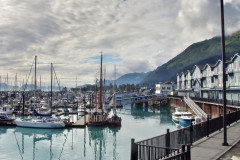
In northern Southeast Alaska, the White Pass and Yukon Route also partly runs through the state from Skagway northwards into Canada (British Columbia and Yukon Territory), crossing the border at White Pass Summit. This line is now mainly used by tourists, often arriving by cruise liner at Skagway. It was featured in the 1983 BBC television series Great Little Railways.
The Alaska Rail network is not connected to Outside. In 2000, the U.S. Congress authorized $6 million to study the feasibility of a rail link between Alaska, Canada, and the lower 48.
Alaska Rail Marine provides car float service between Whittier and Seattle.
Marine transport
Many cities, towns and villages in the state do not have road or highway access; the only modes of access involve travel by air, river, or the sea.
Alaska's well-developed state-owned ferry system (known as the Alaska Marine Highway) serves the cities of southeast, the Gulf Coast and the Alaska Peninsula. The ferries transport vehicles as well as passengers. The system also operates a ferry service from Bellingham, Washington and Prince Rupert, British Columbia in Canada through the Inside Passage to Skagway. The Inter-Island Ferry Authority also serves as an important marine link for many communities in the Prince of Wales Island region of Southeast and works in concert with the Alaska Marine Highway.
In recent years, cruise lines have created a summertime tourism market, mainly connecting the Pacific Northwest to Southeast Alaska and, to a lesser degree, towns along Alaska's gulf coast. The population of Ketchikan may rise by over 10,000 people on many days during the summer, as up to four large cruise ships at a time can dock, debarking thousands of passengers.
Air transport
Cities not served by road, sea, or river can be reached only by air, foot, dogsled, or snowmachine, accounting for Alaska's extremely well developed bush air services—an Alaskan novelty. Anchorage and, to a lesser extent Fairbanks, is served by many major airlines. Because of limited highway access, air travel remains the most efficient form of transportation in and out of the state. Anchorage recently completed extensive remodeling and construction at Ted Stevens Anchorage International Airport to help accommodate the upsurge in tourism (in 2012-2013, Alaska received almost 2 million visitors).
Regular flights to most villages and towns within the state that are commercially viable are challenging to provide, so they are heavily subsidized by the federal government through the Essential Air Service program. Alaska Airlines is the only major airline offering in-state travel with jet service (sometimes in combination cargo and passenger Boeing 737-400s) from Anchorage and Fairbanks to regional hubs like Bethel, Nome, Kotzebue, Dillingham, Kodiak, and other larger communities as well as to major Southeast and Alaska Peninsula communities.
The bulk of remaining commercial flight offerings come from small regional commuter airlines such as Ravn Alaska, PenAir, and Frontier Flying Service. The smallest towns and villages must rely on scheduled or chartered bush flying services using general aviation aircraft such as the Cessna Caravan, the most popular aircraft in use in the state. Much of this service can be attributed to the Alaska bypass mail program which subsidizes bulk mail delivery to Alaskan rural communities. The program requires 70% of that subsidy to go to carriers who offer passenger service to the communities.
Many communities have small air taxi services. These operations originated from the demand for customized transport to remote areas. Perhaps the most quintessentially Alaskan plane is the bush seaplane. The world's busiest seaplane base is Lake Hood, located next to Ted Stevens Anchorage International Airport, where flights bound for remote villages without an airstrip carry passengers, cargo, and many items from stores and warehouse clubs. In 2006 Alaska had the highest number of pilots per capita of any U.S. state.
Other transport
Another Alaskan transportation method is the dogsled. In modern times (that is, any time after the mid-late 1920s), dog mushing is more of a sport than a true means of transportation. Various races are held around the state, but the best known is the Iditarod Trail Sled Dog Race, a 1,150-mile (1,850 km) trail from Anchorage to Nome (although the distance varies from year to year, the official distance is set at 1,049 miles or 1,688 km). The race commemorates the famous 1925 serum run to Nome in which mushers and dogs like Togo and Balto took much-needed medicine to the diphtheria-stricken community of Nome when all other means of transportation had failed. Mushers from all over the world come to Anchorage each March to compete for cash, prizes, and prestige. The "Serum Run" is another sled dog race that more accurately follows the route of the famous 1925 relay, leaving from the community of Nenana (southwest of Fairbanks) to Nome.
In areas not served by road or rail, primary transportation in summer is by all-terrain vehicle and in winter by snowmobile or "snow machine," as it is commonly referred to in Alaska.
Data transport
Alaska's internet and other data transport systems are provided largely through the two major telecommunications companies: GCI and Alaska Communications. GCI owns and operates what it calls the Alaska United Fiber Optic system and as of late 2011 Alaska Communications advertised that it has "two fiber optic paths to the lower 48 and two more across Alaska. In January 2011, it was reported that a $1 billion project to run connect Asia and rural Alaska was being planned, aided in part by $350 million in stimulus from the federal government.
Cities, towns and boroughs
Alaska is not divided into counties, as most of the other U.S. states, but it is divided into boroughs. Many of the more densely populated parts of the state are part of Alaska's 16 boroughs, which function somewhat similarly to counties in other states. However, unlike county-equivalents in the other 49 states, the boroughs do not cover the entire land area of the state. The area not part of any borough is referred to as the Unorganized Borough.
The Unorganized Borough has no government of its own, but the U.S. Census Bureau in cooperation with the state divided the Unorganized Borough into 11 census areas solely for the purposes of statistical analysis and presentation. A recording district is a mechanism for administration of the public record in Alaska. The state is divided into 34 recording districts which are centrally administered under a State Recorder. All recording districts use the same acceptance criteria, fee schedule, etc., for accepting documents into the public record.
Whereas many U.S. states use a three-tiered system of decentralization—state/county/township—most of Alaska uses only two tiers—state/borough. Owing to the low population density, most of the land is located in the Unorganized Borough. As the name implies, it has no intermediate borough government but is administered directly by the state government. In 2000, 57.71% of Alaska's area has this status, with 13.05% of the population.
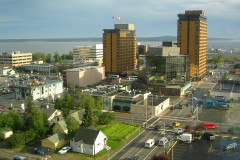
Anchorage merged the city government with the Greater Anchorage Area Borough in 1975 to form the Municipality of Anchorage, containing the city proper and the communities of Eagle River, Chugiak, Peters Creek, Girdwood, Bird, and Indian. Fairbanks has a separate borough (the Fairbanks North Star Borough) and municipality (the City of Fairbanks).
The state's most populous city is Anchorage, home to 278,700 people in 2006, 225,744 of whom live in the urbanized area. The richest location in Alaska by per capita income is Halibut Cove ($89,895). Yakutat City, Sitka, Juneau, and Anchorage are the four largest cities in the U.S. by area.
Cities and census-designated places (by population)
As reflected in the 2010 United States Census, Alaska has a total of 355 incorporated cities and census-designated places (CDPs). The tally of cities includes four unified municipalities, essentially the equivalent of a consolidated city–county. The majority of these communities are located in the rural expanse of Alaska known as "The Bush" and are unconnected to the contiguous North American road network. The table at the bottom of this section lists the 100 largest cities and census-designated places in Alaska, in population order.
Of Alaska's 2010 Census population figure of 710,231, 20,429 people, or 2.88% of the population, did not live in an incorporated city or census-designated place. Approximately three-quarters of that figure were people who live in urban and suburban neighborhoods on the outskirts of the city limits of Ketchikan, Kodiak, Palmer and Wasilla. CDPs have not been established for these areas by the United States Census Bureau, except that seven CDPs were established for the Ketchikan-area neighborhoods in the 1980 Census (Clover Pass, Herring Cove, Ketchikan East, Mountain Point, North Tongass Highway, Pennock Island and Saxman East), but have not been used since. The remaining population was scattered throughout Alaska, both within organized boroughs and in the Unorganized Borough, in largely remote areas.
Public health and public safety
The Alaska State Troopers are Alaska's statewide police force. They have a long and storied history, but were not an official organization until 1941. Before the force was officially organized, law enforcement in Alaska was handled by various federal agencies. Larger towns usually have their own local police and some villages rely on "Public Safety Officers" who have police training but do not carry firearms. In much of the state, the troopers serve as the only police force available. In addition to enforcing traffic and criminal law, wildlife Troopers enforce hunting and fishing regulations. Due to the varied terrain and wide scope of the Troopers' duties, they employ a wide variety of land, air, and water patrol vehicles.
Many rural communities in Alaska are considered "dry," having outlawed the importation of alcoholic beverages. Suicide rates for rural residents are higher than urban.
Domestic abuse and other violent crimes are also at high levels in the state; this is in part linked to alcohol abuse. Alaska has the highest rate of sexual assault in the nation, especially in rural areas. The average age of sexually assaulted victims is 16 years old. In four out of five cases, the suspects were relatives, friends or acquaintances.
Culture
Some of Alaska's popular annual events are the Iditarod Trail Sled Dog Race that starts in Anchorage and ends in Nome, World Ice Art Championships in Fairbanks, the Blueberry Festival and Alaska Hummingbird Festival in Ketchikan, the Sitka Whale Fest, and the Stikine River Garnet Fest in Wrangell. The Stikine River attracts the largest springtime concentration of American bald eagles in the world.
The Alaska Native Heritage Center celebrates the rich heritage of Alaska's 11 cultural groups. Their purpose is to encourage cross-cultural exchanges among all people and enhance self-esteem among Native people. The Alaska Native Arts Foundation promotes and markets Native art from all regions and cultures in the State, using the internet.
Music
Influences on music in Alaska include the traditional music of Alaska Natives as well as folk music brought by later immigrants from Russia and Europe. Prominent musicians from Alaska include singer Jewel, traditional Aleut flautist Mary Youngblood, folk singer-songwriter Libby Roderick, Christian music singer/songwriter Lincoln Brewster, metal/post hardcore band 36 Crazyfists and the groups Pamyua and Portugal. The Man.
There are many established music festivals in Alaska, including the Alaska Folk Festival, the Fairbanks Summer Arts Festival, the Anchorage Folk Festival, the Athabascan Old-Time Fiddling Festival, the Sitka Jazz Festival, and the Sitka Summer Music Festival. The most prominent orchestra in Alaska is the Anchorage Symphony Orchestra, though the Fairbanks Symphony Orchestra and Juneau Symphony are also notable. The Anchorage Opera is currently the state's only professional opera company, though there are several volunteer and semi-professional organizations in the state as well.
The official state song of Alaska is "Alaska's Flag", which was adopted in 1955; it celebrates the flag of Alaska.
Alaska in film and on television
Alaska's first independent picture entirely made in Alaska was The Chechahcos, produced by Alaskan businessman Austin E. Lathrop and filmed in and around Anchorage. Released in 1924 by the Alaska Moving Picture Corporation, it was the only film the company made.
One of the most prominent movies filmed in Alaska is MGM's Eskimo/Mala The Magnificent, starring Alaska Native Ray Mala. In 1932 an expedition set out from MGM's studios in Hollywood to Alaska to film what was then billed as "The Biggest Picture Ever Made." Upon arriving in Alaska, they set up "Camp Hollywood" in Northwest Alaska, where they lived during the duration of the filming. Louis B. Mayer spared no expense in spite of the remote location, going so far as to hire the chef from the Hotel Roosevelt in Hollywood to prepare meals.
When Eskimo premiered at the Astor Theatre in New York City, the studio received the largest amount of feedback in its history to that point. Eskimo was critically acclaimed and released worldwide; as a result, Mala became an international movie star. Eskimo won the first Oscar for Best Film Editing at the Academy Awards, and showcased and preserved aspects of Inupiat culture on film.
The 1983 Disney movie Never Cry Wolf was at least partially shot in Alaska. The 1991 film White Fang, based on Jack London's novel and starring Ethan Hawke, was filmed in and around Haines. Steven Seagal's 1994 On Deadly Ground, starring Michael Caine, was filmed in part at the Worthington Glacier near Valdez. The 1999 John Sayles film Limbo, starring David Strathairn, Mary Elizabeth Mastrantonio, and Kris Kristofferson, was filmed in Juneau.
The psychological thriller Insomnia, starring Al Pacino and Robin Williams, was shot in Canada, but was set in Alaska. The 2007 film directed by Sean Penn, Into The Wild, was partially filmed and set in Alaska. The film, which is based on the novel of the same name, follows the adventures of Christopher McCandless, who died in a remote abandoned bus along the Stampede Trail west of Healy in 1992.
Many films and television shows set in Alaska are not filmed there; for example, Northern Exposure, set in the fictional town of Cicely, Alaska, was filmed in Roslyn, Washington. The 2007 horror feature 30 Days of Night is set in Barrow, but was filmed in New Zealand.
Many reality television shows are filmed in Alaska. In 2011 the Anchorage Daily News found ten set in the state.