Arizona
Description
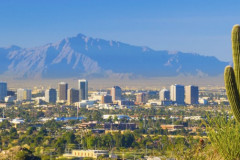
Arizona is a state in the southwestern region of the United States. It is also part of the Western United States and of the Mountain West states. It is the sixth largest and the 14th most populous of the 50 states. Its capital and largest city is Phoenix. Arizona is one of the Four Corners states. It has borders with New Mexico, Utah, Nevada, California, and Mexico, and one point in common with the southwestern corner of Colorado. Arizona's border with Mexico is 389 miles (626 km) long, on the northern border of the Mexican states of Sonora and Baja California.
Arizona is the 48th state and last of the contiguous states to be admitted to the Union, achieving statehood on February 14, 1912. Historically part of the territory of Alta California in New Spain, it became part of independent Mexico in 1821. After being defeated in the Mexican–American War, Mexico ceded much of this territory to the United States in 1848. The southernmost portion of the state was acquired in 1853 through the Gadsden Purchase.
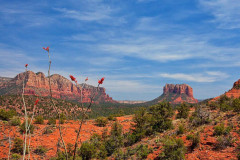
Southern Arizona is known for its desert climate, with very hot summers and mild winters. Northern Arizona features forests of pine, Douglas fir, and spruce trees; the Colorado Plateau; some mountain ranges (such as the San Francisco Mountains); as well as large, deep canyons, with much more moderate summer temperatures and significant winter snowfalls. There are ski resorts in the areas of Flagstaff, Alpine, and Tucson. In addition to the Grand Canyon National Park, there are several national forests, national parks, and national monuments.
About one-quarter of the state is made up of Indian reservations that serve as the home of 27 federally recognized Native American tribes, including the Navajo Nation, the largest in the state and the United States, with more than 300,000 citizens. Although federal law gave all Native Americans the right to vote in 1924, Arizona excluded those living on reservations from voting until its state Supreme Court ruled in 1948 in favor of Native American plaintiffs.
Etymology
The name of the state appears to originate from an earlier Spanish name, Arizonac, derived from the O'odham name alĭ ṣonak, meaning "small spring," which initially applied only to an area near the silver mining camp of Planchas de Plata, Sonora. To the European settlers, their pronunciation sounded like "Arissona". The area is still known as alĭ ṣonak in the O'odham language. Another possible origin is the Basque phrase haritz ona ("the good oak"), as there were numerous Basque sheepherders in the area.
There is a misconception that the state's name originated from the Spanish term for "Arid Zone". The Spanish phrase for "arid zone" would be zona árida in Spanish.
Geography and geology
Arizona is located in the Southwestern United States as one of the Four Corners states. Arizona is the sixth largest state by area, ranked after New Mexico and before Nevada. Of the state's 113,998 square miles (295,000 km2), approximately 15% is privately owned. The remaining area is public forest and park land, state trust land and Native American reservations.
Arizona is well known for its desert Basin and Range region in the southern portions of the state, which is rich in a landscape of xerophyte plants such as the cactus. The topography of this region was shaped by prehistoric volcanism, followed by the cooling-off and related subsidence. Its climate has exceptionally hot summers and mild winters. The state is less well known for its pine-covered north-central portion of the high country of the Colorado Plateau (see Arizona Mountains forests).
Like other states of the Southwest United States, Arizona has an abundance of mountains and plateaus. Despite the state's aridity, 27% of Arizona is forest, a percentage comparable to modern-day France or Germany. The largest stand of ponderosa pine trees in the world is contained in Arizona.
The Mogollon Rim, a 1,998-foot (609 m) escarpment, cuts across the central section of the state and marks the southwestern edge of the Colorado Plateau. In 2002 this was an area of the Rodeo–Chediski Fire, the worst fire in state history.
Located in northern Arizona, the Grand Canyon is a colorful, deep, steep-sided gorge, carved by the Colorado River. The canyon is one of the seven natural wonders of the world and is largely contained in the Grand Canyon National Park—one of the first national parks in the United States. President Theodore Roosevelt was a major proponent of designating the Grand Canyon area as a National Park, visiting on numerous occasions to hunt mountain lion and enjoy the scenery. The canyon was created by the Colorado River cutting a channel over millions of years, and is about 277 miles (446 km) long, ranges in width from 4 to 18 miles (6 to 29 km) and attains a depth of more than 1 mile (1.6 km). Nearly two billion years of the Earth's history have been exposed as the Colorado River and its tributaries cut through layer after layer of sediment as the Colorado Plateau uplifted.
Arizona is home to one of the most well-preserved meteorite impact sites in the world. Created around 50,000 years ago, the Barringer Meteorite Crater (better known simply as "Meteor Crater") is a gigantic hole in the middle of the high plains of the Colorado Plateau, about 25 miles (40 km) west of Winslow. A rim of smashed and jumbled boulders, some of them the size of small houses, rises 150 feet (46 m) above the level of the surrounding plain. The crater itself is nearly 1 mile (1.6 km) wide, and 570 feet (170 m) deep.
Arizona is one of two U.S. states that does not observe Daylight Saving Time (the other being Hawaii). The exception is within the large Navajo Nation (which does observe Daylight Saving Time), located in the northeastern region of the state.
Earthquakes
Generally, Arizona is at low risk of earthquakes, except for the southwestern portion which is at moderate risk due to its proximity to Southern California. On the other hand, Northern Arizona is at moderate risk due to numerous faults in the area. The regions near and west of Phoenix have the lowest risk.
The earliest Arizona earthquakes were recorded at Fort Yuma, on the California side of the Colorado River. They were centered near the Imperial Valley, or Mexico, back in the 1800s. In 1887 Douglas felt the shock of a magnitude 7.2 earthquake with an epicenter 40 miles to the south in the Mexican state of Sonora. The first damaging earthquake known to be centered within Arizona's borders occurred on January 25, 1906, also including a series of other earthquakes centered near Socorro, New Mexico. The shock was violent in Flagstaff.
In September 1910, a series of fifty-two earthquakes caused a construction crew near Flagstaff to leave the area. In 1912, the year Arizona achieved statehood, on August 18, an earthquake caused a 50-mile crack in the San Francisco Range. In early January 1935, the state experienced a series of earthquakes, in the Yuma area and near the Grand Canyon. Arizona experienced its largest earthquake in 1959, with a tremor of a magnitude 5.6. It was centered near Fredonia, in the northwestern part of the state near the border with Utah. The tremor was felt across the border in the neighboring states of Nevada and Utah.
History
For thousands of years before the modern era, Arizona was home to numerous Native American Tribes. Hohokam, Mogollon and Ancestral Puebloan cultures were among the many that flourished throughout the entire state. Many of their pueblos, cliffside dwellings, rock paintings and other prehistoric treasures have survived, attracting thousands of tourists each year.
The first European contact by native peoples was with Marcos de Niza, a Spanish Franciscan, in 1539. He explored parts of the state and made contact with native inhabitants, probably the Sobaipuri. The expedition of Spanish explorer Coronado entered the area in 1540–1542 during its search for Cíbola.
Father Kino was the next European in the region. A member of the Society of Jesus, he led the development of a chain of missions in the region. He converted many of the Indians to Christianity in the Pimería Alta (now southern Arizona and northern Sonora) in the 1690s and early 18th century. Spain founded presidios ("fortified towns") at Tubac in 1752 and Tucson in 1775.
When Mexico achieved its independence from Spain in 1821, what is now Arizona became part of its Territory of Nueva California, also known as Alta California. Descendants of ethnic Spanish and mestizo settlers from the colonial years still lived in the area, with much deeper roots than later European-American migrants from the United States.
In the Mexican–American War (1847), the US occupied Mexico City and pursued its claim to much of northern Mexico, including what later became Arizona. The Treaty of Guadalupe Hidalgo (1848) specified that, in addition to language and cultural rights of the existing inhabitants being considered as inviolable, the sum of US$15 million in compensation (equivalent to about $410 million today) be paid to the Republic of Mexico. In 1853 the US acquired the land below the Gila River from Mexico in the Gadsden Purchase. Arizona was administered as part of the Territory of New Mexico until southern New Mexico Territory seceded from the Union as the Confederate Territory of Arizona on March 16, 1861.
Arizona was recognized as a Confederate Territory by presidential proclamation of Jefferson Davis on February 14, 1862. This is the first official use of the name. Arizona supported the Confederate cause with men, horses, and supplies. Formed in 1862, Arizona Scout Companies fought with the Confederate Army throughout the war. Arizona has the westernmost recorded engagement of the war, the Battle of Picacho Pass.
The federal government declared a new Arizona Territory, consisting of the western half of New Mexico Territory, in Washington, D.C., on February 24, 1863. These new boundaries would later form the basis of the state.
Although names including "Gadsonia", "Pimeria", "Montezuma", and "Arizuma" had been considered for the territory, when President Lincoln signed the final bill, it read "Arizona," and that name was adopted. (Montezuma was not derived from the Aztec emperor, but was the sacred name of a divine hero to the Pima people of the Gila River Valley. It was probably considered—and rejected—for its sentimental value before Congress settled on the name "Arizona.")
Brigham Young sent Mormons to Arizona in the mid- to late 19th century. They founded Mesa, Snowflake, Heber, Safford, and other towns. They also settled in the Phoenix Valley (or "Valley of the Sun"), Tempe, Prescott, and other areas. The Mormons settled what became northern Arizona and northern New Mexico. At the time these areas were located in a part of the former New Mexico Territory.
20th century to present
During the Mexican Revolution from 1910 to 1920, several battles were fought in the Mexican towns just across the border from Arizona settlements. Throughout the revolution, numerous Arizonans enlisted in one of the several armies fighting in Mexico. Only two significant engagements took place on US soil between US and Mexican forces: Pancho Villa's 1916 Columbus Raid in New Mexico, and the Battle of Ambos Nogales in 1918 in Arizona. The Americans won the latter.
After US soldiers were fired on by Mexican federal troops, the American garrison launched an assault into Nogales, Mexico. The Mexicans eventually surrendered after both sides sustained heavy casualties. A few months earlier, just west of Nogales, an Indian War battle had occurred, considered the last engagement in the American Indian Wars, which lasted from 1775 to 1918. US soldiers stationed on the border confronted Yaqui Indians who were using Arizona as a base to raid the nearby Mexican settlements, as part of their wars against Mexico.
Arizona became a US state on February 14, 1912. Arizona was the 48th state admitted to the US and the last of the contiguous states to be admitted.
Cotton farming and copper mining, two of Arizona's most important statewide industries, suffered heavily during the Great Depression. But during the 1920s and even the 1930s, tourism began to develop as the important Arizonan industry it is today. Dude ranches, such as the K L Bar and Remuda in Wickenburg, along with the Flying V and Tanque Verde in Tucson, gave tourists the chance to take part in the flavor and activities of the "Old West". Several upscale hotels and resorts opened during this period, some of which are still top tourist draws. They include the Arizona Biltmore Hotel in central Phoenix (opened 1929) and the Wigwam Resort on the west side of the Phoenix area (opened 1936).
Arizona was the site of German POW camps during World War II and Japanese-American internment camps. Because of wartime fears of Japanese invasion of the West Coast and racial discrimination, the government authorized the removal of all Japanese-American residents from western Washington, western Oregon, all of California, and western Arizona. From 1942 to 1945, they were forced to reside in internment camps built in the interior of the country. Many lost their homes and businesses in the process. The camps were abolished after World War II.
The Phoenix-area German POW site was purchased after the war by the Maytag family (of major home appliance fame). It was developed as the site of the Phoenix Zoo. A Japanese-American internment camp was located on Mount Lemmon, just outside the state's southeastern city of Tucson. Another POW camp was located near the Gila River in eastern Yuma County.
Arizona was also home to the Phoenix Indian School, one of several federal Indian boarding schools designed to assimilate Native American children into mainstream European-American culture. Children were often enrolled into these schools against the wishes of their parents and families. Attempts to suppress native identities included forcing the children to cut their hair, to take and use English names, to speak only English, and to practice Christianity rather than their native religions.
Numerous Native Americans from Arizona fought for the United States during World War II. Their experiences resulted in a rising activism in the postwar years to achieve better treatment and civil rights after their return to the state. After Maricopa County did not allow them to register to vote, in 1948 veteran Frank Harrison and Harry Austin, of the Mojave-Apache Tribe at Fort McDowell Indian Reservation, brought a legal suit, Harrison and Austin v. Laveen, to challenge this exclusion. The Arizona Supreme Court ruled in their favor.
Arizona's population grew tremendously with residential and business development after World War II, aided by the widespread use of air conditioning, which made the intensely hot summers more comfortable. According to the Arizona Blue Book (published by the Arizona Secretary of State's office each year), the state population in 1910 was 294,353. By 1970, it was 1,752,122. The percentage growth each decade averaged about 20% in the earlier decades, and about 60% each decade thereafter.
In the 1960s, retirement communities were developed. These were special age-restricted subdivisions catering exclusively to the needs of senior citizens; they attracted many retirees who wanted to escape the harsh winters of the Midwest and the Northeast. Sun City, established by developer Del Webb and opened in 1960, was one of the first such communities. Green Valley, south of Tucson, was another such community, designed as a retirement subdivision for Arizona's teachers. Many senior citizens from across the U.S. and Canada come to Arizona each winter and stay only during the winter months; they are referred to as snowbirds.
In March 2000, Arizona was the site of the first legally binding election ever held over the internet to nominate a candidate for public office. In the 2000 Arizona Democratic Primary, under worldwide attention, Al Gore defeated Bill Bradley. Voter turnout in this state primary increased more than 500% over the 1996 primary.
Three ships named USS Arizona have been christened in honor of the state, although only USS Arizona (BB-39) was so named after statehood was achieved.
Transportation
Public transportation, Amtrak, and intercity bus
The Phoenix and Tucson metropolitan areas are served by public bus transit systems. Yuma and Flagstaff also have public bus systems. Greyhound Lines serves Phoenix, Tucson, Flagstaff, Yuma, and several smaller communities statewide.
A light rail system, called Valley Metro Rail, has recently been completed in Phoenix; it connects Central Phoenix with the nearby cities of Mesa and Tempe. The system officially opened for service in December 2008.
In Tucson, the Sun Link streetcar system travels through the downtown area, connecting the main University of Arizona campus with Mercado San Agustin on the western edge of downtown Tucson. Sun Link, loosely based on the Portland Streetcar, launched in July 2014.
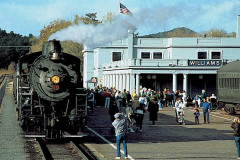
Amtrak Southwest Chief route serves the northern part of the state, stopping at Winslow, Flagstaff, Williams and Kingman. The Texas Eagle and Sunset Limited routes serve South-Central Arizona, stopping at Tucson, Maricopa, Yuma and Benson. Phoenix's Amtrak service was canceled in 1996, and now an Amtrak bus runs between Phoenix and the station in Maricopa.
Aviation
Airports with regularly scheduled commercial flights include: Phoenix Sky Harbor International Airport (IATA: PHX, ICAO: KPHX) in Phoenix (the largest airport and the major international airport in the state); Tucson International Airport (IATA: TUS, ICAO: KTUS) in Tucson; Phoenix-Mesa Gateway Airport (IATA: AZA, ICAO: KIWA) in Mesa; Yuma International Airport (IATA: NYL, ICAO: KNYL) in Yuma; Prescott Municipal Airport (PRC) in Prescott; Flagstaff Pulliam Airport (IATA: FLG, ICAO: KFLG) in Flagstaff, and Grand Canyon National Park Airport (IATA: GCN, ICAO: KGCN, FAA: GCN), a small, but busy, single-runway facility providing tourist flights, mostly from Las Vegas. Phoenix Sky Harbor is currently 7th busiest airport in the world in terms of aircraft movements, and 17th for passenger traffic.
Other significant airports without regularly scheduled commercial flights include Scottsdale Municipal Airport (IATA: SCF, ICAO: KSDL) in Scottsdale, and Deer Valley Airport (IATA: DVT, ICAO: KDVT, FAA: DVT) home to two flight training academies and the Nation's busiest general aviation airport.
Art and culture
Visual arts and museums
Phoenix Art Museum, located on the historic Central Avenue corridor in Phoenix, is the Southwest's largest collection of visual art from across the world. The museum displays international exhibitions alongside the museum's collection of more than 18,000 works of American, Asian, European, Latin American, Western American, modern and contemporary art, and fashion design. With a community education mandate since 1951, Phoenix Art Museum holds a year-round program of festivals, live performances, independent art films and educational programs. The museum also has PhxArtKids, an interactive space for children; photography exhibitions through the museum's partnership with the Center for Creative Photography; the landscaped Sculpture Garden and dining at Arcadia Farms.
Arizona is a recognized center of Native American art, with a number of galleries showcasing historical and contemporary works. The Heard Museum, also located in Phoenix, is a major repository of Native American art. Some of the signature exhibits include a full Navajo hogan, the Mareen Allen Nichols Collection containing 260 pieces of contemporary jewelry, the Barry Goldwater Collection of 437 historic Hopi kachina dolls, and an exhibit on the 19th century boarding school experiences of Native Americans. The Heard Museum has about 250,000 visitors a year.
Sedona, Jerome, and Tubac are known as a budding artist colonies, and small arts scenes exist in the larger cities and near the state universities.
Music
Arizona is prominently featured in the lyrics of many Country and Western songs, such as Jamie O'Neal's hit ballad "There Is No Arizona". George Strait's "Oceanfront Property" uses "ocean front property in Arizona" as a metaphor for a sucker proposition. The line "see you down in Arizona Bay" is used in a Tool song in reference to the possibility (expressed as a hope by comedian Bill Hicks) that Southern California will one day fall into the ocean. Glen Campbell, a notable resident, popularized the song "By The Time I Get To Phoenix".
"Arizona" was the title of a popular song recorded by Mark Lindsay. Arizona is mentioned by the hit song "Take It Easy", written by Jackson Browne and Glenn Frey and performed by the Eagles. Arizona is also mentioned in the Beatles' song "Get Back", credited to John Lennon and Paul McCartney; McCartney sings: "JoJo left his home in Tucson, Arizona, for some California grass." "Carefree Highway", released in 1974 by Gordon Lightfoot, takes its name from Arizona State Route 74 north of Phoenix.
Arizona's budding music scene is helped by emerging bands, as well as some well-known artists. The Gin Blossoms, Chronic Future, Roger Clyne and the Peacemakers, Jimmy Eat World, Caroline's Spine, and others began their careers in Arizona. Also, a number of punk and rock bands got their start in Arizona, including JFA, The Feederz, Sun City Girls, The Meat Puppets, The Maine, The Summer Set, and more recently Authority Zero and Digital Summer.
Arizona also has many singers and other musicians. Singer, songwriter and guitarist Michelle Branch is from Sedona. Chester Bennington, the lead vocalist of Linkin Park, and mash-up artist DJ Z-Trip are both from Phoenix. One of Arizona's better known musicians is shock rocker Alice Cooper, who helped define the genre. Maynard James Keenan, the lead singer of the bands Tool, A Perfect Circle, and Puscifer, calls the town of Cornville his current home.
Other notable singers include country singers Dierks Bentley and Marty Robbins, folk singer Katie Lee, Fleetwood Mac's Stevie Nicks, CeCe Peniston, Rex Allen, 2007 American Idol winner Jordin Sparks, and Linda Ronstadt.
Arizona is also known for its heavy metal scene, which is centered in and around Phoenix. In the early to mid-1990s, it included bands such as Job for a Cowboy, Knights of the Abyss, Greeley Estates, Eyes Set To Kill, blessthefall, The Word Alive, The Dead Rabbitts, and Abigail Williams. The band Soulfly calls Phoenix home and Megadeth lived in Phoenix for about a decade. Beginning in and around 2009, Phoenix began to host a burgeoning desert rock and sludge metal underground, (ala' Kyuss in 1990s California) led by bands like Wolves of Winter, Asimov and Dead Canyon.
American composer Elliott Carter composed his first String Quartet (1950–51) while on sabbatical (from New York) in Arizona. The quartet won a Pulitzer Prize and other awards and is now a staple of the string quartet repertoire.