Tallahassee
Description
Tallahassee /ˌtæləˈhæsi/ is the capital of the U.S. state of Florida. It is the county seat and only incorporated municipality in Leon County, and is the 126th largest city in the United States. Tallahassee became the capital of Florida, then the Florida Territory, in 1824. In 2010, the population was 181,376, and the Tallahassee metropolitan area is 375,751 as of 2014. Tallahassee is the largest city in the Northwest Florida region. Tallahassee is the main center for trade and agriculture in the Florida Big Bend and Southwest Georgia region.
Tallahassee is home to Florida State University, ranked the nation's forty-third best public university by U.S. News & World Report. It is also home to the Florida A&M University, one of the country's largest historically black universities by total enrollment. Tallahassee Community College is a large community college which serves mainly as a feeder school to both Florida State and Florida A&M. Tallahassee qualifies as a significant college town with a student population exceeding 70,000.
Tallahassee is home to the Florida State Capitol, Supreme Court of Florida, Florida Governor's Mansion, and nearly 30 state agency headquarters. The city is also known for its large number of law firms, lobbying organizations, trade associations and professional associations, including the Florida Bar and the Florida Chamber of Commerce. It is also a recognized regional center for scientific research, and home to the National High Magnetic Field Laboratory. In 2015, Tallahassee was awarded the All-American City Award by the National Civic League for the second time. Tallahassee is currently ranked as the 18th best college town in the nation by Best College Reviews.
History
During the 17th century several Spanish missions were established in the territory of the Apalachee to procure food and labor for the settlement at St. Augustine. The largest, Mission San Luis de Apalachee, has been partially reconstructed by the state of Florida. The name "Tallahassee" is a Muskogean Indian word often translated as "old fields" or "old town", and it likely stems from the Creek (later called Seminole) Indians who migrated from Georgia and Alabama to this region in the late 18th and early 19th centuries. They found large areas of cleared land previously occupied by the Apalachee tribe. Earlier, the Mississippian Indians built mounds near Lake Jackson around AD 1200, which survive today in the Lake Jackson Archaeological State Park.
The expedition of Pánfilo de Narváez encountered the Apalachees, although it did not reach the site of Tallahassee. Hernando de Soto and his expedition occupied the Apalachee town of Anhaica in what is now Tallahassee in the winter of 1538–1539. Based on archaeological excavations this site is now known to be located about 0.5 miles (800 m) east of the present Florida State Capitol. The DeSoto encampment is believed to be the first place Christmas was celebrated in the continental United States.
During the First Seminole War, General Andrew Jackson fought two separate skirmishes in and around Tallahassee. The first battle took place on November 12, 1817. Chief Neamathla, of the village of Fowltown, just west of present day Tallahassee had refused Jackson's orders to relocate. Jackson responded by entering the village, burning it to the ground, and driving off its occupants. The Indians later retaliated, by killing 50 soldiers and civilians. Jackson reentered Florida in March 1818. According to Jackson's adjutant, Colonel Robert Butler, they "advanced on the Indian village called Tallahasse (sic) [where] two of the enemy were made prisoner."
State capital
Tallahassee became the capital of Florida during the second legislative session. It was chosen as it was roughly equidistant from St. Augustine and Pensacola, which had been the capitals of the Spanish territories of East Florida and West Florida. The first session of Florida's Legislative Council—as a territory of the United States—met on July 22, 1822 at Pensacola and members from St. Augustine traveled fifty-nine days by water to attend. The second session was in St. Augustine and required western delegates to travel perilously around the peninsula on a twenty-eight-day trek. During this session, it was decided that future meetings should be held at a half-way point. Two appointed commissioners selected Tallahassee, at that point an abandoned Apalachee settlement, as a halfway point. In 1824 the third legislative session met there in a crude log capitol building.
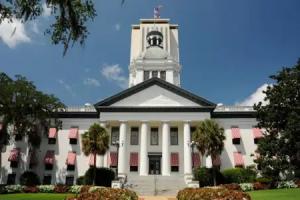
From 1821 through 1845 the rough-hewn frontier capital gradually grew into a town during Florida's territorial period. The Marquis de Lafayette, French hero of the American Revolution, returned for a tour of the United States in 1824. The U.S. Congress voted to give him $200,000 (the same amount he had given the colonies in 1778), US citizenship, and the Lafayette Land Grant, 36 square miles (93 km2) of land that today includes large portions of Tallahassee. In 1845 a Greek revival masonry structure was erected as the Capitol building in time for statehood. Now known as the "old Capitol", it stands in front of the high-rise Capitol building that was built in the 1970s.
Tallahassee was in the heart of Florida's Cotton Belt—Leon County led the state in cotton production—and was the center of the slave trade in Florida. During the American Civil War, Tallahassee was the only Confederate state capital east of the Mississippi not captured by Union forces, and the only one not burned. A small engagement, the Battle of Natural Bridge, was fought south of the city on March 6, 1865, just a month before the war ended.
During the 19th century the institutions that would eventually evolve into what is now Florida State University were established in Tallahassee, firmly cementing its foundations as a university town. These included the Tallahassee Female Academy (founded 1843) and the Florida Institute (founded 1854). In 1851 the Florida legislature decreed two seminaries to be built on either side of the Suwanee River, East Florida Seminary and West Florida Seminary. In 1855 West Florida Seminary was transferred to the Florida Institute building (which had been established as an inducement for the state to place the seminary in Tallahassee). In 1858 the seminary absorbed the Tallahassee Female Academy and became coeducational. Its main building was located near the northwest corner of South Copeland and West Jefferson streets, approximately where FSU's Westcott Building is today.
In 1887 the Normal College for Colored Students, ancestor of today's FAMU, opened its doors. The legislature decided that Tallahassee was the best location In Florida for a college serving negro students. Four years later its name was changed to State Normal and Industrial College for Colored Students.
After the Civil War much of Florida's industry moved to the south and east, a trend that continues today. The end of slavery hindered the cotton and tobacco trade, and the state's major industries shifted to citrus, lumber, naval stores, cattle ranching and tourism. The post-Civil War period was also when many former plantations in the Tallahassee area were purchased by wealthy northerners for use as winter hunting preserves. This included the hunting preserve of Henry L. Beadel, who bequeathed his land for the study of the effects of fire on wildlife habitat. Today the preserve is known as the Tall Timbers Research Station and Land Conservancy, nationally recognized for its research into fire ecology and the use of prescribed burning.
1900–present
Until World War II, Tallahassee remained a small southern town with virtually the entire population living within 1 mile (1.6 km) of the Capitol. The main economic drivers were the colleges and state government, where politicians met to discuss spending money on grand public improvement projects to accommodate growth in places such as Miami and Tampa Bay, hundreds of miles away from the capital. By the 1960s there was a movement to transfer the capital to Orlando, closer to the growing population centers of the state. That motion was defeated and the 1970s saw a long-term commitment by the state to the capital city with construction of the new capitol complex and preservation of the old Florida State Capitol building.
In 1970, the Census Bureau reported city's population as 74.0% white and 25.4% black.
In 1977 a 22-story high-rise Capitol building designed by architect Edward Durell Stone was completed, which is now the third-tallest state capitol building in the United States. In 1978 the old capitol, directly in front of the new capitol, was scheduled for demolition, but state officials decided to keep the Old Capitol as a museum.
Tallahassee was the center of world attention for six weeks during the 2000 United States Presidential election recount, which involved numerous rulings by the Florida Secretary of State and the Florida Supreme Court.
Geography
Tallahassee has an area of 98.2 square miles (254.3 km2), of which 95.7 square miles (247.9 km2) is land and 2.5 square miles (6.5 km2) (2.59%) is water.
Tallahassee's terrain is hilly by Florida standards, being located at the southern end of the Red Hills Region, just above the Cody Scarp. The elevation varies from near sea level to just over 200 feet (61 m), with the state capitol on one of the highest hills in the city. The city includes two large lake basins, Lake Jackson and Lake Lafayette, and borders the northern end of the Apalachicola National Forest.
The flora and fauna are similar to those found in the mid-south and low country regions of South Carolina and Georgia. The palm trees are the more cold-hardy varieties like the state tree, the Sabal palmetto. Pines, magnolias, hickories, and a variety of oaks are the dominant trees. The Southern Live Oak is perhaps the most emblematic of the city.
Urban planning and expansion
The first plan for the Capitol Center was the 1947 Taylor Plan, which consolidated several government buildings in one downtown area. In 1974, the Capitol Center Planning Commission for the City of Tallahassee, Florida responded to growth of its urban center with a conceptual plan for the expansion of its Capitol Center. Hisham Ashkouri, working for The Architects' Collaborative, led the urban planning and design effort. Estimating growth and related development for approximately the next 25 years, the program projected the need for 2.3 million square feet (214,000 m2) of new government facilities in the city core, with 3,500 dwelling units, 100 acres (40 ha) of new public open space, retail and private office space, and other ancillary spaces. Community participation was an integral part of the design review, welcoming Tallahassee residents to provide input as well as citizens' groups and government agencies, resulting in the creation of six separate Design Alternatives. The best elements of these various designs were combined to develop the final conceptual design, which was then incorporated into the existing Capitol area and adjacent areas.
-
Land use
-
Adams Street Mall
-
Topographical map
Tallest buildings
Rank Name Street Address Height feet Height meters Floors Year 1 Florida State Capitol 400 South Monroe Street, 345 101 25 1977 2 Turlington Building 325 West Gaines Street, 318 97 19 1990 3 Plaza Tower 300 South Duval Street 276 84 24 2008 4 Highpoint Center 100 South Adams St 239 70 15 1990 5 Doubletree Hotel 101 South Adams St, 220 67 16 1972
Public safety
Established in 1826, the Tallahassee Police Department claims the distinction of being the oldest police department in the Southern United States, and the second-oldest in the U.S., preceded only by the Philadelphia Police Department (established in 1758). The Boston Police Department was established in 1838 and larger East Coast cities followed with New York City and Baltimore in 1845.
There are over 800 sworn law enforcement officers in Tallahassee. Law enforcement services are provided by the Tallahassee Police Department, the Leon County Sheriff's Office, the Florida Department of Law Enforcement, Florida Capitol Police, Florida State University Police Department, Florida A&M University Police Department, the Tallahassee Community College Police Department, the Florida Highway Patrol, and the Florida Fish and Wildlife Conservation Commission
The Tallahassee Growth Management Building Inspection Division is responsible for issuing permits and performing inspections of public and private buildings in the City limits. These duties include the enforcement of the Florida Building Codes and the Florida Fire Protection Codes. These standards are present to protect life and property. The Tallahassee Building Department is one of 13 currently Accredited Building Departments in the United States.
The Federal Bureau of Investigation, United States Marshals Service, Immigration and Customs Enforcement, Bureau of Alcohol, Tobacco, Firearms and Explosives, Secret Service and Drug Enforcement Administration have offices in Tallahassee. The US Attorney's Office for North Florida is based in Tallahassee.
Fire and rescue services are provided by the Tallahassee Fire Department and Leon County Emergency Medical Services.
Hospitals in the area include Tallahassee Memorial Healthcare, Capital Regional Medical Center and HealthSouth Rehabilitation Hospital of Tallahassee.
Places of interest
- Alfred B. Maclay Gardens State Park
- Carnegie Library at FAMU
- Challenger Learning Center
- College Town at Florida State University
- Doak Campbell Stadium
- Elinor Klapp-Phipps Park
- Florida Governor's Mansion
- Florida State Capitol
- Florida Supreme Court
- Foster Tanner Fine Arts Gallery at Florida A&M University
- Goodwood Museum and Gardens
- Innovation Park
- John G. Riley Center/Museum of African American History & Culture (Riley Museum)
- Knott House Museum
- Lake Ella
- Lake Jackson Mounds Archaeological State Park
- Lafayette Heritage Trail Park
- LeMoyne Center for the Visual Arts
- Mission San Luis de Apalachee
- Museum of Fine Arts at Florida State University
- Museum of Florida History
- National High Magnetic Field Laboratory
- North Florida Fairgrounds
- Railroad Square
- Southeastern Regional Black Archives Research Center and Museum
- Tallahassee Automobile Museum
- Tallahassee Museum
- James D. Westcott Building and Ruby Diamond Auditorium at Florida State University
Festivals and events
- Downtown Getdown (Florida State Seminoles Pep Rally)
- Experience Tallahassee Festival (Welcoming festival for FSU, TCC, and FAMU students)
- First Friday festivals at Railroad Square
- Greek Food Festival
- Oktoberfest
- Opening Nights Performing Arts at Florida State University
- Red Hills Horse Trials
- Southern Music Rising Festival
- Springtime Tallahassee
- Tallahassee Film Festival
- Tallahassee Marathon and Half Marathon
- Tallahassee Wine and Food Festival
- Tallahassee Senior Center's Lifelong Learning Extravaganza – L3X
- Winter Festival
- Florida State University's HackFSU