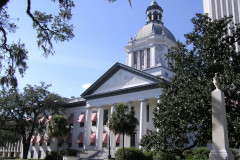
Florida
Description
Florida i/ˈflɒrɪdə/ is a state located in the southeastern region of the United States. The state is bordered to the west by the Gulf of Mexico, to the north by Alabama and Georgia, to the east by the Atlantic Ocean, and to the south by the Straits of Florida and Cuba. Florida is the 22nd most extensive, the 3rd most populous, and the 8th most densely populated of the United States. Jacksonville is the most populous city in Florida, and the largest city by area in the contiguous United States. The Miami metropolitan area is the eighth-largest metropolitan area in the United States. Tallahassee is the state capital.
A peninsula between the Gulf of Mexico, the Atlantic Ocean, and the Straits of Florida, it has the longest coastline in the contiguous United States, approximately 1,350 miles (2,170 km), and is the only state that borders both the Gulf of Mexico and the Atlantic Ocean. Much of the state is at or near sea level and is characterized by sedimentary soil. The climate varies from subtropical in the north to tropical in the south. The American alligator, American crocodile, Florida panther, and manatee can be found in the Everglades National Park.
Since the first European contact was made in 1513 by Spanish explorer Juan Ponce de León – who named it La Florida ([la floˈɾiða] "land of flowers") upon landing there in the Easter season, Pascua Florida – Florida was a challenge for the European colonial powers before it gained statehood in the United States in 1845. It was a principal location of the Seminole Wars against the Native Americans, and racial segregation after the American Civil War.
Today, Florida is distinctive for its large Cuban expatriate community and high population growth, as well as for its increasing environmental issues. The state's economy relies mainly on tourism, agriculture, and transportation, which developed in the late 19th century. Florida is also renown for amusement parks, orange crops, the Kennedy Space Center, and as a popular destination for retirees.
Florida culture is a reflection of influences and multiple inheritance; Native American, European American, Hispanic and Latino, and African American heritages can be found in the architecture and cuisine. Florida has attracted many writers such as Marjorie Kinnan Rawlings, Ernest Hemingway and Tennessee Williams, and continues to attract celebrities and athletes. It is internationally known for golf, tennis, auto racing and water sports.
History
By the 16th century, the earliest time for which there is a historical record, major Native American groups included the Apalachee (of the Florida Panhandle), the Timucua (of northern and central Florida), the Ais (of the central Atlantic coast), the Tocobaga (of the Tampa Bay area), the Calusa (of southwest Florida) and the Tequesta (of the southeastern coast).
European arrival
Florida was the first part of the continental United States to be visited and settled by Europeans. The earliest known European explorers came with the Spanish conquistador Juan Ponce de León. Ponce de León spotted and landed on the peninsula on April 2, 1513. He named the region La Florida ("land of flowers"). The story that he was searching for the Fountain of Youth is a myth.
"In May 1539, Conquistador Hernando de Soto skirted the coast of Florida, searching for a deep harbor to land. He described seeing a thick wall of red mangroves spread mile after mile, some reaching as high as 70 feet (21 m), with intertwined and elevated roots making landing difficult. Very soon, 'many smokes' appeared 'along the whole coast', billowing against the sky, when the Native ancestors of the Seminole spotted the newcomers and spread the alarm by signal fires". The Spanish introduced Christianity, cattle, horses, sheep, the Spanish language, and more to Florida. Both the Spanish and French established settlements in Florida, with varying degrees of success. In 1559, Don Tristán de Luna y Arellano established a settlement at present-day Pensacola, making it the first attempted settlement in Florida, but it was abandoned by 1561.
In 1565, the Spanish settlement of St. Augustine (San Agustín) was established under the leadership of admiral and governor Pedro Menéndez de Avilés, creating what would become the oldest European settlement in the continental U.S. and establishing the first generation of Floridanos and the government of Florida. Spain maintained tenuous control over the region by converting the local tribes to Christianity.
The area of Spanish Florida diminished with the establishment of English settlements to the north and French claims to the west. The English attacked St. Augustine, burning the city and its cathedral to the ground several times. Spain built the Castillo de San Marcos in 1672 and Fort Matanzas in 1742 to defend Florida's capital city from attacks, and to maintain its strategic position in the defense of the Captaincy General of Cuba and the Spanish West Indies.
Florida attracted numerous Africans and African-Americans from adjacent British colonies who sought freedom from slavery. In 1738, Governor Manuel de Montiano established Fort Gracia Real de Santa Teresa de Mose near St. Augustine, a fortified town for escaped slaves to whom Montiano granted citizenship and freedom in return for their service in the Florida militia, and which became the first free black settlement legally sanctioned in North America.
In 1763, Spain traded Florida to the Kingdom of Great Britain for control of Havana, Cuba, which had been captured by the British during the Seven Years' War. It was part of a large expansion of British territory following their victory in the Seven Years' War. A large portion of the Spanish Floridano population left, taking along most of the remaining indigenous population to Cuba. The British soon constructed the King's Road connecting St. Augustine to Georgia. The road crossed the St. Johns River at a narrow point, which the Seminole called Wacca Pilatka and the British named "Cow Ford", both names ostensibly reflecting the fact that cattle were brought across the river there.
The British divided and consolidated the Florida provinces (Las Floridas) into East Florida and West Florida, a division the Spanish government kept after the brief British period. The British government gave land grants to officers and soldiers who had fought in the French and Indian War in order to encourage settlement. In order to induce settlers to move to Florida, reports of its natural wealth were published in England. A large number of British settlers who were "energetic and of good character" moved to Florida, mostly coming from South Carolina, Georgia and England. There was also a group of settlers who came from the colony of Bermuda. This would be the first permanent English-speaking population in what is now Duval County, Baker County, St. Johns County and Nassau County. The British built good public roads and introduced the cultivation of sugar cane, indigo and fruits as well the export of lumber.
As a result of these initiatives northeastern Florida prospered economically in a way it never did under Spanish rule. Furthermore, the British governors were directed to call general assemblies as soon as possible in order to make laws for the Floridas and in the meantime they were, with the advice of councils, to establish courts. This would be the first introduction of much of the English-derived legal system which Florida still has today including trial by jury, habeas corpus and county-based government. Neither East Florida nor West Florida would send any representatives to Philadelphia to draft the Declaration of Independence. Florida would remain a Loyalist stronghold for the duration of the American Revolution.
Spain regained both East and West Florida after Britain's defeat in the American Revolution and the subsequent Treaty of Versailles in 1783, and continued the provincial divisions until 1821.
Joining the United States; Indian Removal
Defense of Florida's northern border with the United States was minor during the second Spanish period. The region became a haven for escaped slaves and a base for Indian attacks against U.S. territories, and the U.S. pressed Spain for reform.
Americans of English descent and Americans of Scots-Irish descent began moving into northern Florida from the backwoods of Georgia and South Carolina. Though technically not allowed by the Spanish authorities, the Spanish were never able to effectively police the border region and the backwoods settlers from the United States would continue to migrate into Florida unchecked. These migrants, mixing with the already present British settlers who had remained in Florida since the British period, would be the progenitors of the population known as Florida Crackers.
These American settlers established a permanent foothold in the area and ignored Spanish officials. The British settlers who had remained also resented Spanish rule, leading to a rebellion in 1810 and the establishment for ninety days of the so-called Free and Independent Republic of West Florida on September 23. After meetings beginning in June, rebels overcame the Spanish garrison at Baton Rouge (now in Louisiana), and unfurled the flag of the new republic: a single white star on a blue field. This flag would later become known as the "Bonnie Blue Flag".
In 1810, parts of West Florida were annexed by proclamation of President James Madison, who claimed the region as part of the Louisiana Purchase. These parts were incorporated into the newly formed Territory of Orleans. The U.S. annexed the Mobile District of West Florida to the Mississippi Territory in 1812. Spain continued to dispute the area, though the United States gradually increased the area it occupied.
Seminole Indians based in East Florida began raiding Georgia settlements, and offering havens for runaway slaves. The United States Army led increasingly frequent incursions into Spanish territory, including the 1817–1818 campaign against the Seminole Indians by Andrew Jackson that became known as the First Seminole War. The United States now effectively controlled East Florida. Control was necessary according to Secretary of State John Quincy Adams because Florida had become "a derelict open to the occupancy of every enemy, civilized or savage, of the United States, and serving no other earthly purpose than as a post of annoyance to them.".
Florida had become a burden to Spain, which could not afford to send settlers or garrisons. Madrid therefore decided to cede the territory to the United States through the Adams-Onís Treaty, which took effect in 1821. President James Monroe was authorized on March 3, 1821 to take possession of East Florida and West Florida for the United States and provide for initial governance. Andrew Jackson, on behalf of the U.S. federal government, served as a military commissioner with the powers of governor of the newly acquired territory for a brief period. On March 30, 1822, the U.S. Congress merged East Florida and part of West Florida into the Florida Territory.
By the early 1800s, Indian removal was a significant issue throughout the southeastern U.S. and also in Florida. In 1830, the U.S. Congress passed the Indian Removal Act and as settlement increased, pressure grew on the United States government to remove the Indians from Florida. Seminoles harbored runaway blacks, known as the Black Seminoles, and clashes between whites and Indians grew with the influx of new settlers. In 1832, the Treaty of Payne's Landing promised to the Seminoles lands west of the Mississippi River if they agreed to leave Florida. Many Seminole left at this time.
Some Seminoles remained, and the U.S. Army arrived in Florida, leading to the Second Seminole War (1835–42). Following the war, approximately 3,000 Seminole and 800 Black Seminole were removed to Indian Territory. A few hundred Seminole remained in Florida in the Everglades.
On March 3, 1845, Florida became the 27th state to join the United States of America. The state was admitted as a slave state, although initially its population grew slowly.
As European-American settlers continued to encroach on Seminole lands, and the United States intervened to move the remaining Seminoles to the West. The Third Seminole War (1855–58) resulted in the forced removal of most of the remaining Seminoles, although hundreds of Seminole Indians remained in the Everglades.
Slavery, war, and disenfranchisement
American settlers began to establish cotton plantations in northern Florida, which required numerous laborers, which they supplied by buying slaves in the domestic market. By 1860 Florida had only 140,424 people, of whom 44% were enslaved. There were fewer than 1,000 free African Americans before the American Civil War.
In January 1861, nearly all delegates in the Florida Legislature approved an ordinance of secession, declaring Florida to be "a sovereign and independent nation" — an apparent reassertion to the preamble in Florida's Constitution of 1838, in which Florida agreed with Congress to be a "Free and Independent State." Although not directly related to the issue of slavery, the ordinance declared Florida's secession from the Union, allowing it to become one of the founding members of the Confederate States, a looser union of states.
The confederal union received little help from Florida; the 15,000 men it offered were generally sent elsewhere. The largest engagements in the state were the Battle of Olustee, on February 20, 1864, and the Battle of Natural Bridge, on March 6, 1865. Both were Confederate victories. The war ended in 1865.
Following the American Civil War, Florida's congressional representation was restored on June 25, 1868, albeit forcefully after Radical Reconstruction and the installation of unelected government officials under the final authority of federal military commanders. After the Reconstruction period ended in 1876, white Democrats regained power in the state legislature. In 1885 they created a new constitution, followed by statutes through 1889 that disfranchised most blacks and many poor whites.
Until the mid-20th century, Florida was the least populous Southern state. In 1900 its population was only 528,542, of whom nearly 44% were African American, the same proportion as before the Civil War. The boll weevil devastated cotton crops.
Forty thousand blacks, roughly one-fifth of their 1900 population, left the state in the Great Migration. They left due to lynchings and racial violence, and for better opportunities. Disfranchisement for most African Americans in the state persisted until the Civil Rights Movement of the 1960s gained federal legislation in 1965 to enforce protection of their constitutional suffrage.
20th-century growth
Historically, Florida's economy was based upon agricultural products such as cattle farming, sugarcane, citrus, tomatoes, and strawberries.
Economic prosperity in the 1920s stimulated tourism to Florida and related development of hotels and resort communities. Combined with its sudden elevation in profile was the Florida land boom of the 1920s, which brought a brief period of intense land development. Devastating hurricanes in 1926 and 1928, followed by the Great Depression, brought that period to a halt. Florida's economy did not fully recover until the military buildup for World War II.
The climate, tempered by the growing availability of air conditioning, and low cost of living made the state a haven. Migration from the Rust Belt and the Northeast sharply increased Florida's population after the war. In recent decades, more migrants have come for the jobs in a developing economy.
With a population of more than 18 million according to the 2010 census, Florida is the most populous state in the Southeastern United States, and the fourth most populous in the United States.
-
Key West Historic District
-
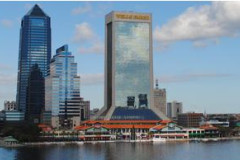
Downtown Jacksonville houses many of the city's iconic and historic structures
-
The Florida House on Capitol Hill, or "embassy of Florida" in D.C.
-
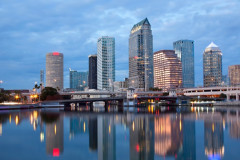
Historic Ybor City in Tampa
-
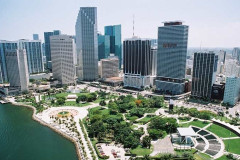
The Downtown Miami Historic District has some of the oldest buildings in Miami
Geography
Much of the state of Florida is situated on a peninsula between the Gulf of Mexico, the Atlantic Ocean and the Straits of Florida. Spanning two time zones, it extends to the northwest into a panhandle, extending along the northern Gulf of Mexico. It is bordered on the north by the states of Georgia and Alabama, and on the west, at the end of the panhandle, by Alabama. It is the only state that borders both the Atlantic Ocean and Gulf of Mexico.
Florida is west of The Bahamas and 90 miles (140 km) north of Cuba. Florida is one of the largest states east of the Mississippi River, and only Alaska and Michigan are larger in water area. The water boundary is 3 nautical miles (3.5 mi; 5.6 km) offshore in the Atlantic Ocean and 9 nautical miles (10 mi; 17 km) offshore in the Gulf of Mexico.
At 345 feet (105 m) above mean sea level, Britton Hill is the highest point in Florida and the lowest highpoint of any U.S. state. Much of the state south of Orlando lies at a lower elevation than northern Florida, and is fairly level. Much of the state is at or near sea level.
However some places such as Clearwater have promontories that rise 50 to 100 ft (15 to 30 m) above the water. Much of Central and North Florida, typically 25 mi (40 km) or more away from the coastline, have rolling hills with elevations ranging from 100 to 250 ft (30 to 76 m). The highest point in peninsular Florida (east and south of the Suwanee River), Sugarloaf Mountain, is a 312-foot (95 m) peak in Lake County. On average, Florida is the flattest state in the United States.
Fauna
Florida is host to many types of wildlife including:
- Marine mammals: bottlenose dolphin, short-finned pilot whale, North Atlantic right whale, West Indian manatee
- Mammals: Florida panther, northern river otter, mink, eastern cottontail rabbit, marsh rabbit, raccoon, striped skunk, squirrel, white-tailed deer, Key deer, bobcats, gray fox, coyote, wild boar, Florida black bear, nine-banded armadillos, Virginia opossum
- Reptiles: eastern diamondback and pygmy rattlesnakes, gopher tortoise, green and leatherback sea turtles, and eastern indigo snake. In 2012, there were about one million American alligators and 1,500 crocodiles.
- Birds: peregrine falcon, bald eagle, northern caracara, snail kite, osprey, white and brown pelicans, sea gulls, whooping and sandhill cranes, roseate spoonbill, Florida scrub jay (state endemic), and others. One subspecies of wild turkey, Meleagris gallopavo, namely subspecies osceola, is found only in Florida. The state is a wintering location for many species of eastern North American birds.
- As a result of climate change, there have been small numbers of several new species normally native to cooler areas to the north: snowy owls, snow buntings, harlequin ducks, and razorbills. These have been seen in the northern part of the state.
- Invertebrates: carpenter ants, termites, American cockroach, Africanized bees, the Miami blue butterfly, and the grizzled mantis.
The only known calving area for the northern right whale is off the coasts of Florida and Georgia.
The native bear population has risen from a historic low of 300 in the 1970s, to 3,000 in 2011.
Since their accidental importation from South America into North America in the 1930s, the red imported fire ant population has increased its territorial range to include most of the Southern United States, including Florida. They are more aggressive than most native ant species and have a painful sting.
A number of non-native snakes and lizards have been released in the wild. In 2010 the state created a hunting season for Burmese and Indian pythons, African rock pythons, green anacondas, and Nile monitor lizards. Green iguanas have also established a firm population in the southern part of the state.
There are about 500,000 feral pigs in Florida.
-
Key deer in the lower Florida Keys
-
The Florida scrub jay is found only in Florida.
-
West Indian manatee
-
Florida panther, native of South Florida
-
Leatherback sea turtle
-
Whooping crane
Flora
There are about 3,000 different types of wildflowers in Florida. This is the third most diverse state in the union, behind California and Texas, both larger states.
On the east coast of the state, mangroves have normally dominated the coast from Cocoa Beach southward; salt marshes from St. Augustine northward. From St. Augustine south to Cocoa Beach, the coast fluctuates between the two, depending on the annual weather conditions.
-
Everglades National Park in Southern Florida
-
Bahia Honda in the Florida Keys
-
Ocala National Forest in Central and Northern Florida.
-
Timucuan Ecological and Historic Preserve in Northeast Florida
Environmental issues
Florida is a low per capita energy user. It is estimated that approximately 4% of energy in the state is generated through renewable resources. Florida's energy production is 6% of the nation's total energy output, while total production of pollutants is lower, with figures of 5.6% for nitrogen oxide, 5.1% for carbon dioxide, and 3.5% for sulfur dioxide.
All potable water resources have been controlled by the state government through five regional water authorities since 1972.
Red tide has been an issue on the southwest coast of Florida, as well as other areas. While there has been a great deal of conjecture over the cause of the toxic algae bloom, there is no evidence that it is being caused by pollution or that there has been an increase in the duration or frequency of red tides.
The Florida panther is close to extinction. A record 23 were killed in 2009 predominately by automobile collisions, leaving about 100 individuals in the wild. The Center for Biological Diversity and others have therefore called for a special protected area for the panther to be established. Manatees are also dying at a rate higher than their reproduction.
Much of Florida has an elevation of less than 12 feet (3.7 m), including many populated areas. Therefore, it is susceptible to rising sea levels associated with global warming. The Atlantic beaches that are vital to the state's economy are being washed out to sea due to rising sea levels caused by climate change. The Miami beach area, close to the continental shelf, is running out of accessible offshore sand reserves.
Geology
The Florida peninsula is a porous plateau of karst limestone sitting atop bedrock known as the Florida Platform. The largest deposits of potash in the United States are found in Florida.
Extended systems of underwater caves, sinkholes and springs are found throughout the state and supply most of the water used by residents. The limestone is topped with sandy soils deposited as ancient beaches over millions of years as global sea levels rose and fell. During the last glacial period, lower sea levels and a drier climate revealed a much wider peninsula, largely savanna. The Everglades, an enormously wide, slow-flowing river encompasses the southern tip of the peninsula. Sinkhole damage claims on property in the state exceeded a total of $2 billion from 2006 through 2010.
Florida is tied for last place as having the fewest earthquakes of any U.S. state. Earthquakes are rare because Florida is not located near any tectonic plate boundaries.
Health
There were 2.7 million Medicaid patients in Florida in 2009. The governor has proposed adding $2.6 billion to care for the expected 300,000 additional patients in 2011. The cost of caring for 2.3 million clients in 2010 was $18.8 billion. This is nearly 30% of Florida's budget. Medicaid paid for 60% of all births in Florida in 2009. The state has a program for those not covered by Medicaid.
In 2013, Florida refused to participate in providing coverage for the uninsured under the Affordable Care Act, popularly called Obamacare. The Florida legislature also refused to accept additional Federal funding for Medicaid, although this would have helped its constituents at no cost to the state. As a result, Florida is second only to Texas in the percentage of its citizens without health insurance.
Architecture
Florida has the largest collection of Art Deco and Streamline Moderne buildings in both the United States and the entire world, most of which are located in the Miami metropolitan area, especially Miami Beach's Art Deco District, constructed as the city was becoming a resort destination. A unique architectural design found only in Florida is the post-World War II Miami Modern, which can be seen in areas such as Miami's MiMo Historic District.
Being of early importance as a regional center of banking and finance, the architecture of Jacksonville displays a wide variety of styles and design principles. Many of state's earliest skyscrapers were constructed in Jacksonville, dating as far back as 1902., and last holding a state height record from 1974 to 1981. The city is endowed with one of the largest collections of Prairie School buildings outside of the Midwest. Jacksonville is also noteworthy for its collection of Mid-Century modern architecture.
Some sections of the state feature architectural styles including Spanish revival, Florida vernacular, and Mediterranean Revival. A notable collection of these styles can be found in St. Augustine, the oldest continuously occupied European-established settlement within the borders of the United States.
Transportation
Airports
Florida has 131 public airports. Florida's seven large hub and medium hub airports, as classified by the FAA, are the following:
City served Code Airport name FAACategory Enplanements Miami MIA Miami International Airport Large Hub 17,017,654 Orlando MCO Orlando International Airport Large Hub 17,017,491 Fort Lauderdale FLL Fort Lauderdale–Hollywood Int'l Airport Large Hub 10,829,810 Tampa TPA Tampa International Airport Large Hub 8,137,222 Fort Myers RSW Southwest Florida International Airport Medium Hub 3,714,157 West Palm Beach PBI Palm Beach International Airport Medium Hub 2,958,416 Jacksonville JAX Jacksonville International Airport Medium Hub 2,755,719
Intercity rail
Florida is served by Amtrak, operating numerous lines throughout, connecting the state's largest cities to points north in the United States and Canada. The busiest Amtrak train stations in Florida in 2011 were: Sanford (259,944), Orlando (179,142), Tampa Union Station (140,785), Miami (94,556), and Jacksonville (74,733). Sanford, in Greater Orlando, is the southern terminus of the Auto Train, which originates at Lorton, Virginia, south of Washington, D.C.. Until 2005, Orlando was also the eastern terminus of the Sunset Limited, which travels across the southern United States via New Orleans, Houston, and San Antonio to its western terminus of Los Angeles. Florida is served by two additional Amtrak trains (the Silver Star and the Silver Meteor), which operate between New York City and Miami. Miami Central Station, the city's rapid transit, commuter rail, intercity rail, and bus hub, is under construction.
The Florida Department of Transportation was preparing to build a high-speed rail between Tampa, Lakeland and Orlando. This was to be the first phase of the Florida High Speed Rail system. Soil work began in July 2010 and construction of the line was slated to begin in 2011, with the initial Tampa-Orlando phase completed by 2014. The second phase, would have extended the line to Miami. Governor Scott, however, refused federal funds and the project has been canceled.
All Aboard Florida is a proposed higher-speed rail service that would run between Orlando and Miami at speeds up to 125 mph. Its Miami to Cocoa portion is scheduled to open in 2016, with the final segment to Orlando opening in 2017.
Public transit
- Miami: Miami's public transportation is served by Miami-Dade Transit that runs Metrorail, a heavy rail rapid transit system, Metromover, a people mover train system in Downtown Miami, and Metrobus, Miami's bus system. Metrorail runs throughout Miami-Dade County and has two lines and 23 stations connecting to Downtown Miami's Metromover and Tri-Rail. Metromover has three lines and 21 stations throughout Downtown Miami. Outside of Miami-Dade County, public transit in the Miami metropolitan area is served by Broward County Transit and Palm Tran; intercounty commuter rail service is provided by Tri-Rail, with 18 stations including the region's three international airports.
- Orlando: Orlando is served by the SunRail commuter train, which runs on a 32 miles (51 km) (61 miles (98 km) when complete) line including four stops in downtown. Lynx bus serves the greater Orlando area in Orange, Seminole, and Osceola counties.
- Tampa: Tampa and its surrounding area use the Hillsborough Area Regional Transit Authority system ("HART"). In addition, downtown Tampa has continuous trolley services in the form of a heritage trolley powered by Tampa Electric Company. Pinellas County and St. Petersburg provide similar services through the Pinellas Suncoast Transit Authority or "PSTA". The beaches of Pinellas County also have a continuous trolley bus. Downtown St. Petersburg has a trolley system.
- Jacksonville: Jacksonville is served by the Jacksonville Skyway, an automated people mover monorail connecting the Florida State College downtown campus, the Northbank central business district, Convention Center, and Southbank locations. The system includes 8 stops connected by two lines. JTA bus has 180 vehicles with 56 lines.
passenger
ridership Population
served % of
population
on transit Modes of transit 1 Miami 367,000 2,554,776 14.4% Tri-Rail, Metrorail, Metromover & Metrobus 2 Fort Lauderdale 147,718 1,748,066 8.5% Tri-Rail (commuter rail) & BCT bus 3 Orlando 97,000 2,134,411 4.4% Lynx bus & Sunrail 4 Gainesville 50,500 125,326 40.3% RTS bus 5 Tampa 50,400 1,229,226 4.1% HART bus & TECO Line Streetcar 6 West Palm Beach 45,100 1,320,134 3.4% Tri-Rail (commuter rail) & Palm Tran (bus) 7 St. Petersburg 42,500 916,542 4.6% PSTA bus 8 Jacksonville 41,500 821,784 5.0% JTA bus & Skyway (people mover) 9 Tallahassee 22,400 181,376 12.4% StarMetro bus