Louisville

Description

Louisville is the largest city in the Commonwealth of Kentucky and the 30th-most populous city in the United States. It is one of two cities in Kentucky designated as first-class, the other being the state's second-largest city of Lexington. Louisville is the historical seat and, since 2003, the nominal seat of Jefferson County.

Louisville was founded in 1778 by George Rogers Clark and is named after King Louis XVI of France, making Louisville one of the oldest cities west of the Appalachian Mountains. Sited beside the Falls of the Ohio, the only major obstruction to river traffic between the upper Ohio River and the Gulf of Mexico, the settlement first grew as a portage site. It was the founding city of the Louisville and Nashville Railroad, which grew into a 6,000-mile (9,700 km) system across 13 states. Today, the city is known as the home of the Kentucky Derby, Kentucky Fried Chicken, the University of Louisville and its Louisville Cardinals athletic teams, Louisville Slugger baseball bats, and three of Kentucky's six Fortune 500 companies. Its main airport is also the site of United Parcel Service's worldwide air hub.

Since 2003, Louisville's borders have been the same as those of Jefferson County because of a city-county merger. The official name of this consolidated city-county government is the Louisville/Jefferson County Metro Government, abbreviated to Louisville Metro. Despite the merger and renaming, the term "Jefferson County" continues to be used in some contexts in reference to Louisville Metro, particularly including the incorporated cities outside the "balance" which make up Louisville proper. The city's total consolidated population as of the 2014 census estimate was 760,026. However, the balance total of 612,780 excludes other incorporated places and semiautonomous towns within the county and is the population listed in most sources and national rankings.

The Louisville-Jefferson County, KY-IN Metropolitan Statistical Area (MSA), sometimes also referred to as Kentuckiana, includes Louisville-Jefferson County and 12 surrounding counties, seven in Kentucky and five in Southern Indiana. As of 2014, the MSA had a population of 1,269,702, ranking 43rd nationally.

History

The history of Louisville spans hundreds of years, and has been influenced by the area's geography and location.

Early history and founding

The rapids at the Falls of the Ohio created a barrier to river travel, and as a result, settlements grew up at this stopping point. The first European settlement in the vicinity of modern-day Louisville was on Corn Island in 1778 by Col. George Rogers Clark, credited as the founder of Louisville. Several landmarks in the community are named after him.

Two years later, in 1780, the Virginia General Assembly approved the town charter of Louisville. The city was named in honor of King Louis XVI of France, whose soldiers were then aiding Americans in the Revolutionary War. Early residents lived in forts to protect themselves from Indian raids, but moved out by the late 1780s. In 1803, explorers Meriwether Lewis and William Clark organized their expedition across America in the town of Clarksville, Indiana at the present-day Falls of the Ohio opposite Louisville, Kentucky.

19th century

The city's early growth was influenced by the fact that river boats had to be unloaded and moved downriver before reaching the falls. By 1828, the population had swelled to 7,000 and Louisville became an incorporated city. The city grew rapidly in its formative years.

Louisville was a major shipping port and slaves worked in a variety of associated trades. The city was often a point of escape for slaves to the north, as Indiana was a free state.

During the Civil War, Louisville was a major stronghold of Union forces, which kept Kentucky firmly in the Union. It was the center of planning, supplies, recruiting, and transportation for numerous campaigns, especially in the Western Theater. By the end of the war, Louisville had not been attacked, although skirmishes and battles, including the battles of Perryville and Corydon, took place nearby. After Reconstruction, returning Confederate veterans largely took political control of the city, leading to the jibe that Louisville joined the Confederacy after the war was over.

The first Kentucky Derby was held on May 17, 1875, at the Louisville Jockey Club track (later renamed Churchill Downs). The Derby was originally shepherded by Meriwether Lewis Clark, Jr., the grandson of William Clark of the Lewis and Clark Expedition, and grandnephew of the city's founder George Rogers Clark. Horse racing had a strong tradition in Kentucky, whose Inner Bluegrass Region had been a center of breeding high-quality livestock throughout the 19th century. Ten thousand spectators watched the first Derby, which Aristides won.

On March 27, 1890, the city was devastated and its downtown nearly destroyed when an F4 tornado tore through as part of the middle Mississippi Valley tornado outbreak. An estimated 74 to 120 people were killed.

20th and 21st centuries

Throughout January 1937, 19.17 inches (48.7 cm) of rain fell in Louisville, and by January 27, the Ohio River crested at a record 57.15 feet (17.42 m), almost 30 feet (9.1 m) above flood stage. These events triggered the "Great Flood of 1937", which lasted into early February. The flood submerged 60–70% of the city, caused complete loss of power for four days, and forced the evacuation of 175,000 or 230,000 residents, depending on sources. Ninety people died as a result of the flood. It led to dramatic changes in where residents lived. Today, the city is protected by numerous flood walls. After the flood, the areas of high elevation in the eastern part of the city had decades of residential growth.

Louisville was a center for factory war production during World War II. In May 1942, the U.S. government assigned the Curtiss-Wright Aircraft Company, a war plant located at Louisville's air field, for wartime aircraft production. The factory produced the C-46 Commando cargo plane, among other aircraft. In 1946, the factory was sold to International Harvester, which began large-scale production of tractors and agricultural equipment. In 1950, the Census Bureau reported Louisville's population as 84.3% white and 15.6% black.

Similar to many other older American cities, Louisville began to experience a movement of people and businesses to the suburbs in the 1960s and 1970s. Middle class residents used newly built freeways and interstate highways to commute to work, moving into more distant but newer housing. Because of tax laws, businesses found it cheaper to build new rather than renovate older buildings. Economic changes included a decline in local manufacturing. The West End and older areas of the South End, in particular, began to decline economically as many local factories closed.

In 1974, a major (F4) tornado hit Louisville as part of the 1974 Super Outbreak of tornadoes that struck 13 states. It covered 21 miles (34 km) and destroyed several hundred homes in the Louisville area. Only two people died.

Since the 1980s, many of the city's urban neighborhoods have been revitalized into areas popular with young professionals and college students. The greatest change has occurred along the Bardstown Road/Baxter Avenue and Frankfort Avenue corridors as well as the Old Louisville neighborhood. In recent years, such change has also occurred in the East Market District (NuLu).

Since the late 1990s, Downtown has experienced significant residential, tourist and retail growth, including the addition of major sports complexes KFC Yum! Center and Louisville Slugger Field, conversion of waterfront industrial sites into Waterfront Park, openings of varied museums (see Museums, galleries and interpretive centers below), and the refurbishing of the former Galleria into the bustling entertainment complex Fourth Street Live!, which opened in 2004.

Geography

As of 2000, Louisville and Jefferson County have a combined area of 399 square miles (1,030 km2), of which 385 square miles (1,000 km2) is land and 13 square miles (34 km2) (3.38%) is covered by water.

Louisville is southeasterly situated along the border between Kentucky and Indiana, the Ohio River, in north-central Kentucky at the Falls of the Ohio. Although situated in a Southern state, Louisville is influenced by both Southern and Midwestern culture. It is sometimes referred to as either one of the northernmost Southern cities or as one of the southernmost Northern cities in the United States.

Louisville is located in Kentucky's outer Bluegrass region. Its development has been influenced by its location on the Ohio River, which spurred Louisville's growth from an isolated camp site into a major shipping port. Much of the city is located on a very wide and flat floodplain surrounded by hill country on all sides. Much of the area was swampland that had to be drained as the city grew. In the 1840s, most creeks were rerouted or placed in canals to prevent flooding and disease outbreaks.

Areas generally east of I-65 are above the flood plain, and are composed of gently rolling hills. The southernmost parts of Jefferson County are in the scenic and largely undeveloped Knobs region, which is home to Jefferson Memorial Forest.

The Louisville-Jefferson County, KY-IN Metropolitan Statistical Area (MSA), the 43rd largest in the United States, includes the Kentucky county of Jefferson (coterminous with Louisville Metro), plus twelve outlying counties—seven in Kentucky and five in Southern Indiana. Louisville's MSA is included in the Louisville–Elizabethtown–Madison, KY–IN Combined Statistical Area (CSA), which also includes the Elizabethtown, KY MSA, as well as the Madison, IN Micropolitan Statistical Area.

The Louisville area is near several other urban areas, especially Frankfort, Kentucky (the state's capital), Cincinnati, Ohio (the two cities' metropolitan statistical areas almost border each other), Lexington, Kentucky, and the Indianapolis, Indiana area (especially Columbus, Indiana, to the north of Southern Indiana).

Panoramic views

Culture

Annual festivals and other events

Louisville is home to many annual cultural events. Perhaps most well-known is the Kentucky Derby, held annually during the first Saturday of May. The Derby is preceded by a two-week-long Kentucky Derby Festival, which starts with the annual Thunder Over Louisville, the largest annual fireworks display in North America. The Kentucky Derby Festival also features notable events such as the Pegasus Parade, The Great Steamboat Race, Great Balloon Race, a combined marathon/mini marathon and about seventy events in total. Esquire magazine has called the Kentucky Derby "the biggest party in the south."

Usually beginning in late February or early March is the Humana Festival of New American Plays at Actors Theatre of Louisville, an internationally acclaimed new-play festival that lasts approximately six weeks.

On Memorial Day weekend, Louisville hosts the largest annual Beatles Festival in the world, Abbey Road on the River. The festival lasts five days and is located on the Belvedere in downtown Louisville.

The summer season in Louisville also features a series of cultural events such as the Kentucky Shakespeare Festival (commonly called "Shakespeare in Central Park"), held in July of every year and features free Shakespeare plays in Central Park in Old Louisville.

Also in July, the Forecastle Festival draws 35,000 visitors annually to Louisville Waterfront Park in celebration of the best in music, art and environmental activism. Past performers include The Black Keys, The Flaming Lips, Widespread Panic, The Smashing Pumpkins, The Avett Brothers, The Black Crowes and hundreds more.

The Kentucky State Fair is held every August at the Kentucky Exposition Center in Louisville as well, featuring an array of culture from all areas of Kentucky. In places, the African American community celebrates Juneteenth commemorating June 19, 1865, when slaves in the western territories learned of their freedom.

In September, in nearby Bardstown, is the annual Kentucky Bourbon Festival, which celebrates the history and art of distilling bourbon whiskey. The suburb of Jeffersontown is also the home of the annual Gaslight Festival, a series of events spread over a week. Attendance is approximately 200,000 for the week.

The month of October features the St. James Court Art Show in Old Louisville. Thousands of artists gather on the streets and in the courtyard to exhibit and sell their wares, and the event is attended by many art collectors and enthusiasts. The show is the second most-attended event next to the Derby.

Another art-related event that occurs every month is the First Friday Hop. A free TARC bus takes art lovers to many downtown area (especially East Market District/NuLu) independent art galleries on the first Friday of every month.

Indie scene

Louisville has blossomed as a booming center for independent art, music and business.

A Louisville locale that highlights this scene is Bardstown Road, an area located in the heart of the Highlands. Bardstown Road is known for its cultural diversity and local trade. The majority of the businesses along Bardstown Road, such as coffee shops, clothing stores and art galleries, are locally owned and operated businesses. Though it is only about one mile (1.6 km) long, this strip of Bardstown Road constitutes much of the city's culture and diverse lifestyle, contributing to the unofficial "Keep Louisville Weird" slogan. Just a few blocks down the road was ear X-tacy, a local record store that was a fixture in the Louisville music scene for many years until late 2011.

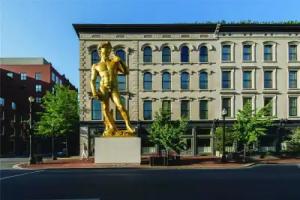
In downtown Louisville, 21c Museum Hotel, a hotel that showcases contemporary art installations and exhibitions throughout its public spaces, and features a red penguin on its roof, is, according to The New York Times, "an innovative concept with strong execution and prompt and enthusiastic service."

Louisville is home to a thriving indie music scene with bands such as Love Jones, Tantric, Squirrel Bait, CABIN, Slint, My Morning Jacket, Houndmouth, Young Widows and Wax Fang. Acclaimed singer/songwriters Will Oldham, who performs under the moniker "Bonnie 'Prince' Billy", is a resident, as was country/rock singer/songwriter Tim Krekel. Cellist Ben Sollee splits his time between Louisville and Lexington. Long running rock/jazz fusion band NRBQ also formed in Louisville in the late 1960s as well as 1980s psychobilly band Bodeco. Post-grunge band Days of the New, at one time including future breakout pop star Nicole Scherzinger, formed in Louisville in the mid-1990s.

The Louisville music scene reaches a crescendo every July during the Forecastle Festival, a three-day music, art and environmental activism festival taking place at Louisville Waterfront Park.

Especially catering to Louisville's music scene is 91.9 WFPK Radio Louisville, a local public radio station funded, in part, from local listeners. The station features not only national and international musicians common to public radio, but also local and regional talent. The station also hosts summer concerts on the waterfront from April until July, where up-and-coming alternative artists are brought to stage.

Museums, galleries and interpretive centers

The West Main District in downtown Louisville features what is locally known as "Museum Row". In this area is the Frazier History Museum, which opened its doors in 2004 as an armaments museum, featuring the only collection of Royal Armouries artifacts outside of the United Kingdom. Since then the Frazier has expanded its focus to broader history. The Frazier Museum has three floors of exhibits, an education center and a tournament ring, which presents daily performances, as well as event spaces available for rent, including a rooftop garden featuring native plants and 4th floor loft-style space that accommodates up to 360 people seated.

Also nearby is the Kentucky Science Center, which is Kentucky's largest hands-on science center and features interactive exhibits, IMAX films, educational programs and technology networks. The Kentucky Museum of Art and Craft, opened in 1981, is a nonprofit organization with a mission to support and promote excellence in art, craft, applied arts and design. The Muhammad Ali Center opened November 2005 in "Museum Row" and features Louisville native Muhammad Ali's boxing memorabilia.

The National Society of the Sons of the American Revolution (SAR) is a patriotic, historical, and educational non-profit organization and a leading male lineage society that perpetuates the ideals of the American war for independence and the founding of our nation. The SAR opened its National Genealogical Research Library in 2010 along Louisville's Museum Row next door to its national headquarters, with an on-site American Revolutionary War Education Center expected to be completed soon.

The Speed Art Museum opened in 1927 and is the oldest and largest art museum in the state of Kentucky. Located adjacent to the University of Louisville, the museum features over 12,000 pieces of art in its permanent collection and hosts traveling exhibitions. Multiple art galleries are located in the city, but they are especially concentrated in the East Market District (NuLu), immediately to the east of downtown. This row of galleries, plus others in the West Main District, are prominently featured in the monthly First Friday Hop.

Several local history museums can be found in the Louisville area. The most prominent among them is The Filson Historical Society, founded in 1884, which has holdings exceeding 1.5 million manuscript items and over 50,000 volumes in the library. The Filson's extensive collections focus on Kentucky, the Upper South and the Ohio River Valley, and contain a large collection of portraiture and over 10,000 museum artifacts. Other local history museums include the Portland Museum, Historic Locust Grove, Conrad-Caldwell House Museum, the Falls of the Ohio State Park interpretive center (Clarksville, Indiana), Howard Steamboat Museum (Jeffersonville, Indiana) and the Carnegie Center for Art and History (New Albany, Indiana). The Falls interpretive center, part of the Falls of the Ohio National Wildlife Conservation Area, also functions as a natural history museum, covering findings in the nearby exposed Devonian fossil bed.

There are also several historical properties and items of interest in the area, including the Belle of Louisville, the oldest Mississippi-style steamboat in operation in the United States. The United States Marine Hospital of Louisville is considered by the National Park Service to be the best remaining antebellum hospital in the United States. It was designed by Robert Mills, who is best known as the designer of the Washington Monument. Fort Knox, spread out among Bullitt, Hardin and Meade Counties (two of which are in the Louisville metropolitan area), is home to the U.S. Bullion Depository and the General George Patton Museum. The previously mentioned Locust Grove, former home of Louisville Founder George Rogers Clark, portrays life in the early days of the city. Other notable properties include the Farmington Historic Plantation (home of the famous Speed family), Riverside, The Farnsley-Moremen Landing and the restored Union Station, which opened in 1891. The Louisville area is also home to the Waverly Hills Sanatorium, a turn-of-the-century (20th) hospital that was originally built to accommodate tuberculosis patients, and subsequently has been reported and sensationalized to be haunted. The Little Loomhouse maintains historical records of local spinning and weaving patterns and techniques, and also offers tours, hands-on activities, and professional-level classes and materials.

Performing arts

The Kentucky Center, dedicated in 1983, located in the downtown hotel and entertainment district, features a variety of plays and concerts. This is also the home of the Louisville Ballet, Louisville Orchestra, Bourbon Baroque, StageOne Family Theatre, Kentucky Shakespeare Festival, which operates the oldest professional outdoor Shakespeare festival, and the Kentucky Opera, which is the twelfth oldest opera in the United States.

The Louisville Orchestra was founded in 1937 by conductor Robert Whitney and Charles Farnsley, then Mayor of Louisville, and was a world leader in commissioning and recording contemporary works for orchestra from the 1950s to 1980s. The Louisville Orchestra today performs more than 125 concerts per year with a core of salaried musicians and is recognized as a cornerstone of the Louisville arts community.

Actors Theatre of Louisville, is in the city's urban cultural district and hosts the Humana Festival of New American Plays each spring. It presents approximately six hundred performances of about thirty productions during its year-round season, composed of a diverse array of contemporary and classical fare.

Louisville is home to a fast-growing independent theatre scene. Theatre 502, Savage Rose Classical Theatre, The Bard's Town Theatre Company, The Liminal Playhouse, Looking For Lilith, Bunbury Theatre Company, Louisville Repertory Theatre, Louisville Improvisors, Pandora Productions, Eve Theatre Company, Squallis Puppeteers and Baby Horse Theatre all curate full seasons of contemporary, classical and experimental work.

The Louisville Palace, the official venue for the Louisville Orchestra, is an ornate theatre in downtown Louisville's so-called theatre district. In addition to orchestra performances, the theatre shows films and hosts concerts.

Iroquois Park is the home of the renovated Iroquois Amphitheater, which hosts a variety of musical concerts in a partially covered outdoor setting.

Parks and outdoor attractions

Louisville Metro has 122 city parks covering more than 13,000 acres (53 km2). Several of these parks were designed by Frederick Law Olmsted, who also designed New York City's Central Park as well as parks, parkways, college campuses and public facilities in many U.S. locations. The Louisville Waterfront Park is prominently located on the banks of the Ohio River near downtown and features large open areas, which often hold free concerts and other festivals. The Big Four Bridge, a former railroad bridge spanning 547 feet (167 m) but is now a pedestrian bridge connecting Waterfront Park with Jeffersonville, Indiana's waterfront park, fully opened in May 2014 with the completion of Jeffersonville's ramp. Cherokee Park, one of the most visited parks in the nation, features a 2.6-mile (4.2 km) mixed-use loop and many well-known landscaping and architectural features including the Hogan's Fountain Pavilion. Other notable parks in the system include Iroquois Park, Shawnee Park, Seneca Park and Central Park.

Further from the downtown area is the Jefferson Memorial Forest, which at 6,218 acres (25.16 km2) is the largest municipal urban forest in the United States., The forest is designated as a National Audubon Society wildlife refuge and offers over 30 miles (48 km) of various hiking trails.

Otter Creek Outdoor Recreation Area, owned and operated by the Kentucky Department of Fish and Wildlife Resources, is another large park in nearby Brandenburg, Kentucky. The park's namesake, Otter Creek, winds along the eastern side of the park. A scenic bend in the Ohio River, which divides Kentucky from Indiana, can be seen from northern overlooks within the park. The park is a popular mountain biking destination, with trails maintained by a local mountain bike organization.

Other outdoor points of interest in the Louisville area include Cave Hill Cemetery (the burial location of Col. Harland Sanders), Zachary Taylor National Cemetery (the burial location of President Zachary Taylor), the Louisville Zoo and the Falls of the Ohio National Wildlife Conservation Area.

In development is the City of Parks, a project to create a 110-mile (180 km) continuous paved pedestrian and biking trail called the Louisville Loop around Louisville Metro while also adding a large amount of park land. Current plans call for making approximately 4,000 acres (16 km2) of the Floyds Fork flood plain in eastern Jefferson County into a new park system called The Parklands of Floyds Fork, expanding area in the Jefferson Memorial Forest, and adding riverfront land and wharfs along the Riverwalk and Levee Trail, both completed segments of the Louisville Loop.

Events

Important events occurring in the city have included the first large space lighted by Edison's light bulb which occurred during the Southern Exposition. (At the time, in 1883, the largest such installation to date.) Also, Louisville had the first library open to African Americans in the South, and medical advances including the first human hand transplant and the first self-contained artificial heart transplant.

Street view

Hotels

2 guests
Adults2+
Children under 170+
Age7+
Age7+
Age7+
Age7+
Age7+
Age7+
Age7+
Age7+
Age7+
Age7+
Search hotel

Reviews

Share your experiences, help others make the right choice!
Think about what you would like to know if you were looking for a review about a place to relax. Please describe in detail what you liked and what you didn't. What would you advise to other guests and to the hotel owner. The more fully you tell about the hotel, the easier it will be for other people to make a choice and they will be very grateful to you!

Map

X