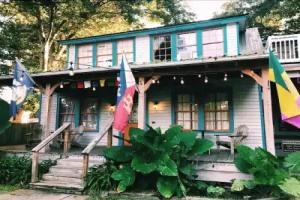
Lafayette

Description

Not be confused with the former city in Jefferson Parish, Louisiana, which was absorbed into New Orleans in 1852.

Lafayette (/ˌlæfiˈjɛt/; French: [lafajɛt]) is a city located along the Vermilion River in southwestern Louisiana. The city of Lafayette is the fourth-largest in the state, with a population of 120,623 at the 2010 census. It is the principal city of the Lafayette, Louisiana Metropolitan Statistical Area, and also the larger, Combined Statistical Area of Lafayette-Opelousas-Morgan City CSA with a population of 611,774 according to 2012 estimates. Lafayette is the parish seat of Lafayette Parish, Louisiana. Its nickname is The Hub City.

The American city was founded as Vermilionville in 1821 by Jean Mouton, a French-speaking man of Acadian descent. In 1884, it was renamed for General Lafayette, who fought with and significantly aided the American Army during the American Revolutionary War. The city's economy was primarily based on agriculture until the 1940s, when the petroleum and natural gas industries became dominant.

Lafayette is considered the center of Acadiana, the area of Cajun and Creole culture in Louisiana and the United States. It developed following the relocation of Acadians after their expulsion by the British from eastern Canada in the late 18th century following France's defeat in the Seven Years' War. There is also a strong Louisiana Creole influence in the area.

History

Geography

Lafayette is located at 30°13′N 92°2′W / 30.217°N 92.033°W / 30.217; -92.033 (30.2139, -92.0294) and has an elevation of 36 feet (11.0 m). According to the United States Census Bureau, the city has a total area of 49.2 square miles (127 km2), of which 49.1 square miles (127 km2) is land and 0.1 square miles (0.26 km2) (0.19%) is water.

Lafayette is located on the West Gulf Coastal Plain. What is now Lafayette was part of the seabed during the earlier Quaternary Period. During this time, the Mississippi River cut a 325-foot-deep (99 m) valley between what is now Lafayette and Baton Rouge. This valley was filled and is now the Atchafalaya Basin. Lafayette is located on the western rim of this valley.

This land, called the southwestern Louisiana Prairie Terrace, is higher up and not made of wetland like much of the surrounding areas to the south and west of Lafayette. Because of this, Lafayette does not suffer significant flooding problems. The Vermilion River runs through the center of Lafayette. Other significant waterways in the city are Isaac Verot Coulee, Coulee Mine, Coulee des Poches and Coulee Ile des Cannes, which are natural drainage canals that lead to the Vermilion River.

Image gallery

  • IIsaac Verot Coulee on the southside of Lafayette, at high water

Education and healthcare

Primary and secondary schools

Public schools

See Lafayette Parish School System for more information.

The public schools in the parish are run by the Lafayette Parish School System. The system has 33 schools, 21 elementary schools, 12 middle schools, and seven high schools. The LPSS offers nine career academies at the high school level, school curricula designed to prepare students in certain career fields.

The nine academies are:

  • The Academy of Business & Finance (Acadiana High School)
  • The Academy of Engineering (Northside High School)
  • The Academy of Environmental Sciences (Northside High School)
  • The Academy of Health Careers (Lafayette High School)
  • The Academy of Information Technology (Carencro High School)
  • The Academy of Performing Arts (Lafayette High School)
  • The Academy of Visual and Applied Arts (Ovey Comeaux High School)
  • The Early College Academy (South Louisiana Community College)
  • Thibodaux Career and Technical High School

The LPSS also offer schools of choice, a program to improve racial diversity at schools. Accepted students are allowed to attend schools outside their school zone (but still within the parish) to receive their state-mandated core curriculum using specialized themes or programs. This is available at all levels, elementary, middle, and high schools, and is designed to provide a more interesting learning experience for the students in the program.

Private schools

See Lafayette Parish Private Schools for list of schools.

Lafayette is home to a large Roman Catholic population and, because of this, Lafayette Parish has many private parochial schools, with grades from kindergarten through twelfth grade.

Universities and colleges

Lafayette has one university, one community college, and two vocational colleges. The University of Louisiana at Lafayette is part of the University of Louisiana System. It is the second-largest university in the state, with an enrollment of approximately 17,508. Schools and colleges related to the institution have been located in Lafayette since 1898.

One of the newest college systems in Louisiana, South Louisiana Community College is headquartered in Lafayette. SLCC partnered with Acadian Ambulance to form the National EMS Academy, which offers EMT-Basic and EMT-Paramedic certification. SLCC is part of the Louisiana Community and Technical College System. Louisiana Technical College (Lafayette campus) is part of the Louisiana Technical College system, which in turn is part of the Louisiana Community and Technical college system. It offers associate degrees in several fields. is a vocational school that offers a few bachelor's degree programs, many associate degree programs, along with a few diploma programs.

Public library system

Healthcare

Lafayette's major healthcare facilities are:

  • Lafayette General Medical Center
  • Lafayette General Surgical Hospital
  • Lafayette Surgical Specialty Hospital
  • University Hospital and Clinics (formerly University Medical Center)
  • Women's and Children's Hospital
  • The Regional Medical Center of Acadiana - (Formerly Southwest Medical Center)
  • Our Lady of Lourdes Regional Medical Center
  • Heart Hospital of Lafayette
  • Park Place Surgical Hospital
  • Cardiovascular Institute of the South(CIS) or Cardiovascular Institute of the South

Culture and contemporary life

Cultural Organizations and Institutions

Cultural organizations include the Acadiana Symphony Orchestra and Conservatory of Music, Chorale Acadienne, Lafayette Ballet Theatre and Dance Conservatory, The Lafayette Concert Band, and Performing Arts Society of Acadiana.

Places of interest

  • Acadiana Center for the Arts
  • Acadian Village is a reconstructed Cajun bayou community (of moved and reassembled authentic buildings) and has a representative collection of Cajun furnishings
  • Alexandre Mouton House Museum - a historic house museum, this was the home to Louisiana's first Democratic governor, Alexandre Mouton; contains a collection of antiques, historical documents, and old Mardi Gras costumes
  • Borden's Ice Cream – the last Borden's Ice Cream location in the United States
  • Children's Museum of Acadiana
  • Cité des Arts
  • Downtown Lafayette
  • Girard Park
  • Heymann Center – performing arts center
  • Acadian Cultural Center of the Jean Lafitte National Historical Park and Preserve
  • Lafayette Natural History Museum & Planetarium
  • Louisiana Immersive Technologies Enterprise (LITE) - a 70,000-square-foot facility at the Research Park; owns the world's first six-sided, digital virtual reality cube as well as the world's largest digital 3-D auditorium
  • Katog Choling Tibetan Cultural Center
  • Vermilionville – One of the world's largest Cajun and Creole living history museums with 7 restored historic structures from the 1765-1890 era.
  • Zoo of Acadiana – located nearby in Broussard

Events

  • Cajun Heartland State Fair - An eleven-day state fair held on the grounds of the Cajundome and Convention Center.
  • Drums Across Cajun Field - An annual DCI show hosted by the Pride of Acadiana
  • Festivals Acadiens et Creoles - An annual collection of festivals celebrating Cajun and Creole cultures.
  • Festival International de Louisiane - An annual international festival of arts and music, celebrating Lafayette and the surrounding area's French heritage.
  • Le Festival de Mardi Gras à Lafayette - The second largest Mardi Gras celebration in Louisiana.
  • Downtown Alive! - A 25-year-old series of free, family-friendly outdoor concerts in the fall and spring.
  • 2nd Saturday Artwalk - An artwalk downtown held every 2nd Saturday of every month.
  • Bach Lunch - A spring outdoor concert series hosted by the Lafayette Natural History Museum and Planetarium, held in Parc Sans Souci downtown.
  • Gulf Brew - An annual beer tasting festival.
  • Louisiana Showcase of Marching Bands - A popular high school marching band festival.
  • Movies in the Parc - A fall outdoor children's movie series in Parc International downtown.
  • Hopefest - A charity festival put on by high school students in the area
  • Crouchstock - An annual music festival held to raise funds for the Jacob Crouch Foundation, a suicide prevention, awareness and education foundation.
  • Southern Screen Film Festival - Fostering the art and education of filmmaking in Lafayette, LA!
  • South Louisiana Blackpot Festival & Cookoff - An annual festival celebrating great music, dancing, food, camping & jamming!
  • INNOV8 Lafayette - A festival of innovation, creativity, and entrepreneurship, founded and led by volunteers of the Greater Lafayette Chamber of Commerce.

Transportation

  • Air: Lafayette Regional Airport (LFT) is located on US Highway 90, on the southeast side of the city with daily scheduled passenger airline services to Houston, Dallas/Fort Worth, Denver, and Atlanta. Charter services depart Lafayette Regional as well as helicopter services and cargo jets.
  • Interstate Highway: I-10 and I-49 (Lafayette serves as I-49's southern terminus, at its intersection with I-10)
  • Passenger rail: The Amtrak Sunset Limited offers service three days a week from New Orleans, Louisiana and Los Angeles, California with selected stops in Louisiana, Texas, New Mexico, Arizona and California. Connections are available in New Orleans to Chicago and to the East Coast via Atlanta. Service eastward to Orlando, Florida remains suspended in the aftermath of Hurricane Katrina.
  • Intercity passenger bus: Greyhound operates a station downtown on Lee Avenue with destinations east and west on I-10, north on I-49 and southeast on US Hwy 90
  • Public transit: Lafayette Transit System (formerly City of Lafayette Transit (COLT)) provides bus service. Public transportation is provided only within Lafayette City Limits.
  • Bicycle facilities: Lafayette is dedicated to growing into a bicycle-friendly community, with a strong push from both the community and government. The Lafayette MPO Bicycle Subcommittee meet once a month and has developed long-term goals for bicycling in the area. BikeLafayette is the areas's bicycle advocacy organization that is very active in promoting bicycle awareness, safety, and education in Acadiana. TRAIL is an organization that promotes bicycling, canoeing, and pedestrian activities. Right now Lafayette has a growing number of dedicated commuter and recreational bicycling facilities, including a bicycle lane on each side of Johnston Street from UL-Lafayette area at Lewis Street to near Ambassador Caffery, ending at Ridge Road. Henderson Levee has opened a 55-mile trail, and there is a mountain bike park in Acadiana Park. UL-Lafayette has installed an off-road paved bicycle path beginning at its Horticultural Center on Johnston Street extending up Cajundome Boulevard to Eraste Landry Road. A number of out of use bicycle/pedestrian sidewalk paths remain from the 1970s and 1980s but are unsigned. A recreational trail extending from Downtown Lafayette into the Cypress Island region of Saint Martin Parish is under development. This path will connect neighboring Breaux Bridge and Saint Martinville with Lafayette.
  • Main road arteries: U.S. Routes 90 (co-signed with Evangeline Thruway, Mudd Avenue and Cameron Street within the city limits) and U.S. Route 167 (co-signed with I-49, Evangeline Thruway and Johnston Street). Ambassador Caffery Parkway, named for Jefferson Caffery, serves as a partial loop connecting I-10 at Exit 100 on the west and US 90 on the south. Other arterial roads include Verot School Road (LA 339), West Congress Street, Kaliste Saloom Road (LA 3095), Ridge Road, Carmel Drive/Breaux Bridge Highway (LA 94), University Avenue (LA 182), Pinhook Road (LA 182), Camellia Boulevard, Guilbeau Road, Moss Street, Willow Street, Louisiana Avenue, Pont Des Mouton Road, Eraste Landry Road, and South College Road.

Street view

Hotels

2 guests
Adults2+
Children under 170+
Age7+
Age7+
Age7+
Age7+
Age7+
Age7+
Age7+
Age7+
Age7+
Age7+
Search hotel

Reviews

Share your experiences, help others make the right choice!
Think about what you would like to know if you were looking for a review about a place to relax. Please describe in detail what you liked and what you didn't. What would you advise to other guests and to the hotel owner. The more fully you tell about the hotel, the easier it will be for other people to make a choice and they will be very grateful to you!

Map

X