Nebraska
Description
Nebraska i/nəˈbræskə/ is a state that lies in both the Great Plains and the Midwestern United States. The state is bordered by South Dakota to the north, Iowa to the east and Missouri to the southeast, both across the Missouri River, Kansas to the south, Colorado to the southwest and Wyoming to the west. Its area is just over 200,000 sq km with almost 1,9 million people. Its state capital is Lincoln. Its largest city is Omaha, which is on the Missouri River.
The state is crossed by many historic trails and was explored by the Lewis and Clark Expedition. The California Gold Rush brought the first large numbers of non-indigenous settlers to the area. Nebraska was admitted as the 37th state of the United States in 1867. The climate has wide variations between winter and summer temperatures, and violent thunderstorms and tornadoes are common. The state is characterized by treeless prairie, which is ideal for cattle-grazing. It is a major producer of beef, pork, corn, and soybeans.
Etymology
Nebraska's name is derived from transliteration of the archaic Otoe words Ñí Brásge, pronounced [ɲĩbɾasꜜkɛ] (contemporary Otoe Ñí Bráhge), or the Omaha Ní Btháska, pronounced [nĩbɫᶞasꜜka], meaning "flat water", after the Platte River that flows through the state.
History
Indigenous peoples lived in the region of present-day Nebraska for thousands of years before European exploration. The historic tribes in the state included the Omaha, Missouria, Ponca, Pawnee, Otoe, and various branches of the Lakota (Sioux), some of which migrated from eastern areas into this region. When European exploration, trade, and settlement began, both Spain and France sought to control the region. In the 1690s, Spain established trade connections with the Apaches, whose territory then included western Nebraska. By 1703, France had developed a regular trade with the native peoples along the Missouri River in Nebraska, and by 1719 had signed treaties with several of these peoples. After war broke out between the two countries, Spain dispatched an armed expedition to Nebraska under Lieutenant General Pedro de Villasur in 1720. The party was attacked and destroyed near present-day Columbus by a large force of Pawnees and Otoes, both allied to the French. The massacre of the Villasur expedition effectively put an end to Spanish exploration of Nebraska for the remainder of the 18th century.
In 1762, during the Seven Years' War, France ceded the Louisiana territory to Spain. France's withdrawal from the area left Britain and Spain competing for dominance along the Mississippi; by 1773, the British were trading with the native peoples of Nebraska. In response to this, Spain dispatched two trading expeditions up the Missouri in 1794 and 1795; the second of these, under James Mackay, established the first European settlement in Nebraska near the mouth of the Platte. Later that year, Mackay's party built a trading post, dubbed Fort Carlos IV (Fort Charles), near present-day Homer. In 1819, the United States established Fort Atkinson as the first US Army post west of the Missouri River, just east of present-day Fort Calhoun. The army abandoned the fort in 1827 as migration moved further west. European-American settlement did not begin in any numbers until after 1848 and the California Gold Rush. On May 30, 1854, the US Congress created the Kansas and the Nebraska territories, divided by the Parallel 40° North, under the Kansas–Nebraska Act. The Nebraska Territory included parts of the current states of Colorado, North Dakota, South Dakota, Wyoming, and Montana. The territorial capital of Nebraska was Omaha. In the 1860s, after the US government forced many of the Native American tribes to cede their lands and settle on reservations, it opened large tracts of land to agricultural development by Europeans and Americans. Under the Homestead Act, thousands of new settlers migrated into Nebraska to claim free land granted by the federal government. Because so few trees grew on the prairies, many of the first farming settlers built their homes of sod, as had the Native Americans such as the Omaha. The first wave of settlement gave the territory a sufficient population to apply for statehood. Nebraska became the 37th state on March 1, 1867, and the capital was moved from Omaha to the center at Lancaster, later renamed Lincoln after the recently assassinated President of the United States, Abraham Lincoln. The battle of Massacre Canyon on August 5, 1873, was the last major battle between the Pawnee and the Sioux. During the 1870s to the 1880s, Nebraska experienced a large growth in population. Several factors contributed to attracting new residents. The first was that the vast prairie land was perfect for cattle grazing. This helped settlers to learn the unfamiliar geography of the area. The second factor was the invention of several farming technologies. Agricultural inventions such as barbed wire, wind mills, and the steel plow, combined with good weather, enabled settlers to make use of Nebraska as prime farming land. By the 1880s, Nebraska's population had soared to more than 450,000 people. The Arbor Day holiday was founded in Nebraska City by territorial governor J. Sterling Morton. The National Arbor Day Foundation is still headquartered in Nebraska City, with some offices in Lincoln. In the late nineteenth century, many African Americans migrated from the South to Nebraska as part of the Great Migration, primarily to Omaha which offered working class jobs in meatpacking, the railroads and other industries. Omaha has a long history of civil rights activism. Blacks encountered discrimination from other Americans in Omaha and especially from recent European immigrants, ethnic whites who were competing for the same jobs. In 1912 African Americans founded the Omaha chapter of the National Association for the Advancement of Colored People to work for improved conditions in the city and state. Activism has continued.
Since the 1960s, Native American activism in the state has increased, both through open protest, activities to build alliances with state and local governments, and in the slower, more extensive work of building tribal institutions and infrastructure. Native Americans in federally recognized tribes have pressed for self-determination, sovereignty and recognition. They have created community schools to preserve their cultures, as well as tribal colleges and universities. Tribal politicians have also collaborated with state and county officials on regional issues.
Geography
Further information: List of counties in Nebraska, List of Nebraska rivers, and Geography of OmahaThe state is bordered by South Dakota to the north; Iowa to the east and Missouri to the southeast, across the Missouri River; Kansas to the south; Colorado to the southwest; and Wyoming to the west. The state has 93 counties; it occupies the central portion of the Frontier Strip. Nebraska is split into two time zones, with the eastern half of the state observing Central Time and the western half observing Mountain Time. Three rivers cross the state from west to east. The Platte River, formed by the confluence of the North Platte and the South Platte, runs through the central portion of the state, the Niobrara River flows through the northern part, and the Republican River runs across the southern part. Nebraska is composed of two major land regions: the Dissected Till Plains and the Great Plains. The easternmost portion of the state was scoured by Ice Age glaciers; the Dissected Till Plains were left behind after the glaciers retreated. The Dissected Till Plains is a region of gently rolling hills; Omaha and Lincoln are in this region. The Great Plains occupy the majority of western Nebraska. The Great Plains region consists of several smaller, diverse land regions, including the Sandhills, the Pine Ridge, the Rainwater Basin, the High Plains and the Wildcat Hills. Panorama Point, at 5,424 feet (1,653 m), is the highest point in Nebraska; despite its name and elevation, it is a relatively low rise near the Colorado and Wyoming borders. A past Nebraska tourism slogan was "Where the West Begins"; locations given for the beginning of the "West" include the Missouri River, the intersection of 13th and O Streets in Lincoln (where it is marked by a red brick star), the 100th meridian, and Chimney Rock.
Federal land management
Areas under the management of the National Park Service include:
- Agate Fossil Beds National Monument near Harrison
- California National Historic Trail
- Chimney Rock National Historic Site near Bayard
- Homestead National Monument of America in Beatrice
- Lewis & Clark National Historic Trail
- Missouri National Recreational River near Ponca
- Mormon Pioneer National Historic Trail
- Niobrara National Scenic River near Valentine
- Oregon National Historic Trail
- Pony Express National Historic Trail
- Scotts Bluff National Monument at Gering
Areas under the management of the National Forest Service include:
- Nebraska National Forest
- Oglala National Grassland
- Samuel R. McKelvie National Forest
Taxation
Nebraska has a progressive income tax. The portion of income from $0 to $2,400 is taxed at 2.56%; from $2,400 to $17,500, at 3.57%; from $17,500 to $27,000, at 5.12%; and income over $27,000, at 6.84%. The standard deduction for a single taxpayer is $5,700; the personal exemption is $118.
Nebraska has a state sales and use tax of 5.5%. In addition to the state tax, some Nebraska cities assess a city sales and use tax, in 0.5% increments, up to a maximum of 1.5%. One county in Nebraska, Dakota County, levies an additional 0.5% county sales tax. Food and ingredients that are generally for home preparation and consumption are not taxable. All real property within the state of Nebraska is taxable unless specifically exempted by statute. Since 1992, only depreciable personal property is subject to tax and all other personal property is exempt from tax. Inheritance tax is collected at the county level.
Transportation
Railroads
Further information: List of Nebraska railroadsThe Union Pacific Railroad, headquartered in Omaha, was incorporated on July 1, 1862, in the wake of the Pacific Railway Act of 1862. Bailey Yard, in North Platte, is the largest railroad classification yard in the world. The route of the original transcontinental railroad runs through the state.
Other major railroads with operations in the state are: Amtrak; BNSF Railway; Canadian Pacific Railway; and Iowa Interstate Railroad.
Roads and highways
Further information: List of Nebraska numbered highwaysInterstate Highways through the State of Nebraska
The U.S. Routes in Nebraska
Law and government
Wikisource has original text related to this article: Nebraska ConstitutionNebraska's government operates under the framework of the Nebraska Constitution, adopted in 1875, and is divided into three branches: executive, legislative, and judicial.
Executive branch
Further information: Governor of NebraskaThe head of the executive branch is Governor Pete Ricketts. Other elected officials in the executive branch are Lieutenant Governor Mike Foley, Attorney General Doug Peterson, Secretary of State John A. Gale, State Treasurer Don Stenberg, and State Auditor Charlie Janssen. All elected officials in the executive branch serve four-year terms.
Legislative branch
Further information: Nebraska Legislature and Nebraska State CapitolNebraska is the only state in the United States with a unicameral legislature. Although this house is officially known simply as the "Legislature", and more commonly called the "Unicameral", its members call themselves "senators". Nebraska's Legislature is also the only state legislature in the United States that is officially nonpartisan. The senators are elected with no party affiliation next to their names on the ballot, and the speaker and committee chairs are chosen at large, so that members of any party can be chosen for these positions. The Nebraska Legislature can also override a governor's veto with a three-fifths majority, in contrast to the two-thirds majority required in some other states.
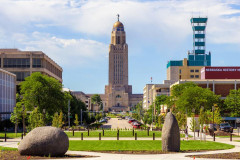
The Legislature meets in the third Nebraska State Capitol building, built between 1922 and 1932. It was designed by Bertram G. Goodhue. Built from Indiana limestone, the Capitol's base is a cross within a square. A 400-foot domed tower rises from this base. The Sower, a 19-foot bronze statue representing agriculture, crowns the Capitol. The state Capitol is considered an architectural achievement and has been recognized by the American Institute of Architects.
When Nebraska became a state in 1867, its legislature consisted of two houses: a House of Representatives and a Senate. For years, US Senator George Norris and other Nebraskans encouraged the idea of a unicameral legislature, and demanded the issue be decided in a referendum. Norris argued:
The constitutions of our various states are built upon the idea that there is but one class. If this be true, there is no sense or reason in having the same thing done twice, especially if it is to be done by two bodies of men elected in the same way and having the same jurisdiction.
Unicameral supporters also argued that a bicameral legislature had a significant undemocratic feature in the committees that reconciled House and Senate legislation. Votes in these committees were secretive, and would sometimes add provisions to bills that neither house had approved. Nebraska's unicameral legislature today has rules that bills can contain only one subject, and must be given at least five days of consideration. In 1934, due in part to the budgetary pressure of the Great Depression, Nebraska citizens ran a state initiative to vote on a constitutional amendment creating a unicameral legislature, which was approved. In effect, the House of Representatives (the lower house) was abolished; today's Nebraska state legislators are commonly referred to as "Senators".
Judicial branch
Further information: Nebraska Supreme CourtThe judicial system in Nebraska is unified, with the Nebraska Supreme Court having administrative authority over all Nebraska courts. Nebraska uses the Missouri Plan for the selection of judges at all levels. The lowest courts in Nebraska are the county courts, above that are twelve district courts (containing one or more counties). The Court of Appeals hears appeals from the district courts, juvenile courts, and workers' compensation courts. The Nebraska Supreme Court is the final court of appeal.
Federal government representation
Further information: United States congressional delegations from NebraskaNebraska's U.S. senators are Deb Fischer and Ben Sasse, both Republicans; Fischer, elected in 2012, is the senior.
Nebraska has three representatives in the House of Representatives: Jeff Fortenberry (R) of the 1st district; Brad Ashford (D) of the 2nd district; and Adrian Smith (R) of the 3rd district.
Nebraska is one of two states (with Maine) that allow for a split in the state's allocation of electoral votes in presidential elections. Under a 1991 law, two of Nebraska's five votes are awarded to the winner of the statewide popular vote, while the other three go to the highest vote-getter in each of the state's three congressional districts.