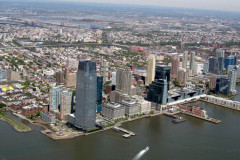
New Jersey
Description
New Jersey is a state in the northeastern and mid-Atlantic regions of the United States. It is bordered on the north and east by New York, on the southeast and south by the Atlantic Ocean, on the west by Pennsylvania, and on the southwest by Delaware. New Jersey is the fourth-smallest state but the 11th-most populous and the most densely populated of the 50 United States. New Jersey lies entirely within the combined statistical areas of New York City and Philadelphia and is the third-wealthiest U.S. state by per capita income as of 2014.
New Jersey was inhabited by Native Americans for more than 2,800 years, with historical tribes such as the Lenape along the coast. In the early 17th century, the Dutch and the Swedes made the first European settlements. The English later seized control of the region, naming it the Province of New Jersey after the largest of the Channel Islands, Jersey, and granting it as a colony to Sir George Carteret and John Berkeley, 1st Baron Berkeley of Stratton. New Jersey was the site of several decisive battles during the American Revolutionary War in the 18th century.
In the 19th century, factories in cities such as Camden, Paterson, Newark, Trenton, and Elizabeth helped to drive the Industrial Revolution. New Jersey's geographic location at the center of the Northeast megalopolis, between Boston and New York City to the northeast, and Philadelphia, Baltimore, and Washington, D.C., to the southwest, fueled its rapid growth through the process of suburbanization in the second half of the 20th century. In the first decades of the 21st century, this suburbanization began reverting to consolidation of New Jersey's culturally diverse populace toward more urban settings within the state, with towns home to commuter rail stations outpacing the population growth of more automobile-oriented suburbs since 2008.
History
Around 180 million years ago, during the Jurassic Period, New Jersey bordered North Africa. The pressure of the collision between North America and Africa gave rise to the Appalachian Mountains. Around 18,000 years ago, the Ice Age resulted in glaciers that reached New Jersey. As the glaciers retreated, they left behind Lake Passaic, as well as many rivers, swamps, and gorges.
New Jersey was originally settled by Native Americans, with the Lenni-Lenape being dominant at the time of contact. Scheyichbi is the Lenape name for the land that is now New Jersey. The Lenape were several autonomous groups that practiced maize agriculture in order to supplement their hunting and gathering in the region surrounding the Delaware River, the lower Hudson River, and western Long Island Sound. The Lenape society was divided into matrilinear clans that were based upon common female ancestors. These clans were organized into three distinct phratries identified by their animal sign: Turtle, Turkey, and Wolf. They first encountered the Dutch in the early 17th century, and their primary relationship with the Europeans was through fur trade.
Colonial era
The Dutch became the first Europeans to lay claim to lands in New Jersey. The Dutch colony of New Netherland consisted of parts of modern Middle Atlantic states. Although the European principle of land ownership was not recognized by the Lenape, Dutch West India Company policy required their colonists to purchase land which they settled. The first to do so was Michiel Pauw who established a patronship called Pavonia in 1630 along the North River which eventually became the Bergen. Peter Minuit's purchase of lands along the Delaware River established the colony of New Sweden. The entire region became a territory of England on June 24, 1664, after an English fleet under the command of Colonel Richard Nicolls sailed into what is today New York Harbor and took control of Fort Amsterdam, annexing the entire province.
During the English Civil War, the Channel Island of Jersey remained loyal to the British Crown and gave sanctuary to the King. It was from the Royal Square in St. Helier that Charles II of England was proclaimed King in 1649, following the execution of his father, Charles I. The North American lands were divided by Charles II, who gave his brother, the Duke of York (later King James II), the region between New England and Maryland as a proprietary colony (as opposed to a royal colony). James then granted the land between the Hudson River and the Delaware River (the land that would become New Jersey) to two friends who had remained loyal through the English Civil War: Sir George Carteret and Lord Berkeley of Stratton. The area was named the Province of New Jersey.
Since the state's inception, New Jersey has been characterized by ethnic and religious diversity. New England Congregationalists settled alongside Scots Presbyterians and Dutch Reformed migrants. While the majority of residents lived in towns with individual landholdings of 100 acres (40 ha), a few rich proprietors owned vast estates. English Quakers and Anglicans owned large landholdings. Unlike Plymouth Colony, Jamestown and other colonies, New Jersey was populated by a secondary wave of immigrants who came from other colonies instead of those who migrated directly from Europe. New Jersey remained agrarian and rural throughout the colonial era, and commercial farming developed sporadically. Some townships, such as Burlington on the Delaware River and Perth Amboy, emerged as important ports for shipping to New York City and Philadelphia. The colony's fertile lands and tolerant religious policy drew more settlers, and New Jersey's population had increased to 120,000 by 1775.
Settlement for the first 10 years of English rule took place along Hackensack River and Arthur Kill – settlers came primarily from New York and New England. On March 18, 1673, Berkeley sold his half of the colony to Quakers in England, who settled the Delaware Valley region as a Quaker colony. (William Penn acted as trustee for the lands for a time.) New Jersey was governed very briefly as two distinct provinces, East and West Jersey, for 28 years between 1674 and 1702, at times part of the Province of New York or Dominion of New England.
In 1702, the two provinces were reunited under a royal governor, rather than a proprietary one. Edward Hyde, Lord Cornbury, became the first governor of the colony as a royal colony. Britain believed that he was an ineffective and corrupt ruler, taking bribes and speculating on land. In 1708 he was recalled to England. New Jersey was then ruled by the governors of New York, but this infuriated the settlers of New Jersey, who accused those governors of favoritism to New York. Judge Lewis Morris led the case for a separate governor, and was appointed governor by King George II in 1738.
Revolutionary War era
New Jersey was one of the Thirteen Colonies that revolted against British rule in the American Revolution. The New Jersey Constitution of 1776 was passed July 2, 1776, just two days before the Second Continental Congress declared American Independence from Great Britain. It was an act of the Provincial Congress, which made itself into the state Legislature. To reassure neutrals, it provided that it would become void if New Jersey reached reconciliation with Great Britain.
New Jersey representatives Richard Stockton, John Witherspoon, Francis Hopkinson, John Hart, and Abraham Clark were among those who signed the United States Declaration of Independence.
During the American Revolutionary War, British and American armies crossed New Jersey numerous times, and several pivotal battles took place in the state. Because of this, New Jersey today is often referred to as "The Crossroads of the Revolution." The winter quarters of the revolutionary army were established there twice by General George Washington in Morristown, which was called the military capital of the revolution.
On the night of December 25–26, 1776, the Continental Army under George Washington crossed the Delaware River. After the crossing, he surprised and defeated the Hessian troops in the Battle of Trenton. Slightly more than a week after victory at Trenton, American forces gained an important victory by stopping General Cornwallis's charges at the Second Battle of Trenton. By evading Cornwallis's army, Washington made a surprise attack on Princeton and successfully defeated the British forces there on January 3, 1777. Emanuel Leutze's painting of Washington Crossing the Delaware became an icon of the Revolution.
American forces under Washington met the forces under General Henry Clinton at the Battle of Monmouth in an indecisive engagement in June 1778. Washington attempted to take the British column by surprise; when the British army attempted to flank the Americans, the Americans retreated in disorder. The ranks were later reorganized and withstood the British charges.
In the summer of 1783, the Continental Congress met in Nassau Hall at Princeton University, making Princeton the nation's capital for four months. It was there that the Continental Congress learned of the signing of the Treaty of Paris (1783), which ended the war.
On December 18, 1787, New Jersey became the third state to ratify the United States Constitution, which was overwhelmingly popular in New Jersey, as it prevented New York and Pennsylvania from charging tariffs on goods imported from Europe. On November 20, 1789, the state became the first in the newly formed Union to ratify the Bill of Rights.
The 1776 New Jersey State Constitution gave the vote to "all inhabitants" who had a certain level of wealth. This included women and blacks, but not married women, because they could not own property separately from their husbands. Both sides, in several elections, claimed that the other side had had unqualified women vote and mocked them for use of "petticoat electors", whether entitled to vote or not; on the other hand, both parties passed Voting Rights Acts. In 1807, the legislature passed a bill interpreting the constitution to mean universal white male suffrage, excluding paupers; the constitution was itself an act of the legislature and not enshrined as the modern constitution.
19th century
On February 15, 1804, New Jersey became the last northern state to abolish new slavery and enacted legislation that slowly phased out existing slavery. This led to a gradual decrease of the slave population. By the close of the Civil War, about a dozen African Americans in New Jersey were still held in bondage. New Jersey voters initially refused to ratify the constitutional amendments banning slavery and granting rights to the United States' black population.
Industrialization accelerated in the northern part of the state following completion of the Morris Canal in 1831. The canal allowed for coal to be brought from eastern Pennsylvania's Lehigh Valley to northern New Jersey's growing industries in Paterson, Newark, and Jersey City.
In 1844, the second state constitution was ratified and brought into effect. Counties thereby became districts for the State Senate, and some realignment of boundaries (including the creation of Mercer County) immediately followed. This provision was retained in the 1947 Constitution, but was overturned by the Supreme Court of the United States in 1962 by the decision Baker v. Carr. While the Governorship was stronger than under the 1776 constitution, the constitution of 1844 created many offices that were not responsible to him, or to the people, and it gave him a three-year term, but he could not succeed himself.
New Jersey was one of the few Union states (the others being Delaware and Kentucky) to select a candidate other than Abraham Lincoln twice in national elections, and sided with Stephen Douglas (1860) and George B. McClellan (1864) during their campaigns. McClellan, a native Philadelphian, had New Jersey ties and formally resided in New Jersey at the time; he later became Governor of New Jersey (1878–81). (In New Jersey, the factions of the Democratic party managed an effective coalition in 1860.) During the American Civil War, the state was led first by Republican Governor Charles Smith Olden, then by Democrat Joel Parker. During the course of the war, over 80,000 from the state enlisted in the Northern army; unlike many states, including some Northern ones, no battle was fought there.
In the Industrial Revolution, cities like Paterson grew and prospered. Previously, the economy had been largely agrarian, which was problematically subject to crop failures and poor soil. This caused a shift to a more industrialized economy, one based on manufactured commodities such as textiles and silk. Inventor Thomas Edison also became an important figure of the Industrial Revolution, having been granted 1,093 patents, many of which for inventions he developed while working in New Jersey. Edison's facilities, first at Menlo Park and then in West Orange, are considered perhaps the first research centers in the U.S. Christie Street in Menlo Park was the first thoroughfare in the world to have electric lighting. Transportation was greatly improved as locomotion and steamboats were introduced to New Jersey.
Iron mining was also a leading industry during the middle to late 19th century. Bog iron pits in the southern New Jersey Pinelands were among the first sources of iron for the new nation. Mines such as Mt. Hope, Mine Hill and the Rockaway Valley Mines created a thriving industry. Mining generated the impetus for new towns and was one of the driving forces behind the need for the Morris Canal. Zinc mines were also a major industry, especially the Sterling Hill Mine.
20th century
Through both World Wars, New Jersey was a center for war production, especially in naval construction. Battleships, cruisers, and destroyers were made in this state. New Jersey manufactured 6.8 percent of total United States military armaments produced during World War II, ranking fifth among the 48 states. In addition, Fort Dix (1917) (originally called "Camp Dix"), Camp Merritt (1917) and Camp Kilmer (1941) were all constructed to house and train American soldiers through both World Wars. New Jersey also became a principal location for defense in the Cold War. Fourteen Nike Missile stations were constructed, especially for the defense of New York City and Philadelphia, Pennsylvania. PT-109, a motor torpedo boat commanded by Lt. (j.g.) John F. Kennedy in World War II, was built at the Elco Boatworks in Bayonne. The aircraft carrier USS Enterprise (CV-6) was briefly docked at the Military Ocean Terminal in Bayonne in the 1950s before she was sent to Kearney to be scrapped. In 1962, the world's first nuclear-powered cargo ship, the NS Savannah, was launched at Camden.
New Jersey prospered through the Roaring Twenties. The first Miss America Pageant was held in 1921 in Atlantic City, the Holland Tunnel connecting Jersey City to Manhattan opened in 1927, and the first drive-in movie was shown in 1933 in Camden. During the Great Depression of the 1930s, the state offered begging licenses to unemployed residents, the zeppelin airship Hindenburg crashed in flames over Lakehurst, and the SS Morro Castle beached itself near Asbury Park after going up in flames while at sea.
In 1951, the New Jersey Turnpike opened, permitting fast travel by car and truck between North Jersey (and metropolitan New York) and South Jersey (and metropolitan Philadelphia).
In the 1960s, race riots erupted in many of the industrial cities of North Jersey. The first race riots in New Jersey occurred in Jersey City on August 2, 1964. Several others ensued in 1967, in Newark and Plainfield. Other riots followed the assassination of Dr. Martin Luther King, Jr. in April 1968, just as in the rest of the country. A riot occurred in Camden in 1971.
As a result of an order from the New Jersey Supreme Court to fund schools equitably, the New Jersey legislature passed an income tax bill in 1976. Prior to this bill, the state had no income tax.
21st century
In the early part of the 2000s, two light rail systems were opened: the Hudson–Bergen Light Rail in Hudson County and the River Line between Camden and Trenton. The intent of these projects were to encourage transit-oriented development in North Jersey and South Jersey, respectively. The HBLR in particular was credited with a revitalization of Hudson County and Jersey City in particular. Urban revitalization has continued in North Jersey in the 21st century. As of 2014, Jersey City's Census-estimated population was 262,146, with the largest population increase of any municipality in New Jersey since 2010, representing an increase of 5.9% from the 2010 United States Census, when the city's population was enumerated at 247,597. In 2010, Newark experienced its first population increase since the 1950s.
Geography
New Jersey is bordered on the north and northeast by New York (parts of which are across the Hudson River, Upper New York Bay, the Kill Van Kull, Newark Bay, and the Arthur Kill); on the east by the Atlantic Ocean; on the southwest by Delaware across Delaware Bay; and on the west by Pennsylvania across the Delaware River.
New Jersey can be thought of as five regions, based on natural geography and population. Northeastern New Jersey, the Gateway Region, lies closest to Manhattan in New York City, and up to a million residents commute daily into the city to work via automobile or mass transit. Northwestern New Jersey, or the "Skylands", is, compared to the northeast, more wooded, rural, and mountainous. The "Shore", along the Atlantic Coast in the central-east and southeast, has its own natural, residential, and lifestyle characteristics owing to its location by the ocean. The Delaware Valley includes the southwestern counties of the state, which reside within the Philadelphia Metropolitan Area. The fifth region is the Pine Barrens in the interior of the southern part. Covered rather extensively by mixed pine and oak forest, it has a much lower population density than much of the rest of the state.
New Jersey also can be broadly divided into three geographic regions: North Jersey, Central Jersey, and South Jersey. Some New Jersey residents do not consider Central Jersey a region in its own right, but others believe it is a separate geographic and cultural area from the North and South.
The federal Office of Management and Budget divides New Jersey's counties into seven Metropolitan Statistical Areas, including sixteen counties in the New York City or Philadelphia metro areas. Four counties have independent metro areas, and Warren County is part of the Pennsylvania-based Lehigh Valley metro area. (See Metropolitan Statistical Areas of New Jersey for details.)
It is also at the center of the Northeast megalopolis.
Additionally, the New Jersey Commerce, Economic Growth, & Tourism Commission divides the state into six distinct regions to facilitate the state's tourism industry. The regions are:
- Gateway Region, encompassing Middlesex County, Union County, Essex County, Hudson County, Bergen County, and Passaic County.
- Skylands Region, encompassing Sussex County, Morris County, Warren County, Hunterdon County, and Somerset County.
- Shore Region, encompassing Monmouth County and Ocean County.
- Delaware River Region, encompassing Mercer County, Burlington County, Camden County, Gloucester County, and Salem County.
- Greater Atlantic City Region, encompassing Atlantic County.
- Southern Shore Region, encompassing Cumberland County and Cape May County.
High Point, in Montague Township, Sussex County, is the highest elevation, at 1,803 feet (550 m). The Palisades are a line of steep cliffs on the lower west side of the Hudson River, in Bergen County and Hudson County.
Major rivers include the Hudson, Delaware, Raritan, Passaic, Hackensack, Rahway, Musconetcong, Mullica, Rancocas, Manasquan, Maurice, and Toms rivers.
Sandy Hook, along the eastern coast, is a popular recreational beach. It is a barrier spit and an extension of the Barnegat Peninsula along the state's Atlantic Ocean coast.
Long Beach Island ("LBI"), a barrier island along the eastern coast, has popular recreational beaches. The primary access point to the island is by a single bridge connection to the mainland. Barnegat Lighthouse is on the northern tip.
Areas managed by the National Park Service include:
- Appalachian National Scenic Trail
- Delaware National Scenic River
- Delaware Water Gap National Recreation Area
- Ellis Island National Monument
- Gateway National Recreation Area in Monmouth County
- Great Egg Harbor River
- Morristown National Historical Park in Morristown
- New Jersey Coastal Heritage Trail Route
- New Jersey Pinelands National Reserve
- Paterson Great Falls National Historical Park
- Thomas Edison National Historical Park in West Orange
Prominent geographic features include:
- Delaware Water Gap
- Great Bay
- Great Swamp National Wildlife Refuge
- Highlands
- Hudson Palisades
- Meadowlands
- Pine Barrens
- South Mountain
Transportation
Roadways
The New Jersey Turnpike is one of the most prominent and heavily traveled roadways in the United States. This toll road carries interstate traffic between Delaware and New York, and the East Coast in general. Commonly referred to as simply "the Turnpike," it is known for its numerous rest areas named after prominent New Jerseyans as diverse as inventor Thomas Edison; United States Secretary of the Treasury Alexander Hamilton; United States Presidents Grover Cleveland and Woodrow Wilson; writers James Fenimore Cooper, Joyce Kilmer, and Walt Whitman; patriot Molly Pitcher; Red Cross founder Clara Barton; and football coach Vince Lombardi.
The Garden State Parkway, or simply "the Parkway," carries relatively more in-state traffic than interstate traffic and runs from the town of Montvale along New Jersey's northern border to its southernmost tip at Cape May for 172.4 miles (277.5 km). It is the trunk that connects the New York metropolitan area to Atlantic City and is consistently one of the safest roads in the nation. With a total of 15 travel and 6 shoulder lanes, the Driscoll Bridge on the Parkway, spanning the Raritan River in Middlesex County, is the widest motor vehicle bridge in the world by number of lanes as well as one of the busiest.
New Jersey is connected to New York City via various bridges and tunnels. The double-decked George Washington Bridge carries the heaviest load of motor vehicle traffic of any bridge in the world, at 102 million vehicles per year, over fourteen lanes, from Fort Lee, New Jersey in Bergen County across the Hudson River to the Trans-Manhattan Expressway in the Washington Heights neighborhood of Upper Manhattan in New York City; Interstate 95 and U.S. Route 1/9 cross the Hudson River via the "GWB", while U.S. Route 46, which lies entirely within New Jersey, ends halfway across the bridge at the state border with New York. The Lincoln Tunnel connects to Midtown Manhattan carrying New Jersey State Route 495 and the Holland Tunnel connects to Lower Manhattan carrying I-78. These are the three major Hudson River crossings that see heavy vehicular traffic. New Jersey is also connected to Staten Island by three bridges — from south to north: the Outerbridge Crossing, Goethals Bridge, and Bayonne Bridge.
Other expressways in New Jersey include the Atlantic City Expressway, the Palisades Interstate Parkway, Interstate 76, Interstate 78, Interstate 80, Interstate 95, Interstate 195, Interstate 278, Interstate 280, Interstate 287, Interstate 295, and Interstate 676. Other major roadways include U.S. 1, New Jersey Route 4, U.S. 9, New Jersey Route 10, and New Jersey Route 17.
New Jersey has interstate compacts with all three of its neighboring states. The Port Authority of New York and New Jersey, the Delaware River Port Authority (with Pennsylvania), and the Delaware River and Bay Authority (with Delaware) operate most of the major transportation routes into and out of New Jersey. Bridge tolls are collected in one direction only – it is free to cross into New Jersey, but motorists must pay when exiting the state. Exceptions to this are the Dingman's Ferry Bridge and the Delaware River – Turnpike Toll Bridge where tolls are charged both ways. The Washington Crossing and Scudders Falls (on I-95) bridges near Trenton, as well as Trenton's Calhoun Street and Bridge Street ("Trenton Makes") bridges, are toll-free. In addition, * Riverton-Belvidere Bridge, Northampton Street Bridge, Riegelsville Bridge, and Upper Black Eddy-Milford Bridge are free Delaware River bridges into and out of NJ.
- Uhlerstown-Frenchtown Bridge – (NJ 12)
- Lumberville-Raven Rock Bridge – (pedestrian)
- Centre Bridge-Stockton Bridge – (PA 263 / CR 523)
New Jersey became the only U.S. state where all fuel dispensing stations are required to sell full-service gasoline to customers at all times, after Oregon's introduction of restricted self-service gasoline availability took effect in 2016. It is unlawful for a customer to serve oneself gasoline in New Jersey.
Airports
Newark Liberty International Airport is one of the busiest airports in the United States. Operated by the Port Authority of New York and New Jersey, which runs the other two major airports in the New York metropolitan area (John F. Kennedy International Airport and LaGuardia Airport), it is one of the main airports serving the New York City area. United Airlines is the facility's largest tenant, operating an entire terminal at Newark, which it uses as one of its primary hubs. FedEx Express operates a large cargo hub. The adjacent Newark Airport railroad station provides access to the trains of Amtrak and NJ Transit along the Northeast Corridor Line.
Two smaller commercial airports, Atlantic City International Airport and Trenton-Mercer Airport, also operate in other parts of New Jersey. Teterboro Airport, in Bergen County, is a general aviation airport popular with private and corporate aircraft, due to its proximity to New York City. Millville Municipal Airport, in Cumberland County, is a general aviation airport popular with private and corporate aircraft, due to its proximity to the shore.
Rail and bus
Further information: New Jersey Transit Bus Operations, New Jersey Transit Rail Operations, Port Authority Trans-Hudson, and PATCO SpeedlineThe NJ Transit Corporation (NJ Transit) operates extensive rail and bus service throughout the state. NJ Transit is a state-run corporation that began with the consolidation of several private bus companies in North Jersey. In the early 1980s, it acquired the commuter train operations of Conrail that connect towns in northern and central New Jersey to New York City. NJ Transit has eleven lines that run throughout different parts of the state. Most of the trains start at various points in the state and most end at either Pennsylvania Station, in New York City, or Hoboken Terminal in Hoboken. NJ Transit began service between Atlantic City and Lindenwold in 1989 and extended it to Philadelphia, Pennsylvania, in the 1990s.
NJ Transit also operates three light rail systems in the state. The Hudson-Bergen Light Rail connects Bayonne to North Bergen, with planned expansion into Bergen County communities. The Newark Light Rail is partially underground, and connects downtown Newark with other parts of the city. The River Line connects Trenton and Camden.
The PATH is a subway and above-ground railway which links Hoboken, Jersey City, Harrison and Newark with New York City. The PATH operates four lines that connect various points in North Jersey and New York. The lines all terminate in Hudson County, Essex County or Manhattan in New York City.
The PATCO High Speedline links Camden County and Philadelphia. PATCO operates a single elevated and subway line that runs from Lindenwold to Center City Philadelphia. PATCO operates stations in Lindenwold, Voorhees, Cherry Hill, Haddonfield, Haddon Township, Collingswood, and Camden, along with four stations in Philadelphia.
Amtrak also operates numerous long-distance passenger trains in New Jersey to and from neighboring states and around the country. In addition to the Newark Airport connection, other major Amtrak railway stations include Trenton Rail Station, Metropark, and the grand historic Newark Penn Station.
SEPTA also has two lines that operate into New Jersey. The Trenton Line terminates at the Trenton Transit Center, and the West Trenton Line terminates at the West Trenton Rail Station in Ewing.
AirTrain Newark is a monorail connecting the Amtrak/NJ Transit station on the Northeast Corridor to the airport's terminals and parking lots.
Some private bus carriers still remain in New Jersey. Most of these carriers operate with state funding to offset losses and state owned buses are provided to these carriers of which Coach USA companies make up the bulk. Other carriers include private charter and tour bus operators that take gamblers from other parts of New Jersey, New York City, Philadelphia, and Delaware to the casino resorts of Atlantic City.
Ferries
In the Port of New York and New Jersey, New York Waterway has ferry terminals at Belford Harbor, Jersey City, Hoboken, Weehawken, and Edgewater Landing. There are slips at Port Liberte, Liberty Harbor, Exchange Place in Jersey City, Port Imperial and Lincoln Harbor in Weehawken, Hoboken Terminal and 14th Street in Hoboken. Manhattan terminals are located at Wall Street/Pier 11, Battery Park City (BPC) or West Midtown Ferry Terminal. Liberty Water Taxi in Jersey City has ferries from Paulus Hook and Liberty State Park to (BPC). Statue Cruises has service from Liberty State Park and Statue of Liberty National Monument, including Ellis Island. (Although there is a bridge from Ellis Island to the park built for renovations on the island it is not open for public use.) SeaStreak offers services from the Raritan Bayshore to Manhattan and during the Met's season to Shea Stadium. The ferries on leave from Atlantic Highlands and two terminals in Highlands. Ferry service from Keyport and Perth Amboy have been also been proposed. Service from Elizabeth at Newark Bay is proposed in conjunction with re-development plans on the shore near Jersey Gardens.
On the Delaware Bay, the Delaware River and Bay Authority operates the Cape May-Lewes Ferry. The agency also operates the Forts Ferry Crossing for passengers across the Delaware River. The Delaware River Port Authority operates the RiverLink Ferry between the Camden waterfront and Penn's Landing in Philadelphia, Pennsylvania.
Private bus carriers
Several private bus lines provide transportation service in the state of New Jersey. Below is a list of major carriers and their areas of operation:
- Academy – commuter bus service from Burlington, Middlesex, Monmouth, and Ocean counties to lower and midtown Manhattan
- Broadway Bus – local bus service in Bayonne
- Coach USA
- Community Coach – commuter bus service from Essex and Morris counties
- ONE Bus/Olympia Trails – local bus service in Essex and Union counties, commuter bus service from the Raritan Valley to Manhattan
- Red & Tan in Hudson County – local bus service in Hudson County
- Rockland Coaches – commuter and local bus service from Bergen County to Manhattan
- Suburban Trails – commuter bus service from Middlesex County to Manhattan, local bus service in Middlesex County
- DeCamp Bus Lines – commuter bus service from Essex County to Manhattan
- Greyhound – interstate bus service from terminals in Newark, Atlantic City, and Mount Laurel
- Lakeland Bus Lines – commuter and local bus service from Morris, Somerset, Union, and Sussex counties to Manhattan
- Martz Trailways – service from Warren County to Manhattan
- Montgomery & West Side IBOA—local bus service in Jersey City
- Trans-Bridge Lines – service from the Skylands Region to and from Manhattan
Points of interest
Museums
New Jersey has many museums of all kinds. A few major museums in the state are listed.
Museum Location Year opened Type New Jersey State Museum Trenton 1895 General Education Liberty Science Center Liberty State Park, Jersey City 1993 Science museum Maywood Station Museum Maywood 2004 Railroad museum Montclair Art Museum Montclair 1914 Art museum Newark Museum Newark 1909 Natural Science & Art museum Princeton University Art Museum Princeton 1884 Art museum Thomas Edison Museum Menlo Park 1938 Thomas Edison museumEntertainment and concert venues
Visitors and residents take advantage of and contribute to performances at the numerous music, theater, and dance companies and venues located throughout the state, including:
Venue Type Location Year opened Prudential Center Arena Newark 2007 Izod Center Arena Meadowlands Sports Complex 1981 PNC Bank Arts Center Amphitheater Holmdel 1977 NJPAC Concert Hall Newark 1997 Paper Mill Playhouse Regional Theater Millburn 1968 State Theater Regional Theater New Brunswick 1921 Boardwalk Hall Arena Atlantic City 1926 Susquehanna Bank Center Amphitheater Camden 1995 Sun National Bank Center Arena Trenton 1999Theme parks
Main Park Other Parks Location Year opened Six Flags Great Adventure Six Flags Wild Safari, Six Flags Hurricane Harbor Jackson 1974 Clementon Amusement Park Splash World Clementon 1907 Land of Make Believe Pirate's Cove Hope 1958 Morey's Piers Raging Waters and Ocean Oasis Waterparks Wildwood 1969 Action Park None Vernon 1998 Casino Pier None Seaside Heights 1960Jersey Shore
Culture
General
Like every state, New Jersey has its own cuisine, religious communities, museums, and halls of fame.
New Jersey is the birthplace of modern inventions such as: FM radio, the motion picture camera, the lithium battery, the light bulb, transistors, and the electric train. Other New Jersey creations include: the drive-in movie, the cultivated blueberry, cranberry sauce, the postcard, the boardwalk, the zipper, the phonograph, saltwater taffy, the dirigible, the seedless watermelon, the first use of a submarine in warfare, and the ice cream cone.
There are mineral museums in Franklin and Ogdensburg.
Diners are common in New Jersey. The state is home to many diner manufacturers and has more diners than any other state: over 600. There are more diners in the state of New Jersey than any other place in the world.
New Jersey is the only state without a state song. I'm From New Jersey is incorrectly listed on many websites as being the New Jersey state song, but it was not even a contender when in 1996 the New Jersey Arts Council submitted their suggestions to the New Jersey Legislature.
New Jersey is frequently the target of jokes in American culture, especially from New York City-based television shows, such as Saturday Night Live. Academic Michael Aaron Rockland attributes this to New Yorkers' view that New Jersey is the beginning of Middle America. The New Jersey Turnpike, which runs between two major East Coast cities, New York City and Philadelphia, is also cited as a reason, as people who traverse through the state may only see its industrial zones. Reality television shows like Jersey Shore and The Real Housewives of New Jersey have reinforced stereotypical views of New Jersey culture, but Rockland cited The Sopranos and the music of Bruce Springsteen as exporting a more positive image.
Cuisine
New Jersey is known for several foods developed within the region, including pork roll (or Taylor ham), cheesesteaks, and scrapple.
Credit for the development of submarine sandwiches is claimed by several states with substantial Italian American populations, including New Jersey.
Music
New Jersey has long been an important area for both rock and rap music. Some prominent musicians from or with significant connections to New Jersey are:
- Singer Frank Sinatra was born in Hoboken. He sang with a neighborhood vocal group, the Hoboken Four, and appeared in neighborhood theater amateur shows before he became an Academy Award–winning actor.
- Bruce Springsteen, who has sung of New Jersey life on most of his albums, is from Freehold. Some of his songs that represent New Jersey life are "Born to Run", "Spirit In The Night," "Rosalita (Come Out Tonight)", "Thunder Road", "Atlantic City", and "Jungleland".
- The Jonas Brothers all reside in Wyckoff, New Jersey, where the eldest and youngest brothers of the group, Kevin and Frankie Jonas, were born.
- Irvington's Queen Latifah was the first female rapper to succeed in music, film, and television.
- Lauryn Hill is from South Orange, New Jersey. Her 1998 debut solo album, The Miseducation of Lauryn Hill, sold 10 million copies internationally. She also sold millions with The Fugees second album The Score.
- Southside Johnny, eponymous leader of Southside Johnny and the Asbury Jukes was raised in Ocean Grove. He is considered the "Grandfather of the New Jersey Sound" and is cited by Jersey-born Jon Bon Jovi as his reason for singing.
- Redman (Reggie Noble) was born, raised, and resides in Newark. He is the most successful African-American solo hip-hop artist out of New Jersey.
- All members of The Sugarhill Gang were born in Englewood.
- Roc-A-Fella Records rap producer Just Blaze is from Paterson, New Jersey.
- Jon Bon Jovi, from Sayreville, reached fame in the 1980s with hard rock outfit Bon Jovi. The band has also written many songs about life in New Jersey including "Livin' On A Prayer" and named one of their albums after the state. (see New Jersey)
- Singer Dionne Warwick was born in East Orange.
- Singer Whitney Houston (who is Dionne Warwick's cousin) was born in Newark, and grew up in neighboring East Orange.
- Jazz pianist and bandleader Count Basie was born in Red Bank in 1904. In the 1960s, he collaborated on several albums with fellow New Jersey native Frank Sinatra. The Count Basie Theatre in Red Bank is named in his honor.
- Parliament-Funkadelic, the funk music collective, was formed in Plainfield by George Clinton.
- Asbury Park is home of The Stone Pony, which Bruce Springsteen and Bon Jovi frequented early in their careers
- Hip-hop pioneers Naughty By Nature are from East Orange.
- In 1964, the Isley Brothers founded the record label T-Neck Records, named after Teaneck, their home at the time.
- The Broadway musical "Jersey Boys" is based on the lives of the members of the Four Seasons, three of whose members were born in New Jersey (Tommy DeVito, Frankie Valli, and Nick Massi) while a fourth Bob Gaudio was born out of state but raised in Bergenfield, NJ.
- Jazz pianist Bill Evans was born in Plainfield in 1929.
- Post-hardcore band Thursday was formed in New Brunswick, New Jersey. Numerous songs reference the city.
- Horror punk band The Misfits hail from Lodi, as well as their founder Glenn Danzig.
- Punk rock poet Patti Smith is from Mantua.
- Indie rock veterans Yo La Tengo are based in Hoboken. They also have a song called "The Night Falls on Hoboken".
- New Jersey was the East Coast hub for ska music in the 1990s. Some of the most popular ska bands, such as Catch 22 and Streetlight Manifesto, come from East Brunswick.
- Black Label Society's and Ozzy Osbourne's famed guitarist Zakk Wylde was born in Bayonne and raised in Jackson
- The Bouncing Souls original four members grew up in Basking Ridge and formed in New Brunswick in the late 1980s.
- My Chemical Romance's Frank Iero, Gerard Way, Mikey Way, and Ray Toro all are from New Jersey.
- Cobra Starship frontman Gabe Saporta is from New Jersey
- Punk band The Gaslight Anthem hails from New Brunswick, New Jersey.
- Experimental metal band The Dillinger Escape Plan are from Morris Plains, NJ.
- Debbie Harry, born in Miami, Florida, in 1945 but raised by her adoptive parents in Hawthorne.
Comics and video games
- The Lost and Damned (2009), The Ballad of Gay Tony and Max Payne 3 (2012) take place in New Jersey.
- The Grand Theft Auto series has parodied the state multiple times, with "New Guernsey" and "Alderney City" appearing as locations in games in the series.
- Some incarnations of DC Comics's fictional Gotham City are located in New Jersey.