Dallas
Description
Dallas is a major city in the state of Texas and is the largest urban center of the fourth most populous metropolitan area in the United States. The city proper ranks ninth in the U.S. and third in Texas after Houston and San Antonio. The city's prominence arose from its historical importance as a center for the oil and cotton industries, and its position along numerous railroad lines. The bulk of the city is in Dallas County, of which it is the county seat; however, sections of the city are located in Collin, Denton, Kaufman, and Rockwall counties. According to the 2010 United States Census, the city had a population of 1,197,816. The United States Census Bureau's estimate for the city's population increased to 1,300,092 as of July 1, 2015.
The city is the largest economic center of the 12-county Dallas–Fort Worth–Arlington metropolitan area (commonly referred to as DFW), which had a population of 7,102,796 as of July 1, 2015, representing growth in excess of 676,000 people since the 2010 census. In 2014, the metropolitan economy surpassed Washington, DC to become the fifth largest in the United States, with a 2014 real GDP over $504 billion. In 2013, the metropolitan area led the nation with the largest year-over-year increase in employment and advanced to become the fourth-largest employment center in the nation (behind New York City, Los Angeles and Chicago) with more than three million non-farm jobs. As of June 2016, the metropolitan job count has increased to 3,523,400 jobs. The city's economy is primarily based on banking, commerce, telecommunications, technology, energy, healthcare and medical research, and transportation and logistics. The city is home to the third-largest concentration of Fortune 500 companies in the nation (behind New York City and Houston). In the latest rankings released in 2013, Dallas was rated as a "beta plus" world city by the Globalization and World Cities Study Group & Network, and was 14th in world rankings of GDP by the Organisation for Economic Co-operation and Development.
Located in North Texas, Dallas is the main core of the largest metropolitan area in the South and the largest inland metropolitan area in the United States that lacks any navigable link to the sea. Dallas and nearby Fort Worth were developed due to the construction of major railroad lines through the area allowing access to cotton, cattle, and later oil in North and East Texas. The construction of the Interstate Highway System reinforced Dallas' prominence as a transportation hub with four major interstate highways converging in the city, and a fifth interstate loop around it. Dallas developed as a strong industrial and financial center, and a major inland port, due to the convergence of major railroad lines, interstate highways, and the construction of Dallas/Fort Worth International Airport, one of the largest and busiest airports in the world.
History
Preceded by thousands of years of varying indigenous cultures, the Caddo people inhabited the Dallas area before Spanish colonists claimed the territory of Texas in the 18th century as a part of the Viceroyalty of New Spain. Later, France also claimed the area but never established much settlement.
In 1819, the Adams-Onís Treaty between the United States and Spain defined the Red River as the northern boundary of New Spain, officially placing the future location of Dallas well within Spanish territory. The area remained under Spanish rule until 1821, when Mexico declared independence from Spain, and the area was considered part of the Mexican state of Coahuila y Tejas. In 1836, the Republic of Texas, with majority Anglo-American settlers, gained independence from Mexico to become a distinct nation.
In 1839, Warren Angus Ferris surveyed the area around present-day Dallas. John Neely Bryan established a permanent settlement near the Trinity River named Dallas in 1841. The origin of the name is uncertain. The Republic of Texas was annexed by the United States in 1845 and Dallas County was established the following year. Dallas was formally incorporated as a city on February 2, 1856.
With construction of railroads, Dallas became a business and trading center, and was booming by the end of the 19th century. It became an industrial city, attracting workers from Texas, the South and the Midwest. The Praetorian Building of 15 stories, built in 1909, was the first skyscraper west of the Mississippi and the tallest building in Texas for some time. It marked the prominence of Dallas as a city. A racetrack for Thoroughbreds was built and their owners established the Dallas Jockey Club. Trotters raced at a track in Fort Worth, where a similar Drivers Club was based. The rapid expansion of population increased competition for jobs and housing.
In 1921, the Mexican president Álvaro Obregón along with the former revolutionary general visited downtown Dallas' Mexican Park in Little Mexico, the small park was located on the corner of Akard and Caruth Street, site of the current Fairmount Hotel. The small neighborhood of Little Mexico was home to the Hispanic population that had come to Dallas due to factors like the American Dream, better living conditions or the Mexican Revolution.
On November 22, 1963, President John F. Kennedy was assassinated on Elm Street while his motorcade passed through Dealey Plaza in downtown Dallas. The upper two floors of the building from which alleged assassin Lee Harvey Oswald shot Kennedy, the Texas School Book Depository, have been converted into a historical museum covering the former president's life and accomplishments.
On July 7, 2016, multiple shots were fired at a peaceful protest in downtown Dallas, held against the police killings of two black men from other states. The gunman, later identified as Micah Xavier Johnson, began firing at police officers at 8:58 p.m., killing five officers and injuring nine. Two bystanders were also injured. This marked the deadliest day for U.S. law enforcement since the September 11 attacks. Johnson told police during a standoff that he was upset about recent police shootings of black men and wanted to kill whites, especially white officers. After hours of negotiation failed, police resorted to a robot-delivered bomb, killing Johnson inside El Centro College. The shooting occurred in an area of hotels, restaurants, businesses, and residential apartments only a few blocks away from Dealey Plaza.
Geography
Dallas is the county seat of Dallas County. Portions of the city extend into neighboring Collin, Denton, Kaufman, and Rockwall counties. According to the United States Census Bureau, the city has a total area of 385.8 square miles (999.3 km2), 340.5 square miles (881.9 km2) of it being land and 45.3 square miles (117.4 km2) of it (11.75%) water. Dallas makes up one-fifth of the much larger urbanized area known as the Dallas–Fort Worth Metroplex, in which one quarter of all Texans live.
Architecture
Dallas' skyline contains several buildings over 700 feet (210 m) in height. Although some of Dallas' architecture dates from the late 19th and early 20th centuries, most of the notable architecture in the city is from the modernist and postmodernist eras. Iconic examples of modernist architecture include Reunion Tower, the JFK Memorial, I. M. Pei's Dallas City Hall and Morton H. Meyerson Symphony Center. Good examples of postmodernist skyscrapers are Fountain Place, Bank of America Plaza, Renaissance Tower, JPMorgan Chase Tower, and Comerica Bank Tower.
Several smaller structures are fashioned in the Gothic Revival style, such as the Kirby Building, and the neoclassical style, as seen in the Davis and Wilson Buildings. One architectural "hotbed" in the city is a stretch of historic houses along Swiss Avenue, which contains all shades and variants of architecture from Victorian to neoclassical. The Dallas Downtown Historic District protects a cross-section of Dallas commercial architecture from the 1880s to the 1940s.
Neighborhoods
Central DallasCentral Dallas is anchored by Downtown, the center of the city, along with Oak Lawn and Uptown, areas characterized by dense retail, restaurants, and nightlife. Downtown Dallas has a variety of named districts, including the West End Historic District, the Arts District, the Main Street District, Farmers Market District, the City Center business district, the Convention Center District, and the Reunion District. "Hot spots" in this area include Uptown, Victory Park, Oak Lawn, Dallas Design District, Trinity Groves, Turtle Creek, Cityplace, Knox/Henderson, Greenville and West Village.
East DallasEast Dallas is home to Deep Ellum, a trendy arts area close to Downtown, the homey Lakewood neighborhood (and adjacent areas, including Lakewood Heights, Wilshire Heights, Lower Greenville, Junius Heights, and Hollywood Heights/Santa Monica), historic Vickery Place and Bryan Place, and the architecturally significant neighborhoods of Swiss Avenue and Munger Place. Its historic district has one of the largest collections of Frank Lloyd Wright-inspired Prairie-style homes in the United States. In the northeast quadrant of the city is Lake Highlands, one of Dallas' most unified middle-class neighborhoods.
South DallasSouth Dallas, a distinct neighborhood southeast of Downtown, lays claim to the Cedars, an eclectic artist hotbed, and Fair Park, home of the annual State Fair of Texas, held in late September and through mid-October. Southwest of Downtown lies Oak Cliff, a hilly area that has undergone gentrification in recent years, in neighborhoods such as the Bishop Arts District. Oak Cliff was a township founded in the mid-1800s and annexed in 1903 by the city of Dallas. Today, most of the area's northern residents are Hispanic. The ghost town of La Reunion once occupied the northern tip of Oak Cliff. South Oak Cliff has a population that is a mixture of African American, Hispanic, and Native American.
South Side Dallas is currently a popular location for nightly entertainment at the NYLO rooftop patio and lounge, The Cedars Social, and the famous country bar Gilley's. The neighbourhood has undergone extensive development and community integration. What was once an area characterized by high rates of poverty and crime is now one of the most attractive social and living destinations in the city.
Further east, in the southeast quadrant of the city, is the large neighborhood of Pleasant Grove. Once an independent city, it is a collection of mostly lower-income residential areas stretching to Seagoville in the southeast. Though a city neighborhood, Pleasant Grove is surrounded by undeveloped land on all sides. Swampland and wetlands separating it from South Dallas will in the future be part of the Great Trinity Forest, a subsection of the city's Trinity River Project which is planned to restore and preserve wetlands, newly appreciated for habitat and flood control.
Dallas is surrounded by many suburbs; three enclaves are within the city boundaries—Cockrell Hill, Highland Park, and University Park
Topography
Dallas and its surrounding area are mostly flat; the city itself lies at elevations ranging from 450 to 550 feet (137 to 168 m). The western edge of the Austin Chalk Formation, a limestone escarpment (also known as the "White Rock Escarpment"), rises 230 feet (70 m) and runs roughly north-south through Dallas County. South of the Trinity River, the uplift is particularly noticeable in the neighborhoods of Oak Cliff and the adjacent cities of Cockrell Hill, Cedar Hill, Grand Prairie, and Irving. Marked variations in terrain are also found in cities immediately to the west in Tarrant County surrounding Fort Worth, as well as along Turtle Creek north of Downtown.
Dallas, like many other cities, was founded along a river. The city was founded at the location of a "white rock crossing" of the Trinity River, where it was easier for wagons to cross the river in the days before ferries or bridges. The Trinity River, though not usefully navigable, is the major waterway through the city. Its path through Dallas is paralleled by Interstate 35E along the Stemmons Corridor, then south alongside the western portion of Downtown and past south Dallas and Pleasant Grove, where the river is paralleled by Interstate 45 until it exits the city and heads southeast towards Houston. The river is flanked on both sides by 50 feet (15 m) tall earthen levees to protect the city from frequent floods.
Since it was rerouted in the late 1920s, the river has been little more than a drainage ditch within a floodplain for several miles above and below downtown Dallas, with a more normal course further upstream and downstream, but as Dallas began shifting towards postindustrial society, public outcry about the lack of aesthetic and recreational use of the river ultimately gave way to the Trinity River Project, which was begun in the early 2000s and is scheduled to be completed in the 2010s. If the project materializes fully, it promises improvements to the riverfront in the form of man-made lakes, new park facilities and trails, and transportation upgrades.
The project area will reach for over 20 miles (32 km) in length within the city, while the overall geographical land area addressed by the Land Use Plan is approximately 44,000 acres (180 km2) in size—about 20% of the land area in Dallas. Green space along the river will encompass approximately 10,000 acres (40 km2), making it one of the largest and diverse urban parks in the world.
White Rock Lake, a reservoir constructed at the beginning of the 20th century, is Dallas' other significant water feature. The lake and surrounding park is a popular destination for boaters, rowers, joggers, and bikers, as well as visitors seeking peaceful respite from the city at the 66-acre (267,000 m2) Dallas Arboretum and Botanical Garden, located on the lake's eastern shore. White Rock Creek feeds into White Rock Lake, and then exits on to the Trinity River southeast of downtown Dallas. Trails along White Rock Creek are part of the extensive Dallas County Trails System.
Bachman Lake, just northwest of Love Field Airport, is a smaller lake also popularly used for recreation. Northeast of the city is Lake Ray Hubbard, a vast 22,745-acre (92 km2) reservoir located in an extension of Dallas surrounded by the suburbs of Garland, Rowlett, Rockwall, and Sunnyvale. To the west of the city is Mountain Creek Lake, once home to the Naval Air Station Dallas (Hensley Field) and a number of defense aircraft manufacturers. North Lake, a small body of water in an extension of the city limits surrounded by Irving and Coppell, initially served as a water source for a nearby power plant but is now being targeted for redevelopment as a recreational lake due to its proximity to Dallas-Fort Worth International Airport, a plan that the lake's neighboring cities oppose.
White Rock LakeCulture
Cuisine
Dallas is known for its barbecue, authentic Mexican, and Tex-Mex cuisine. Famous products of the Dallas culinary scene include the frozen margarita. Fearing's restaurant at the Ritz-Carlton Dallas hotel in Uptown Dallas was named the best hotel restaurant in the US for 2009 by Zagat Survey. The Ritz-Carlton Dallas hotel was also named 2009 best US hotel by Zagat, and 2009 No. 2 hotel in the world by Zagat, trailing only the Four Seasons King George V in Paris, France. A number of nationally ranked steakhouses can be found in the Dallas area, including Bob's Steak & Chop House, currently ranked No. 1 according to the USDA Prime Steakhouses chart.
Arts
The Arts District in the northern section of Downtown is home to several arts venues and is the largest continuous arts district in the United States. Notable venues in the district include the Dallas Museum of Art, the Morton H. Meyerson Symphony Center home to the Dallas Symphony Orchestra and Dallas Wind Symphony, The Trammell & Margaret Crow Collection of Asian Art, and the Nasher Sculpture Center.
Venues that are part of the AT&T Dallas Center for the Performing Arts include the Winspear Opera House home to the Dallas Opera and Texas Ballet Theater, the Dee and Charles Wyly Theatre home to the Dallas Theater Center and the Dallas Black Dance Theater, and City Performance Hall.
Also, not far north of downtown is the Meadows Museum at Southern Methodist University. In 2009 it joined up with "Prado on the Prairie" for a three-year partnership. The Prado focuses on Spanish visual art and boasts the best collection of Spain's art in North America, with works by Picasso, Goya, Velasquez, El Greco, Murillo, Zurbaran, Ribera, Fortuny, Rico, de Juanes, Plensa and plenty of other Spaniards. These works, as well as Non-Spanish highlights like sculptures by Rodin and Moore have been so successful of a collaboration that the Prado and Meadows have agreed upon an extension of the partnership.
The Arts District is also home to DISD's Booker T. Washington High School for the Performing and Visual Arts, a magnet school which was recently expanded.
City Center District, next to the Arts District is home to the Dallas Contemporary.
Deep Ellum, immediately east of Downtown, originally became popular during the 1920s and 1930s as the prime jazz and blues hot spot in the South. Artists such as Blind Lemon Jefferson, Robert Johnson, Huddie "Lead Belly" Ledbetter and Bessie Smith played in original Deep Ellum clubs such as the Harlem and the Palace. Today, Deep Ellum is home to hundreds of artists who live in lofts and operate in studios throughout the district alongside bars, pubs, and concert venues. A major art infusion in the area results from the city's lax stance on graffiti, and a number of public spaces including tunnels, sides of buildings, sidewalks, and streets are covered in murals. One major example, the Good-Latimer tunnel, was torn down in late 2006 to accommodate the construction of a light rail line through the site.
Like Deep Ellum before it, the Cedars neighborhood to the south of Downtown has also seen a growing population of studio artists and an expanding roster of entertainment venues. The area's art scene began to grow in the early 2000s with the opening of Southside on Lamar, an old Sears warehouse converted into lofts, studios and retail. Within this building, Southside on Lamar hosts the Janette Kennedy Gallery with rotating gallery exhibitions featuring many local, national, and international artists. Current attractions include Gilley's Dallas and Poor David's Pub. Dallas Mavericks owner and local entrepreneur Mark Cuban purchased land along Lamar Avenue near Cedars Station in September 2005, and locals speculate that he is planning an entertainment complex for the site.
South of the Trinity River, the flourishing Bishop Arts District in Oak Cliff is home to a number of studio artists living in converted warehouses. Walls of buildings along alleyways and streets are painted with murals and the surrounding streets contain many eclectic restaurants and shops.
Dallas has an Office of Cultural Affairs as a department of the city government. The office is responsible for six cultural centers located throughout the city, funding for local artists and theaters, initiating public art projects, and running the city-owned classical radio station WRR.
Dallas is the setting of the TV series Dallas. Movies filmed there include The X Files and Dallas Buyers Club.
Events
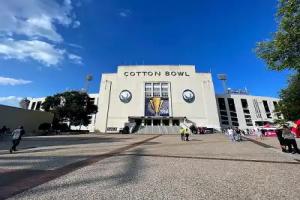
The most notable event held in Dallas is the State Fair of Texas, which has been held annually at Fair Park since 1886. The fair is a massive event, bringing in an estimated $350 million to the city's economy annually. The Red River Shootout, which pits the University of Texas at Austin against The University of Oklahoma at the Cotton Bowl also brings significant crowds to the city. The city also hosts the State Fair Classic and Heart of Dallas Bowl at the Cotton Bowl.
Other well-known festivals in the area include several Cinco de Mayo celebrations hosted by the city's large Mexican American population, and Saint Patrick's Day parade along Lower Greenville Avenue, Juneteenth festivities, Taste of Dallas, the Deep Ellum Arts Festival, the Greek Food Festival of Dallas, the annual Halloween event "The Wake" featuring lots of local art and music, and two annual events on Halloween include; a Halloween parade on Cedar Springs Road and a "Zombie Walk" held in Downtown Dallas in the Arts District.
With the opening of Victory Park, WFAA Channel 8 has begun to host an annual New Year's Eve celebration in AT&T Plaza that the television station hopes will reminisce of celebrations in New York's Times Square, and on New Year's Eve 2011 set a new record of 32,000 people in attendance. Also, several Omni hotels in the Dallas area host large events to welcome in the new year including murder mystery parties, rave inspired events, and other events.
Places of interest
- African American Museum (Dallas)
- American Airlines Center
- Ann & Gabriel Barbier-Mueller Museum
- Arts District, Dallas
- AT&T Performing Arts Center
- Bishop Arts District
- Cedars, Dallas
- Cotton Bowl
- Dallas Arboretum and Botanical Garden
- Dallas Baptist University
- Dallas Firefighters Museum
- Dallas Heritage Village, in the Cedars, Dallas
- Dallas Holocaust Museum/Center for Education & Tolerance
- Dallas Museum of Art
- Dallas World Aquarium
- Dallas Zoo
- Dealey Plaza
- Dee and Charles Wyly Theatre
- Design District, Dallas
- Fair Park
- Federal Reserve Bank of Dallas
- Frontiers of Flight Museum
- Galleria Dallas
- George W. Bush Presidential Center
- Highland Park Village
- John Fitzgerald Kennedy Memorial
- Kalita Humphreys Theater, designed by Frank Lloyd Wright
- Katy Trail (Dallas)
- Klyde Warren Park
- Margaret Hunt Hill Bridge
- Meadows Museum
- Morton H. Meyerson Symphony Center
- Munger Place Historic District, Dallas
- Museum of Biblical Art (Dallas)
- Museum of Geometric and MADI Art
- The Nasher Sculpture Center
- NorthPark Center
- Pioneer Plaza
- Perot Museum of Nature and Science
- Reunion Tower
- Sixth Floor Museum at Dealey Plaza
- Southern Methodist University
- Southfork Ranch as seen on Dallas (1978 TV series) and Dallas (2012 TV series)
- Swiss Avenue, Dallas historical district
- Texas School Book Depository
- Texas Theatre
- Thanks-Giving Square
- Trammell & Margaret Crow Collection of Asian Art
- Trinity River Audubon Center
- Victory Park
- White Rock Lake
Recreation
Public galleries
Southwest GallerySouthwest Gallery has been open to the public since 1967 and is located in a 16,000 square feet (1,500 m2) gallery that features fine art on a broad range including contemporary, hyper-realism, Texas landscape, western, and antique.
Kittrell/Riffkind Art GlassKittrell/Riffkind Art Glass was first opened in October 1990 and merged with Southwest Gallery in October 2015. The glass gallery offers an array of sculpture, goblets, jewelry, scent bottles, paperweights, platters, and wall art.
Parks
Dallas maintains and operates 406 parks on 21,000 acres (85 km2) of parkland.
The city's parks contain 17 separate lakes, including White Rock and Bachman lakes, spanning a total of 4,400 acres (17.81 km2). In addition, Dallas is traversed by 61.6 miles (99.1 km) of biking and jogging trails, including the Katy Trail, and is home to 47 community and neighborhood recreation centers, 276 sports fields, 60 swimming pools, 232 playgrounds, 173 basketball courts, 112 volleyball courts, 126 play slabs, 258 neighborhood tennis courts, 258 picnic areas, six 18-hole golf courses, two driving ranges, and 477 athletic fields.
Fair ParkDallas' flagship park is Fair Park. Built in 1936 for the Worlds Fair and the Texas Centennial Exposition, Fair Park is the world's largest collection of Art Deco exhibit buildings, art, and sculptures; Fair Park is also home to the State Fair of Texas, the largest state fair in the United States.
Klyde Warren ParkNamed after Klyde Warren, the young son of billionaire Kelcy Warren, Klyde Warren Park was built above Woodall Rodgers Freeway and connects Uptown and Downtown, specifically the Arts District.
Klyde Warren Park is home to countless amenities including: an amphitheater, jogging trails, children's park, My Best Friend's Park (dog park), a putting green, croquet, ping pong, chess, an outdoor library, and two restaurants: Savor and Relish. Food trucks give hungry people another option of dining and are lined along the park's downtown side.
There are also weekly planned events including: yoga, zumba, skyline tours, Tai Chi, and meditation.
Since 2013 Klyde Warren park is home to a free trolley stop on Olive St., which riders can connect to Downtown, McKinney Avenue, and West Village.
Turtle Creek ParkBuilt in 1913, Turtle Creek Park is a 23.7 acre linear park in-between Turtle Creek and Turtle Creek Boulevard in the aptly named Turtle Creek neighborhood.
Archaeological surveys discovered dart points and flint chips dating 3,000 years to 1,000 B.C. This site was later discovered to be home to Native Americans who cherished the trees and natural spring water. The park is across Turtle Creek from Kalita Humphreys Theater, designed by Frank Lloyd Wright.
Lake Cliff ParkOpened on July 4, 1906, Lake Cliff Park was called "the Southwest's Greatest Playground". The park was home to an amusement park, a large pool, waterslides, the world's largest skating rink, and three theaters, the largest being the 2,500-seat Casino Theater. After the streetcar bridge which brought most of the park visitors collapsed, Lake Cliff Park was sold. The Casino Theater moved and the pool was demolished after a polio scare in 1959. The pool was Dallas' first municipal pool.
Reverchon ParkIn 1935, Dallas purchased 36 acres (15 ha) from John Cole's estate to develop Reverchon Park. Reverchon Park was named after botanist Julien Reverchon, who left France to live in the La Reunion colony in present-day West Dallas. Reverchon Park was planned to be the crown jewel of the Dallas park system and was even referred to as the "Central Park" of Dallas. Improvements were made throughout the years including the Iris Bowl, picnic settings, a baseball diamond, and tennis courts. The Iris Bowl celebrated many Greek pageants, dances, and other performances. The Gill Well was installed for nearby residents and drew people all across Texas who wanted to experience the water's healing powers. The baseball diamond was host to a 1953 exhibition game for the New York Giants and the Cleveland Indians.
Trinity River ProjectAs part of the ongoing Trinity River Project, the Great Trinity Forest, at 6,000 acres (24 km2), is the largest urban hardwood forest in the United States and is part of the largest urban park in the United States. The Trinity River Audubon Center is a new addition to the park. Opened in 2008, it serves as a gateway to many trails and other nature viewing activities in the area. The Trinity River Audubon Center is the first LEED-certified building constructed by the City of Dallas Parks and Recreation Department.
Katy TrailNamed after its former railroad name, the Missouri-Kansas-Texas Railroad (or "MKT" Railroad), the 3.5 mile stretch of railroad was purchased by the City of Dallas and transformed into the city's premier trail. Stretching from Victory Park, the 30-acre Katy Trail passes through the Turtle Creek and Knox Park neighborhoods and runs along the east side of Highland Park. The trail currently terminates at Central Expressway, however extensions are under way to extend the trail to the White Rock Lake Trail in Lakewood.
In 2015, the Katy Trail was awarded "Best Public Place" from the Urban Land Institute.
PreservesDallas also hosts three of the twenty-one preserves of the extensive (3,200 acres (13 km2)) Dallas County Preserve System. Both the Joppa Preserve, the McCommas Bluff Preserve the Cedar Ridge Preserve are all within the Dallas city limits. The Cedar Ridge Preserve was formerly known as the Dallas Nature Center, but management was turned over to Audubon Dallas group, which now manages the 633-acre (2.56 km2) natural habitat park on behalf of the city of Dallas and Dallas County. The preserve sits at an elevation of 755 feet (230 m) above sea level, and contains a variety of outdoor activities, including 10 miles (16 km) of hiking trails and picnic areas.
Dallas ZooThe city is also home to Texas' first and largest zoo, the 95 acres (0.38 km2) Dallas Zoo, which opened at its current location in 1888.
