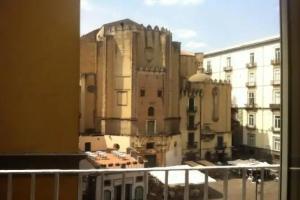
Cappella Sansevero in Naples
Description
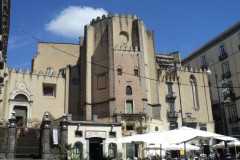
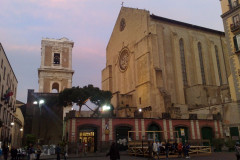
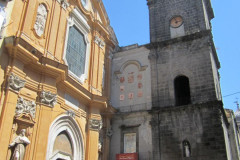
The Cappella Sansevero is a chapel located on Via Francesco de Sanctis 19, just northwest of the church of San Domenico Maggiore, in the historic center of Naples, Italy. The chapel is more properly named the Chapel of Santa Maria della Pietà, or the Pietatella. It contains works of art by some of the leading Italian artists of the 18th century.
History
Its origin dates to 1590 when John Francesco di Sangro, Duke of Torremaggiore, after recovering from a serious illness, had a private chapel built in what were then the gardens of the nearby Sansevero family residence, the Palazzo Sansevero. The building was converted into a family burial chapel by Alessandro di Sangro in 1613 (as inscribed on the marble plinth over the entrance to the chapel). Definitive form was given to the chapel by Raimondo di Sangro, Prince of Sansevero, who also included Masonic symbols in its reconstruction. Until 1888 a passageway connected the Sansevero palace with the chapel.
The chapel received its alternative name of Pietatella from a painting of the Virgin Mary (La Pietà), spotted there by an unjustly arrested prisoner, as reported in the book "Napoli Sacra" by Cesare d'Engenio Caracciolo in 1623. When the chapel was constructed it was originally dedicated to Santa Maria della Pietà, after the painting.
Works of art
The chapel houses almost thirty works of art, among which are three idiosyncratic sculptures. These statues are emblematic of the love of decoration in late-Baroque, and are made of a marble-like substance that, in whole or in part, was invented by Raimondo. Raimondo also participated in the design of the works of art in the chapel. The Veiled Truth (Pudizia, also called Modesty or Chastity) was completed by Antonio Corradini in 1750 as a tomb monument dedicated to Cecilia Gaetani dell'Aquila d'Aragona, mother of Raimondo. A Christ Veiled under a Shroud (also called Veiled Christ), shows the influence of the veiled Modesty, and was completed in 1753 by Giuseppe Sanmartino. The Release from Deception (Disinganno) by Francesco Queirolo of Genoa serves as a monument to Raimondo's father.
The ceiling, the Glory of Paradise, was painted by Francesco Maria Russo in 1749. The original floor (most of the present one dates from 1901) was in black and white (said to symbolize good/evil) in the design of a labyrinth (a masonic symbol for "initiation").
In the basement there is a painting by the Roman artist Giuseppe Pesce, Madonna con Bambino, dating from around 1750. It was painted using wax-based paints of Raimondo di Sangro's own invention. The prince presented this painting to his friend Charles Bourbon, king of Naples.
The following is a list of the works of art in the chapel, numbered in the accompanying diagram, along with the artist:
- Monument to Cecco de' Sangro, Francesco Celebrano;
- Monument to Giovan Francesco Paolo de' Sangro, Antonio Corradini;
- Il decoro, Antonio Corradini;
- Monument to Paolo de' Sangro, Bernardino Landini - Giulio Mencaglia;
- La liberalità, Francesco Queirolo;
- Monument to Duke Giovan Francesco Paolo de' Sangro, Giacomo Lazzari;
- Lo zelo della religione, Fortunato Onelli;
- Painting of Raimondo de' Sangro, Carlo Amalfi;
- La soavità del giogo maritale, Paolo Persico;
- Altar to St. Rosalia, Francesco Queirolo;
- Veiled Truth (Pudicizia), Antonio Corradini;
- Monument to Alessandro de' Sangro, Unknown artist, 18th century;
- Angel, Paolo Persico;
- Altar (La Deposizione), Francesco Celebrano and La Pietà (painting by unknown artist, 17th century);
- Angel, Paolo Persico;
- Coretto;
- Release from Deception (Il Disinganno), Francesco Queirolo;
- Altar to St. Odorisio, Francesco Queirolo;
- La Sincerità, Francesco Queirolo;
- Monument to Raimondo de' Sangro, Francesco Maria Russo;
- Basement with anatomical models and painting by Giuseppe Pesce;
- Il Dominio di sé stessi, Francesco Celebrano;
- Monument to Paolo de' Sangro, Antonio Corradini;
- L'Educazione, Francesco Queirolo;
- Monument to Paolo de' Sangro, Giorgio Marmorano - Giacomo Lazzari;
- Divine Love, unknown artist of the 19th century;
- Monument to Giovan Francesco de' Sangro, Francesco Celebrano;
- Veiled Christ, Giuseppe Sanmartino.
Anatomical exhibits
The chapel also displays two early examples of what was long thought to be a form of plastination in its basement. These "anatomical models" (macchine anatomiche) were thought to be examples of the process of "human metallization" (metallizzazione umana) as implemented by anatomist Giuseppe Salerno ca. 1760 from a commission by Raimondo di Sangro. The exhibit consists of a mature male and a pregnant woman. Their skeletons are encased in the hardened arteries and veins which are colored red and blue respectively. Previously, historians have surmised that the corpses could have been created by injecting the hardening substances directly into the veins of living subjects. However, recent analysis shows no evidence of techniques involving injection. Analysis of the "blood vessels" indicate they are constructed of beeswax, iron wire, and silk.
Wikimedia Commons has media related to Cappella Sansevero (Naples).Street view
Reviews
If you visit Naples is in my opinion a must-stop ....
The council, having regard to that, you can't make the picture, and many (like myself) then buy the photos of the interior you could lower the price of the ticket ...
It's a great shame cameras are prohibited. I don't agree with the rule.
The famous Veiled Christ is truly spectacular, as are many of the sculptures, but my favourite piece were the two preserved human circulatory systems in the crypt below. They are truly incredible. You really can test your anatomy knowledge!
Well worth a visit.
This museum should be much more famous, now it's one of my favorites.
Oh, you may try the audio guide if you want to know every single detail. But it's not necessary, we didn't buy it (the texts inside are in English too).
The veiled Christ is in the centre, you can walk around all sides, but a barrier prevents one from touching it.