Riga
Description
Riga ) is the capital and the largest city of Latvia. With 641,007 inhabitants (July 2015), Riga is the largest city of the Baltic states and home to more than one third of Latvia's population. The city lies on the Gulf of Riga, at the mouth of the Daugava. Riga's territory covers 307.17 km2 (118.60 sq mi) and lies between 1 and 10 metres (3.3 and 32.8 ft) above sea level, on a flat and sandy plain.
Riga was founded in 1201 and is a former Hanseatic League member. Riga's historical centre is a UNESCO World Heritage Site, noted for its Art Nouveau/Jugendstil architecture and 19th century wooden architecture. Riga was the European Capital of Culture during 2014, along with Umeå in Sweden. Riga hosted the 2006 NATO Summit, the Eurovision Song Contest 2003, and the 2006 IIHF Men's World Ice Hockey Championships. It is home to the European Union's office of European Regulators for Electronic Communications (BEREC). Riga is served by Riga International Airport, the largest airport in the Baltic states.
Riga is a member of Eurocities, the Union of the Baltic Cities (UBC) and Union of Capitals of the European Union (UCEU).
Etymology
One theory for the origin of the name Riga is that it is a corrupted borrowing from the Liv ringa meaning loop, referring to the ancient natural harbour formed by the tributary loop of the Daugava River. The other is that Riga owes its name to this already-established role in commerce between East and West, as a borrowing of the Latvian rija, for threshing barn, the "j" becoming a "g" in German—notably, Riga is called Rie by English geographer Richard Hakluyt (1589), and German historian Dionysius Fabricius (1610) confirms the origin of Riga from rija. Another theory could be that Riga was named after Riege, the German name for the River Rīdzene, a tributary of the Daugava.
History
Historical affiliationsLivonian Order 1201–1561
Kingdom of Poland 1561–1569
Polish–Lithuanian Commonwealth 1569–1621
Kingdom of Sweden 1621–1710
Tsardom of Russia 1710–1721
Russian Empire 1721–1917
German Empire 1917-1918
Republic of Latvia 1918–1940
Soviet Union 1940–1941
Nazi Germany 1941–1944
Soviet Union 1944–1991
Republic of Latvia 1991–present
Founding
The river Daugava has been a trade route since antiquity, part of the Vikings' Dvina-Dnieper navigation route to Byzantium. A sheltered natural harbour 15 km (9.3 mi) upriver from the mouth of the Daugava—the site of today's Riga—has been recorded, as Duna Urbs, as early as the 2nd century. It was settled by the Livs, an ancient Finnic tribe.
Riga began to develop as a centre of Viking trade during the early Middle Ages. Riga's inhabitants occupied themselves mainly with fishing, animal husbandry, and trading, later developing crafts (in bone, wood, amber, and iron).
The Livonian Chronicle of Henry testifies to Riga having long been a trading centre by the 12th century, referring to it as portus antiquus (ancient port), and describes dwellings and warehouses used to store mostly corn, flax, and hides. German traders began visiting Riga, establishing a nearby outpost in 1158.
Along with German traders also arrived the monk Meinhard of Segeberg to convert the Livonian pagans to Christianity. (Catholic and Orthodox Christianity had already arrived in Latvia more than a century earlier, and many Latvians baptised) Meinhard settled among the Livs, building a castle and church at Ikšķile, upstream from Riga, and established his bishopric there. The Livs, however, continued to practice paganism and Meinhard died in Ikšķile in 1196, having failed his mission. In 1198, the Bishop Berthold arrived with a contingent of crusaders and commenced a campaign of forced Christianization. Berthold was killed soon afterwards and his forces defeated.
The Church mobilised to avenge. Pope Innocent III issued a bull declaring a crusade against the Livonians. Bishop Albert was proclaimed Bishop of Livonia by his uncle Hartwig of Uthlede, Prince-Archbishop of Bremen and Hamburg in 1199. Albert landed in Riga in 1200 with 23 ships and 500 Westphalian crusaders. In 1201, he transferred the seat of the Livonian bishopric from Ikšķile to Riga, extorting agreement to do so from the elders of Riga by force.
Under Bishop Albert
The year 1201 also marked the first arrival of German merchants in Novgorod, via the Dvina. To defend territory and trade, Albert established the Order of Livonian Brothers of the Sword in 1202, open to nobles and merchants.
Christianization of the Livs continued. In 1207, Albert started on fortification of the town. Emperor Philip invested Albert with Livonia as a fief and principality of the Holy Roman Empire. To promote a permanent military presence, territorial ownership was divided between the Church and the Order, with the Church taking Riga and two-thirds of all lands conquered and granting the Order a third. Until then, it had been customary for crusaders to serve for a year and then return home.
Albert had ensured Riga's commercial future by obtaining papal bulls which decreed that all German merchants had to carry on their Baltic trade through Riga. In 1211, Riga minted its first coinage, and Albert laid the cornerstone for the Riga Dom. Riga was not yet secure as an alliance of tribes failed to take Riga. In 1212, Albert led a campaign to compel Polotsk to grant German merchants free river passage. Polotsk conceded Kukenois (Koknese) and Jersika to Albert, also ending the Livs' tribute to Polotsk.
Riga's merchant citizenry chafed and sought greater autonomy from the Church. In 1221, they acquired the right to independently self-administer Riga and adopted a city constitution.
That same year Albert was compelled to recognise Danish rule over lands they had conquered in Estonia and Livonia. Albert had sought the aid of King Valdemar of Denmark to protect Riga and Livonian lands against Liv insurrection when reinforcements could not reach Riga. The Danes landed in Livonia, built a fortress at Reval (Tallinn) and set about conquering Estonian and Livonian lands. The Germans attempted, but failed, to assassinate Valdemar. Albert was able to reach an accommodation with them a year later, however and, in 1222, Valdemar returned all Livonian lands and possessions to Albert's control.
Albert's difficulties with Riga's citizenry continued; with papal intervention, a settlement was reached in 1225 whereby they no longer had to pay tax to the Bishop of Riga, and Riga's citizens acquired the right to elect their magistrates and town councillors. In 1226, Albert consecrated the Dom Cathedral, built St. James's Church, (now a cathedral) and founding a parochial school at the Church of St. George.
In 1227, Albert conquered Oesel and the city of Riga concluded a treaty with the Principality of Smolensk giving Polotsk to Riga.
Albert died in January 1229. He failed in his aspiration to be anointed archbishop but the German hegemony he established over the Baltic would last for seven centuries.
Hanseatic League
In 1282, Riga became a member of the Hanseatic League. The Hansa was instrumental in giving Riga economic and political stability, thus providing the city with a strong foundation which endured the political conflagrations that were to come, down to modern times.
Riga in 1650. The inscription reads: Prospect der Stadt Riga ums Jahr 1650 (View at the City of Riga in 1650). Drawing by Johann Christoph BrotzeHoly Roman Empire, Polish–Lithuanian Commonwealth, the Swedish and Russian Empires
As the influence of the Hanseatic League waned, Riga became the object of foreign military, political, religious and economic aspirations. Riga accepted the Reformation in 1522, ending the power of the archbishops. In 1524, iconoclast targeted a statue of the Virgin Mary in the Cathedral to make a statement against religious icons. It was denounced as a witch, and given a trial by water in the Daugava River. The statue floated, so it was denounced as a witch and burnt at Kubsberg. With the demise of the Livonian Order during the Livonian War, Riga for twenty years had the status of a Free Imperial City of the Holy Roman Empire before it came under the influence of the Polish–Lithuanian Commonwealth by the Treaty of Drohiczyn, which ended the war for Riga in 1581. In 1621, during the Polish–Swedish War (1621–1625), Riga and the outlying fortress of Daugavgriva came under the rule of Gustavus Adolphus, King of Sweden, who intervened in the Thirty Years' War not only for political and economic gain but also in favour of German Lutheran Protestantism. During the Russo-Swedish War (1656–1658), Riga withstood a siege by Russian forces.
Riga remained the largest city in Sweden until 1710, a period during which the city retained a great deal of autonomous self-government. In that year, in the course of the Great Northern War, Russia under Tsar Peter the Great besieged plague-stricken Riga. Along with the other Livonian towns and gentry, Riga capitulated to Russia, but largely retained their privileges. Riga was made the capital of the Governorate of Riga (later: Livonia). Sweden's northern dominance had ended, and Russia's emergence as the strongest Northern power was formalised through the Treaty of Nystad in 1721. Riga became an industrialised port city of the Russian empire, in which it remained until World War I. By 1900, Riga was the third largest city in Russia after Moscow and Saint Petersburg in terms of the number of industrial workers and number of theatres.
During these many centuries of war and changes of power in the Baltic, and despite demographic changes, the Baltic Germans in Riga had maintained a dominant position. By 1867, Riga's population was 42.9% German. Riga employed German as its official language of administration until the installation of Russian in 1891 as the official language in the Baltic provinces, as part of the policy of Russification of the non-Russian speaking territories of the Russian Empire, including Congress Poland, Finland and the Baltics, undertaken by Tsar Alexander III. More and more Latvians started moving to the city during the mid-19th century. The rise of a Latvian bourgeoisie made Riga a centre of the Latvian National Awakening with the founding of the Riga Latvian Association in 1868 and the organisation of the first national song festival in 1873. The nationalist movement of the Young Latvians was followed by the socialist New Current during the city's rapid industrialisation, culminating in the 1905 Revolution led by the Latvian Social Democratic Workers' Party.
Interwar period
The 20th century brought World War I and the impact of the Russian Revolution of 1917 to Riga. The German army marched into Riga on 3 September 1917. On 3 March 1918, the Treaty of Brest-Litovsk was signed, giving the Baltic countries to Germany. Because of the Armistice with Germany of 11 November 1918, Germany had to renounce that treaty, as did Russia, leaving Latvia and the other Baltic States in a position to claim independence. Latvia, with Riga as its capital city, thus declared its independence on 18 November 1918. Between World War I and World War II (1918–1940), Riga and Latvia shifted their focus from Russia to the countries of Western Europe. The United Kingdom and Germany replaced Russia as Latvia's major trade partners. The majority of the Baltic Germans were resettled in late 1939, prior to the occupation of Estonia and Latvia by the Soviet Union in June 1940.
World War II and the Soviet Union
During World War II, Latvia was occupied by the Soviet Union in June 1940 and then was occupied by Nazi Germany in 1941–1944. The city's Jewish community was forced into the Riga Ghetto and a Nazi concentration camp was constructed in Kaiserwald. On 25 October 1941, the Nazis relocated all Jews from Riga and the vicinity to the ghetto. Most of Latvia's Jews (about 24,000) were killed on 30 November and 8 December 1941 in the Rumbula massacre. By the end of the war, the remaining Baltic Germans were expelled to Germany.
The Soviet Red Army re-entered Riga on 13 October 1944. In the following years the massive influx of labourers, administrators, military personnel, and their dependents from Russia and other Soviet republics started. Microdistricts of the large multi-storied housing blocks were built to house local workers. By 1989, the percentage of Latvians in Riga had fallen to 36.5%.
21st century
In 2004, the arrival of low-cost airlines resulted in cheaper flights from other European cities such as London and Berlin and consequently a substantial increase in numbers of tourists.
In November 2013, the roof of a supermarket collapsed, possibly as a result of the weight of materials used in the construction of a garden on the roof. At least 54 people were killed. The Latvian President Andris Berzins described the disaster as "a large scale murder of many defenceless people".
Riga was the European Capital of Culture in 2014.
Geography
Transport
Riga, with its central geographic position and concentration of population, has always been the infrastructural hub of Latvia. Several national roads begin in Riga, and European route E22 crosses Riga from the east and west, while the Via Baltica crosses Riga from the south and north.
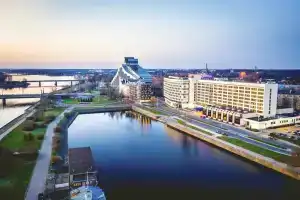
As a city situated by a river, Riga also has several bridges. The oldest standing bridge is the Railway Bridge, which is also the only railroad-carrying bridge in Riga. The Akmens Bridge connects Old Riga and Pārdaugava; the Salu Bridge connects Maskavas Forštate and Pārdaugava via Zaķusala; and the Vanšu Bridge connects Old Riga and Pārdaugava via Ķīpsala. In 2008, the first stage of the new Dienvidu Bridge route across the Daugava was completed, and was opened to traffic on 17 November.
The Dienvidu Bridge is currently the biggest construction project in the Baltic states in 20 years, and it is to reduce traffic congestion in the city centre. Another major construction project is the planned Riga Northern Transport Corridor, which is scheduled to commence in 2010.
The Freeport of Riga facilitates cargo and passenger traffic by sea. Sea ferries currently connect Riga Passenger Terminal to Stockholm operated by Tallink.
Riga has one active airport that serves commercial airlines—the Riga International Airport (RIX), built in 1973. Renovation and modernization of the airport was completed in 2001, coinciding with the 800th anniversary of the city. In 2006, a new terminal extension was opened. Extension of the runway was completed in October 2008, and the airport is now able to accommodate large aircraft such as the Airbus A340, Boeing 747, 757, 767 and 777. Another terminal extension is under construction as of 2014. The annual number of passengers has grown from 310,000 in 1993 to 4.7 million in 2014, making Riga International Airport the largest in the Baltic States.
The former international airport of Riga, Spilve Airport, located 5 km (3.11 mi) from Riga city centre, is currently used for small aircraft, pilot training and recreational aviation. Riga was also home to a military air base during the Cold War — Rumbula Air Base.
Public transportation in the city is provided by Rīgas Satiksme which operates a large number of trams, buses and trolleybuses on an extensive network of routes across the city. In addition, many private owners operate minibus services.
Riga is connected to the rest of Latvia by trains operated by the national carrier Passenger Train, whose headquarters are in Riga. There are also international rail services to Russia and Belarus, and plans to revive passenger rail traffic with Estonia. A TEN-T project called Rail Baltica envisages building a high-speed railway line via Riga connecting Tallinn to Warsaw using standard gauge, expected to be put into operation in 2024.
Riga International Coach Terminal provides domestic and international connections by coach.
Architecture
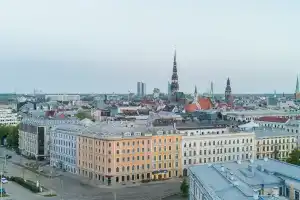
The radio and TV tower of Riga is the tallest structure in Latvia and the Baltic States, and one of the tallest in the European Union, reaching 368.5 m (1,209 ft). Riga centre also has many great examples of Art Nouveau architecture, as well as a medieval old town.
-
Riga Castle
-
Stockholm School of Economics in Riga
-
Swedish Gate
-
Līvu Square
-
Freedom Monument
-
Top of Freedom Monument in Riga, Latvia.
-
Base of Freedom Monument in Riga, Latvia
-
Latvian National Museum of Art
-
Latvian Academy of Art
-
Art Museum Riga Bourse
-
The radio and TV tower
-
National Library of Latvia
Art Nouveau
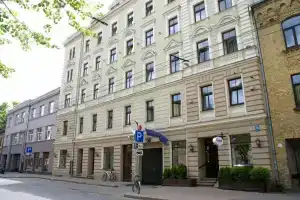
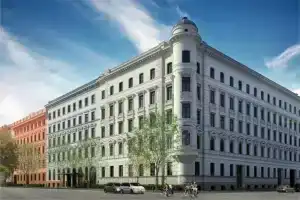
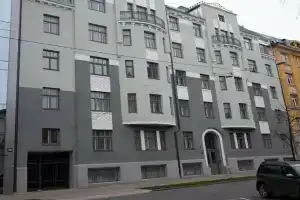
It is generally recognized that Riga has the finest and the largest collection of art nouveau buildings in the world. This is due to the fact that at the end of the 19th and beginning of the 20th centuries, when art nouveau was at the height of its popularity, Riga experienced an unprecedented financial and demographic boom.[original research?] In the period from 1857 to 1914 its population grew from 282,000 to 558,000 making it the 4th largest city in the Russian Empire (after Saint-Petersburg, Moscow and Warsaw) and its largest port. The bourgeoisie of Riga used their wealth to build imposing apartment blocks around the former city walls. Local architects, mostly graduates of Riga Technical University, adopted current European movements, and in particular Art Nouveau.[original research?] In that period around 800 Art Nouveau buildings were erected. The majority of them are concentrated in the central part of Riga and a few more in the Old Town.
-
Alberta iela 1
-
Alberta iela 2a
-
Alberta iela 4
-
Alberta iela 8
-
Alberta iela 12
-
Alberta iela 12 staircase
-
Alberta iela 12 staircase detail
-
Strēlnieku iela
-
Elizabetes iela 10a balcony
-
Elizabetes iela 10b detail
-
Elizabetes iela 13
-
Elizabetes iela 23
-
Ģertrūdes iela
-
Jauniela 25
-
Brīvības iela 99
-
Smilšu iela 8 détail
-
Kalēju iela 22
Culture
Theatres
- The Latvian National Opera was founded in 1918. The repertoire of the theatre embraces all opera masterpieces. The Latvian National Opera is famous not only for its operas, but for its ballet troupe as well.
- The Latvian National Theatre was founded in 1919. The Latvian National Theatre preserves the traditions of Latvian drama school. It is one of the biggest theatres in Latvia.
- The Riga Russian Theatre is the oldest professional drama theatre in Latvia, established in 1883. The repertoire of the theatre includes classical plays and experimental performances of Russian and other foreign playwrights.Riga Russian Theatre
- The Daile Theatre was opened for the first time in 1920. It is one of the most successful theatres in Latvia. This theatre is distinguished by its frequent productions of modern foreign plays.
- Latvian State Puppet Theatre was founded in 1944. This theatre presents shows for children and adults.
- The New Riga Theatre was opened in 1992. It has an intelligent and attractive repertoire of high quality that focused on a modern, educated and socially active audience.
-
Latvian National Opera
-
Latvian National Theatre
World Choir Games
Riga hosted the biannual 2014 World Choir Games from 9–19 July 2014 which coincided with the city being named European Capital of Culture for 2014. The event, organised by the choral foundation, Interkultur, takes place at various host cities every two years and was originally known as the "Choir Olympics". The event regularly sees over 15'000 choristers in over 300 choirs from over 60 nations compete for gold, silver and bronze medals in over 20 categories. The competition is further divided into a Champions Competition and an Open Competition to allow choirs from all backgrounds to enter. Choral workshops and festivals are also witnessed in the host cities and are usually open to the public.
Universities
- University of Latvia (LU)
- Riga Technical University (RTU)
- Riga Stradiņš University (RSU)
- Riga Graduate School of Law (RGSL)
- School of Business Administration Turiba (BAT)
- Stockholm School of Economics in Riga (SSE Riga)
- BA School of Business and Finance (BA)
- Transport and Telecommunication Institute (TTI)
- Riga International School of Economics and Business Administration (RISEBA)