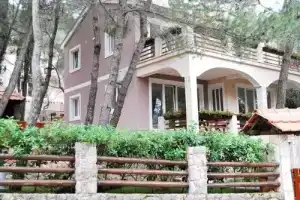
Herceg Novi

Description

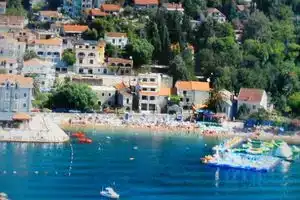
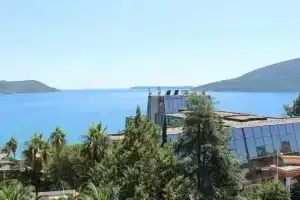
Herceg Novi is a coastal town in Montenegro located at the entrance to the Bay of Kotor and at the foot of Mount Orjen. It is the administrative center of the Herceg Novi Municipality with around 33,000 inhabitants. Herceg Novi was known as Castelnuovo ("New castle" in Italian) between 1482 and 1797 when it was part of Ottoman Empire and the Albania Veneta of the Republic of Venice. Herceg Novi has had a turbulent past, despite being one of the youngest settlements on the Adriatic. A history of varied occupations has created a blend of diverse and picturesque architectural style in the city. The city administration is formed by a coalition of DPS and civic association "Izbor".

Name

In Montenegrin, the town is known as Herceg Novi or Херцег Нови; in Italian as Castelnuovo; and in Greek as Neòkastron (Νεοκαστρον).

History

Herceg Novi was founded (on a former small fishing village existing since Roman Empire times) as a fortress in 1382 by first Bosnian King Stjepan Tvrtko I and was called Sveti Stefan or Castelnuovo. After the death of Tvrtko, Duke Sandalj Hranić of the Herzegovinian Kosačas acquired Castelnuovo. During his reign, Herceg Novi picked up trading salt. When Hranić died, his nephew, Herzog Stjepan Vukčić Kosača, inherited Castelnuovo. Under Stjepan, Castelnuovo expanded and thus became a city, renaming it to Herceg Novi. The Turks conquered Herceg Novi in 1482, and ruled for 200 years, until 1687. However, there was a short pause between 1538 and 1539 when it was held by the Spaniards before they were defeated in the Siege of Castelnuovo.

Venice gained control of the city and included it into Albania Veneta, an administrative unit on the territory of present-day coastal Montenegro. On 24 August 1798, Herceg Novi was annexed by Austria but was then ceded to Russia as per the Treaty of Pressburg on 26 December 1805. The Russians officially occupied Herceg Novi between 28 February 1806 and 12 August 1807.

On 7 July 1807, Herceg Novi was ceded to France as per the Treaty of Tilsit. Official French rule over Herceg Novi began on 12 August 1807, when the Russians left the city. The city was part of Dalmatia until 14 October 1809, when it was annexed to the newly created Illyrian Provinces.

Herceg Novi, as well as the rest of the Bay of Kotor, was overtaken by Montenegrin forces in 1813. It was under control of a temporary government based in Dobrota between 11 September 1813 and 10 June 1814, which was supported by Montenegro. The appearance of Austro-Hungarian forces in 1814 caused the Prince-Bishop of Montenegro to turn over the territory to Austrian administration on 11 June.

After Herceg Novi was retaken, as well as the rest of the bay, it became part of the Dalmatian crownland. The bay was under Austro-Hungarian control until 1918.

In 1900, the two names ERZEG NOVI and CASTELNUOVO PRESSO CATTARO were used in bilingual cancellations.

The Kingdom of Montenegro attempted to retake the Bay of Kotor during World War I, it was bombarded from Lovćen, but by 1916 Austria-Hungary defeated Montenegro. On 7 November 1918, the Serbian Army entered the bay and were greeted by the people as liberators. The bay later became a part of the self-proclaimed State of Slovenes, Croats and Serbs. Within a month, this region united with Serbia to form Kingdom of Serbs, Croats and Slovenes, renamed to Yugoslavia in 1929. The bay was a municipality of Dalmatia until it was, like all historic entities, abolished in 1922. It was incorporated into the Zeta Oblast, from 1929 Zeta Banate.

Herceg Novi was annexed by the Italians during World War II in 1941. It became a part of the province of Cattaro. Herceg Novi was later retaken by Yugoslav Partisan forces on 10 September 1943. Within the reformed Yugoslavia, Herceg Novi became part of the People's Republic of Montenegro.

Population

Historical population Year Pop. ±% 1981 12,686 — 1991 15,105 +19.1% 2003 16,493 +9.2% Source:

The Herceg Novi municipality stretches from Prevlaka to the Verige strait. An almost unbroken string of towns lie along this strip of coast, accommodating the municipality's 30,864 (2011 census) residents. These include Igalo, Herceg Novi, Baošići, Đenovići, Meljine and Bijela.

Ethnic composition Ethnicity 2011 2003 1991 1981 1971 1961 Albanians 41(0.13%) 25(0.08%) 103(0.37%) 83(0.35%) 83(0.45%) 67(0.44%) Croat 662(2.15%) 798(2.42%) 630(2.28%) 702(3.01%) 1,195(6.5%) 1,544(10.18%) Montenegrins 10,395(33.68%) 9,447(28.80%) 11,223(40.67%) 9,877(42.46%) 8,581(46.71%) 8,849(58.38%) Muslims 283(0.92%) 299(0.91%) 332(1.2%) 152(0.65%) 82(0.44%) 31(0.2%) Serbs 15,260(49.44%) 17,470(52.89%) 8,528(30.91%) 3,844(16.52%) 5,216(28.39%) 4,261(28.11%) Yugoslavs 157(0.51%) 270(0.82%) 5,257(19.05%) 8,006(34.42%) 2,553(13.89%) 102(0.67%) Undeclared 2,908(9.42%) 2,746(8.31%) Others 1,158(3.75%) 1,979(5.99%) 1,516(5.52%) 594(2.59%) 658(3.62%) 303(2.02%) Total 30,864 33,034 27,589 23,258 18,368 15,157

Tourism

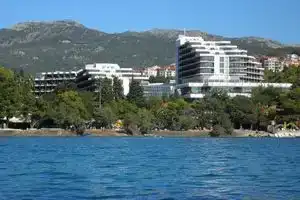
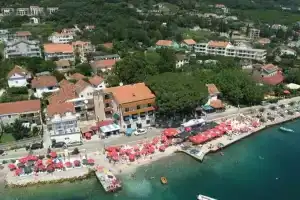
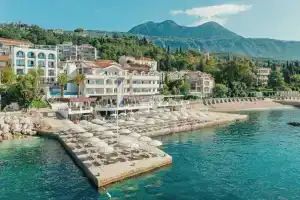
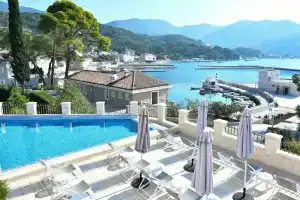
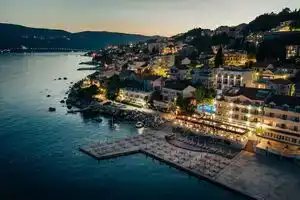
Herceg Novi is a major Montenegrin tourist destination. It is well known as a spa and health center; nearby Igalo has an abundance of healing sea mud called "igaljsko blato" (Igalo mud) and mineral water springs called "igaljske slatine" (Igalo water springs). The most famous tourist attractions in Herceg Novi are castle Forte Mare built by the Bosnian king Tvrtko I in 1382, a clock tower built by Austrians in the 19th century, the Kanli tower built by Turks, and the Serbian church St. Michael Archangel in central Belavista Square.

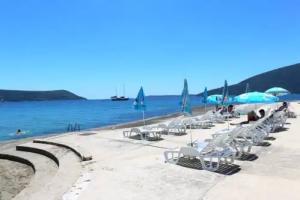
Whilst the city itself is not a major destination for sunbathing, with no long sandy beaches along the rest of the Boka Kotorska bay, many beaches are reachable by boat. Tourist companies organise one-day boat trips to Luštica peninsula, which lies opposite to the town. Popular Luštica peninsula beach sites include Žanjic, Mirište and Rose. Herceg Novi accounted for one-third of overnight stays in Montenegro before the Yugoslav wars, but the situation has changed since in favour of Budva, Kotor and other resorts in the northern part of the coast.

Zelenika which is also a small city in Herceg Novi s also a very popular place to visit along the shores of Montenegro.

Culture

"JUK Herceg-Fest"

This cultural events center was established on 24 February 1992. Two years later the cultural center joined with the "Orijen" movie distribution and production company. Together they have played a crucial role in enhancing the city's cultural life. Among many annual festivities are the mimosa celebration, local theatrical events, and a film and music fest.

"Operosa Opera Festival"

The Operosa opera festival takes place during the summer in the Kanli Kula amphitheater inside the fortress of Stari Grad.

The Herceg Novi City Archive

In 1956 the Archive was returned to Herceg Novi after being temporarily relocated to Zadar, Croatia. The Archive was relocated to Zadar by Italians during the Second World War. The original archive building, built in 1885, suffered severe damage from the 1979 earthquake. Shortly afterward, the building was renovated. Today, the Archive is 700 m2 (7,535 sq ft) in size. The Archive features modern equipment and a library open to the public. The oldest document in the Archive originated in 1685. The library contains approximately 30,000 volumes and 1,000 periodicals.

Historical Museum

The museum was established in 1949 and officially opened in 1953. The museum building, a gift to the city from the former mayor, Mirko Komnenović (1870–1941), and his wife Olga, is at least 150 years old.

City library

The library contains at least 30,000 volumes. Among the contributors to this collection are Dušan Petković (5,000 books), Veljka Radojević (1,500), Doklestić, Daljev, Lučić, Subotić and others.

Transport

Herceg Novi or Igalo is usually the final destination of buses that come from inland Montenegro and Serbia. The Adriatic Motorway, a two-lane motorway that extends for the length of the Montenegrin coast, goes through Herceg Novi before it merges with the Croatian road network at the Debeli Brijeg border crossing.

The ferry operates on the Kamenari - Lepetane line at Verige Strait, eliminating the need to go all the way around Boka Kotorska bay in order to reach Tivat, Kotor, Budva and inland Montenegro.

Tivat Airport is 23 km (14 mi) away (via the ferry). There are regular flights to Belgrade and Zürich, and dozens of charter planes land daily on Tivat airport during the summer season. Dubrovnik Airport in Croatia is some 30 km (19 mi) away, and it maintains regular flights to many European destinations.

Street view

Hotels

2 guests
Adults2+
Children under 170+
Age7+
Age7+
Age7+
Age7+
Age7+
Age7+
Age7+
Age7+
Age7+
Age7+
Search hotel

Reviews

Share your experiences, help others make the right choice!
Think about what you would like to know if you were looking for a review about a place to relax. Please describe in detail what you liked and what you didn't. What would you advise to other guests and to the hotel owner. The more fully you tell about the hotel, the easier it will be for other people to make a choice and they will be very grateful to you!

Map

X